Posted by Managementguru in Change management, Economics, International Business, Principles of Management
on Mar 15th, 2014 | 0 comments
Factors That Influence Global Economy The industrial and business environment of developing countries has been subjected to a sea of changes owing to the economic reforms and policies in the light of globalization, privatization and liberalization. A long term economic vision is necessary for these countries to establish themselves in the global market which facilitates the process of becoming self sufficient in due course of time. Let me present you with a synopsis of how this change can happen and how countries are adapting themselves in lieu of the global economic boom. Multi Brand Retail Markets: Many multinational companies have acquired and are trying to acquire a major part of equity in multibrand retail markets of the host country and sometimes they opt for Joint ventures to factorize the economy of scale which also proves to be a win-win situation for both the parties. Developing countries have altered their economic views on foreign direct investment and are very liberal in their attitude in providing with the necessary licenses. The entry of multinational companies and their potential investment has even altered core sectors like power, oil and telecommunications. Moreover, the benefit of cheap labor, economic subsidies for the start of operations in economically backward regions lures foreign investors. Rush of Entrepreneurship: There is a rush of entrepreneurship in the developing countries, in the form of setting up of small scale industries, cottage industries for which liberal subsidies are provided by the governments to encourage the act of entrepreneurialism. Also people want to go for diversification, mergers and acquisitions in the wake of global competition. Capital Markets’ Role: Capital markets have gained new buoyancy. The rapid growth of stock market and its influence over the international economic scenario have made foreign brokers to keenly follow the market changes for potential investment. The one striking feature of the economy of developing countries is that, it is a self made economy and withstands the pressures of the business cycle, such as recession and inflation, unlike foreign markets that have failed to stabilize their markets owing to what is called sub prime lending, a plan that has failed to achieve the desired economic growth. Instead of making the capital market alive with fresh infusions of funds, it has left many banks and financial institutions bankrupt. Banking Sector: Banking sector has scaled to greater heights and has come under a competitive environment. Deregulation of interest rates to attract potential investors, new technology, products and aggressive marketing usher in new competition; disinvestment of government equity in nationalized banks have made banks to operate as commercial institutions and their services get marketed as branded consumer products. Financial services have emerged as a new business and funding options are aplenty increasing the chances of raising capital. This has evolved as a separate and major source of business fetching revenue to the service providers. Private Sector: Private sector is gaining importance in countries like India, where they have entered all the core industries like oil, mining, telecommunications, road building, railways, ports, civil aviation etc. This serves as a revenue source for the government and this kind of economic restructuring has brought a wave of enthusiasm amongst the potential investors. Imports have become an entrepreneurial activity and are out of the government domain and this has been facilitated by relaxation of licensing hassles. These are some of the recent trends in the developing countries that have captured the interest of multinational...

Posted by Managementguru in Business Ethics, Business Management, Principles of Management, Strategy
on Mar 15th, 2014 | 0 comments
Social Value of Corporate Companies Economic Responsibilities: Ethical and discretionary responsibilities of a business firm are listed in the order of priority. First, a firm has to satisfy its economic responsibilities, followed by fulfilling legal responsibilities in order to survive in the market. Only then, it can think about or focus on purely voluntary actions pertaining to ethical consideration. In this competitive market situation, a business unit has to concentrate on profit making, the primary motive behind any business activity. However; it is easier said than done. You cannot hit the bull’s eye at the very first attempt. A firm has to become economically stable first; only then, it integrates social commitments in its agenda. Arguments for social responsibility: Public image: Socially responsible firms gain more customers and employees feel proud to work for such organizations. Handling the government regulations with ease: Government is a massive institution with long arms. It seeks to regulate business in public interest. Before government stretches its long arms, business persons should discharge their obligations to society. Business is resourceful: With a pool of resources, such as capital, labor and expertise, business is in a better position to tackle social problems and work for social goals. Let business try: It is that many other institutions have failed in handling social problems. So why should not a business enterprise handle social problems? Prevention is better than cure: Social problems have to be handled by the management at some point of time or the other. Problems with labor unions should be handled in a diplomatic way, so that they will not develop into serious social breakdown that consumes most of the management’s time. As a token of gratitude: Business units benefit from society. Based on the commonly accepted principle, that one owes debts of gratitude towards those who benefits us, the corporations have debts that it owes to society. Arguments against social responsibility: Profit maximization is the ultimate goal: Business units are accused of having profit maximization as their goal. Since business operates in a world of poverty and hunger, the economic efficiency of business is a matter of priority and should be the sole mission of business. Society has to pay the cost: The costs of social responsibility will be passed on to the society and the question is can the society bear these additional costs? Lack of social skills: Managers are here to solve economic problems and they do not possess knowledge or skills to provide the right solutions for social problems. Business has enough power: Business already is wielded with enough social power. The society should not take any steps, which will make it stronger. Social overhead costs: Costs on social responsibility is considered a social cost, which will not immediately benefit the business. Why spend money on an object, the benefits of which will be relished only in the future. Lack of broad support: The idea of business involvement in achieving social goals is not widely supported by many groups in society. Business and society are interlinked in many ways and the business has to handle the societal aspects with great care or else it may have to face the consequences arising out of such misappropriation or...
Posted by Managementguru in Business Ethics, Business Management, Human Resource, Principles of Management
on Mar 15th, 2014 | 0 comments
What is Social Audit? A formal review of a company’s endeavors in social responsibility. A social audit is a method of assessing, comprehending, reporting on, and eventually improving an organization’s social and ethical performance. A social audit assists in closing gaps between vision/goal and reality, as well as between efficiency and effectiveness. Social Obligations of Business Organizations: Every business organization has certain social obligations to be duly discharged to employees, government, owners, buyers, public, environment etc. It is a good thing that businesspersons of today have understood their obligations and have been discharging them ably. Social audit scans the scope of the social responsibilities of a business enterprise and evaluates an organization’s social performance. Introduction to 3D Modeling Measure of Social Performance There are no specific measures established to rate the social performance standards of a business enterprise. Nevertheless, business enterprises do not seem to understand the relevance of social audit because much importance is attached with the economic aspects of a business. The features of social audit are listed down for better understanding of the process: The focus is on the social aspect of a business organization rather than its economic aspect. The activities of a firm that has an impact on the society, such as, environmental quality, consumerism, opportunities for women and other disadvantaged people in the society are taken into consideration for analytical purpose. How to measure social performance of companies? Social audit is confined to the process rather than concentrating on the results of social action. It is quite difficult to measure social performance in quantitative terms. How do you quantify social philosophy of management and human values? Qualitative measurement is also relative, as, what appears right to one person may not be so for another. So a combination of quantitative and qualitative data must be used for the purpose of this audit. If an internal auditor does the assessment, there is this problem of loyalty, which will outweigh all the other shortcomings present in the business. If an external consultant is made to assess the situation, he can analyze the situation with no bias but he will not be familiar with the business activity of that particular firm. Therefore, a combination of both can work out well to carry out the assessment as they can complement each other. A New but Necessary Concept Social audit is a new concept, so there are not much standard procedures available to follow. Most companies are at the beginning of the learning curve with this process. When companies do begin audit procedures, they tend to find that the process is more complex than originally contemplated. However, every aspect of business and its management has to be explored and analyzed for the benefit of future generations, so as to take proactive measures to tackle problem situations. Business firms obtain their resources from the society and are dependent on the society to sell their produce too. Hence, it becomes their moral responsibility of caring for the society, within their scope and potential....
Posted by Managementguru in Business Ethics, Business Management, CSR, Economics, Organisational behaviour, Principles of Management
on Mar 15th, 2014 | 0 comments
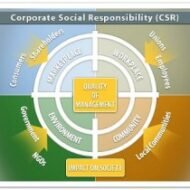
CSR – An Image or Ethos A company’s sense of responsibility towards the community and environment in which it functions is known as corporate social responsibility.The object of social responsibilities of business has become the hot topic for discussion. Let’s not forget that really big companies are into the process of service benefiting economically backward population. It is widely accepted that accountability to owners is too narrow a concept for today’s business and that there is no reason why owner’s interests should take precedence over the interest of other claimants-employees, consumer community and the society at large. Responsibilies of Business Concerns: There is no definition of the concept of social responsibility which is valid for all business concerns and for all times. This is because responsibilities of business should be related to the changing societal expectations, which is dependent upon the social, cultural, political and other environmental forces, which are dynamic too. Business responsibility to the society goes beyond simply assuming the profit-making role. It implies that the management has to protect and improve the welfare of the society as a whole along with its own interest. What is the primary objective of a business? One common misunderstanding about the concept of social responsibility has to be clarified here. It does not challenge the primary objectives of business. It does not say that “to make profit is to sin.”Profiteering is different from profit making. Selfish interest is different from self-interest. Social responsibility is against profiteering and selfish business behavior. But profit making and self interest should be the basic elements of corporate responsibilities. Economic concerns and social concerns need not be viewed as opposite ends. They are complementary to each other. They are consistent with one another. Thus the nature and content of business responsibilities depend upon societal expectations placed on organizations which include invariably the economic performances and legal obligations, and go beyond them. How far it goes beyond depends on the economic, social and political environment in which the business and society operates. Arguments against social responsibility: The arguments against social responsibility are based on the belief that the society assigns a strictly economic role to the organizations and the concept dilutes the primary purpose of the business. Business should mind its business and business persons don’t have the right attitude to serve the society. Let it be the responsibility of government and social service organizations. Business has already enough economic and social power and no more concentration of power is necessary to business circles. Service to society is undoubtedly an important objective of business. It can render service to society by providing quality goods and services to the community; it can provide adequate opportunities to the members of the society; provide goods and services at reasonable price. Another important aspect would be to ensure control of pollution towards air, water and soil. Showing concern for the well -being of other constituencies of the society is a good gesture that helps the business to earn goodwill and support of the society as a...
Posted by Managementguru in Business Ethics, Business Management, Principles of Management, Project Management, Strategy
on Mar 15th, 2014 | 0 comments

Environmental Sustainability-A Global Strategy Conservation of Environmental Resources: Corporate companies that are involved in the manufacture of electrical and electronic goods are becoming more and more concerned about the conservation of environmental resources, looking for convenient and eco friendly alternate biodegradable energy resources, thus leading to reduced energy consumption, beneficial to both the firm and society in general. “Go Green”, is the mantra that not only adds to the firm’s image but also appeals to the customers and suppliers who are associated with these firms. Disposal of E-Waste: Disposal of e-waste is one thing and recycling is another, both of which have to be handled with care. Developing countries have not evolved a proper processing system to discard or recycle the electronic waste such as scraps, obsolete devices, broken instruments etc., which can cause serious pollution problems and health hazards. The governments of all developed and developing countries enforce pollution control measures to monitor and control the quality of air, water and land. Any chemical exposure during recycling of waste can cause irreparable consequences, like the one in a nuclear reactor leak, where the harmful effects of radioactive substance stay for a long time, affecting the masses over the generations to come. The World- One Big Global Village: The revolution in the IT (information and technology) industry has made the world very small, converting it into a global village. Obviously the percentage of consumers using personal computer systems and networking systems is quite high. What happens to the electronic waste? How do people dispose it of? Do they really have the awareness or at least concern about the negative consequences and dangers of the improper disposal methods? Developed countries at least make it a point to impose fine on vendors and consumers who do not follow the federal laws on how to dispose e-waste. A general awareness is seen among the people of these nations. But, what is the condition in developing nations, where there are no strict rules laid down, that neither control the disposal of electronic goods nor ensures the health and safety standards of labor involved in such processes. Recycling Plants: Governments can encourage manufacturers who incorporate waste recycling plants as part of their production that helps in usable component recovery and facilitates cost-effective processing of electronic waste in volumes. The crux of the whole idea of recycling is to avoid the green gas emissions as a result of manufacturing products from scratch. Recycling of electronic products by dismantling them and recovering the usable components makes a great difference in conserving the energy resources, less contribution to pollution and increased efficiency utilization. Green Computing: Green computing is aimed by many of the electronic vendors where caution is exercised even right from designing the product through its production, usage, disposal and recycling, that no negative impact is created on the environment. In the modern computer era, where each and every organization employ numerous computer systems, network and communication systems, printers, storage devices for its communication and business transactions, environmental safety has to be included in the policy framework.RTGS (Real Time Gross Settlement) and Net Banking are e-tools that cannot be done with and businesses stumble if there is a hitch in these money transfer mechanisms. When we are able to appreciate the power of technology, we should also try to counterbalance its darker side through environmentally sustainable operations. Countries with high population density are supposed to exert unprecedented pressure on the environmental resources such as land, soil, air, water and forests. The government has to frame strong policies in order to arrest the degradation process. IT industry helps a nation to grow economically and at the same time should also aim at building an environmentally sustainable...