Posted by Managementguru in Business Ethics, Business Management, CSR, Human Resource, Principles of Management
on Mar 12th, 2014 | 0 comments

What is the relationship between Corporate Social Responsibility and Business Ethics Business ethics can be defined as the principles and standards that establish acceptable conduct in business organizations. The acceptability of behaviour in business is determined by customers, competitors, government regulators, interest groups, and the public, as well as each individual’s personal moral principles and values. Can Ethics be Taught? I feel that ethics cannot be taught: it is an inbuilt entity and in countries like India where religion is all pervasive in business or any other discipline, this quality is imbibed in every individual right from his birth. The power of money and authority plays a major role in changing a man’s perspective and bureaucratic hurdles and red tapism mar the pace of business development. Businessmen should never compromise ethical principles with short-sighted objectives of amassing material wealth but should develop a spirit of altruism. Management education should focus also on training the individuals to be ethic-savvy apart from being mere decision making authorities satisfied with their designation and power of authority. Employees have the same kind of ethical responsibility towards their organisation and should not misuse time and property and should not place their interests before the enterprise objectives. What is Corporate Social Responsibility? Many consumers and social advocates reckon that businesses should not only make a profit but also consider the social implications of their activities. We define social responsibility as a business’s obligation to maximize its positive impact and minimize its negative impact on society. Although many people use the terms social responsibility and ethics interchangeably, they do not mean the same thing. Business ethics relates to an individual’s or a work group’s decisions that society evaluates as right or wrong, whereas social responsibility is a broader concept that concerns the impact of the entire business’s activities on society. There are good business reasons for a strong commitment to ethical values: 1. Ethical companies have been shown to be more profitable. 2. Making ethical choices results in lower stress for corporate managers and other employees. 3. Our reputation, good or bad, endures. 4. Ethical behaviour enhances leadership. 5. The alternative to voluntary ethical behaviour is demanding and costly regulation. Points to Ponder relating to behavioral ethics. 1. What conflicts of interest have you personally experienced in personal or professional roles? 2. If you perceive a potential conflict for yourself, what are some ways you might ensure that this conflict doesn’t lead to unethical behavior for you and others? 3. When have others’ conflicts of interest impacted how you or those you know were treated? 4. What types of policies can or do organizations implement to try to reduce conflicts of interest or their costs? 5. Why do you believe conflicts of interest are so pervasive in society? Why don’t we take more steps to avoid them? 6. Why is it so hard for individuals to recognize their own conflicts of interest, and how is this impacted by behavioral biases? Unethical behavior,conflicts,personal interests,responsibility What is Conflict of Interest? Conflict of interest arises when there is a clash between responsibility and reward. Say, if a doctor decides to be more business-like, if a judge decides to favor one party, if a ruling party favors a decision not good for the masses, what will happen? A conflict of interest exists when a person must choose whether to advance his or her own personal interests or those of others. Wal-Mart Stores, Inc., may have the toughest policy against conflict of interest in the retail industry. Sam Walton, the late founder of Wal-Mart, disallowed company buyers from accepting so much as a cup of coffee from suppliers. The Wal-Mart policy is black...

Posted by Managementguru in Business Ethics, Business Management, Human Resource, Principles of Management
on Mar 12th, 2014 | 0 comments

The Need for Business Ethics Every individual should be guided by certain code of conduct. Ethics deal with personal conduct and moral duty and concerns human relations with respect to right and wrong. In business, ethics is doubly important and the society expects the businessmen to act ethically. Business ethics adds to the image of the company and develops a sense of trust in the minds of people and a long lasting relationship that is to stay. If the businessmen act ethically there is no need for legal rules and regulations that govern the code of conduct. Most of today’s businessmen want to make a fast buck and does not have business ethics. Benefits of Business Ethics 1. Creates Credibility 2. Helps in ethical decision making 3. Enhances quality of living 4. Corresponds to basic human needs Business ethics is primarily concerned with the relationship of business goals and techniques to specifically human ends. It is a dynamic philosophy of socio-economic adjustments whose field is widening day by day. Pic Courtesy: Asuccessfulcareer Definition of Business Ethics: Typical definitions refer to the “rightness or wrongness of behavior, but not everyone agrees on what is morally right or wrong, good or bad, ethical or unethical.” “Application of general principles of ethic customary in a society to the areas where business operates.” In the words of T.M.Garrett, “business ethics is a study of moral rightness and wrongness of the acts involved in the production, distribution and exchange of economic goods and services.” Elements of Business Ethics: · It should be above business interests-no harm should be done to the society · It is more of a code of business behavior · It has responsibilities as roots and outcome as fruits · It is guided not by sentiments and emotions but by definite tenets · It has to be followed by one’s own will and cannot be enforced upon · It cultivates high sense of honesty, general welfare, justice and responsibility in the minds of businessmen · It emphasizes the importance of self discipline over external control by legislation. The businessmen should not make false promises which destroy the fair image of the business. Principles of Business Ethics: · Do not sell substandard or defective products or stick to under measurement · Do not resort to hoarding, black-marketing or profiteering · Do not destroy or distort competition · Ensure accuracy and sincerity in advertising, labeling and packaging · Do not tarnish the image of competitors by unfair practices · Make accurate business records available to all authorized persons · Pay proper taxes and satisfy other obligations · Do not form cartel agreements to control production, price etc. to the common determinant · Refrain from secret kick backs or pay-offs to customers, suppliers, administrators, politicians etc., · Ensure payment of fair wages to and fair treatment of employees · Fulfill honestly all responsibilities towards the organization. Owners, employees, consumers, suppliers, government and society at large. The most common unethical practices being followed would be: 1. Adulteration 2. Spurious products 3. Duplicates 4. Injurious products 5. Defective Advertisements 6. Low salaries 7. Poor working Conditions 8. Exploitation- Sexual harassment and bullying, use of child labor 9. Financial misconduct-Employees being made to sign for more than actually paid for 10. Tax evasion- Improper records or bogus records to show hiked up profit in the p&l 11. Pollution 12. Bribes and circulation of money to buy political support- The notoriously popular 2G...
Posted by Managementguru in Business Ethics, Business Management, Decision Making, Principles of Management, Strategy
on Mar 11th, 2014 | 0 comments

Spirituality and Management The purpose of correlating spirituality and management might present a weird picture to some. Research of the old Hindu scriptures, epics and Vedas disclose the secrets of management etiquettes coated with spiritual sugar which serves as a road map for us to cherish and follow. As an ardent follower of the BHAGAVAT GITA, THE UNIVERSAL BOOK OF SPIRITUAL SCIENCE, it was really amazing for me to know that the core principles of management have already been defined and dealt with that were formulated at a later date by MANAGEMENT GURUS like PETER DRUCKER, HENRY FAYOL, C. K. PRAHALAD and the like. I would like to present four qualities that struck me while I was comparing and contemplating. PERCEPTION AND UNDERSTANDING THE INNER SELF SELF MOTIVATION AND SELF TRANSCENDENCE DUTIES AND RESPONSIBILITIES LEADERSHIP The Leader and the Manager: The LEADER IS BEING FOLLOWED willingly, but a manager has to command individuals in order to adhere to his instructions. So, being a good leader starts from soul searching or understanding the nature of one’s inner self. SELF CONCEPTION gives a different dimension to approach problems. Spiritual experiences induce clarity in thinking that leads to ethical decision making. The spiritual experiences of Arjuna, one of the PANCHA PANDAVAS with LORD KRISHNA made him stronger (at will) and sharper (right perception). Decision Making: “I am the strength of those who are devoid of personal desire and attachment. O Arjuna, I am the legitimate desire in those, who are not opposed to righteousness, “says Lord Sri Krishna. At the war front, Arjuna the GREAT WARRIOR is not sure whether to fight against his own kith and kin. The inspiring words of Krishna motivated him to come out from the state of INERTIA and enter RIGHTEOUS ACTION. It is a testimony of what philosophers call the transcendence from alienation to self confidence to reach ethical decision making. One can never forego his duty or responsibility, be it his personal life or in the management arena. EFFECTIVENESS IS DOING THE RIGHT THINGS EFFICIENCY IS DOING THINGS RIGHT https://www.slideshare.net/parthacharya/management-lessons-from-mahabharata-9806655 Forming a VISION, planning the right Strategies, pooling the resources, hiring right people for the right job, setting goals and objectives, reviewing by MANAGEMENT BY OBJECTIVES, MANAGEMENT BY EXCEPTION, rewards and recognition, all have been dealt with a masterly excellence in MAHABARATHA which talks about the GURUKSHETRA WAR between the PANDAVAS and KAURAVAS or to simply put it, between THE GOOD AND THE EVIL. “The Supreme Lord is situated in everyone’s heart, O Arjuna, and is directing the wanderings of all living entities, who are seated as on a machine, made of the material energy.”Mind can make you LIBERATED OR BONDED that depends upon your WILL to master it or be a slave. Controlling your mind in turn controls your actions and thought process that leads to well augured efforts that proves fruitful to the human race. Leaders are born and not made goes the saying. But if you are able to be THE MASTER OF YOUR MIND, you are a leader made. Management Lessons from THE BHAGAVAT GITA Applicable to both western and Indian school of management, THE BHAGAVAT GITA deals with problems at the GRASS ROOT LEVEL relating to THE HUMAN PSYCHE. https://www.slideshare.net/singhm91/management-lessons-from-bhagvad-gita It enlightens us on all managerial techniques, goading us towards a serene atmosphere and state of affairs in place of the conflicts, stress, and lack of co-ordination, common in most of the enterprises world wide. “Do your duty perfectly, and the results will follow suit”, is the crux of GITA. How many of us can transform ourselves into such personalities? Can we ever overcome the desires...
Posted by Managementguru in Business Ethics, Business Management, Decision Making, Principles of Management, Strategy
on Mar 11th, 2014 | 0 comments
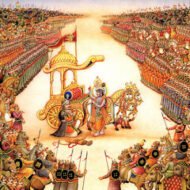
VEDIC MANAGEMENT AND LEADERSHIP INDIAN MANAGEMENT AND VEDIC LEADERSHIP From time immemorial, vedic scriptures and Upanishads have inspired people to acquire knowledge and wisdom about management principles and practices. Great spiritual leaders like Adisankara believed to be the reincarnation of Lord Shiva, Shri Krishna, the reincarnation of Lord Mahavishnu ,Lord Buddha, Shri Ramakrishna Paramahamsa have spoken of the infinite realities of life . The Philosophy of Unlearning: It is really amazing to know that these teachings though popular for their philosophical perspective also are a source of inspiration for management philosophy. These scriptures are excellent guides for attaining focus and help us to unlearn old school of thought and rejuvenate us with proper perspective and approach. Inspiration from Bhagavat Gita: Most of us would have heard about this quote from the Bhagavat Gita- “Do your duty without expectations”- “The fruits of which will be reaped automatically.” I used to wonder if this is possible, but all business men and entrepreneurs will definitely go by this since it proves to be the highest business philosophy too. Businesses thrive when done with a perfect vision , backed up by strong policies and ethical procedures. Adisankara: Adhi sankara has already paved the way for “Equality among the masses” when he realized and reiterated that people cannot be and should not be discriminated based on their caste and creed. His life span was very short-he was hardly 32 years when he left this world, but his preachings are there to stay forever. He was definitely a natural leader in presenting his views with clarity that serve as an eternal guide for mankind. Lord Krishna – A Magnificient Leader: Leaders ought to be natural and inspire people to follow them willingly. Lord Krishna was such a magnificient leader of Dwabara yuga who was a mentor for the Pancha pandavas and Gauravas too. The sad part of the story was Gauravas were not willing or not wise enough to utilise the services of Lord Krishna. We miss many viable business opportunities by oversight like Duryodana, the leader of Gauravas- he was a great warrior but not a good listener. “To be heard, you have to first listen,” I think this is the first step in the process of management Progress is impossible without change and those who are not willing to change cannot change anything. How true these words of George Bernardshaw are! Leaders of next century need to have better adaptive capabilities, cross-functional expertise, a positive attitude towards unlearning and re learning and also develop leadership of various levels of organization. What do Vedic Scriptures say? Coming back to vedic scriptures, they direct the mankind towards purifying the mind so that it becomes the hot seat of infinite energy leading to higher levels of strategic thinking and performance. The problem with us is that we always tend to correlate spirituality with renunciation of worldly life- It is not that; making the energy chakras inside our body live and active is the saarams ( essence) taking us to a heightened level in terms of thinking and action. To be a good leader your health should be fine in three key areas 1. Mental health Intelligence and creativity at its best Increased self-actualisation and self-confidence Greater ability to focus Higher levels of moral judgement Reduced anxiety and depression 2. Physical health Reduced need (or no need) for seeing the doctor for treatment Decreased risk factor for disease Reduction of high blood pressure Decreased alcohol consumption and drug abuse Stress reduction Prevention of ageing and increased longevity Note: It has been scientifically proved that by reciting GAYATHRI MANTRA and performing Sandhya vandanam, which is a natural yoga or pranayama method, your life...
Posted by Managementguru in Business Management, International Business, Marketing, Principles of Management
on Mar 11th, 2014 | 0 comments

Key Strategies of Global Marketing Globalization means many things to many people. For some it is a new paradigm – a set of fresh beliefs, working methods and economic, political and socio-cultural realities in which the previous assumptions are no longer valid. For developing countries, it means integration with the world economy. It can be better understood if we look it at this perspective- “the world integrated into one huge market”. It calls for the removal of all trade barriers among countries and a perfect competitive market prevails and the stress can lead to many positive and possible outcomes in terms of QualityQuantityUniquenessForeign exchangeBenefits to the host countryIncreased productivity leading toEconomic growth Well, it does not end there. An MNC (multi national company), by operating in more than one country gains r and d, production, marketing and financial advantages in terms ofcost and labor that other competitors may not enjoy. The global company views the world as one market, minimize the importance of national boundaries, sources, and raise capital and markets wherever it can do the job best. Why do companies go global? One reason could be the rapid shrinking of time and distance across the globe thanks to faster communication, speedier transportation, growing financial flows and rapid technological changes. It is being realized that the domestic markets are no longer adequate and rich. Japanese have flooded the U. S. Market with automobiles and electronic goods because the home market was not big enough to absorb whatever was produced. Companies at the first stage of globalization have only passive dealings with foreign individuals and organizations. By the second stage, companies deal directly with their overseas counterparts, though they might continue to use third parties also. The company might decide to set up an import or export department. Next comes the shedding of domestic capacity and floating an international organization and have a direct hand in exporting, importing, and perhaps producing goods and services abroad. Seldom companies reach this stage, even if they do, they recede later. The company can have a strong foothold in the countries it is organizing its activity only by way of * Superior product quality* Demand* Customer preference for that particular product range that the company offer* A dynamic CEO projecting and boosting company’s image,* Brand image* Availability of skilled labor* Licenses* Access to necessary infrastructure* Feasible financial structure* Viability in the long run* Marketing mix Chennai in India has become a hub for so many corporate as well as global companies since the business climate is very favorable and enterprising. Some of the strategies in globalization would be * Deciding whether to go global* Deciding which markets to enter* Deciding how to enter the market* Learning to handle differences* Adjusting the managing process* Deciding organization structure* Selecting a managerial approach. Developing countries like India have adopted new economic policies that are expected to encourage the international companies setting their foot in India, by which it compels many Indian companies to pursue internationalization vigorously. True globalization marks the beginning of a new economic era of growth and...