Posted by Managementguru in Business Management, Change management, International Business, Principles of Management
on Mar 7th, 2014 | 0 comments

GLOBALIZATION AND INTERNATIONAL MANAGEMENT Management as a concept has transcended all geographical boundaries and cultures to gain significance. International management has extended itself beyond traditional management practices reflecting different perspectives influenced by cultural diversity and conflicting social forces. The issue of cultural diversity is used to argue that it is divergence that is taking place and not convergence. The emphasis is on the national culture that acts as a key determinant in management behavior. National and regional differences may become one of the most crucial problems for management-in particular for the management of multinational, multicultural organizations, whether public or private. International Managers: Organizations are on the look out for international managers who could transcend themselves nationally to fit into any location for a specific job consideration. Managers are expected to live abroad and run the overseas division or company They are also sent to complete temporary assignments of limited duration, like plant installation and sales missions Companies aim at developing an international manager who can overcome a limited set of national and cultural boundaries, such as euro-manager, middle eats manager. Expatriates: Companies prefer to have their managers as expatriates, owing to the lack of availability of skills in the host country, to prevent dilution of control, to safeguard the overseas investment and to increase performance. But organizations also have to give a second thought about the cost involved in transferring the expatriates, recruitment and issues regarding legal restrictions. International managers have to possess the following skills to compete in the global environment. Technical expertise and experience Sound financial skills People skills, especially cultural empathy, team-building and motivation Intellectual skills, seeing the big picture, thinking macro not micro Emotional maturity, being adaptable,independent,sensitive to national culture,confident,having self awareness to overcome prejudice Having ambition, drive, persistence, stamina and energy. Focus of Global Organizations: Global organizations employ several techniques to develop international managers. They focus on in-house language, culture courses and tailored development programmes for host country managers, imparting education courses with an international base. International firms are also concerned about the power, politics, conflicting priorities, view points existing in the international scenario and they have to confront with coalition of vested interests. To cope, and more importantly to survive, in an organization, there is a growing view that managers have to become politically competent. De-Centralization: Decentralization is the key factor that is going to decide the developing trend of organizations in the years to come. A smaller, but more highly skilled, group of managers will assume an “expanded role” in clearly defined strategic business units. They will be given greater control over resources, technical, financial and human, and be expected to utilize those resources to achieve broad objectives and performance targets. A trend may develop where there is a shift by individuals away from the objective of managing a team of people towards a search for autonomy, creativity, growth and accountability for oneself, if the organizations fail to suitably reward the managers and present them with suitable career...

Posted by Managementguru in Decision Making, Principles of Management, Project Management
on Mar 7th, 2014 | 0 comments

Fundamental Aspect of a Project Planning is the fundamental aspect of any management system as it sets the direction or pathway, which the firm has to follow in order to accomplish the goals and objectives of an organization. In a project management or a process management, planning is the key function followed by preparation of a proposal or a report that analyses and defines the resources necessary to carry on the project. This project report can then be sent for evaluation by an expert consultant to determine the feasibility and viability of the project. Organising to Get the Desired Result A project undertaken has to be meticulously planned and organized to achieve the desired result in the given time frame. One has to understand that a project differs from a process in that, it involves fixed time fame and cost frame. Say,for instance, your firm is rewarded with a project to design ERP solutions for a big corporate company. What will be step one? You will try to gather all the details regarding organization structure and hierarchy, people involved and their designations, availability of physical resources, whether the corporate firm is technically equipped, product portfolio, strategic business units and their viability, distribution channels and so on., As one is aware, enterprise resource solution software integrates production, marketing and human resource departments to facilitate even flow of information and quick execution of orders without any time delay. Picture Courtesy: Project Management and Leadership Champions Data Collection Data collection is inevitable and has to be precise to attain your set goals. The next logical step will be deciding the time frame and allocating resources (human and other physical resources) to carry on the project. If you feel that the delivery deadline cannot be met with, you have to immediately inform your sponsors about the time delay and extend your time frame for the project to materialize. On -Time Delivery Projects that involve production and delivery of goods depend on the manufacturing cycle time and delivery lead time. Implementation becomes a cake walk if your business plan has incorporated, 1) well laid down step by step procedures, 2) leverage for uncertainty in the external environment and 3) focus on proper communication. Communicating the entire project plan as per the intentions to the people concerned is very vital for the success of a project, because people should understand, what needs to be done, what is one’s role, and the strategies evolved by the management. PERT and CPM Program evaluation and review techniques (PERT) and critical pathway method are some of the tools that help in ascertaining the progress rate of projects. These tools help in identifying specific milestones and activities that are to be carried out in a sequential manner and also to estimate the time required for each activity, with a help of a network diagram. A very interesting and simple video explaining how to determine project duration using critical path…. Success of a project management is determined by Decision making ability Communication skills Negotiation techniques and Time management skills, of the project manager and also depends on how well it protects the interests of the stakeholders involved. A project is a comprehensive team effort with the budget and time well within the scope of the...
Posted by Managementguru in Business Management, Labor Management, Organisational behaviour
on Mar 7th, 2014 | 0 comments

People Management and Trade Unions Need for Trade Unions Why do employees join trade unions is an important question. Most of the workers are members of any one of the trade unions. One of the major objectives of trade unionism is to promote industrial democracy. This objective is achieved when trade union is an organization of the workers, for the workers and by the workers”. In practice this rarely happens and instead unions become an oligarchy. Union leaders by and large, show authoritative behavior with less participation, openness and transparency. Decision-making is centralized, elections are often postponed and positions are filled repeatedly by nominations. Rank and file is pampered with promises and seldom gets near to decision-making process. Positions get worse when unions are guided by outside leaders and regulated by the policies of political parties. Ideology of Trade Unions Absence of democratic leadership reduces the effectiveness of trade unions and prevents the development of trade union leadership from among the workers within the industries. In due course, trade unions become obsessed with political ideology or personal interest ousting the welfare of the workers. Before we move on to the functions of trade unions, let us understand the reasons for the existence of such organizations. To get a common platform to air ones views, aims, ideas and feelings and obtain recognition and status among fellow workers. Make use of the principle of unity for the purpose of securing good working conditions, higher economic compensations, better career prospects and welfare needs. Security of employment and protection against calamity of accident, death and social security after retirement. Restrict management action which is against the interest of the workers. Functions of a Trade Union The internal functions of a labor union includes better wage claim, to ensure better working conditions, reasonable work etc.,The external functions include conducting night school, games, sports and other recreational activities. These two functions may be grouped as economic and social functions. Many unions try to capture political power through election, so that they can influence upon the programmes and policies of government in favor of labor. This function is known as political function. Under the legal functions, the interpretation of law takes the major share. A jist of the main purpose of trade organizations: To improve the standard of living and working condition of the workers. To protect the security of workers’ employment. To ensure better health, reasonable working hours and welfare measures. To improve the political status. To raise the vocational status. To bring better participation in the management. To inculcate the feeling of self respect and confidence among worker force. To bring industrial peace and harmony. As long as unionism is considered as an anathema by the management, there will be lack of harmony and mutual trust between the management and labor force. Management must not consider labor unions as a legal obligation as it does not develop faith and goodwill. Instead the union has to be viewed as a partner in trade to live with and work with. Union must also recognize that work is worship and the survival and success of organization depends on the very survival and success of the workforce. Once the team spirit is built up no unreasonable demands will be raised and union leaders must view strikes and lock outs as last resorts to put pressure on management. The Trade Unions Act, 1926– An act to provide for the registration of Trade Unions and in certain respects to define the law relating to registered Trade...
Posted by Managementguru in Business Management, Organisational behaviour, Principles of Management
on Mar 7th, 2014 | 0 comments
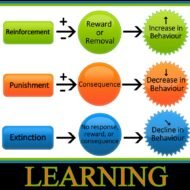
Reinforcers and Behaviour Changes Reinforcers induce and enhance the association between the cue and the expectancy. This leads to increased performance levels and positive attitude development. This is an effective and efficient strategy that has been proved to be successful. Reinforcement is inevitable for learning process and in a dynamic corporate business environment, unlearning the old things and learning and adapting oneself to satisfy the needs of the changing environmental and economic factors is the critical success factor that serves as the backbone of the success of the company. Significance of Learning: Learning is not the only attribute that gets enhanced by reinforcers; as a result there is a repetition of desirable behavior that helps in maintaining the consistency, cordiality and climate of the organization. Reinforces increase the strength of response leading to desirable or undesirable consequences depending upon the kind of reinforcer, which might be a reward or a punishment. Either way it elicits response that gets strengthened in course of time. Mindset of People: The management side that is the deciding authority has to come to clear terms with the kind of treatment applicable on specific situations; say for instance when there is a need to complete a project in the stipulated time or achieve quantifiable targets which may prove very challenging or increase the production capacity in order to retain a major market share. Whatever be the case, the morale of the workers down the line, executives who coordinate the process, the managers who manage and report has to be maintained in the highest order. The mind set of the people working for you is very important as it encompasses the quality of work done, commitment to duty and determination to reach the target on time. Rewards: Rewards always make people happy and are found to be positively reinforcing. If you feel that monetary rewards are always a better stimulus, you are wrong. Money is always considered to be a reward; to consider it as a reinforcer cannot be neglected but at the same time it definitely is not a positive reinforcer.Feedback on performance is rated high on the reinforcer scale which takes you to the next level as a performer. Modern organizations have understood the system’s anomaly that gives undue importance to the huge amount of data that speaks volumes about people and their merits and achievements. Is it really enough to know things about people? People expect feedback about their performance and people with some degree of achievement definitely have an intense desire to know how they are doing? The more specific your feedback is, better the impact and greater the delay between the performance and feedback, the less the effect. Work Environment: The work environment itself can serve as a very good positive reinforcer provided there is freedom of expression, liberty to participate and an open door policy adopted by the managers and superiors. The top level management must take utmost care to design the reward system in such a way that it warrants fairness and equity. Employees are motivated to go for self appraisals with goal setting that is the biggest reinforcer of all times. Recognition: Recognition, rewards and praise tend to boost the ego of individuals which you can work it up to your advantage. Punishment is one of the most used and convenient but least understood and badly administered aspect of learning and reinforcing. Punishment equally alters the behavior of your subordinates which becomes more complex in course of time. Positively dealing with your subordinates by giving them one more chance, of course with a warning might serve the purpose. If punishments modify the behavior...
Posted by Managementguru in Business Management, Principles of Management, Training & Development
on Mar 7th, 2014 | 0 comments
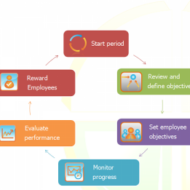
MBO BY PETER DRUCKER Peter Ferdinand Drucker was an influential writer, management consultant, and self-described “social ecologist. Harvard Business Review honored Drucker in the June 2004 with his seventh McKinsey Award for his article, “What Makes an Effective Executive”, the most awarded to one person. The Concept of MBO: Management by objectives was a concept introduced by the doyen of management, Peter Drucker. This concept involves formulation of objectives for the entire organization and which are then broken down into divisional, departmental and finally individual objectives. Objectives are decided on the basis of mutual consultation between managers and employees at the departmental and divisional levels and thus it can be appropriately called an integration of top down and bottom up approaches in management. The specific aim is to make the employees participate in decision making and thus motivate them to perform better. Management by objectives follows a step-by-step procedure that ensures the feasibility of the action plans decided upon. Realistic and achievable plans are set. Activities to be preformed are identified. Logical relationship between the sequences of activities is laid down. Time frame and cost frame are fixed. Resources to be allocated are decided upon. Salient features of the process: Self control and Self direction: The workers exhibit keen self control in that, they self appraise their performance that results in intrinsic motivation. Setting short goals and periodical review to match the current performance with the expected standards greatly boosts the performance of each and every individual and gives him the necessary drive to accomplish the assigned tasks. Periodic progress review: This helps to correct errors and deviations if any. This review is done by managers of higher levels in a constructive way and adequate counseling and guidance can be given to the subordinates to bridge the shortfall if any, in performance. This is possible only when there exists a mutual understanding between the superior and subordinates to find reasons and solve problems together. Reviews need not necessarily pinpoint errors but also revise future plans and actions. The major emphasis of management by objectives lies in its result oriented approach. What is the relationship between management by objectives and motivation? Motivation of an employee can be brought about by financial incentives such as bonus, increments, pay and perks or non-financial incentives such as recognition, appreciation and additional responsibilities. But nothing can equal self-motivation which makes an employee perform with aplomb. As management by objectives is directly linked with goal-setting, performance becomes better and better as the goals are set at a higher level. It involves complete participation from the employees’ end and when specific goals are set by mutual consent of workers and management, the results are magnificent. Many firms practice management by objectives to promote harmony and sense of belonging in the minds of employees as a result of which there is remarkable improvement in performance and productivity. The focus is on improving the job design and work module to make the jobs more meaningful, interesting and...