Posted by Managementguru in Business Management, Marketing, Principles of Management
on Mar 4th, 2014 | 0 comments
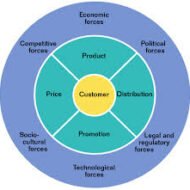
Key Components of Marketing System The core marketing system of a company comprises the suppliers, company, marketing intermediaries and target customers. The success of the company is also affected by competitor’s presence and other segments of public. The management has to watch and plan for all these factors to serve and satisfy the specified set of needs of a chosen target market. Supplier Selection: A company has to choose suppliers who offer the best mix of quality, delivery schedule, guarantee and low cost. Say, a firm involved in manufacturing confectioneries has to procure sugar, cocoa, caramel, milk powder; Labor, equipment, fuel, electricity and other factors of production are also to be obtained. If the company’s product has a good market, it can opt for continuous production. If it is a growing firm, it cannot go for voluminous production, but only supply goods against confirmed orders. In either case, the choice of suppliers is determined by one major factor called ‘cost’. Of course, one can never compromise on quality and so the company has to decide whether to purchase the inputs or make its own. Pic Courtesy : 5 Steps to Successful Supplier Selection The relationship of a company with the suppliers should be of a long-term nature, since any sudden change in the supplier’s environment will have a substantial impact on the company’s marketing operations. Sudden supply shortages, labor strikes and other events can interfere with the fulfillment of delivery promises to customers. This will result in sales decline in the short run and loss of goodwill in the long run. Back orders lead to loss of customers and in course of time their trust. The business firms must plan for alternate source of supply to avoid the risk of over-dependence on any one source of supplier. Company The marketing department has to work in tandem with the other departments of the company namely, finance, production, personnel and research and development, while designing and implementing its marketing plans. Finance department – has to be consulted regarding the availability and deployment of funds to carry out the marketing plans. Production department – to gauge market demand and to decide on the supply of products based on demand. R and D – new product development. Equally important is Digital Marketing which is considered to be an integral part of your promotional activities – What you are seeing above is a depiction of tools that help you in marketing your products online. Marketing intermediaries: Channel members are the link between the company and the customers. Agents and middlemen find customers who are wholesalers or retailers to take on the title and sell the merchandise. Also there are physical distribution firms who assist in stocking and moving goods from the warehouse to the destinations. The marketing executives have to deal with these intermediaries prudently in order to enhance the operational efficiency of the marketing function. Logistic firms, shippers and airliners help to move the goods from one location to another. Competitors: All the business firms in a particular market segment vie for the same resources and customers. A car manufacturing company in an automobile industry has to compete with other car manufacturers as well as with two wheelers. This implies that competition may come in different forms and each company has to identify potential threat from competitors, study their activities and capture their moves to win over the competition. Public: A company has to keep a close watch on people’s preferences to satisfy their requirements and also it is expected to give back something to the society in the form of social welfare measures. Employees belonging to different culture groups with differing attitudes,...

Posted by Managementguru in Business Management, Marketing, Principles of Management
on Mar 4th, 2014 | 0 comments
Market Research for Product Line Management Business firms, whether involved in the manufacture of goods or delivery of services, have to understand the importance of marketing research that would give a fair idea about their territory of operations and the scope for development. Let me first clarify the obvious difference between a market research and marketing research. While market research is confined to only a market which comprises of its potential and actual buyers, a marketing research delves deep into and further beyond, covering all areas of marketing including the market. Identification of Consumer Needs: Identification of consumer needs and satisfying them is vital for the emergence of a buyers market. Although firms manufacture goods that are competitive in terms of quality and price, it is the middlemen, the linking factor between the manufacturer and the wholesaler or retailer, that have a commanding grip on distribution, affecting sales volumes. Extensive marketing research will help firms to solve such problems of middlemen and distribution, to cater to the needs of the ever expanding market. Preference of People: People’s preference always changes resulting in a sea change of market conditions. In order to anticipate and meet any such changes, a firm needs to analyze the market conditions on a day to day basis. Also improving the product design helps a firm to retain its customer base. How does a firm survive in the market without knowing the elemental changes that are happening in its immediate environment? Pricing is one of the crucial factors that determine the acceptance ratio of a product or range of products. Information Source: Marketingtutor A separate department is maintained by some top corporate firms to collect relevant information about the pricing strategies of rival companies that helps them to take the market lead, by quoting competitive prices comparatively. Such secret agendas are a need of the hour to outsmart your rivals. Sales Promotion and Advertisement Campaigns: Another component of the research planning is sales promotion and advertisement campaigns. Sales promotion is solely dependent upon the sales force and the marketing manager has to play a key role in integrating their functions to bring out their strengths. The activities of the sales personnel should be oriented towards targets and a mission without a target is like travelling without knowing the destination. Information Source: BBAMANTRA When we talk about advertisements, they not only sell tangible products but also intangible things like morals, values, love etc., So, it becomes even more important for the advertisers to follow some built in standards that does not affect the ethical values of the society concerned and also they should make it a point not to make women a mere object of attraction. The market research that is a part of marketing research includes the study of the following: Market sizeMarket potentialMarket shareMarket segmentsMarket trends and seasonal trendsSales forecastingConsumer profileConsumer preferenceCompetitor analysisMeasuring the price elasticity of demand and much more. Such marketing research helps a firm to develop a comprehensive plan regarding effective training programmes, sales force management, research and development programmers and effective control mechanisms. It also facilitates efficient decision making and the operational tasks of marketing management, thereby contributing to customer satisfaction and efficiency of the...
Posted by Managementguru in Business Management, Marketing, Principles of Management
on Mar 4th, 2014 | 0 comments

What is Market Structure It is the makeup of a particular market like different characteristics, size, value, number of providers etc. Market Structures Define How Businesses Compete and Influence Pricing. Here’s a Quick Breakdown Monopoly: A single firm dominates the market, setting prices without competition. Think of a local electricity provider. Oligopoly: A few large firms control the market, often influencing prices collectively. Examples include telecom companies. Monopolistic Competition: Many firms sell similar but slightly differentiated products, competing on branding and quality—like clothing brands. Perfect Competition: Numerous small firms sell identical products, with no single firm influencing prices. Agriculture markets often resemble this. In 2025, digital platforms and AI-driven pricing strategies are reshaping these structures. Business markets are always dynamic in nature and influenced by the number and size of potential buyers and sellers, which in turn affects the pricing of a product. If the price is set too high, say, in a homogeneous market, the firm will not be able to survive and compete with other suppliers in the market. If the price is too low, it will not be sufficient enough to cover the profit margin. If you are a monopoly player, then you are the price maker and the price you fix goes unchallenged. First let us have a glimpse on different kinds of market structure and their effect on determining the price. Four different market structures are identified. Perfect Competition Consists of huge number of buyers and sellers, each too small to affect the price of the product-sellers are “price takers and not price makers.” Homogenous products Easy entry and exit to and from the market Agents have perfect knowledge about market conditions. Here, the product is totally undifferentiated, and the sellers always sell their product at market determined prices. Otherwise, they fail to attract their customers. Price cutting becomes unnecessary as producers can sell their total output at market price. Monopoly Only one seller in the market Factors prevail that stops other firms from entering into the market, such as, exclusive government license, access to natural resources, patent holding, being a pioneer in the field etc., The product is highly differentiated from other goods There must be no good substitutes Monopolistic Competition Has elements of both monopoly and perfect competition Resembles monopoly in that, product of individual firms are slightly differentiated from others and does not serve as a perfect substitute Resembles perfect competition, in the sense that, there are a large number of sellers and the action of one does not have any effect on the other The difference lies in the fact that sellers have some control over price fixing as some customers might be willing to pay a slightly higher price if the products are differentiated from the competitors. Oligopoly Involves unspecified number of buyers Only a small number of sellers exist The actions of each firm affect the other sellers in an oligopoly market Products are homogenous or differentiated To persist in the long run an oligopoly firm has to do something that prevents the entry of new firms into the market, either in the form of product differentiation or clever advertising. Price cutting or increase affects the sales of other firms too and so the sellers must be cautious of this interdependent characteristic of the market structure. A clear idea and analysis of the market structure in which the firm operates, target customers, size of the firm and knowledge about competitor strategy as well as general trend of the market is helpful in formulating appropriate strategies regarding pricing and promotion of your...
Posted by Managementguru in Business Management, Marketing, Principles of Management
on Mar 4th, 2014 | 0 comments

Product pricing is the strategic process of determining the monetary value for a product, balancing profitability with customer appeal. It considers factors like market demand, competition, production costs, and perceived value to find the optimal price point. Price is one of the crucial components of the marketing-mix and plays an important role to bring about product market integration. It is the only factor that generates revenue, the reason why much research is done before fixing the basic price of a product. In a narrow sense, price is the amount of money charged for a product or a service. But in a broader perspective, it is the sum of all values that a customer gain by exchanging money for using a product or enjoying a service; now, what do you mean by values? It may denote customer satisfaction, endurance, efficiency, effectiveness of the purchase etc. Establish the Pricing Objectives: How does a business firm go about fixing the price? The first step would be establishing the pricing objectives based on the factors that govern the price and ascertaining their relevance and importance in the light of prevailing economic conditions. The firm must provide the customers with the value worth the money paid for. Thus, determining the product value in monetary terms and formulating pricing policies and strategies accordingly is very important. Price is influenced by both external and internal factors. The internal factors that influence pricing may be, Corporate objectives and marketing objectives of the firm-Obviously a firm would like to survive in the market by maximizing its profit followed by retention of market share. To retain the existing customers and to attract new customers, a firm has to focus on “quality” and “customer service”. If you lose an existing customer, it is equivalent to losing ten new customers, as loyal customers increase your customer listing. Where do you want to stand in the market is another question you have to ask yourself! The desirable market positioning of a firm is also dependent on price fixation mechanisms. The characteristics of a product also influence the pricing, as the nature decides the mode and cost of production. Price elasticity or demand of the product-A hardcore business person will never try to penetrate a new market with his existing product or introduce a new product in existing markets without substantial marketing research, since the demand for the product may very form market to market and only by “test marketing” does a firm can acquire some insight about the nature of demand. Cost of marketing-Without proper canvassing you cannot expect your product to hit the right note. There should be sufficient financial planning that well falls in line with your marketing plan. The external factors that influence pricing may be, Market characteristics-Here, industry analysis is needed, to gauge the trend of the products of similar nature and the stage of the industry in its life cycle-whether it has reached the saturation point. If so, how can you expect to make a mark in an industry that is already falling back? Sometimes, the industry might be thriving, leaving behind certain firms that cannot meet the expectations of the industry. In such cases too, caution is to be exercised to predict your chances of success based on your merits and shortcomings. Bargaining power of the customers-you cannot expect to sell premium products in a market where the potential buyers belong to the middle-class category. Even such markets are captured by intelligent marketers who follow the strategy of price skimming. Competitor’s pricing policy-Constant updates about your competitor’s pricing strategy keeps you at bay and also helps you in deciding your game plan. Big corporate firms very...
Posted by Managementguru in Business Management, Marketing, Principles of Management
on Mar 4th, 2014 | 0 comments
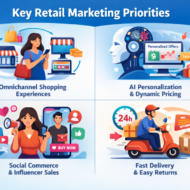
Consumer behavior in 2025-26 is shaped by AI, sustainability, digital convenience, and experience-driven engagement. While the core trends remain universal, their application varies by industry. Here’s how Retail, FMCG, and Technology brands can adapt consumer marketing strategies to stay competitive. 🤩Be sure to download the free Strategic Marketing Planner available at the end of this blog post. 1. Retail Marketing Trends (2025-26) Retail marketing is now driven by hyper-personalization and omnichannel experiences. Consumers expect seamless movement between online stores, mobile apps, social platforms, and physical outlets. AI-powered recommendations, smart inventory management, and personalized promotions are transforming how retailers engage shoppers. Social commerce is a major growth driver, with platforms like Instagram and TikTok influencing product discovery and impulse purchases. Retailers are also investing in experiential marketing — interactive stores, virtual try-ons, and loyalty programs with gamification elements. Key retail marketing priorities: Omnichannel shopping experiences AI-driven personalization and dynamic pricing Social commerce and influencer-led sales Faster delivery and easy returns Retail brands that balance convenience with engaging brand experiences will win long-term loyalty. I publish sponsored content and collaborations relevant to my audience.For inquiries, contact me at: managementguru.net@gmail.com 2. FMCG Marketing Trends (2025-26) Fast-Moving Consumer Goods (FMCG) marketing is increasingly shaped by sustainability, affordability, and trust. Consumers are more conscious of what they buy- eco-friendly packaging, ethical sourcing, and transparency strongly influence purchase decisions. Digital marketing plays a critical role, with short-form videos, regional influencer content, and mobile-first campaigns driving awareness. Data-led promotions and localized pricing help FMCG brands stay competitive in cost-sensitive markets. Direct-to-consumer (D2C) channels are also expanding, allowing brands to gather real-time consumer insights and build deeper relationships. Key FMCG marketing priorities: Sustainable and ethical branding High-impact digital and regional marketing D2C engagement and loyalty programs Value-based pricing strategies In 2025–26, FMCG success depends on trust, visibility, and everyday relevance. 3. Technology Marketing Trends (2025-26) Technology marketing is evolving from product-focused messaging to solution-driven storytelling. Consumers and businesses alike want technology that simplifies life, improves productivity, and delivers measurable value. AI, automation, and data security are central to buying decisions. Content marketing, thought leadership, and community-building are critical for tech brands. Free trials, freemium models, and personalized onboarding experiences help reduce adoption friction. Subscription-based pricing and flexible plans are now standard expectations. Key technology marketing priorities: AI-powered personalization and automation Educational content and value storytelling Trust, privacy, and cybersecurity messaging Community-driven growth and retention Tech brands that focus on clarity, credibility, and customer success will dominate future markets. Conclusion Across Retail, FMCG, and Technology, consumer marketing in 2025-26 is defined by personalization, digital integration, sustainability, and experience-led engagement. Brands that adapt these trends to their industry context, while keeping consumers at the center will build stronger loyalty, higher conversions, and long-term growth. Strategic Marketing...