Posted by Managementguru in Business Management, Marketing, Principles of Management, Strategy
on Mar 4th, 2014 | 0 comments

A niche market is a specific segment of a larger market with distinct needs and preferences. Finding the right niche is crucial for start-up success. It allows you to focus your resources, differentiate your offerings, and build a loyal customer base. Look For Problems What problems or pain points exist in the market? What needs are not being met? Identifying unmet needs is a key step in finding a profitable niche market. Look for areas where you can provide solutions or improvements. The process of new product development starts with the search for new ideas. Abstract ideas are molded in such a way to suit the market needs. Businesspersons who want to capture a major share of the market have to think out of the box, to tide over the competition. Small things can make a big difference. Monotonous pattern of thinking will not help you in the long run to survive and sustain in the market. The Significance of R&D The objective is to obtain ideas for new products, new attributes for the existing products and new usage for the existing product line. Why do you think so much of investment goes into research and development? The fruits of such R and D activities are reflected in the form of improved sales turn over. Market updates on a daily basis also gives you an excellent feedback about the new products that throng the market. Think about this, it is not possible for every organization to invest such huge sums in R and D which demands technically qualified personnel to carry out the research activities and it is next to impossible that each and every firm in the market can establish the necessary infrastructure for the purpose of research. SWOT Analysis What might be the solution? Companies generally rely on internal sources, customers, competitors, distributors, suppliers and others for new product ideas. The sales force of a firm can provide excellent inputs as they meet customers on a regular basis. Through SWOT analysis, a company can make a conscious, deliberate and systematic effort to identify opportunities that can be profitably exploited. Top management should encourage the employees to think more imaginatively to create a niche market for its product range. The management has to prioritise its objectives first and channelise the efforts of employees accordingly. Steps to be Followed in New Product Development Generation of new product ideas Screening of ideas – It serves the purpose of reducing the large number of ideas generated, to spot the good ones and drop the bad ones. Concept development and testing – An inherent idea must be developed into a product concept, should include the customer, the major customer benefits and the features defining it. Development of marketing strategy – This is helpful in launching the product at the right time and right place to the right people. Business analysis – A review of cost versus profit analysis, estimated size and growth rate of the market segment, estimated sales and market share for the new product in the light of financial feasibility. Development of the product – If the business analysis gives a satisfactory report as to the rate of return on investment and payback period, the R and D department goes ahead with manufacturing the prototype which is the preliminary version of the final product. Test marketing – It provides an opportunity to understand market response to the new product and its proposed marketing programme in a more realistic market environment than in simulated conditions. Commercialization – The product is released into the market, distribution channels are established, thus initiating its life cycle. The success of new products can be attributed to two aspects, one...

Posted by Managementguru in Marketing, Principles of Management
on Mar 4th, 2014 | 0 comments
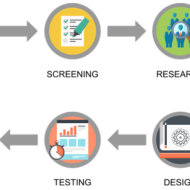
What Do You Mean by New Product Development? In business and engineering, new product development (NPD) is the complete process of bringing a new product to market. Innovate or Die: Product management should be viewed form a broader perspective by business firms, in that, it has to include new product development as part of the action plan, apart from appraising the existing product line, positioning them effectively and taking brand decisions wisely. “Innovate or die’, is the modern entrepreneurial slogan. Unless organizations innovate and introduce new products, they cannot survive in the competitive market. Strategies defining the organization’s future are built upon the portfolio of new products. Picture Cortesy: Coschedule Need for new product development: People always welcome change and new product development is an opportunity for the firms to meet the changes in consumer demands. They are a source of competitive advantage. Your new product may infuse a fresh lease of life to your sagging profits. New products may turn out to be the star performers of your firm and provide long term financial return on your investment. Some firms take the smart strategic choice of using the idle capacity of their plant for manufacture of a new product that may utilize the existing production and operation resources to an optimum level. They capitalize on research and development. Products that create a wave are a result of research on market trend and consumer preference. Firms can make it, if their research is customer-centric rather than product-centric. They provide opportunities for reinforcing or changing strategic direction. It is wiser to discontinue production of a product that does not find acceptance and divest the funds in a beneficial venture. They leverage marketing and brand equity. Big corporate firms while introducing new products make a big publicity, so that it can attract potential investors and consumers. They enhance the corporate image. You cannot expect a firm to make it big with a single product line or confined to one area of development. The growth of a company is evident only when it ventures into multifarious disciplines reflecting its capacity for expansion and diversification. Picture Courtesy: Staenz Also if a company grows, the growth of the stake holders is rest assured as the company would be in a position to offer decent dividends with bonus. Even if a growing company ploughs back its profits for expansion, it is again a good thing for the investors as further expansion obviously means growing profits. They affect human resources-a new product is perceived differently by different people. It is a need satisfying concept with benefit for buyers; a bundle of need satisfying features for marketers; a way to add value for intermediaries; an opportunity to design for R and D and a chance; to assemble and process for the production department. They meet environmental threats-Until recent times, products were not subjected to environmental evaluation, but the recent crises regarding global warming and pollution has been an eye opener for all nations which are enforcing much rules and regulations, demanding for production aimed at environmentally safe products. New product development is a multi-dimensional concept, inherent in most organizations. The process is initiated when the organizations are subject to market pressure and the firms are left with no choice other than to take up the challenge. A List of Productivity Terms Automation – The use of robots or other automatic equipment to do certain tasks Business Productivity – The amount of goods or services produced by a business from a set amount of resources Capital Goods – Manufactured or constructed items that are used...
Posted by Managementguru in Business Management, Marketing, Principles of Management
on Mar 3rd, 2014 | 0 comments

Customer centric: refers to the orientation of a company to the needs and behaviors of its customers. Product centric: refers to the orientation of a company towards manufacturing and improving the product line. All products that enter the market are not given the kind of welcome which only certain products are able to enjoy. Why is that only few products are top notch and others average performers? The answer is very simple, you need to be customer centric rather focusing on improving your product and its range. What is the fun in making products that go bland over a period of time? Creating an appealing product does not suffice the requirements of the consumers. Understanding the consumer, his needs and preferences makes you a good marketer. “What people want to buy and what you want people to buy are entirely two different entities.” Customer Preferences Marketing is a concept that talks about creating a favorable environment or identifying a niche where you can sell your products comfortably or where the products can sell themselves provided the focus is on the target customer. What companies do now in the name of marketing is nothing but product promotion that exhausts huge chunk of money from the management’s treasury. Business schools have a great role to play in idealizing these concepts for the better understanding of management graduates, make them deliver the right choice of action in real time environment. Marketing starts right from developing a prospective business idea into a concrete business plan followed by branding and promotions. But the product base has to be built upon customer wanton and preferences. Indigenous Products The soft drink “Bovonto” is very popular and a preferred drink in south of Tamilnadu, India and the manufacturers have their plants at various places in Tamilnadu. Although not a big name in the international market, it is a direct competitor for Coke and Pepsi in the southern regions of Tamilnadu. The grape vine is that the product is a perfect “market fit”. To our amusement and amazement, the product has communicated well with the marketplace through taste and quality. Here is the unerring message, ‘Let the product speak for itself’. Indigenous products always gain instant recognition as they connect well with the local people emotionally. If people of each and every country vows only to buy indigenous products, many MNC’s would be out of business and filing for bankruptcy. Such is the power of the market and people who are the owners of the market. What is that ‘X’ factor that makes your product different and unique Let’s look at it from another perspective. Incidentally you happen to develop a great product, and you want to market the product. This situation calls for patenting the product and again it can be made market centric by finding the right market segment for the product and promoting it in such a way that the product content appeals to the market. Tell the masses how your product can solve specific problems through its unique content. What is that ‘X’ factor that makes your product different and unique as well is what you have to communicate to the people whom you are targeting. Facebook has revolutionized the internet marketplace by offering simple and user-friendly interface and a sophisticated niche for each and every individual who wants to make his/ her presence felt. A good business plan is one which incorporates the best of ideas from all spheres of the company, as marketing is not a separate entity, and promotions call for huge investments. Many companies fail to understand the basis of market success which is solving the problem and not selling. Promotions alone...
Posted by Managementguru in Business Management, Marketing
on Mar 3rd, 2014 | 0 comments
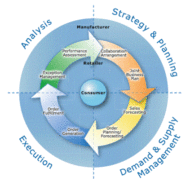
What is Product Forecasting? It is the science of predicting the degree of success a new product will enjoy in the marketplace. Forecasting is said to be the first and foremost step in the planning process. One of the requirements for effective long-term planning by managers is to assess the changes in technology and environmental conditions that could affect the firm. This is termed as environmental scanning which facilitates the firm to benchmark its performance as against the top industry standards. Technological forecasting involves anticipating development of new products and processes and the time taken for such kind of innovations to be accepted and absorbed in the market. External Environmental Scanning Environmental forecasts focus on factors such as population growth, availability of resources, social and political trends that may affect the firm’s future. Business firms become more informative on, The percentage of market share for existing products of the firm Future demand for its product range Decline in sales proportions Consumer feedback about product performance Customer satisfaction Sales team performance level Pitfalls in marketing strategies Need for new product development Unidentified customer needs and so on All predictive activity is subject to error, but technological and environmental forecasting is particularly different because they often involve assessing ideas and relationship that do not exist at the time the analysis is being performed. These forecasts are best suited for predicting performance a year or two in the future. Plan of Future Course of Action Based on forecasting, the firm decides the future course of action. Sales forecasts help the firm to decide on the volume of production for the next few months and aid in aggregate capacity planning. Labor productivity is a crucial factor in determining the success of a business environment, especially a production environment. Manpower planning is purely based on production forecasts where in, the labor hour productivity is also taken into consideration. Forecasting Techniques In the absence of empirical data, the forecasts must be based on expert opinions. Techniques like Delphi method can be used for this purpose. A group of experts is asked to assess a particular situation, presented with the judgments of others in the group, and then asked to reevaluate their individual positions based on what they have heard. The process continues until a consensus is arrived or until it is apparent that there will be no consensus. This helps the firm to consolidate its position with respect to specific problem situations. The Delphi method has been successfully used to forecast the nature and timing of technological change. Techniques like Delphi and Brainstorming also help in the process of identification of bottlenecks, the current business trend, the firm’s future prospects, range of estimates for the desired breakthroughs etc. Although the pattern of a business cycle or a product cycle for the most part, follows a fairly predictable pattern, the firm cannot overlook probabilities, upon which the firm has to capitalize on. The firm has to become alert and employ some innovations at that point of time, when the market becomes saturated. Or else, the rate of growth declines and the firm has to decide whether to continue with the operations which calls for additional investment or close down the...
Posted by Managementguru in Business Management, Organisational behaviour, Principles of Management
on Mar 3rd, 2014 | 0 comments
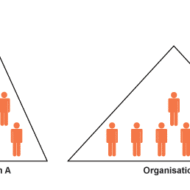
Levels of Organization An organization is a network consisting of people interacting to accomplish the enterprise objectives. The inter relationship is always complex as groups tend to develop conflicts and difference of opinion among themselves and in between. Hence the structure of an organization should be designed to clarify who is to do what task and who is responsible for what results and to furnish decision-making devoid of uncertainty. Organization implies to Recognizing and classifying the required activities Grouping of activities in order to achieve the objectives Appointing a manager and assigning him with the necessary authority to lead each group The provision for co-ordination vertically and horizontally “Organization is the establishment of authority and relationships with provision for coordination between them, both vertically and horizontally in the enterprise structure,” According to Koontz. FORMAL ORGANISATION It implies a formalized intentional structure of roles or positions. Formal organization must be flexible. The formal structure is laid down by the top management The levels are designed on the basis of specialization Purely task oriented and not people oriented Rules are very stringent and everyone is expected to follow them without fail INFORMAL ORGANISATION A network of personal and social relations arising spontaneously as people associate with one another and not restricted by the formal rules or structure. One important aspect of organizing is the establishment of department. Department designates a distinct area, division, or branch of an organization over which a manager has authority for the performance of specified activities. Spontaneous in nature More people oriented Based on religion, culture, common problems faced by the workforce etc., Membership is voluntary and the same person can be a member of many groups. ORGANISATION LEVELS AND SPAN OF MANAGEMENT Why there is a need to organize? To co-ordinate the activities of the people involved in the organization’s functions for which there needs to be certain levels established to facilitate the co-operation effective. There are two types of spans, 1. Wide span 2. Narrow span Pic Courtesy: LumenLearning WIDE SPAN: Wide span of management has fewer organizational levels with more number of sub-ordinates reporting to a superior. Though it proves advantageous for the superior as delegation becomes part of the process and hence work is shared, care must be taken in selecting the right people for completion of tasks and clear policies must be made to avoid confusion. There is this tendency of overloaded superiors to become decision bottlenecks and there exists the danger of superior’s loss of control too. This kind of management needs exceptionally qualified managers to lead the respective groups. NARROW SPAN: Narrow span of management involves many organizational levels with fewer number of employees reporting to a superior. This facilitates close supervision, close control and fast communication between superiors and subordinates. On the contrary, superiors tend to get too involved in subordinates’ work and this kind of management incurs higher costs due to many levels in the organization and there is excessive distance between the lowest and top most levels. FACTORS DETERMINING AN EFFECTIVE SPAN: 1. Training of Subordinates: Well trained subordinates save much time and energy of the superiors and training has to be a continuous process as the technological policies and procedures are subjected to change periodically. 2. Clarity of Delegation of Authority: Clarity implies direction and guidance from the manager’s end to the subordinate. A manager has the responsibility of clearly explaining the task and the methods involved to complete the task in a suitable manner to his subordinates. In cases of machine handling, “On the Job Training” becomes inevitable. If not, the work will not be completed as per the schedule due to lack of clarity. 3. Clarity of Plans: In a production environment, the workers have to be...