Posted by Managementguru in Business Management, Decision Making, Principles of Management
on Feb 26th, 2014 | 0 comments

METHODS OF DECISION MAKING A. Marginal income or Cost analysis: This method is used to compare additional revenues arising from additional costs. Break even point is that point in which the cost equals revenue and it can be defined as a no loss, no gain situation. Profit can be enjoyed by a firm only when the revenue exceeds cost that is after crossing the break even point. A manager must have all the necessary data pertaining to total cost and its various components in order to arrive at a decision. B. Cost-effective analysis: This tries to find out the cheapest way in reaching the objective or shall we say the greatest value for expenditure. Mass production facilitates in factorizing the economies of scale where the objective is oriented towards output and sustained availability of the product year round. C. Experience: The mistakes committed become great lessons in due course of time generally and this holds good for managers involved in making crucial decisions. It ensures right decisions to be taken in similar situations. But one has to remember that decisions are inclined to make an impact on future events. So, it is up to the manager to take the right kind of decisions using his intuitions as well as experience. The late chairman of SIMPSONS GROUP, Anantharamakrishnan was very intuitive and under his leadership the organization touched new heights and diversified its activities like never before. Note: Anantharamakrishnan is remembered for his successful business practices, efficient management of the labour unions and for triggering the growth of the automobile industry of Chennai which has earned the city the epithet “Detroit of India”. As a result he himself came to be remembered as the “Henry Ford of South India.” Courtesy: Wikipedia D. Experimentation: Why people go for test-marketing? Because when the factors are intangible, you have to try out every alternative only through experiments or trail and error. Market surveys and questionnaires are useful tools when it comes to launching of a new product in the target market. E. Research and analysis: This involves the application of tools and techniques of operations research to the process of decision making based on mathematical functions. Risk-analysis and Decision-trees are the other methods used that illustrate decision points, chance events, and probability of each course of action. TYPES OF DECISIONS: · Routine and Strategic: Routine- regular decisions involving day to day affairs of the firm- leave procedures, work atmosphere. Strategic decisions are central to the firm’s operations- price fixing, product elimination etc. · Individual and Group decisions: Managers at the top level are inclined to take individual decisions and some important inter-departmental decisions may be taken up by members of the respective groups. · Programmed and Non-programmed decisions: Decision taken by the low-level personnel which are regular and repetitive in nature are programmed-late attendance, medical compensation etc., Non-repetitive and unusual decisions like mergers and acquisitions, collaboration agreements belong to the non-programmed category. · Simple and Complex decisions: Where the problem is simple but the outcome has a high degree of certainty are called mechanistic or routine decisions. Where the problem is simple but the outcome has a low degree of certainty are judgmental in nature. Where the problem is complex and the outcome has a high degree of certainty are analytical and where the problem is complex but the outcome has low degree of certainty are adaptive decisions. MAKING EFFECTIVE DECISIONS: · Timing of decisions: A new product only if introduced into the market at the right time will be a success for which the manager should select the appropriate time for taking the decisions. · Effective communication: The decisions taken should be communicated down the line for effective implementation. · Top management support: The support of top management is indispensable for effective decision-making since it...

Posted by Managementguru in Business Management, Decision Making, Principles of Management, Productivity
on Feb 26th, 2014 | 0 comments
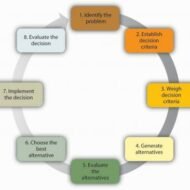
The Process of Decision Making There is a need to broaden our understanding about decision-making process. Decision making is not an independent entity and relies upon many other factors like precedence, social processes and random eventualities. It has three components; identification of the issue, the possible course of action and choosing the best amongst the choices of action available. The decision-making process is continuous since the business environment is dynamic and constantly poses challenges to the decision makers. Organizations are viewed as “Garbage can models” of decision making, in which actions, decisions and outcome are randomly mixed in the flow of events. With this introduction let us proceed to know more about the nature and types of decision making. NATURE OF DECISION-MAKING: 1. It is closely related to solving problems and issues 2. It is associated with all the important management functions like planning, organizing and controlling 3. Fayol and Urwick feels that decision-making is concerned only to the extent that it affects delegation and authority 4. Chester I Bernard in his “Functions of the Executive” says that the process is nothing but narrowing down of choice 5. Herbert A Simon considers decision-making as a process of intelligence, design and choice activities 6. According to Peter Drucker, it is a central part of the management process THE DECISION-MAKING PROCESS: The following steps are involved in the process of decision-making Recognizing the problem: Think about this; if there is a decline in the sales volume of your company or say if the value of your stock decreases, you are forced to make decisions to manage the contingency. In such situations, the first step would be to recognize or identify the problem area. A problem identified is half done. In this instance, the reason might be competitor strength or lack of necessary investment in the key strategic business units. Deciding priorities among the problems: A manager need not and cannot look after all the problems prevailing in the organization. He should know how to delegate authority and the responsibility that goes along with it. Subordinates can be entrusted with the handling of small and trivial problems while the manager can handle very important ones that might affect the functioning of the firm. He should ask the following questions to diagnose the situation. 1. What is the real problem? 2. What are the causes and effects of the problem? 3. Is this problem very important? 4. Can sub-ordinates handle this problem? 5. Which is the most pressing problem to be solved? Diagnosing the problem: Now the manager must start diagnosing the problem. Each and every individual has a different perspective and perceive the problem from a different angle. This depends upon the background orientations and training. The right way of approach for any manager would be to systematically analyze the problem for identifying the alternative courses of action. Developing alternative courses of action: This step involves creativity and innovative capabilities as the manager has to think from all possible angles and directions. Managers holding senior corporate positions are exposed to more of this kind of atmosphere where they are forced to make quick decisions in accordance with what the situation demands. Outside expert consultants are also put into use by some companies for developing choice alternatives. The following are the five PSYCHOLOGICAL STEPS for developing alternatives: 1. Saturation– A manager must be thoroughly familiar with the problem 2. Deliberation– Analyzing the problem from several points of view 3. Incubation– Temporarily switching off the conscious search to relax for the purpose of clear thinking 4. Illumination– A flash of light may occur after sometime giving him the right insights and ideas. 5. Accommodation– The ideas are made into a concrete proposal Evaluating the alternatives: The pros and cons of each and every choice is thoroughly subjected to scrutiny in terms of cost, time, risk, results expected, deviations anticipated...
Posted by Managementguru in Business Management, CSR, Principles of Management
on Feb 26th, 2014 | 0 comments

According to Raymond Bauer, “Social responsibility is seriously considering the impact of the company’s actions on the society. It may also refer to the person’s obligation to evaluate in the decision making process, the effects of both his personal and institutional decisions and actions on the whole system, according to Keith Davis and Cobert Blomstorm. A) SOCIAL OBJECTIVES OF BUSINESS: 1. The focus should be on quality, safety, service and security which lead to customer satisfaction. Quality– Product superiority and durability Safety– Products should not cause any harm to the consumers Service– After sales service is the link that builds a long standing relationship between the company and customers Security– Sense of satisfaction and belief on the company’s brand 2. The business has social responsibility of giving adequate opportunities to the members of the society. If everybody aims at white collar job, how does a nation grow economically? Developing economies should promote and encourage entrepreneurs to create more “Job Opportunities.” This especially suits countries like India and China where the pressure of population is very high. 3. Mass production facilitates in factorizing the economy of scale and at the same time aids in providing with quality goods at reasonable prices to the consumers. We see big chain of retail shops like Cosco and Wal-Mart in the US have made this possible where consumers can avail discount for bulk purchase. In India, Big Bazaar is a forerunner in this kind of retail marketing which enhances the material well being of a community and raises the average standard of living of the people. 4. Another main objective of business would be to control the percentage of pollution in air, water and land. Discharge of effluent in a lake or a river by the industrial enterprise may result in water pollution and also affects the plant, animal life and fish and birds to a considerable extent. Stringent laws must be in place to avoid such incidences and protect the society. B) RESPONSIBILITY TO CONSUMERS There is only one valid definition of business purpose: “to create a customer”, the customer is the foundation of a business and keeps it in existence. The responsibilities of a business towards its customers would be: Increased productivity in order to make goods available for the consumers at the right time at right prices; this solely depends upon the increased efficiency of functioning of the businessConstantly strive to improve the quality of goodsR & D to improve product quality and to come out with better and new productsProper distribution structure to reach even the remotest of locationsRemove hoarding, black marketing, profiteering by middlemen or anti-social elementsProvide them with the required after sales serviceEnsure that the product supplied has no adverse effectSufficient information about the product has to be given to the consumers regarding the adverse effects and precautions to be taken while using the productNo misleading product information through improper advertisements or otherwiseTo provide an opportunity for being heard and to redress consumer grievances Consumer courts are becoming popular in India for handling consumer grievances swiftly and efficiently. It is but a sad thing that many people do not know that they can address issues relating to quality, quantity or service. The businesses should understand the consumer needs and take necessary measures to satisfy those needs. C) REPONSIBILITY TO THE COMMUNITY To prevent environmental pollution and to preserve the ecobalanceAssisting in the overall development of a localityUse alternate energy resourcesContributing to research and developmentRehabilitate the population displaced by the operation of the businessDevelopment of economically backward areasPromotion of small scale industriesContributing to the national effort It is gratifying to see that many leading corporate icons of...
Posted by Managementguru in Business Management, Principles of Management
on Feb 26th, 2014 | 0 comments
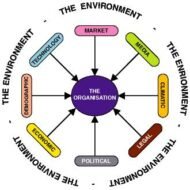
Factors of External Environment of Business What do you mean by Business Environment: The sum total of all things external to firms and industries that affect the functioning of the organization is called Business Environment. Elements of Business Environment 1. ECONOMIC 2. SOCIAL 3. CULTURAL 4. POLITICAL 5. LEGAL 6. TECHNOLOGICAL 7. DEMOGRAPHIC 8. GEOGRAPHICAL 9. ECOLOGICAL 1. Economic Environment This refers to all economic factors that influence and affects the very survival of an organization. Can be classified into · Economic factors affecting demand · Competitive forces Economic factors affecting demand The existence of an organization depends on the demand for its products or services. The customers’ ability to buy and willingness to pay determine the demand factor. The buying power is determined again by · Employment · Income taxes · Saving and · Prices The money acquired by an individual through employment is utilized for paying taxes which is the first priority and then comes saving or spending. In developing countries like India, much importance is attached to the habit of saving in the form of insurance policies or mutual fund deposits or investment on immovable assets. This makes the economy strong and stable even during times of recession, whereas we witness the economy of some developed countries entirely shaken when there is an economic depression. Sub Prime Lending Sub prime lending may prove to be disastrous for a growing or grown nation when the money is lent by the banks to third parties without proper securities or collaterals. While the initiative is intended to increase the growth rate or GDP, the end result may not live up to the expectations when the money is parted to individuals or firms with poor financial credentials. Disposable Income Disposable income also decreases when the tax rate increases and his/her ability to buy is reduced. Equally important is the willingness to by because the fact that an individual has the ability does not mean that he or she will buy. Willingness is affected by the preferences for products and the expectation about future factors like the price fluctuation, increase in one’s own income, general economic trend and so on. Competitive forces Firms have to first survive in order to succeed in the market. To accomplish this they exert competitive force on each other through one or the other following methods. · Price cutting · Promotion-advertising, personal selling · Design, feature and packing · Number and type of customer services offered give a cutting edge to firms competing in the race. 2. Social and Cultural Environment The social environment depends upon the · The class structure · Mobility · Nature of the social organization and · Development of social institutions People always have the unending desire to move from one occupational category to another and this is the main reason for high job turn over in IT industries for various reasons like pay, promotions, job satisfaction etc., This is the same reason which can be attributed to the failure of many good projects that go underway due to lack of continuation of the same initiative with which it was started. The above said process is more prevalent in urban societies than rural where scope of mobility is much the less among farmers, artisans and those engaged in traditional crafts and cottage industries. 3. Political Environment A smart manager has to be on tenter hooks to gauge the trends in political scenario that directly or indirectly affect the functioning of the firm. The political weather is highly unpredictable and may be classified into · Long-term changes · Quick changes · Cyclical changes · Regional changes Now-a-days we see that the economic depression in...
Posted by Managementguru in Business Management, Principles of Management
on Feb 25th, 2014 | 0 comments
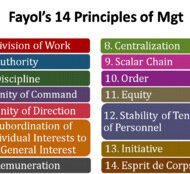
Evolution of Management Theory -II MANAGEMENT PROCESS SCHOOL Henri Fayol (1841-1925) Henri Fayol has propagated 14 principles on management which are very popular. 1. Division of labor: He insists on a high degree of specialization in order to improve efficiency. Both managerial and technical works are amenable to specialization which leads to better work with the same efforts. 2. Authority and Responsibility: Authority can be classified into Official and Personal authority, the former needed by a manager to extract work from the subordinates and the latter emanating from the manager’s own intelligence, integrity, experience, personality, knowledge and skills. Responsibility comes along with authority; one who has the authority should also be able to take up responsibility. 3. Discipline: Obedience, diligence, correct attitude and outward mark of respect is the essence of discipline which exists as an unwritten agreement between the management and its employees 4. Unity of Command: A subordinate must receive orders and instructions from one superior only. 5. Unity of Direction: Activities of similar nature should be grouped under one superior so that the efforts could be streamlined towards the common goal. 6. Sub-ordination of individual’s interest to the Common Goal: The personal interests of an individual (like money, recognition etc.) should not be placed before the goal of the organization, which is maximizing production. 7. Remuneration: Fair and equitable remuneration should be provided to employees to ensure better production and satisfaction. 8. Centralization: The concentration and dispersal of authority must be balanced in an organization 9. Scalar Chain: The authority chain from top to bottom should be followed at all times for the purpose of effective communication. 10. Order: Human and material resources should be co-ordinated so as to be in the required place at the required time. 11. Equity: Fairplay, justice and friendliness is what the employees expect of the organization. 12. Stability of Tenure of Personnel: Too much of Job turn over and rotation affect the work in progress and destruct the stability of the work units 13. Initiative: Subordinates must be encouraged to participate in the decision making process to show their initiative. 14. Espirit De Corps: “In union there is strength and so is team work.” Team spirit and a sense of unity and togetherness should be fostered and administered in an organization. Join Over 290+ Other Entrepreneurs Who Are Using This Course. Become An Outsourcing Master In 30 Minutes James D.Mooney and Allen C.Reilay The Line and the Staff Principle: According to this principle, the line authorities get things done while it recognizes the role of staff authority who are experts in providing guidance and advice. The emphasis is on, · Hierarchial structure · Clear decision · Delegation of Authority and Responsibility · Specialization of Tasks · Co-ordination of activities and · Utilization of staff experts A short course designed to help managers select the right person to join their team! Staff Recruitment THE HUMAN RELATIONS SCHOOL The human behaviorists believed in COLLABORATIVE management which is possible when managers are capable of harmonizing the efforts of individuals at all levels of the organization. This concept draws heavily from psychology and social psychology. · Motivation · Leadership · Communication · Training · Participative management · Group dynamics are assigned importance The important contributors are Elton Mayo, Roethlisberger, Mary Parker Follet, Chester I Bernard, Abraham Maslow and Douglas McGregar. THE EMPIRICAL SCHOOL Case study analogy is the best way to understand management is the idea behind this school of thought. The mistakes of managers are converted into rich experiences over a period of time and the findings are transferred to the practitioners in the management profession. The contributors are, · American Management Association · Harvard Business School · Ernest Dale. However, critics feel that this may not be suitable when it...