Posted by Managementguru in Operations Management, Project Management
on Feb 24th, 2014 | 0 comments
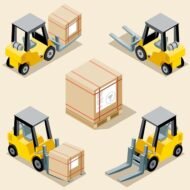
Minimize Movement and Maximize Productivity Manufacturing organizations handle many types of materials in their production environment. Raw materials, materials-in-progress, finished goods, accessories, components, packaging materials, maintenance and repair supplies, scrap and many more must be handled in an efficient manner to make the operations cost-effective and to avoid wastage. The principle behind material handling process is said to be “no handling”, which is not practicable in reality. So it would be appropriate to say, that the objective of materials handling would be, to reduce the number of handlings as well as reducing the distances through which the materials are handled. Why efficient materials handling is inevitable in a manufacturing set-up? The movement of materials from the receiving area to the shipping area through the production line does not add value to the product but only to the cost. Further, plant layout and materials handling are complementary to each other. A production facility must incorporate a good plant layout that enhances the efficiency of movement of materials with ease and should deliver maximum productivity. Principles for Efficient Materials Handling There are certain principles that serve as a guide for efficient materials handling. These provide a framework for selecting specific materials handling equipments that form the core of the production system. Eliminate handling-If not, reduce the distance travelled by the materials Keep moving-If not, reduce the time spent at crucial points Simple patterns of material flow is appreciated-If not, reduce back tracking, cross overs, congestion Carry pay loads Carry full loads Use reliable and inexpensive source of power Materials handling should be considered in the light of movement of men, machines, tools and information. It also depends on the type of product manufactured, quantity, value and size of the organization. Cost effectiveness can be achieved if the firm is able to reduce the manufacturing cycle time through faster movement of materials and thus work-in-progress inventory costs can also be controlled and reduced. Design of the plant layout that facilitates sequential flow of materials through the production facility, improved working conditions, safety in the movement of materials, contribution to better quality by avoiding damage to the materials due to inefficient handling and workers being appraised about the importance of smooth materials handling result in higher productivity at lower manufacturing cost. Factors to considered while deciding on material handling equipments Adaptability, flexibility, load capacity, power, speed, nature of supervision required, space requirements, ease of maintenance, environment friendliness and cost are some of the factors to be taken into consideration while deciding on the type of material handling equipments. Also, the capabilities of manpower to operate the equipment and safety of personnel cannot be overlooked. It is important to select and design, materials handling system that are expensive to purchase and operate. For instance, if overhead cranes are to be used, the structure of the building should be strong enough to support the installation. Spacious aisles are mandatory if the loads are heavy and transported across the shop floors. Equipments used Elevators, hoists, industrial trucks like fork-lift trucks, pallet trucks, pipelines, automatic transfer devices, automated guided vehicles, and industrial robots are some of the handling equipments that have found their ideal place in this process. Materials handling activity should be evaluated like any other activity to gauge its effectiveness. The focus should be on the manufacturing cycle efficiency, equipment utilization, percentage of time lost, total number of moves and material handling costs as percentage of manufacturing...

Posted by Managementguru in Operations Management
on Feb 24th, 2014 | 0 comments
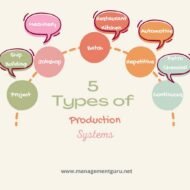
Production systems can be classified as Job-shop, Batch, Mass and Continuous production systems. Here we will explain about Batch and Jobshop production systems, their benefits and limitations. Batch Production What is batch production? A manufacturing process in which components or goods are produced in groups (batches) and not in a continuous stream. Characteristics: 1. Shorter production runs. 2. Plant and machinery are flexible. 3. Plant and machinery set up is used for the production of item in a batch and change of set up is required for processing the next batch. 4. Manufacturing lead-time and cost are lower as compared to job order production. Benefits 1. Better utilisation of plant and machinery. 2. Promotes functional specialisation. 3. Cost per unit is lower as compared to job order production. 4. Lower investment in plant and machinery. 5. Flexibility to accommodate and process number of products. 6. Job satisfaction exists for operators. Limitations 1. Material handling is complex because of irregular and longer flows. 2. Production planning and control is complex. 3. Work in process inventory is higher compared to continuous production. 4. Higher set up costs due to frequent changes in set up. Job Shop Production What is job-shop production? A job shop is a type of manufacturing process in which small batches of a variety of custom products are made. In the job shop process flow, most of the products produced require a unique set-up and sequencing of process steps. Job shops are usually businesses that perform custom parts manufacturing for other businesses. However, examples of job shops include a wide range of businesses—a machine tool shop, a machining center, a paint shop, a commercial printing shop, and other manufacturers that make custom products in small lot sizes. These businesses deal in customization and relatively small production runs, not volume and standardization. This is a custom made furniture design! Characteristics: 1. High variety of products and low volume. 2. Use of general purpose machines and facilities. 3. Highly skilled operators who can take up each job as a challenge because of uniqueness. 4. Large inventory of materials, tools, parts. 5. Exhaustive planning is essential for sequencing the requirements of each product, capacities for each work centre and order priorities. Benefits 1. Because of general purpose machines and facilities variety of products can be produced. 2. Operators will become more skilled and competent, as each job gives them learning opportunities. 3. Full potential of operators can be utilised. 4. Opportunity exists for Creative methods and innovative ideas. Limitations 1. Higher cost due to frequent set up changes. 2. Higher level of inventory at all levels and hence higher inventory cost. 3. Production planning is complicated. 4. Larger space...
Posted by Managementguru in Operations Management
on Feb 24th, 2014 | 0 comments
Types of Production Systems -I Continuous Production What is continuous production? The manufacture of products requiring the sequential performance of different processes on a series of multiple machines receiving the material for manufacture through a closed channel. For example, continuous production is generally conducted in the paper and chemical business. Characteristics 1. Dedicated plant and equipment with zero flexibility. 2. Material handling is fully automated. 3. Process follows a fixed sequence of operations. 4. Component materials cannot be readily identified with final product. 5. Planning and scheduling is a routine action. Technical Web Testing 101- Introducing the tools, techniques and thought processes that help you become more technical, and test more thoroughly. Benefits 1. Standardisation of product and process sequence. 2. Higher rate of production with decreased cycle time. 3. Higher capacity utilisation due to line balancing. 4. Manpower is not required for material handling as it is completely automatic. 5. Person with limited skills can be used on the production line. 6. Unit cost is lower due to high volume of production. Limitations 1. Flexibility to accommodate and process number of products does not exist. 2. Very high investment for setting flow lines. 3. Product differentiation is limited. Mass Production What is mass production? The manufacture of a product on a large scale. The mass production of items is often done by using an assembly line, or another efficient means of production. The process is often carefully determined, to try to produce the greatest quantity of items while using the fewest resources (such as labor and/or time). Mass production has become popular since the assembly line became prominent in the 1900s, although the process embodies principles of efficiency that have been around much longer. Characteristics: 1. Standardisation of product and process sequence. 2. Dedicated special purpose machines having higher production capacities and output rates. 3. Large volume of products. 4. Shorter cycle time of production. 5. Lower in process inventory. 6. Perfectly balanced production lines. 7. Flow of materials, components and parts is continuous and without any back tracking. 8. Production planning and control is easy. 9. Material handling can be completely automatic. Benefits 1. Higher rate of production with reduced cycle time. 2. Higher capacity utilisation due to line balancing. 3. Less skilled operators are required. 4. Low process inventory. 5. Manufacturing cost per unit is low. Limitations Following are the limitations of Mass Production: 1. Breakdown of one machine will stop an entire production line. 2. Line layout needs major change with the changes in the product design. 3. High investment in production facilities. 4. The cycle time is determined by the slowest...
Posted by Managementguru in Labor Management, Operations Management
on Feb 23rd, 2014 | 0 comments

What is Operations Management and Why is it Important? Operation is that part of as organization, which is concerned with the transformation of a range of inputs into the required output (services) having the requisite quality level. Management is the process, which combines and transforms various resources used in the operations subsystem of the organization into value added services in a controlled manner as per the policies of the organization. The set of inter-related management activities, which are involved in manufacturing certain products, is called as production management. If the same concept is extended to services management, then the corresponding set of management activities is called as operations management. What is Production? Production is defined as ‘the step-by-step conversion of one form of material into another form through chemical or mechanical process to create or enhance the utility of the product to the user’. Thus production is a value addition process. At each stage of processing, there will be value addition. Pic Courtesy: Minds.com Edwood Buffa defines production as ‘a process by which goods and services are created’. Some examples of production are: manufacturing custom-made products like, boilers with a specific capacity, constructing flats, some structural fabrication works for selected customers, etc., and manufacturing standardized products like, car, bus, motor cycle, radio, television, etc. Characteristics of a Production System 1. Production is an SYSTEMATIZED activity, so every production system has an objective. 2. The system transforms the various inputs to useful outputs. 3. It WORKS IN TANDEM with the other organisation systems. 4. There exists a feedback about the activities, which is essential to control and improve system performance. Evolution of Production Management Why Operations Management is Important? Increases productivity of every organization Leads to economic growth and development Helps employees to receive high wages Earns profit for a company Also plays a strategic role in a firm’s competitive success Want to Learn Some Interesting Operations Management Terms? Capacity planning—The process of determining the production capacity needed by an organization to meet changing demands for its products. Different types of capacity exist. For example, design capacity is the maximum amount of work that an organization is capable of completing in a given period; effective capacity is the maximum amount of work that an organization is capable of completing in a given period due to constraints such as quality problems, delays, and material management. Efficiency—Performing activities at the lowest possible cost. Enterprise resource planning (ERP)—Large, sophisticated software systems used for identifying and planning the enterprise-wide resources needed to coordinate all activities involved in producing and delivering products. Forecasting—The process of predicting future events, including product demand. Just-in-time—A philosophy designed to achieve high-volume production through elimination of waste and continuous improvement. Lean systems—Sometimes synonymous with just-in-time, it is a philosophy that takes a total system approach to creating efficient operations through the elimination of waste. Location analysis—Identifying the best location for facilities. Mass customization—The ability of a firm to highly customize its goods and services at high volumes through its operations management function. Product design—The process of deciding on the unique and specific features of a product. Process selection—The process of identifying the unique features of the production process that will give the product its unique characteristics. Process selection typically goes hand in hand with product design, as we need to create a process that gives rise to the particular product design desired. An excellent product design is worthless if a process for its creation cannot be developed. Productivity—A measure of how efficiently an organization converts inputs into outputs. It is usually measured by a ratio of output divided by input. Productivity is essentially a scorecard of how efficiently resources are used and a measure of...
Posted by Managementguru in Change management, Organisational behaviour
on Feb 23rd, 2014 | 0 comments
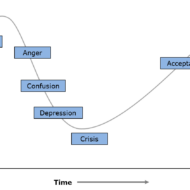
Resistance to change should be considered as a good sign and can be compared to fever while there is a bodily infection. It creates a platform for the firm to find out the causes for resistance and hence the solution. Causes for Resistance to Change Individual Resistance A. Economic factors: When pay is tied up with productivity, resistance arises. B. Habit: It is the habit of humans to resist anything new. C. Fear of the unknown: Freshers always have a feeling of insecurity and uncertainty when they join an organization. D. Change affects emotions and sentiments: People are disturbed both emotionally and sentimentally when there is a change. E. Lack of clarification: People interpret change in different ways; so there is a need for the organization to clarify as to the nature of the change and its implied consequences or implications. F. For the sake of opposing: Illogical and weird opinions are given by the employees just for the sake of opposing. Resistance to change Organizational Resistance A. Built-in-Mechanism: People working in groups experience shock when there is a structural change introduced in the system as they are tuned to a set of rules and procedures. B. Group norms: This also acts as a strong source of resistance acting as a constraint C. Threat to expertise: Technological innovations pose new threats everyday to the non-technical persons D. Threat to established power relationship: If the powers are re-assigned amongst the managerial cadre there arises unrest E. Threat to established resource allocation: Budget reallocations are resisted by departments that are not favored How to Overcome Resistance to Change? Education and Communication: The logic of change must be conveyed to the employees in a convincing manner and full facts must be communicated without an iota of doubt. Participation: It becomes difficult for individuals or groups to resist change when they are made to act as change agents Facilitation and Support: Change agents can offer counseling, training etc to pacify the employees Use of Group Force: Groups can exert more pressure on attitudes, values and behavior and hence, if the group cohesiveness is strong, the change is easier to achieve. Leadership for Change: A strong leader-manager can create a climate for psychology support from subordinates Negotiation: The key persons or individuals whom the management think are potential change agents can be rewarded and brought to the negotiating table Manipulation: Twisting information, creation of false rumors, withholding undesirable information are some of the tactics of manipulation that decrease the intensity of resistance to change. Coercion: Application of force that includes threats of transfers, delay in promotions, negative performance evaluation can decrease the resistance and also the credibility. Manipulation and coercion must be considered as last options to reduce the pressure as generally people will welcome any change that is positive and beneficial to the organization in the long run. It is the responsibility of the management to project the change in a gradual and convincing manner to the...