Posted by Managementguru in Financial Accounting, Financial Management
on Feb 20th, 2014 | 0 comments

Debtor Management or Receivables Management Profit is directly proportional to the volume of sales, provided all your business transactions are cash based. Is it possible for a manufacturer, wholesaler or retailer to carry on his business without offering credit in this competitive business environment? The answer is a definite “no”, because extension of credit improves your sales and thus your profit. Problems arise only when a firm is not able to recover the debt within the stipulated period of time from the customers. What is receivables management or debtors’ management? It covers two aspects- one, the kind of money that is being invested in debt rotation; second, the risk factor which includes loss of money or the opportunity cost foregone by the organisation. Had these funds not been tied in receivables, the firm would have invested the same elsewhere and earned income thereon. A transaction entirely through cash is definitely a possible option, but whether it is lucrative in the long run must be subject to consideration. When customers are not offered credit, they choose concerns that extend credit facilities and thus you may lose your earlier customers and also exposed to the risk of declining sales proportions. Credit Sales In credit sales, the supplier offers credit for a specific time period, which is an investment from the angle of supplier and largest single source of short term financing from the angle of the customer. The supplier should be able to recover the amount of interest on the credit investment he has made. How? Recovery of debt within the stipulated credit period Taking interest from the customer for the period of delay Volume sales Surplus capital to offset these negative impacts on rotation of funds Proper formulation and execution of credit policies by the finance manager Discipline in collection policy and its execution. Discounts Cash discounts, quantity discounts and trade discounts are offered by many firms to the customers to encourage credit sales, favoring bulk purchases. A firm cannot be expected to survive long by pursuing the policy of cash sales while similar firms can overtake it by adapting to liberal credit policies. The main aspects of receivables management decisions are as follows: Time period of credit Credibility of the customer Cash discounts Trade discounts Learn the basics of the Income Statement, Balance Sheet and Cash Flow Statement and understand how they fit together. Credit Policy Credit policy on one hand stimulates sales and so also its gross earnings, but on the other may be accompanied by added costs, such as: 1) Clerical expenses involved in investigating additional accounts and servicing added volume of receivables, 2) increased bad-debt losses due to credit extension to less credit worthy customers, 3) higher cost of capital. Incremental earnings from increased sales should be matched with incremental costs that arise due to credit terms, to avoid funds being tied up in receivables. In course of time it would deprive you of your profits. The pivotal consideration of your credit policy would be the selection of credit worthy customers or debtors. If your funds become sticky, recovery becomes next to impossible and you need to proceed legally to claim your rights. Properly maintained accounting records and vouchers will stand as a testimony in your favor, in the court of...

Posted by Managementguru in Financial Management, Principles of Management
on Feb 20th, 2014 | 0 comments

Capital Budgeting- Long Term Resource Planning What is Capital Budgeting? Capital Budgeting refers to the process of planning expenditures that give rise to revenues or returns over a number of years. The process of investment analysis is essential to have a sustainable advantage in the competitive market and to stabilize the profits through resourceful strategic business units. The firm’s management must be on the alert to explore the opportunities present in the market. Obsolete product lines and changes in consumer tastes may present additional problems to a business enterprise affecting the profitability and growth. When a firm decides to venture into projects that demand huge investments, the management has to scrutinize the economic feasibility of such projects. The process of capital investment is also crucial because the projects are for the most part irreversible. Say, for example, if a business firm purchases a special type of machinery, and after installation, if the firm reverses its decision to sell the merchandise due to some technical reasons, it will have only a very small second hand value. Business firms based on the cash flow of the project and the capital recovery period do long-term investment. Why do firms opt for capital budgeting. The reasons may be: To replace worn out equipments that will affect the production efficiency To replace obsolete equipments to install new and more efficient ones To expand production facilities in lieu of increasing demand for the firm’s products and to capture new markets To divest the surplus funds from other business units and to rotate the funds, as idle funds will not generate any revenue To develop new products Research and development Investments made to comply with government regulations, such as projects undertaken to meet government’s health and safety regulations, pollution control and to satisfy other legal requirements. People Involved The proposals for new projects come from the internal environment, such as department heads, executives, employees and of course the management. Experts in product development, marketing research, industrial engineering examine the investment proposals and they may regularly meet with the heads of other divisions in brainstorming sessions to zero in on the proposals. This free course from Udemy is Ideal for people interested in entrepreneurship, fintech, big data, startups, finance, private equity, VCs, & investing. https://www.udemy.com/crowdfund-investing-101-the-basics-of-equity-crowdfunding/ Departments Involved While the firm’s top management makes the final say or decision to undertake or not a major investment project, the process is likely to involve most of the firm’s divisions. Each department has to present its view on the feasibility and viability of the project. The marketing department- on the demand for the new or modified products that the firm plans to sell The production, engineering, personnel and purchasing departments- on the estimation and cost of the investment projects The financing department on- how the required investments funds have to be raised. Thus, the process of expenditure analysis can truly be said to integrate the operation of all the major divisions of the...
Posted by Managementguru in Business Management, Decision Making, Leadership, Startups, Strategy
on Feb 19th, 2014 | 0 comments

Effective Strategy Generation Why effective strategy generation is necessary? A business enterprise has to generate strategic alternatives and determine the effectiveness of its strategic decisions in order to be successful in the market. Various approaches to strategy formulations exist and it is a real complex phenomenon in that, a wrong strategic execution may produce irreparable consequences which may prove detrimental to the survival of the firm. The method of strategy formation usually follows the traditional approach, based on rational and normative disposition. Sometimes different thought processes may also serve as basic premises for the evolution of new strategies. Intuition: The strategy evolves in the mind of the chief executive without ever being explicitly stated and without the aid of formal procedures. Personal judgment also backs up this process. People with excellent intuition are often remembered for their imagination, drive and expansive vision leading to corporate growth and prosperity. To look into the future with such creativity and brilliance is the basic premise of this approach. Disjointed Incrementalism: This approach towards strategy making reflects an attitude of management having strong preference to act only when there is a need or only when forced to, and then considering a few convenient alternatives involving only small, non-disruptive changes in the organization. This approach is followed by firms that enjoy a pretty decent profit margin in the existing business and possess an exclusive niche in the market; they will not be ready to come out of their cocoons for fear of failure. The firm cannot take the risk of setting unrealistic goals deviating away from the status quo. Pic Courtesy: Account Manager Tips Entrepreneurial Approach: Systematic risk-makers and takers who look for and find opportunities belong to this category. Entrepreneurs view challenges as opportunities and not as problems. Key factor approach: This approach is based on determining the really significant factors that are important in the success of a particular business and concentrating major decisions on it. Say, for instance, a quality product at relatively low price may be a critical factor for a business firm. But eventually it has to achieve this in order to capture the market whence the same critical factor becomes unique to the company and adds value. Integrated approach: Analyzing the present internal and external conditions Identifying and evaluating the present strategy Search for strength and weaknesses viewed within the present strategy and environment Considering changes in the present strategy Generating alternatives unified to resolve the problems and exploit the opportunities Developing alternative unified strategies by combining the various alternatives in each of the problem and opportunity area Evaluation of unified strategy in terms of the enterprise objectives and choosing the strategy that best satisfies the objectives. Strategy formations should conform and comply with the changes in the external environment and the change called for may be in the strategy itself or in the implementation of the...
Posted by Managementguru in Business Management, Change management, Marketing, Organisational behaviour, Strategy
on Feb 18th, 2014 | 0 comments
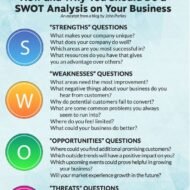
SWOT and Synergy SWOT Analysis On the basis of its resources and behavior, an organization develops certain strengths and weaknesses which when combined lead to synergistic effects. Such effects manifest themselves in the form of organizational competencies. It is necessary for a firm to look for and develop factors that adds to its strength, as strength is considered to be an inherent capacity which an organization can use to gain strategic advantage. Pic Courtesy: Clickfunnels A weakness, on the other hand, is an inherent limitation or constraint which creates a strategic disadvantage for the organization. Financial strength, for example, is a result of availability of financial sources and efficient rotation of funds. A weakness in the operations management area might be a result of inappropriate plant location, obsolete plant layout and technology. It has to be noted that an organization cannot enjoy the privilege of having only strengths and devoid of any weaknesses. Then the performance level would become saturated to the point of monotony and there exists no scope for growth or improvement. Only when presented with challenges, any functional area exhibits synergy, as strengths and weaknesses do not exist in isolation but combine within a functional area, and also across different functional areas. Synergy Synergy is needed at all levels for better productivity. Say, within a functional area like marketing, synergistic effort may occur when the product, pricing, distribution and promotional aspect support each other, resulting in higher level of marketing synergy. The same when happens at an even higher level, leads to operating synergy, say, for example, synergistic efforts between marketing and production department to decide on the production forecast and pricing. Distinctive competence helps a firm to develop strategic advantage that leads to comprehensive growth and development. Limitations of SWOT: A SWOT analysis can over emphasize internal strengths and overlook external threats It can be static and may ignore the changing circumstances It might give undue importance to a single strength or an element of strategy A strength is not necessarily a source of strategic advantage. Amazon.in...
Posted by Managementguru in Business Management, Strategy
on Feb 18th, 2014 | 0 comments

What is Distinctive Competence Distinctive Competence is a competency unique to a business organization, a competency superior in some aspect than the competencies of other organizations, which facilitates the production of a unique value proposition in the function of the business. Apple’s distinctive competencies: Innovative culture, successful entry into new markets, human centered design and development. What is distinctive competence? How does it serve as a critical factor for a firm to outsmart its rivals? This is the topic for discussion. Distinctive competence is nothing but the unique capacity of a firm in terms of resources, behavior, strengths and synergy, in relatively or exceptionally large measures. It is the advantage a company has over its competitors, because it can do something that they cannot or it can do something better than they can. Distinctive competence can be in the form of Patents Exclusive access to natural resources Government licenses Pioneer efforts Superior product Product quality Competitive price Unmatched promotional offers, such as discounts and prize coupons Particular attribute of a product-say, highly fuel efficient four wheeler Market niche creation for highly specialized products Superior R and D skills Possessing large number of equity share holders Marketing skills Managerial skills Synergistic work force Supportive union and what not. It is unfortunate that some firms fail to cash in on these competencies for better strategic formulations that might help them to have an edge over their competitors. These critical success factors have to be developed by organizations to capitalize the strategic opportunities that they present for developmental...