Posted by Managementguru in Accounting, Economics
on Feb 17th, 2014 | 0 comments
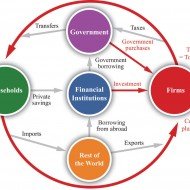
National Accounting Concepts Why knowing about national accounting concepts is important? National income data are of great importance for the economy of a country. In modern days they are regarded as the accounts of an economy, which are known as social accounts. Social accounts tell us how the aggregate of a nation’s revenue, output and product result from the income of different individuals, products of industries and transactions of international trade. National policy formulations: The computation of national income forms a basis for a nation to develop its policies for important spheres of action such as employment policies, monetary policies and fiscal policies that determine the growth of an economy. These figures enable us to know the direction which the industrial output, investment, saving etc. take and proper measures can be adopted to bring the economy on the right path. Facilitates Planning: Gross Domestic Product Gross National Product Net Domestic Product Net National Product Per Capita Income Disposable Personal Income All these factors comprise the national income and indicate the money value of the flow of goods and services available annually in an economy. Also this statistics helps a nation for proper economic planning. The per capita income refers to the earning capacity of individuals in an economy and more the per capita income, higher is the economic welfare of a country. Uncontrolled population growth and unemployment are major reasons for low per capita income. The wealth cannot be evenly distributed owing to high birth rates and low mortality rates and making the ends meet with the available scant resources becomes a major problem for developing countries. Distribution of income From the data pertaining to wages, rent, interest and profits, we learn of the disparities in the incomes of different sections of the society. Similarly the regional distribution of income is revealed. It is only on the basis of these that the government adopts measures to remove inequalities in income distribution and attempts at regional equilibrium. There have been differences of opinion regarding ‘nation’ in the concept of national income. In the calculation process, the term ‘nation’ has to be defined exactly as to whether it is the geographical entity of the country to be taken up for computing national income or the incomes earned by the nationals including those residing abroad. Further, since everything has to be equated to the money value, services produced in the economy out of love for humanity cannot be brought under the term national income. Besides, there is an overlapping of occupations, especially in the rural sector of certain countries, which makes it difficult to know about incomes from various...

Posted by Managementguru in Economics
on Feb 17th, 2014 | 0 comments

Managerial Economics and Decision Making One has to observe the economic prospects of a particular #industry before venturing into it. Most of the people are not aware of the existence of some businesses with fantastic economic characteristics like high rate of return on invested capital, substantial profit margins and consistent growth. How do you think Bill Gates and Warren Buffet were able to make it on the Forbes top millionaires list? Successful leaders focus on the economics of a business for decision making. Economic Aspects of a Market Managerial economics is a #management science that gives you more idea about the economic aspects of a market and how they affect your decision making. This is very important because economic profits play a crucial role in a market based economy., While above normal profits are indicators of expansion and growth, below normal profits cautions you about tightening or retrenchment. Business economics is comprised of several tools of micro and macro economic analysis which are useful in management decision-making that act as facilitators to solve business problems. Micro economic instruments used in this context include demand analysis, production and cost analysis, breakeven analysis, theory of pricing, technical progress, location decisions and capital budgeting . Factors Influencing Management Decisions The macroeconomic concepts that are directly or indirectly related to management decisions include analysis of national income, business cycles, monetary policy, fiscal policy, central banking, public finance, economic growth, international trade, balance of payments, protectionism, free trade, exchange rates and international monetary system. The scope of management science is broad and is closely linked with economic theory, decision sciences and accounting. Traditional economics deals with theory and methodology of management, while managerial or business economics applies these theories to solve business problems. The tools and analytical techniques are useful in providing optimal solutions to business problems. Relationship with economics : Managerial economics borrows concepts from economics to idealize the strategic actions needed for decision making in a problem situation. The analysis of micro and macro economic concepts adds valuable information for the organization. Say, for example, national income forecasting is an important aid for the analysis of business conditions that in turn could be an invaluable contribution to forecast demand for specific product groups. Theories of market structure can be analyzed for market segmentation. Managers have the freedom to choose between the decision alternatives that best suits the objectives of the business enterprise. The challenge is to justify the alternative in terms of cost and benefit. Relationship with decision sciences : Decision models are created to format solutions for problem situations and the process uses techniques such as, optimization, differential calculus and mathematical programming. This also helps to analyze the impact of alternative courses of action and evaluate the results of the model. Economic models provide the organizations with the necessary insight concerning value maximization Relationship to Accounting The accounting data and statements constitute the language of business. The accounting profession has a significant impact on cost and revenue information and classification. A manager therefore must be familiar with the generation, interpretation and use of accounting data. Accounting is also seen as a decision management tool and not as a mere practice of book-keeping. The concepts and practices of accounting can be well applied to improve the economic scope of a project. Economic theory is all about allocating scarce resources between competing ends and managerial economics advocates rules for improving managerial decisions and for efficiently achieving the goals of an...
Posted by Managementguru in Business Management, Economics, International Business, Principles of Management
on Feb 16th, 2014 | 0 comments

The factors that affect the economic environment of business are listed below. Macro Environment The management of a firm is influenced and affected by many factors that exist in the external environment, also called as macro environment. These are beyond the scope of business control and affect the functioning of a business enterprise. Factors of External Environment that Affect Business These factors may present themselves in the form of opportunities or threats and it is the responsibility of a manager to identify the changes in the external environment, be it, social, economic, political, legal, technological, demographic or ecological and devise action plans accordingly, to suit the changing demands and needs of the macro environment. Buying Power of People The most important and prime factor that affects a firm’s operations and its basic survival is the economic factor. Economy of a country is prosperous only when it is self sufficient and withstands the pressure of inflation or recession. Businesses can flourish only if there is a regular demand for the products manufactured. Economic Factors that Affect Demand The buying power of people and their willingness to pay are also important economic factors that affect demand. In developing countries, people concentrate on “saving” rather than spending, where the economy is showing steady growth. For instance in India, people invest their money in gold and land,both being considered as solid appreciating disposable income,assets. Why do we turn to nonprofits, NGOs and governments to solve society’s biggest problems? Michael Porter admits he’s biased, as a business school professor, but he wants you to hear his case for letting business try to solve massive problems like climate change and access to water. Why? Because when business solves a problem, it makes a profit — which lets that solution grow. Watch the Video Disposable Income The ability of people to buy, largely depends on their employment, income tax and price of the product. The disposable income of people in developing countries is very meager and it further decreases if the rate of tax increases. Ability to Buy This also affects his or her ability to buy. If his concentration is on “saving”, again his ability to purchase is restricted. Even if the individual has the purchasing power, there is no assurance that he or she will buy, it all depends on their willingness to buy. The purchasing power parity of developing countries is very low when compared to developed countries. Role of Technology In recent times, technology also has played an enormous role in bringing an array of new products into the market, and has improved man’s preference for better products. For a business firm, it is very difficult to predict people’s preference as well as changes in their preferences. It needs a great deal of market research and regular updations. If the prices are in decreasing trend, people will not buy the product immediately; they will wait for some more time to derive maximum benefit or value out of their purchase. So, people’s perception about the market economy, social influences and changing preferences definitely affect the willingness to buy. Competitive Market Managing the competition proves to be a tougher task for each and every individual business firm. In today’s modern high flying business environment, people always expect value added services for the products purchased. Business organisations are in a position to compete for customer’s interest as well as income. Firms think of price reductions, aggressive promotional efforts, attractive offers, differentiated product offerings and customer service as competitive tools to have a sustainable and distinctive advantage over others. Offering new product designs, attractive packing, extended credit facilities, free door delivery and fast and competent repair services...
Posted by Managementguru in Video Lecturers
on Feb 16th, 2014 | 0 comments
The accounting equation is the basis of accounting. However, the formal equation can be confusing. In this lecture you will learn the simplified equation (What=Who) and how it is the foundation of the accounting profession. By the end of the lecture you will understand the more formal accounting...
Posted by Managementguru in Economics, International Business
on Feb 16th, 2014 | 0 comments

Economic Growth Strategies A Purview on Economic Growth Strategies for Developing Countries A developing country is one where the per capita income is low relative to that of fully developed countries. In human terms developing countries typically have major population percentage with poor health, low levels of literacy, inadequate dwellings and meager diets. The key to development rests on four fundamental factors namely human resources, natural resources, capital formation and technology. Human resources: A lot of poor countries are forever running hard just to stay in place. Even as a developing nation’s GDP rises, so does its population. So it becomes a mammoth task for such nations to overcome poverty with birth rates so high. Equitable distribution of wealth cannot happen in an economy unless and until it becomes self sufficient. One strategy will be to curb the population, even if such actions run against prevailing religious norms. Strategies for Developement Economic planners in developing countries lay great emphasis on the following strategies of development with regard to human capital: Control disease and improve health and nutrition Improve education, reduce illiteracy and train workers Above all, do not underestimate the importance of human resources. Literate people are knowledgeable and resourceful; their analytical skills help them to weigh the pros and cons of specific social situations that affect their standards of living. Asian countries like India and China with exploding population figures are in a situation to invest their human capital for productive purposes. Pinning Your Way to Profit With Pinterest Natural Resources: Some developing nations with meager endowments of natural resources such as land and minerals have to divide the available resources among the dense population. Perhaps the most valuable of all the resources would be arable land, as most of the people in developing countries employ themselves in farming, which is the primary economic activity. Hence the productive use of land with appropriate conservation, fertilizers and tillage will go- far in increasing a poor nation’s output. More over land ownership patterns are a key to providing farmers with strong incentives to invest in capital land’s yield. When farmers own land, they are more willing to make improvements, such as irrigation systems and undertake appropriate conservation practices. The governments have to think in these lines if their economy is based on agricultural activity: Farmers should be appraised about modern farming techniques and provided with farming equipments and fertilizers at subsidized rates. Note:-nothing should be given as free as freebies make them lethargic and unmotivated. Much of cultivable lands are being destroyed for commercial purposes which have to be checked. Power generation and supply should be copious and uninterrupted as farming, solely is dependent on availability and usage of ground water. Pumping of water is done through jet pumps and electric motors. Budding population can make a marked difference in the field of farming, as it is impossible for a nation to generate white collar jobs for everyone and it definitely elevates the capacity of youth from being mere employees to that of owners. Organic farming has found a place for itself in international market and human capital of developing nations can be employed in research and development of new strains that will facilitate to capture the global market. Capital formation: Rates of productive capital formation are low in developing countries because of deprived income; little can be saved for the future. The financing of growth in poor countries has always been an unstable link in the productive mechanism. Countries should definitely have a balanced and cautious approach when they plan to finance ambitious development programmes as they will be forced to borrow heavily from other developed countries or the World Bank. Technological change and innovations: This is...