Posted by Managementguru in Business Management, Principles of Management
on Feb 15th, 2014 | 0 comments

Management is more than just overseeing tasks—it’s the art and science of turning vision into reality. Whether you’re running a small business, leading a team, or scaling a global enterprise, management touches every corner of an organization. From planning and decision-making to coordination and control, its scope is vast and dynamic. It spans across functions like finance, marketing, operations, and human resources, adapting to changing environments and evolving goals. Understanding the scope of management helps us grasp how organizations thrive, how leaders steer progress, and how systems stay aligned with purpose. Management determines the very survival of the organization Management concepts are applied in both business and non-business organizations In countries like USA the demand for management consultants is widespread and they have more clients from 1) Government 2) Hospitals 3) Universities 4) Schools 5) Professional associations 6) Community agencies etc. In India it is sad to see that only graduates coming out of reputed business schools being placed in the cream of positions by the corporates and others who pass out from the so called second grade institutes struggling to establish themselves. Many institutes offer management courses in the undergraduate and graduate levels for name’s sake, fail to implant the core purpose and perspective of the concepts of management in the minds of individuals. Also lack of expert faculty who have wide exposure and industry experience make the course dull and lifeless. Key Aspects of Scope of Management Management is said to be “Universal” and applied to all the organizations of the society, whether it is large or small, profit making or non-profit making, and a manufacturing or service enterprise Managing is the key social function and management is the effective, integrative,constitutive, determining, and differential organ of the society Management is the organ of leadership, direction and decision in a business enterprise and responsible for producing the results. Management has evolved as the most lucrative academic discipline by itself offering huge scope for the graduates to perform and excel as teachers. Management faculty are in great demand all over the world and are as well compensated for their services. New disciplines of management like Public Health, Health care, Information Technology, Labor management are gaining importance Effective management is aimed at improved productivity (efficient people produce effective results-so ‘RIGHT PEOPLE FOR THE RIGHT JOB’ becomes essential). The society has various facets like government, suppliers, local community, competitors, unions, stockholders, customers etc. The manager is the spokesperson in-charge of negotiating and spending much of his time to predict and influence the future environment and take pro-active measures. This is the managerial function relating to the environment....

Posted by Managementguru in Business Management, Principles of Management
on Feb 15th, 2014 | 0 comments
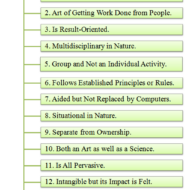
Nature and Characteristics of Management Some good definitions on Management: According to Harold Koontz, “Management is the art of getting things done through and with people in formally organised groups.”- in his book “The Management Theory Jungle”. According to Henri Fayol, “To manage is to forecast and to plan, to organise, to command, to co-ordinate and to control.”- in his book “Industrial and General Administration”. According to Peter Drucker, “Management is a multi-purpose organ that manages business and manages managers and manages workers and work.”- in his book “The Principles of Management”. According to Mary Parker Follet, “Management is the art of getting things done through people.” According to William F.Glueck, Management is the effective utilization of human and material resources to achieve the enterprise objective. Concepts of Management: Management as an Activity Leader is the Manager Team consist of the Subordinates Synergy – Leads to enhanced performance The activities of management are: Interpersonal activities Decisional activities Informative activities Management as a Process Management is a continuous process involving interaction of people and integration of human, physical and financial resources. Management as an Economic Resource Management is an important factor of production like Land Labor and Capital Management as a Team The team comprises of Top level management- CEO ,CHAIRMAN,PRESIDENT and the like Middle level management-Department Heads Low level management-Work force or the Employees Pic Courtesy: Charismatic Leaders Management as an Academic Discipline Getting a management degree has become the order of the day and many reputed educational institutions are coming out with a new discipline in management course every day that rewards an exciting and challenging career for the graduates. Management professionals are the need of the hour for corporate companies to manage the dynamic environment that poses very many challeneges. Management as a Group Chief executive (managing director), Departmental heads Supervisors make up the management group. Nature and Characteristics of Management 1. Management is goal-oriented: The ultimate purpose of management is to achieve certain goals over a period of time. The goals must be realistic and achievable that ensure efficient utilization of the resources and satisfy the enterprise objectives. 2. Management is universal: Where ever there is a business activity or non-business activity, management comes into the fore. Be it a small family function or a multi crore business activity, you need people and other resources to make it a success. 3. Management is an Integrative Force: Team work creates synergy and accomplishment of the firm’s objectives by the unified and co-ordinated efforts of all the individuals working for that firm. Note: 1+1=2, we all know that . Have you heard of 1+1>2 , Yes, synergy is the combined effort of all the people working as a team that leads to enhanced performance levels facilitating the completion of objectives in a short span of time. Dhirubhai Ambani was very popular for completing tasks in lightning speed. This was possible only because he had able administrators who shared the same kind of wavelength. 4. Management is a Social Process: You can become an excellent manager without becoming a good leader, but you cannot be an excellent leader without becoming a good manager. This explains it all. Management is a social process since it involves people and their inter personal relationship. A good manager succeeds in motivating , guiding and extracting work from people working under him. 5. Management is multidisciplinary: Management takes inspiration from disciplines like engineering, sociology, psychology, economics, anthropology etc. 6. Management is a continuous Process: Management is a dynamic and an on-going process. A business has to die on its own. 7. Management is Intangible: The success of management can only be measured...
Posted by Managementguru in Economics, Financial Management, Management Accounting
on Feb 14th, 2014 | Comments Off on Concept of Cost

The concept of cost along with demand and supply constitute three of the basic areas of managerial economics. Analysis of cost is essential when it comes to large-scale production, where the firm is in a position to factorize the economies of scale. For a profit-maximizing firm, the decision to add a new product is done by comparing additional revenues to additional costs associated with that project. Aids in Decision Making Decisions on capital investment are made by comparing rate of return on investment with the opportunity cost of the funds used to make capital acquisition. Costs are equally important in non-profit sector. For example, to obtain funding for a new dam, a government agency has to demonstrate that the value of the benefits of the dam like flood control and water supply, will exceed the cost of the project. It is necessary that we define the term ‘cost’ for better understanding. The traditional definition tends to focus on the explicit and historical dimensions of cost. In contrast, the economic approach to cost emphasizes opportunity cost rather than historical and includes both explicit and implicit costs. Opportunity Cost Opportunity costs are fundamental costs in economics, and are used in computing cost benefit analysis of a project. Such costs, however, are not recorded in the account books but are recognized in decision making by computing the cash outlays and their resulting profit or loss. Opportunity cost is the minimum price that would be necessary to retain a factor-service in it’s given use. It is also defined as the cost of sacrificed alternatives. For instance, a person chooses to forgo his present lucrative job which offers him Rs.50000 per month, and organizes his own business. The opportunity lost (earning Rs. 50,000) will be the opportunity cost of running his own business. Fixed and Variable Cost: A company’s total cost is composed of its total fixed costs and its total variable costs combined. Variable costs vary with the amount produced. Fixed costs remain the same, no matter how much output a company produces. Semi-variable is the type of costs, which have the characteristics of both fixed costs and variable costs. Fixed costs and variable costs comprise total cost. Total cost is a determinant of a company’s profits which is calculated as: Profits = Sales – Total Costs. The cost which remains same, regardless of the volume produced, is known as fixed cost. A variable cost is a corporate expense that changes in proportion with production output. Variable costs increase or decrease depending on a company’s production volume; they rise as production increases and fall as production...
Posted by Managementguru in Economics, Financial Management, Sales
on Feb 14th, 2014 | 0 comments

Demand and Supply in Different Markets Demand Criteria Since the analysis of a business firm is central to managerial economics, we are primarily interested in the demand for a commodity faced by a firm. The demand for a commodity faced by a firm depends on the size of the market, industry demand for the commodity, the form in which the market is organized and the number of firms in the industry vying for the same set of resources and customers. Demand Curve The market demand curve for a commodity shows the various quantities of the commodity demanded in the market per time period at various alternative prices of the commodity, while holding everything else constant. The curve is negatively sloped, indicating that price and quantity are inversely related. The things held constant in drawing a market demand curve for a product are the number of customers in the market, consumer’s income, the prices of related commodities and tastes. Types of Markets Monopoly and Perfect Competition Coming back to the form of a business firm, at one end there exist the monopolist (the sole producer of a commodity for which there are no good substitutes), and at the other end, perfect competition, where there are a large number of firms producing a homogenous product and each firm is too small to affect the price of the commodity by its own actions. In such a case, each firm is a price taker unlike the monopolist who is a price maker thanks to the product exclusivity factor. Oligopoly In oligopoly there are only a few firms in the industry producing either a homogenous or differentiated product. Since there are only a few firms, the pricing, advertising and other promotional behavior of each firm greatly affect the other firms in the industry and evoke imitation or duplication. We witness many industrial giants fighting for their market share in the respective industrial domains. Monopolistic In monopolistic competition, there are many firms selling a differentiated product. As the name implies, monopolistic competition has elements of both competition and monopoly. The monopoly element arises because each firm’s product is somewhat different from other firm’s products that facilitate the firms to have some degree of control over the price. Although we try to establish an inverse relationship between price and demand, the other side of the coin shows a different picture in that, as the income levels of a consumer is on an increasing trend, his or her purchasing power increases. Consumers tend to purchase more of most commodities like automobiles, housing, travel and so on, when the income rises. There are some goods, however of which the consumer purchases decline as income rises- for example, maize and similar cheap foods as the consumer has the power to buy goods with better quality and there is no need for a compromise. Demand is one of the most important aspects of managerial economics, since a firm would not be established or survive if a sufficient demand for its product did not exist or could not be created. A firm could have the most efficient production techniques and the most effective management, but still without a demand for its product that is sufficient to cover all production and selling costs over the long run, it simply could not survive. Demand is thus essential for the creation, survival and profitability of a...
Posted by Managementguru in Economics, Financial Management
on Feb 14th, 2014 | 0 comments
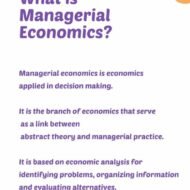
Introduction to the basic concepts of managerial economics and how it helps in managerial decision making. Managerial economics is concerned with various micro and macro-economic tools and analysis which can be used in managerial decision making to solve business problems.