Posted by Managementguru in Marketing, Social Media, Startups, Technology
on Apr 8th, 2015 | 0 comments
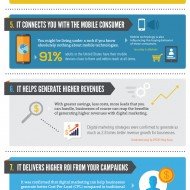
Disclaimer: This content is curated and since information related to digital marketing is available aplenty on the Internet, I thought of compiling data in a sequential and comprehensive manner for the benefit of the readers. One of the easiest, fastest and cheapest ways for businesses to reach consumers today is via the Internet. Read on: Fed Fix: What is Inbound Marketing? This resourceful article explains essential inbound marketing strategies and tactics that companies can use to boost their campaigns’ effectiveness. Digital marketing, also known as Internet or online marketing, is quickly replacing print, television and radio advertisement as the marketing approach of choice for businesses of all sizes. Recent research revealed that 1 in 4 of every business-advertising dollar is dedicated to Internet marketing. Digital marketing uses internet connected devices such as smart phones, laptops and tablets to engage customers online via technologies such as web and email in conjunction with digital customer data such as characteristics and behaviour. Channels include display advertising, search engine optimisation (SEO) and search engine marketing (SEM). It also includes email, RSS, blogging, podcasting, video streams, social networks and instant response messaging. If you are looking for an edge over your competitors, a digital marketing strategy can provide many benefits to today’s savvy business owner. Benefits of Digital Marketing for Small Business 👇 Instant Access Wide reach to internet users in a single click. Cost Effective A well planned and targeted digital marketing campaign can help your business reach your target audience at a lower cost compared to traditional marketing tactics. Open 24/7 Your website is available to your target audience 24/7. Increases Customer Retention and Loyalty Engage with your customers in a more personalised way when you advertise your products and services. Community Building and Reputation Social media provides the perfect platform to build customer loyalty and build strong online reputation. Research Provides the possibility for an immediate response and feedback from today’s connected consumer. It’s Measurable Track your online campaign’s success in real time. Digital Marketing Channels or Campaigns Online marketing doesn’t only revolve around your website. Although this is an important part of it, you should be aware of other channels that will aid your digital marketing strategy. Whether you’re looking at low budget or blow–the- budget campaigns, these forms of digital marketing are ideal for small businesses as you can adapt your activity to suit your financial situation: 👇 Discover a huge collection of digital assets on Social Media Marketing here! 1. Content Marketing Your website is a powerful tool within your marketing strategy. Most of the time this is where you will be directing your customers to when you engage with them so it’s important to ensure you have interesting content to keep your customers on the site for longer. Start by keeping an interesting blog so that you can share relevant content with your customers and draw them to your site. With new technologies, more people are reading content on their mobile phones and tablets than ever before. It’s important to ensure your website is easy to browse and interact with on these different devices so that customers can have a good user experience on the move. 2. Search Engine Marketing Stay ahead of your competitors by driving traffic to your website using Search Engine Optimisation (SEO). It works by optimising your site to increase its organic ranking in search engine results (for example how high up you would appear in a search list on Google), so that customers will be more likely to visit your site. Search engine marketing focuses on improving your ranking using specific methods such as improving your use of keywords (words and phrases...

Posted by Managementguru in Business Management, Marketing, Operations Management, Technology
on Jun 18th, 2014 | 0 comments
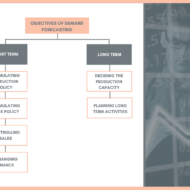
Objectives of Forecasting The objective of this post is to impart some light on the uses and importance of forecasting and to get you acquainted with various forecasting techniques. What is Forecasting? Forecasting is a technique that uses historical data as inputs to make informed estimates that are predictive in determining the direction of future trends. And also to know how these techniques are used in an organization’s decision making process. Nature of Forecast A forecast is an estimate of an event which will happen in future – be it, demand of a product, rainfall at a particular place, population of a country, or growth of a technology.It is estimated based on the past data related to a particular event and hence it is not a deterministic quantity.In any industrial enterprise, forecasting is the first level decision activity before consolidating other decision problems like, materials planning, scheduling, type of production system.Forecasting provides a basis for co-ordination of plans for activities in various units of a company.All the functional managers in any organization will base their decision on the forecast value. So, it provides vital information for that organization. Classification of Forecasts Technology forecastsEconomic forecastsDemand forecasts 1. Technology Forecast Technology is a combination of hardware and software. Hardware is any physical product while software is the know-how, technique or procedure. Technology forecast deals with certain characteristics like level of technical performance, rate of technological advances. It is a prediction of the future characteristics of useful machines, products, process, procedures or techniques. TIFAC – Technology Information Forecasting and Assessment Council is an autonomous organization set up in 1988 under the Department of Science & Technology. In 1993, TIFAC embarked upon the major task of formulating a Technology Vision for the country in various emerging technology areas. 2. Economic Forecast Government agencies and other organizations involve in collecting data and prediction of estimate on the general business environment. Economic forecast This involves the application of statistical models utilizing variables sometimes called indicators. Some of the most well-known economic indicators include inflation and interest rates, GDP growth/decline, retail sales and unemployment rates. This is used to predict future tax revenues, level of business growth, level of employment, level of inflation etc. Also, these will be useful to business circles to plan their future activities based on the level of business growth. 3. Demand Forecast This gives the expected level of demand for goods or services. This is the basic input for business planning and control. Hence, the decisions for all the functions of any corporate house are influenced by demand forecast. Factors Affecting Demand Forecast Business cycleRandom variationCustomer’s planProduct’s life cycleCompetitor’s efforts and pricesCustomer’s confidence and attitudeQualityCredit policyDesign of goods or servicesReputation for serviceSales...
Posted by Managementguru in Operations Management, Principles of Management, Technology
on May 12th, 2014 | 0 comments
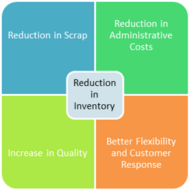
Just in Time Manufacturing Concept JIT Philosophy: With the progression in product-process technologies and the hybrid manufacturing systems, the Japanese have been perfecting a manufacturing system called ‘Just in Time’ or ‘JIT’. This JIT operating system is nothing but a production strategy that strives to improve business return on investment by reducing in-process inventory and associated carrying costs. The JIT purchasing system has emphasis on timing to supply materials just in time for use on the factory floor. Equally important emphasis is given to close and long term relationship with a few suppliers. The suppliers in JIT manufacturing are geographically closely located. Specifications: Producing and delivering finished goods ‘just in time’ to be sold Partly finished goods ‘just in time’ to be assembled into finished goods Parts ‘just in time’ to go into partly finished goods Materials ‘just in time’ to be made into parts. Loose specifications instead of rigid product specifications are used which leads to best use of supplier specialization and expertise for low cost and better quality. Frequent deliveries (daily deliveries) of small lots of exact quantities required are supplied directly to the shop floor avoiding large inventories, paper work and double inspection. The JIT system underlines the mutual confidence between buyer and supplier and long term relationship. This leads to investment by the supplier for the benefit of the buyer in terms of plant and equipment for improvement of quality, reduction of cost and shortening manufacturing lead times. Where does the responsibility lie? ‘The responsibility for the quality rests with the manufacturer of the part’ is the principle behind this Japanese practice. The primary responsibility for quality is transferred from quality control department to the production department. The quality control is considered a line function rather than staff function. The processes are designed to have less specialization on the part of workers. The physical layout is arranged in such a way that workers can operate two or three machines effectively and thereby become multifunctional. Good Quality First Time Every Time: Workers are organized in small closely linked groups thereby building team work. The production for each stage is planned in small lot sizes just meeting the needs of the subsequent stage. The system is such that even if one item produced is substandard, it would affect subsequent processes causing shortages and exposing the process or worker who has produced substandard item. This acts as a great motivator to produce good quality first time, every time. This also heightens the awareness among the workers about the inter dependence of processes. Taiichi Ohno, Father of the Toyota Production System saw this as an attribute rather than a problem. He used an analogy of lowering the water level in a river to expose the rocks to explain how reducing inventory showed where production flow was disrupted. Once bottle necks were exposed, they could be rectified or removed. Since one of the main barriers was rework, lowering inventory shoved each shop to improve its own quality. Just-in-time is a means to improving performance of the system, not an end. The result of the Japanese manufacturing system is quite pervasive in the areas of: Reduction in inventory Reduction in scrap Reduction in work Reduction in indirect costs Reduction in spare Reduction in administrative costs Increase in motivation of workers Increase in quality Better response to customers Better system flexibility and quicker response. What is kanban? Kanban is Japanese for “visual signal” or “card.” Toyota line-workers used a Kanban (i.e., an actual card) to signal steps in their manufacturing process. The system’s highly visual nature allowed teams to communicate more easily on what work needed to be done and when. It...
Posted by Managementguru in Business Management, Intellectual Property Rights, International Business, Principles of Management, Technology
on Mar 26th, 2014 | 0 comments

The Idea behind Patent Protection In product markets, the problem of imitation poses a great problem for innovators who are deprived of enjoying economic profits fully. If imitators are able to move in rapidly and capture a substantial share of the market, the initial profits earned by innovators may not be sufficient to cover their costs and risks in the long run. However, a substantial delay between the time of innovation and successive entry by competitors may provide the pioneers with decent profits and make invention and innovation a more attractive activity. The patent system, by establishing a period of time during which the firm faces reduced competition, increases the expected return for innovative effort. Product and Process Innovations: A nation by stimulating research and development can increase the prospects of product and process innovations. Governments can encourage such innovations by granting patents. Three criteria must be satisfied to obtain a patent: The invention must be new It must not have been known to the public before the inventor completed it for more than one year prior to a patent application It must be useful and must be non-obvious Picture Courtesy: Basics What are Patents? Patents confer the exclusive right to the use of an idea for a long period (which varies between nations,say,in countries like India, it is seven to fourteen years, depending on the nature of the product) within which the innovator might be able to recover his initial investment. Another reason to grant patents is to provide for widespread disclosure of new ideas and techniques. The main objective of patent protection is to encourage research and development. Patents: Encourage research and invention Induce an inventor to disclose his discoveries instead of keeping them as a secret. Offer a reward for the expenses of developing inventions to the state at which they are commercially practicable; and Provide an inducement to invest capital in new lines of production Granting of Patents: The idea behind granting of patents thus is to benefit the society. Developing countries have to offer patent protection, the lack of which has made many foreign firms shy away from investing in core sectors like pharmaceuticals and biotechnology in these nations. As a result, people of these countries are forced to buy life saving drugs like those for cancer and have to pay ruinous prices. Once patent protection is available, there is a possibility for manufacturing most of the drugs that are being imported, eventually leading to a fall in the price levels. One of the difficult aspects of patent law is the principle that, whether a patent is to be issued to the person who conceives the idea or who first files for a patent. Another international issue involving patents is that, countries allow firms to steal and copy protected ideas, due to lack of severe legal enforcements or lack of interest. Either way it proves detrimental to the interest of the patent holders and such violations have to be strictly prohibited. Note: THE PATENTS ACT, 1970: An Act to amend and consolidate the law relating to patents The Patent Amendment Act,2005 The Patent Rules,2003 and Amendment Rules,2006 are some of the laws that protect patents in...
Posted by Managementguru in Business Management, Economics, Principles of Management, Strategy, Technology
on Mar 26th, 2014 | 0 comments
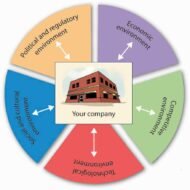
Technological Impact on Business Environment and Society The tremendous technological growth that is being witnessed is made possible through extensive programmes of technological research being conducted by many types of researchers working within universities, business, and non-profit research organizations. Technological developments are strong and all pervasive forces of the business environment. Technology is the scientific knowledge to practical problems. Technology feeds on itself and it affects business in two major ways: Through its impact on society in generalThrough its direct influence on business operations and activities. Technology and Economic Growth: Technology affects society. In fact, we feel its effect in our everyday lives. It affects economic growth, our standard of living and our culture. However, some of the effects of technology are highly beneficial and some detrimental. These effects on members of the society may in turn affect business practices. We are surrounded by so much of technology, that we take it for granted and usually do not realize how much it affects us until we have to do without electricity, water, transport or telephone. Technological developments have raised the standard of living. In spite of inflationary pressure and considerably a high degree of unemployment, generally families eat better, wear a wider variety of clothing, and live in more comfortable homes. Technology and Lifestyle: Technology also influences basic aspects of our culture, including religion, education, mobility, health care, art, language, laws and their enforcement. For example, technological advances in health care allow physicians to treat their patients in a virtual environment through video conferencing, which again is helpful in legal environment too for the judges to proceed with investigations on hard core criminals, who need not be produced before the court for security reasons. Creative Destruction: Every new technology is a force involved in creative destruction. Say, television hurts movies, synthetic fibers are considered rival for cotton fiber. The discovery of new technology even sometimes affects economic growth-TV with its high entertainment value takes away productive hours of mankind. Each new technology creates major long term consequences, which are not always foreseeable. How do you justify nations spending more money to develop missiles, nuclear weapons and bombs for the sake of security? Developing nations have to buy technology from foreign countries, as they are not resourceful in terms of capital needed for Research and Development, expertise, patents, licenses, and equipments and so on. This transfer of technology involves huge costs as a result of which a vicious circle is formed, in which weak technology creates dependence and dependence creates weakness. Conserve, Reduce, Recycle: The recent trend can be enumerated through this slogan, “Conserve, reduce and recycle”. The stress today is on clean production measures, advanced robotics, zero-emition vehicles, material recycling and alternative fuels and materials. This change towards love for environment by the technologists is a sure sign of positive...