Currently Browsing: Principles of Management
Posted by Managementguru in Human Resource, Labor Management, Organisational behaviour, Principles of Management, Training & Development
on Mar 18th, 2014 | 0 comments
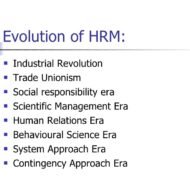
Evolution and Growth of Human Resource Management It is very interesting to trace out the evolution and growth of Human Resource Management. People – The Principal Resource The principal resource of any organization is people and managing people is the most important and challenging aspect of an organization. What we call human resource management today, dates back to 1800 b.c.,which is evident from the inscriptions of Babylonian code of Hammurabi and Kautilya’s Arthasashtra, which explains in detail the importance of selection, incentives, performance evaluation, quality of a manager and wage rates. So,we understand that the concept of managing people has existed even in the previous eras through ancient literature and philosophy. India, China and Greece have been the origin points of human resource management concepts. Evolution of Human Resource Management Industrial Revolution Till, 1930’s, there was no such department called “personnel management” that was considered necessary to cater to the needs and welfare of the labor society. The factory manager was acting as a link between the workers and the management, and most of the time he had to comply with the rules of the management to satisfy them, even if it were against the welfare of the workers. Also proper attention was not given to areas like, worker safety, security and living conditions. Industrial revolution saw mass exodus of workers to urban areas in search of jobs. Need for Employment Department Application of science and technology in production made the rich owners even richer; the poor workers were not paid adequately and their life became miserable. Since the owners lost direct contact with the employees, managers came into the picture to take over control of production and administration. Machines ruled the industry and importance of labor got reduced. This condition existed for sometime until the advent of new and improved management concepts by people like F.W.Taylor who is considered to be the father of scientific management and B.F.Goodrich who was instrumental in forming the “employment department” which can be considered the fore runner of present human resource department. Introduction of Scientific Management Scientific methods were introduced to make the workers perform the job with ease and perfection. It also saved enormous time and reduced the monotony of work. job-designs, job-specification, training and development and human relations were given due importance and the owners slowly started realizing the importance of labor. Through 1940’s to 1970’s behavioral approach was applied to professional management, the major architects being Abraham Maslow, Herzberg and Douglas McGregor. This approach suggested managers to modify their leadership styles to suit the type of followers and motivate the workers. Consequences of World War I and II World War I and II also had profound influence on Human resource development. The concepts of role playing, improved training methods, supervision and group discussions came into the fray. The advent of labor unions also established a clear pathway for the workers to claim their rights, ably supported by the labor laws enacted by various governments. International labor organization was formed in 1919 which created sensation in the worker community all over the world. All said and done, empowerment of workers has been achieved only in developed nations where “job security” is no more a great concern because job opportunities are more. But in unorganized and small sectors, employers continue to exploit workers because “supply” is more than “demand”. The responsibility to develop and empower the employees solely lies on the shoulders of human resource department. It should try to address the problems of workers to the management and amicably settle issues relating to wages, welfare, safety and security. → Objectives and Functions of...

Posted by Managementguru in Human Resource, Principles of Management, Training & Development
on Mar 18th, 2014 | 0 comments
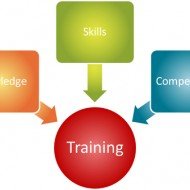
Employee Training – Train Your #Employees to Tone up their Spirit What is Training & Development: process to obtain or transfer #knowledge, #skills and abilities needed to carry out a specific activity or task. Human Resource training is not at all a complex process; with the right kind of supervisors, who impart training and their subordinates being enthusiastic about learning, it seems to be quite an easy job. But, some firms fail to achieve the desired productivity, in spite of good training programmes and availability of efficient workers. The biggest problem being, the failure to impart relevant training, by identifying and analyzing the training needs which too often is not the case. To be successful, firms have to adopt a systematic approach to training process. Training fills the gap between what someone can do and what he should be able to do. The first aim of training is to ensure that, as quickly as possible people can reach an acceptance level in their jobs. Training then builds on this foundation by enhancing skills and knowledge as required to improve performance in the present job or to develop potential for the future. Steps involved in systematic approach of training: 1) Identifying and analyzing training needs: Training should always fall in line with the #objectives of the organization to be achieved and it should be relevant to the context. Running training programmes just for the sake of running it, without defining the purpose, or sending the trainees for a workshop that has nothing to do with what the trainees really need to learn -all these are inappropriate methods of training and it makes the trainees lose their focus and direction. Another problem you will meet in the off-the job training is that, transferring the knowledge to action in the work place. If the objectives are not specified and appraised properly to the trainees, they will not be able to satisfy your expectations. So, a thorough analysis of what people need to know as trainees at different functional levels proves useful in saving much time and labor of the firm. 2) Job analysis-a basis for identification of training needs: The basis for training starts from job analysis, where the organization has to be quite prudent about its specifications and expectations well defined. The indicated specifications may be about, Knowledge -what the worker needs to know in terms of professional, technical, technological, commercial aspects. Skills-Manual, intellectual, perceptual, analytical or social which depends on the nature of the job. A top level employee needs to possess more analytical skills backed up by rational thinking, whereas a lower level employee is only expected to deliver his technical skills properly. Attitudes: The disposition to behave or to perform in accordance with the requirement of the work. This is one of the most important aspects that is neglected by most of the organizations by sheer oversight. If a customer is not properly received in a boutique shop or a restaurant, think what will be the response and reaction of the customer? If a worker does not pay due respect to his superior or boss, what are the chances of his career advancement? Whether it is a production environment or a market environment, firms must teach the trainees to conform to the guidelines regarding #attitude. 3) Prepare your training plans based on the objectives: Decide on the content of the course, as established by job and task analysis and information from performance appraisals. Decide on the training techniques, which may be, Job instruction On-the -job training Coaching Lecturing Computer based training Action learning Interactive video etc., which are a combination of on- the job and off-the job training...
Posted by Managementguru in Business Management, Human Resource, Organisational behaviour, Principles of Management, Training & Development
on Mar 18th, 2014 | 0 comments
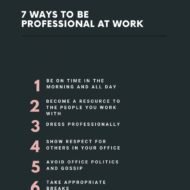
Self Appraisal-Amuse Yourself What is Self Appraisal: Self evaluation process involved in determining the level of self efficacy . By and large, corporate companies go for a one tier system of appraisal-where the supervisor generates a confidential report about his subordinates as and when required. This serves as a basis for the management to decide on increments or promotion for the respective candidate. But the question is, is this system fool proof? Definitely not. There are certain lapses that deserve mention and the management has to design suitable appraisal formats to improve or strengthen the weak areas. Purple Minimalist We Are Hiring Project Manager Poster by managementguru.net Some areas where the appraisal process can take a deviation: A biased report given by the appraiser due to various reasonsPerception of appraiser may be wrongThe appraiser sees the appraisee through his ideas and not from the management’s view point, which may lead to clash of ideas where the appraisee is made the victimFlaws in the design of the appraisal process where the top management may not come to know the real need of the appraiseeAppraisees sometimes don’t identify themselves with the organization and its objectivesAppraisees may not know what kind of behavior traits is expected of them by the management So it is imperative on the part of the management to introduce self appraisal process in its agenda, where the appraisee himself becomes the appraiser. This helps the organization to accomplish its overall objectives in a short time through a high performance system. This kind of appraisal by ‘oneself’ makes each and every employee to clearly understand where he stands against the expected scale of behavior. 7 ways to be professional at work Two-tier system as we may call it will help in the following manner: Participative approach infuses a sense of belongingness amongst the workforcePotential of the appraisee can be brought outThe real problem of the employees is knownHigher level of approach or interest to know or evaluate one’s own behavior is seen. Basically, organizations must examine their assumptions about human behavior and come to a common belief about people. If they believe people are basically “bad” management might go for hiring “watch-out-look-out” supervisors, rigid disciplinary regulations, and separate facilities such as parking, dining and rest rooms. All these clearly spell out the existence of distinction between the management and workforce. If the organization comes to a common agreement that people are basically “good”, entirely the approach will be different. Every worker becomes a manager and uniform treatment is given to both the employees and managers of higher cadre. Essentially in my opinion, no organization or work society will succeed without visionaries and uniform treatment that is consistent with basic principles and ethics. It has to be understood that work attitudes and values are ultimately a company’s best competitive advantage. Note: Larsen & Toubro – Engineering major Larsen & Toubro has developed a competency matrix which lists 73 competencies-that vary across managerial levels-to measure performance and gauge developmental needs of its employees. National Panasonic – The Japanese white-goods major has developed a performance-assessment system driven by Key Result Areas (KRAs). KRAs describe performance goals-business, functional, and behavioural ones-with defined time-frames and are decided jointly by the employee and his manager at the beginning of the...
Posted by Managementguru in Business Management, Entrepreneurship, Human Resource, Leadership, Principles of Management, Training & Development
on Mar 18th, 2014 | 0 comments
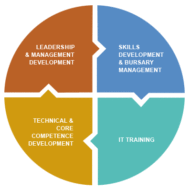
Executive Development – Options are Wide Open Who is an Executive: A person or group having administrative or managerial authority in an organization. While “executive” and “manager” and “leader” are often used interchangeably, “executive” is commonly used to signify the top 5% to 10% of the organization. Executive Development : aimed at developing the skills and competencies of those that (will) have executive positions in organisation. Capabilities of a Good Manager: A good manager can make an organization grow, survive and shine amidst tough competition, if he is bestowed with corporate competencies such as perseverance, capacity to put in hard work, sense of loyalty and responsibility, all of which may be inherited or acquired qualities. Loyalty stems from internalized morality that may be a result of his value system. Executive success is what the organizations should aim for, and firms should try to figure out the fundamental components that make up the success formula or equation. Road to Self-Development: In less developed countries, employees are more than satisfied if they are provided with a job that offers safety and security. Their thinking is restricted to mere physical and biological comforts and does not go beyond that point, where self development and self-actualization come into the picture. In developed countries, the situation is quite different, where the workers aim for empowerment and look for reasons that motivate them to do a job. Money also has its due role to play, and people whose wages are very meager cannot be expected to aim for empowerment, where their single motive is mere survival. Abraham Maslow’s Point of View: Abraham Maslow puts forward the hierarchical needs theory, arguing that, there are five levels of needs for people in general, right from physiological needs at the bottom of the pyramid and need for self actualization at the top, and safety, security and esteem needs coming in between. He points out that, once a need is satisfied, it ceases to be a motivator. This is so evident in our day to day lives, where wants and needs never cease to exist and once a want is satisfied, human mind wanders to catch hold of another. So, organizations should understand and analyze, what factors best motivate their employees, particularly their managers (who might serve as a source of inspiration to their subordinates).It should be remembered that non-availability of jobs leads to dissatisfaction whereas availability of jobs need not motivate employees. Some factors which have been proven to be real motivators are as following: Recognition Opportunities for self development Additional responsibilities(lateral expansion) Timely rewards(in terms of money and appreciation) Security Inculcating a sense of belongingness Conducive corporate atmosphere Corporate culture Good human relations Economic burden makes people less enthusiastic and anxious in developing countries and this hinders them from delivering to their fullest potential. Also the bureaucratic approach followed by conservative firms, autocratic leadership style and lack of supportive atmosphere make people work like automatons devoid of creativity. Such firms may show good results in terms of productivity initially, but in due course has to pay the price, in terms of absenteeism, high attrition rates and less efficiency. It has been proven that job satisfaction is directly proportional to efficiency. When people find a job tedious and monotonous, they tend to lose interest, which will be evident from their lack lustrous performance. Performance management has its bearing on executive success and by providing with ample scope for career advancement and autonomy; managers prove their mettle even within limited scope of resources. Acceleration of executive change implies the development of the executive mind for performing managerial activities in a better way. Note : A survey of CEOs in Fortune 500 enterprises indicated that executives spend little time with their...
Posted by Managementguru in Business Management, Human Resource, Labor Management, Organisational behaviour, Principles of Management, Strategy
on Mar 18th, 2014 | 0 comments
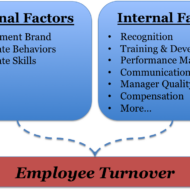
Smart Retention Strategies: Before going into the details of how to handle attrition, the first thing you must understand and realize is this. Each person working for you will have different expectations, perspectives and demands about his job, work environment and compensation respectively. Right at the time of recruiting and selecting the employee, his ideas must be taken into consideration and then it becomes the prerogative of the management whether to hire the person for that particular job. So the first step will be the right person for the right job, giving due importance to the anticipation of the employee who is going to become a member of your business family. Udemy Best Sellers:New Manager Training in Essential SkillsLeadership: Practical Leadership Skills Need for Open Conversation: In case of a small firm or company, it is easy for the manager to have a one on one conversation with each employee to settle his score of grievances then and there. Managers must have an open conversation without room for any ambiguity in the minds of his workers. The manager should try to protect the interest of the employees by representing their demands to the management at the right time. Many employees quit their positions because they have a nagging feeling at the back of their minds that their immediate boss is not the right kind of person to whom they can look up to and ask for support. In big corporates it is not easy to go for a one on one approach. A unique corporate culture that Trains the employees to have an uniform approach to all the systems of routineLed by an effective leader who controls and monitors the behavior and attitude of the workersPossesses sound management practices that make the employees come out with their suggestions freely and induce them to participateProvides satisfactory compensationIncorporates an open door policy catering to the different needs of people and also to the different levels of management, will help the managers to have a healthy relationship with the employees. Human Wants and Needs: Human wants are unlimited and when one want is satisfied, we want more of the same or yet another of a higher order. Approach your workforce to satisfy their craving either in terms of compensation or recognition which will also help to retain your workforce to a greater extent. There should be room for growth, especially for entrepreneurial minds and minds that have parallel thinking. Pic Courtesy: CuteHR Self-Motivation is the Key: Although motivation brings cheer amongst your workforce, self-motivated employees produce better results. Job satisfaction is a relative term; it differs with individuals, some like challenges and some are easily satisfied with an increase in salary quotient. A comprehensive appraisal on the personality of your workforce will give you a clear picture of the IQ (Intelligence Quotient) and EI (Emotional Intelligence) range of your employees which helps in designating employees in the appropriate slots. Such human rationing saves you a lot of time, energy and money as the employees are guaranteed satisfaction in their jobs. Contracts and Agreements: Contracts and agreements bind the employees to the firm only legally. How is that going to help you in terms of productivity? If one of your employees is going to work with discontent, he becomes a problem source spreading the same kind of feeling to others working with him. So it is also necessary for the management to spot out these problem persons either to bring them back into the groove or fire them without any further delay. Rising costs of living and unemployment ratios are really of economic concern, but still we find employees just like that quitting...