Posted by Managementguru in Business Ethics, Business Management, CSR, Economics, Organisational behaviour, Principles of Management
on Mar 15th, 2014 | 0 comments
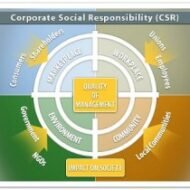
CSR – An Image or Ethos A company’s sense of responsibility towards the community and environment in which it functions is known as corporate social responsibility.The object of social responsibilities of business has become the hot topic for discussion. Let’s not forget that really big companies are into the process of service benefiting economically backward population. It is widely accepted that accountability to owners is too narrow a concept for today’s business and that there is no reason why owner’s interests should take precedence over the interest of other claimants-employees, consumer community and the society at large. Responsibilies of Business Concerns: There is no definition of the concept of social responsibility which is valid for all business concerns and for all times. This is because responsibilities of business should be related to the changing societal expectations, which is dependent upon the social, cultural, political and other environmental forces, which are dynamic too. Business responsibility to the society goes beyond simply assuming the profit-making role. It implies that the management has to protect and improve the welfare of the society as a whole along with its own interest. What is the primary objective of a business? One common misunderstanding about the concept of social responsibility has to be clarified here. It does not challenge the primary objectives of business. It does not say that “to make profit is to sin.”Profiteering is different from profit making. Selfish interest is different from self-interest. Social responsibility is against profiteering and selfish business behavior. But profit making and self interest should be the basic elements of corporate responsibilities. Economic concerns and social concerns need not be viewed as opposite ends. They are complementary to each other. They are consistent with one another. Thus the nature and content of business responsibilities depend upon societal expectations placed on organizations which include invariably the economic performances and legal obligations, and go beyond them. How far it goes beyond depends on the economic, social and political environment in which the business and society operates. Arguments against social responsibility: The arguments against social responsibility are based on the belief that the society assigns a strictly economic role to the organizations and the concept dilutes the primary purpose of the business. Business should mind its business and business persons don’t have the right attitude to serve the society. Let it be the responsibility of government and social service organizations. Business has already enough economic and social power and no more concentration of power is necessary to business circles. Service to society is undoubtedly an important objective of business. It can render service to society by providing quality goods and services to the community; it can provide adequate opportunities to the members of the society; provide goods and services at reasonable price. Another important aspect would be to ensure control of pollution towards air, water and soil. Showing concern for the well -being of other constituencies of the society is a good gesture that helps the business to earn goodwill and support of the society as a...

Posted by Managementguru in Business Ethics, Business Management, Principles of Management, Project Management, Strategy
on Mar 15th, 2014 | 0 comments
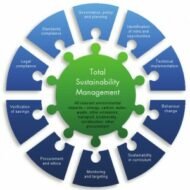
Environmental Sustainability-A Global Strategy Conservation of Environmental Resources: Corporate companies that are involved in the manufacture of electrical and electronic goods are becoming more and more concerned about the conservation of environmental resources, looking for convenient and eco friendly alternate biodegradable energy resources, thus leading to reduced energy consumption, beneficial to both the firm and society in general. “Go Green”, is the mantra that not only adds to the firm’s image but also appeals to the customers and suppliers who are associated with these firms. Disposal of E-Waste: Disposal of e-waste is one thing and recycling is another, both of which have to be handled with care. Developing countries have not evolved a proper processing system to discard or recycle the electronic waste such as scraps, obsolete devices, broken instruments etc., which can cause serious pollution problems and health hazards. The governments of all developed and developing countries enforce pollution control measures to monitor and control the quality of air, water and land. Any chemical exposure during recycling of waste can cause irreparable consequences, like the one in a nuclear reactor leak, where the harmful effects of radioactive substance stay for a long time, affecting the masses over the generations to come. The World- One Big Global Village: The revolution in the IT (information and technology) industry has made the world very small, converting it into a global village. Obviously the percentage of consumers using personal computer systems and networking systems is quite high. What happens to the electronic waste? How do people dispose it of? Do they really have the awareness or at least concern about the negative consequences and dangers of the improper disposal methods? Developed countries at least make it a point to impose fine on vendors and consumers who do not follow the federal laws on how to dispose e-waste. A general awareness is seen among the people of these nations. But, what is the condition in developing nations, where there are no strict rules laid down, that neither control the disposal of electronic goods nor ensures the health and safety standards of labor involved in such processes. Recycling Plants: Governments can encourage manufacturers who incorporate waste recycling plants as part of their production that helps in usable component recovery and facilitates cost-effective processing of electronic waste in volumes. The crux of the whole idea of recycling is to avoid the green gas emissions as a result of manufacturing products from scratch. Recycling of electronic products by dismantling them and recovering the usable components makes a great difference in conserving the energy resources, less contribution to pollution and increased efficiency utilization. Green Computing: Green computing is aimed by many of the electronic vendors where caution is exercised even right from designing the product through its production, usage, disposal and recycling, that no negative impact is created on the environment. In the modern computer era, where each and every organization employ numerous computer systems, network and communication systems, printers, storage devices for its communication and business transactions, environmental safety has to be included in the policy framework.RTGS (Real Time Gross Settlement) and Net Banking are e-tools that cannot be done with and businesses stumble if there is a hitch in these money transfer mechanisms. When we are able to appreciate the power of technology, we should also try to counterbalance its darker side through environmentally sustainable operations. Countries with high population density are supposed to exert unprecedented pressure on the environmental resources such as land, soil, air, water and forests. The government has to frame strong policies in order to arrest the degradation process. IT industry helps a nation to grow economically and at the same time should also aim at building an environmentally sustainable...
Posted by Managementguru in Business Ethics, Business Management, Entrepreneurship, Organisational behaviour, Principles of Management
on Mar 15th, 2014 | 0 comments
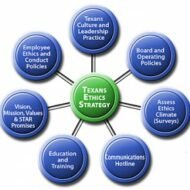
The Origin of Unethical Behavior Ethical considerations in business are important to managers as it is to individuals in their personal lives. Personal life and business life cannot be perfectly separated with respect to moral judgements. A number of factors have been established as significant in making ethical standards a primary concern of business managers. What are Values? For the individual, the job is the centre of life, and its value must be, in harmony with the rest of life, if he is to be a whole and healthy personality. In an industrial society. The values tend to become those of the entire corporate culture. The public is insisting that business leaders are, in fact, responsible for the general social welfare and that the manager’s responsibilities go far beyond those of running the business. Even if the manager insists on a narrow definition of his role as possible, it is, however, essential that he takes these intangibles into consideration since they are the real motivating force in an organization. Expectations of the Society: If an organization did not behave in accordance with the social systems and expectations, it may not merely lose its market share but face another piece of legislated control and might also lose its very right to exist. Many a times managers may be forced to compromise their personal ethics and moral values in order to achieve organizational goals. Everyday ethical decisions are usually made between the lesser of the two evils rather than obvious right and wrong. Often it may be difficult for the manager to free himself from taking a biased attitude and look at issues objectively. In spite of good intentions, he becomes involved in the situation and it becomes difficult to retreat and take a detached point of view in examining the issue from an ethical standpoint. In the light of these problems, certain examples can be cited to answer the question as to what constitutes unethical behavior. Padding expense accounts to obtain reimbursement for questionable business expense. Revealing confidential information of trade secrets. Giving or accepting gifts or favors. Using company property and/or materials for personal use. Leaving the job without abiding by the sales contract. Being severely critical of competitors. Attempting to corner opportunities by bribing public officials. Price discrimination, unfair trade practices, unfair pricing etc. , Dishonesty in fulfilling contracts. Politics inside the organization. Unless and until the professional manager puts the interest of the organization in front of his own, places the duty to the society above his duty to the organization wholeheartedly, there is no point in talking about ethics in theory. Though a number of firms spend their time, money and energy in formulating statements, in reality their enthusiasm is lost in practice. The gap between the espoused and practiced values creates a dissonance in the minds of the people, and as a result in the...
Posted by Managementguru in Business Ethics, Business Management, CSR, Entrepreneurship, Principles of Management
on Mar 15th, 2014 | 0 comments
![Code of Ethics]()
Institutionalize Your Code of Ethics Business Ethics is a term we often come across in the world of corporate business. Ethics generally distinguishes between the right and the wrong. But you might argue, what is right for one person may not be for the other. “True! But there are certain principles that are widely accepted by everyone that guides the behavior of individuals or a business enterprise. Shall we say that Business Ethics is an UNWRITTEN CODE OF CONDUCT which governs the conduct of a business enterprise and also helps it in reaching the right decision? CSR CORPORATE SOCIAL RESPONSIBILITY comes into the big picture when you talk about business or professional ethics. When a person gears up himself to start a business, he studies the market as to how supportive it would be to carry on his business. He segments the market, evaluates the demography, approaches financial institutions like banks for loans, creates a big cacophony about the government’s red tapism to acquire licenses to do his business and when all these criteria accords a green signal he ventures into the market with a confidence that is backed up by all the above factors. Say by the end of the first year, he has done great business and the time has come for income tax or sales tax payments, a small voice cuckoos from within, asking him to think twice or to venture the possibilities of EVADING TAX. Once he tastes the essence of success and the POWER OF MONEY he deviates from the RIGHT CONDUCT and BEHAVIOR. He conveniently abstains himself from performing his duties towards customers, employees, government, share holders, stake holders and others. Mind you, being ethical is a statutory phenomenon and not a thing to be taken for granted. If your motivation and effort is oriented only TOWARDS PROFIT, thriving longer in the market will become a matter of concern. Every action has an equal and opposite reaction: “Whatever is that you take, you have to repay.”This is applicable both in personal life as well in business. Yogis’ have ascertained the fact time and again that you have to dissolve your karma or past actions to be a liberated soul. Neo world scientists also second this thought,” every action has an equal and opposite reaction. “Being ethical is not that demanding or tough as you have conceived it to be. In simpler terms, it even teaches you to be highly compassionate towards your fellowmen. Various aspects affecting ethical behavior in a business organization would be: Policies regarding moral duty and obligation Accounting ethics Corporate culture Ethics in management development programmes Dealing with “gray areas” Disciplinary procedures Review and updating the ethical code Increased concern about the well informed public Government regulations Value based management practices Enlightening the managers of top cadre Rewards and recognitions for people with right conduct and the list goes on and on. Corruptions, Bribery, Black marketing are some of the JARGONS that are strictly prohibited words and actions in the dictionary of ethics. Sound ethical practices not only create an IMAGE for your company, but also the recognition among your own employees that you could relish. Being ethical is not that difficult, only that it calls for undeterred determination and inbuilt...
Posted by Managementguru in Business Management, Entrepreneurship, Human Resource, Leadership, Principles of Management
on Mar 13th, 2014 | 0 comments
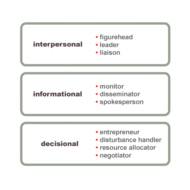
Research on Managerial Roles by Henry Mintzberg and Peter Drucker Henry Mintzberg, the canadian academic observed a few managers and analysed their behaviors and arrived at some conclusions which are listed in the table below. He also identified and attributed ten managerial roles of significance in correlation with the managerial functions. S.NoManagement Functions% of time spent1.Relating to external environment1.82.Planning and setting Objectives19.53.Decision-making6.04.Organising15.05.Leadership and inter-personal role28.46.Communication12.67.Control12.78.Staffing4.1 This table very clearly explains the role of a manager as a leader and the extent of influence he exerts on his sub-ordinates. Proper planning and goal-setting are the key contributors for the successful functioning of a firm. LEADER VS. MANAGER Coming to the managerial roles they can be classified as, 1. Interpersonal roles 2. Informational roles 3. Decisional roles Inter-Personal Roles: Figurehead role– The function is more of a ceremonial nature, like attending the family functions of employees, greeting visitors and a manager performs the symbolic duties of a head of the organization.Leader– He has to plan the HR requirements and motivates the staff to perform well. “Managers are people who do things right; leaders are people who do the right thing.” Remember a manager has to be a leader whereas it is not so in the case of a leader.Liaison– The manager acts as a link between the organization and the external environment to build image and rapport. Informational Roles: Monitor– The manager has to update himself with the current scenario in order to utilize the information for organizing and prompt decision-making.Disseminator– The manager has to communicate and distribute information to his subordinates to effectively accomplish the enterprise objectives.Spokesperson– Efficiently has to communicate the company’s policies to prospective clients and others. Decisional Roles: Entrepreneur– He has to be innovative by adapting to the changes in the environment. He has to be adventurous, persistent and strategic during tough times.Disturbance handler– He has to find appropriate solutions to problemsResource allocator– He has to apportion and allocate resources properly besides delegating authority to the work forceNegotiator– He has to negotiate resources outside and conflicts inside the organization. MANAGERIAL DIMENSIONS Managing: Science or Art? One perspective is Managing, like all other disciplines- whether medicine, music composing or even cricket is an art. It is “know-how.” Still managers can use the organized knowledge about management to perform better. So let us put it this way, Managing as practice is an art; the organized knowledge underlying the practice may be referred to as a science. Let them be complementary to each other and be present in peaceful co-existence. Drucker “ON MANAGERIAL FUNCTIONS ” – A manager has to look after The specific purpose and mission of a firmIncrease productivity by making the employees more productiveConsiderate about social impacts and social responsibilities In his view, the areas a manager has to focus and concentrate are 1. Market standing 2. Innovation 3. Productivity 4. Financial and Physical resources 5. Profitability 6. Manager performance and development 7. Worker performance and attitude 8. Public responsibility He says that business has only two functions- marketing and innovation. While others were concentrating on products and commodities, he concentrated on people and their performance. His “management by objectives- MBO ” became a very popular concept though it faced criticism. MBO according to Drucker is a philosophy that rests on a concept of human action, behaviour and motivation. It sets personal goals (both shortterm and longterm) to be achieved by each individual working for the organization and coverts them into challenges to be accomplished, thus motivating the individuals. The Effective Manager The effective manager is a situational manager who evaluates each approach in the light of circumstances and selects the one that most effectively and efficiently achieve individual...