Currently Browsing: Principles of Management
Posted by Managementguru in Business Management, Human Resource, Organisational behaviour, Principles of Management
on Mar 13th, 2014 | 0 comments
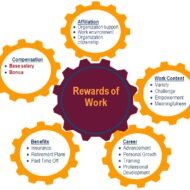
Operative Functions of HRM Staffing Staffing is one of the managerial functions. But this function is normally performed by the HR managers for all the departments of the firm. In most organizations, the HR department establishes personnel policies and coordinates the HR functions of all the departments. This function is also called the operative function or HRM function. It includes, amongst others, the processes of hiring, training, compensating, appraising and retaining employees, and attending to their labour relations, health and safety, and equality concerns. Procurement Procurement refers to a string of activities undertaken by the HR managers for filling the present and future vacancies of the organization. The activities include job analysis and designing, HR planning, recruitment and, finally, the selection of suitable employees. Here, job analysis refers to both the determination of specific tasks and responsibilities connected to a job and identifying the skills, knowledge and abilities required for the job holder. HR planning involves choosing and placing the right person at the right job and at the right time. Recruitment involves gathering a pool of applicants from which suitable employees may be selected. Lastly, selection involves screening, testing, interviewing and hiring the most suitable employees for the organization. SCOPE AND CHARACTERISTICS OF HRM Development Development here refers to both employees’ training and management development. HR managers are accountable for conducting and supervising training and development programmes for employees. The very purpose of a training and development programme is to increase the employees’ competencies in their job by improving their knowledge, skills and abilities. Training and development is widely accepted as a method for enhancing the employee skills, increasing the individual and organizational performance, improving the employee morale, and achieving the business growth and success. Compensation Compensation refers to the determination of the pay scale and other benefits for the employees. Establishing and maintaining the pay system of an organization is one of the principal jobs of the HR managers. They must devise ways to ensure fair and equitable pay rates. In addition, HR managers should regularly manage the performance evaluation system of the organization, and continuously design reward systems such as performance-linked incentive plans and bonus and flexible work schedules. Maintenance The maintenance function aims at retaining efficient and experienced employees in the organization. This calls for creativeHR practices. In this regard, HR managers are responsible for offering a wide range of HR programmes covering occupational safety, health promotion and physical fitness, canteen facilities, recreation activities, transportation programmes, employee suggestion schemes, career counselling and growth for creating a positive work environment. OBJECTIVES AND FUNCTIONS OF HRM Integration It consists mainly of industrial relations and aims at ensuring good relations between the management and the employees. HR managers have to implement industrial relations programmes that would ensure ethical and fair treatment in disciplinary action, grievance redressal, and career management processes. They should also counsel the employees and the management to prevent and, when necessary, resolve disputes over labour agreements or other labour relation issues. It is to be understood here that the functions of HRM can vary widely from one organization to another, depending upon its nature, size, and objectives. For instance, a smaller organization may follow a shorter HRM process with a greater emphasis on functions like procurement and compensation and little or no priority for activities like training and development and industrial relations maintenance. On the contrary, large organizations may pursue a longer and more comprehensive HRM process to meet the requirements of both the management and the workforce. WANNA TAKE A HR QUIZ N CHECK YOUR HR IQ? 1. The development and application of employees’ skills and energies to accomplish the goals and objectives of the...

Posted by Managementguru in Business Management, Human Resource, Organisational behaviour, Principles of Management
on Mar 13th, 2014 | 0 comments
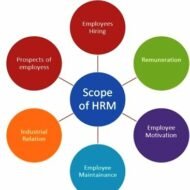
Scope and Characteristics of HRM 1. Personnel aspect: concerned with manpower planning, recruitment, selection, placement, transfer, promotion, training and development, lay off and retrenchment, remuneration, incentives, productivity, etc.; 2. Welfare aspect; dealing with working conditions and provision of amenities such as canteens, crèches, rest and lunch rooms, housing, transport, medical assistance, education, health, safety, recreation facilities, etc.; and 3. Industrial Relations aspect: the legal part which covers union-management relations, joint consultation, collective bargaining, grievance redress and disciplinary procedures, settlement of disputes, etc. Small Business Management and Marketing Essentials CHARACTERISTICS OF HUMAN RESOURCE MANAGEMENT: 1. It is an art and a science: The art and science of HRM is indeed very complex. HRM is both the art of managing people by recourse to creative and innovative approaches; it is a science as well because of the precision and demanding application of theory that is required. 2. It is pervasive: Development of HRM covers all levels and all categories of people, and management and operational staff. No discrimination is made between any levels or categories. All those who are managers have to perform HRM. It is pervasive also because it is required in every department of the organisation. All kinds of organisations, profit or non-profit making, have to follow HRM. 3. It is a continuous process: First, it is a process as there are number of functions to be performed in a series, beginning with human resource planning to recruitment to selection, to training to performance appraisal. To be specific, the HRM process includes acquisition (HR planning, recruitment, selection, placement, socialisation), development (training and development, and career development), utilisation (job design, motivation, performance appraisal and reward management), and maintenance (labour relations, employee discipline, grievance handling, welfare, and termination). Second, it is continuous, because HRM is a never-ending process. 4. HRM is a service function: HRM is not a profit centre. It serves all other functional departments. But the basic responsibility always lies with the line managers. HRM is a staff function – a facilitator. The HR Manager has line authority only within his own department, but has staff authority as far as other departments are concerned. 5. HRM must be regulation-friendly: The HRM function has to be discharged in a manner that legal dictates are not violated. Equal opportunity and equal pay for all, inclusion of communities in employment, inclusion of tribal’s and farmers in the benefits and non-violation of human rights must be taken care of by the HRM. 6. Interdisciplinary and fast changing: It is encompassing welfare, manpower, personnel management, and keeps close association with employee and industrial relations. It is multi- disciplinary activity utilising knowledge and inputs from psychology, sociology, economics, etc. It is changing itself in accordance with the changing environment. It has travelled from exploitation of workers to treating them as equal partners in the task. 7. Focus on results: HRM is performance oriented. It has its focus on results, rather than on rules. It encourages people to give their 100%. It tries to secure the best from people by winning the whole hearted cooperation. It is a process of bringing people and organization together so that the goals of each are met. It is commitment oriented. 8. People-centred: HRM is about people at work both as individuals and a group. It tries to help employees to develop their potential fully. It comprises people-related functions like hiring, training and development, performance appraisal, working environment, etc. HRM has the responsibility of building human capital. People are vital for achieving organizational goals. Organizational performance depends on the quality of people and employees. 9. Human relations philosophy: HRM is a philosophy and the basic assumption is that employees are human beings and not a factor of production like...
Posted by Managementguru in Business Ethics, Business Management, CSR, Human Resource, Principles of Management
on Mar 12th, 2014 | 0 comments
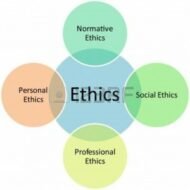
What is the relationship between Corporate Social Responsibility and Business Ethics Business ethics can be defined as the principles and standards that establish acceptable conduct in business organizations. The acceptability of behaviour in business is determined by customers, competitors, government regulators, interest groups, and the public, as well as each individual’s personal moral principles and values. Can Ethics be Taught? I feel that ethics cannot be taught: it is an inbuilt entity and in countries like India where religion is all pervasive in business or any other discipline, this quality is imbibed in every individual right from his birth. The power of money and authority plays a major role in changing a man’s perspective and bureaucratic hurdles and red tapism mar the pace of business development. Businessmen should never compromise ethical principles with short-sighted objectives of amassing material wealth but should develop a spirit of altruism. Management education should focus also on training the individuals to be ethic-savvy apart from being mere decision making authorities satisfied with their designation and power of authority. Employees have the same kind of ethical responsibility towards their organisation and should not misuse time and property and should not place their interests before the enterprise objectives. What is Corporate Social Responsibility? Many consumers and social advocates reckon that businesses should not only make a profit but also consider the social implications of their activities. We define social responsibility as a business’s obligation to maximize its positive impact and minimize its negative impact on society. Although many people use the terms social responsibility and ethics interchangeably, they do not mean the same thing. Business ethics relates to an individual’s or a work group’s decisions that society evaluates as right or wrong, whereas social responsibility is a broader concept that concerns the impact of the entire business’s activities on society. There are good business reasons for a strong commitment to ethical values: 1. Ethical companies have been shown to be more profitable. 2. Making ethical choices results in lower stress for corporate managers and other employees. 3. Our reputation, good or bad, endures. 4. Ethical behaviour enhances leadership. 5. The alternative to voluntary ethical behaviour is demanding and costly regulation. Points to Ponder relating to behavioral ethics. 1. What conflicts of interest have you personally experienced in personal or professional roles? 2. If you perceive a potential conflict for yourself, what are some ways you might ensure that this conflict doesn’t lead to unethical behavior for you and others? 3. When have others’ conflicts of interest impacted how you or those you know were treated? 4. What types of policies can or do organizations implement to try to reduce conflicts of interest or their costs? 5. Why do you believe conflicts of interest are so pervasive in society? Why don’t we take more steps to avoid them? 6. Why is it so hard for individuals to recognize their own conflicts of interest, and how is this impacted by behavioral biases? Unethical behavior,conflicts,personal interests,responsibility What is Conflict of Interest? Conflict of interest arises when there is a clash between responsibility and reward. Say, if a doctor decides to be more business-like, if a judge decides to favor one party, if a ruling party favors a decision not good for the masses, what will happen? A conflict of interest exists when a person must choose whether to advance his or her own personal interests or those of others. Wal-Mart Stores, Inc., may have the toughest policy against conflict of interest in the retail industry. Sam Walton, the late founder of Wal-Mart, disallowed company buyers from accepting so much as a cup of coffee from suppliers. The Wal-Mart policy is black...
Posted by Managementguru in Business Ethics, Business Management, Human Resource, Principles of Management
on Mar 12th, 2014 | 0 comments
The Need for Business Ethics Every individual should be guided by certain code of conduct. Ethics deal with personal conduct and moral duty and concerns human relations with respect to right and wrong. In business, ethics is doubly important and the society expects the businessmen to act ethically. Business ethics adds to the image of the company and develops a sense of trust in the minds of people and a long lasting relationship that is to stay. If the businessmen act ethically there is no need for legal rules and regulations that govern the code of conduct. Most of today’s businessmen want to make a fast buck and does not have business ethics. Benefits of Business Ethics 1. Creates Credibility 2. Helps in ethical decision making 3. Enhances quality of living 4. Corresponds to basic human needs Business ethics is primarily concerned with the relationship of business goals and techniques to specifically human ends. It is a dynamic philosophy of socio-economic adjustments whose field is widening day by day. Pic Courtesy: Asuccessfulcareer Definition of Business Ethics: Typical definitions refer to the “rightness or wrongness of behavior, but not everyone agrees on what is morally right or wrong, good or bad, ethical or unethical.” “Application of general principles of ethic customary in a society to the areas where business operates.” In the words of T.M.Garrett, “business ethics is a study of moral rightness and wrongness of the acts involved in the production, distribution and exchange of economic goods and services.” Elements of Business Ethics: · It should be above business interests-no harm should be done to the society · It is more of a code of business behavior · It has responsibilities as roots and outcome as fruits · It is guided not by sentiments and emotions but by definite tenets · It has to be followed by one’s own will and cannot be enforced upon · It cultivates high sense of honesty, general welfare, justice and responsibility in the minds of businessmen · It emphasizes the importance of self discipline over external control by legislation. The businessmen should not make false promises which destroy the fair image of the business. Principles of Business Ethics: · Do not sell substandard or defective products or stick to under measurement · Do not resort to hoarding, black-marketing or profiteering · Do not destroy or distort competition · Ensure accuracy and sincerity in advertising, labeling and packaging · Do not tarnish the image of competitors by unfair practices · Make accurate business records available to all authorized persons · Pay proper taxes and satisfy other obligations · Do not form cartel agreements to control production, price etc. to the common determinant · Refrain from secret kick backs or pay-offs to customers, suppliers, administrators, politicians etc., · Ensure payment of fair wages to and fair treatment of employees · Fulfill honestly all responsibilities towards the organization. Owners, employees, consumers, suppliers, government and society at large. The most common unethical practices being followed would be: 1. Adulteration 2. Spurious products 3. Duplicates 4. Injurious products 5. Defective Advertisements 6. Low salaries 7. Poor working Conditions 8. Exploitation- Sexual harassment and bullying, use of child labor 9. Financial misconduct-Employees being made to sign for more than actually paid for 10. Tax evasion- Improper records or bogus records to show hiked up profit in the p&l 11. Pollution 12. Bribes and circulation of money to buy political support- The notoriously popular 2G...
Posted by Managementguru in Business Ethics, Business Management, Decision Making, Principles of Management, Strategy
on Mar 11th, 2014 | 0 comments
Spirituality and Management The purpose of correlating spirituality and management might present a weird picture to some. Research of the old Hindu scriptures, epics and Vedas disclose the secrets of management etiquettes coated with spiritual sugar which serves as a road map for us to cherish and follow. As an ardent follower of the BHAGAVAT GITA, THE UNIVERSAL BOOK OF SPIRITUAL SCIENCE, it was really amazing for me to know that the core principles of management have already been defined and dealt with that were formulated at a later date by MANAGEMENT GURUS like PETER DRUCKER, HENRY FAYOL, C. K. PRAHALAD and the like. I would like to present four qualities that struck me while I was comparing and contemplating. PERCEPTION AND UNDERSTANDING THE INNER SELF SELF MOTIVATION AND SELF TRANSCENDENCE DUTIES AND RESPONSIBILITIES LEADERSHIP The Leader and the Manager: The LEADER IS BEING FOLLOWED willingly, but a manager has to command individuals in order to adhere to his instructions. So, being a good leader starts from soul searching or understanding the nature of one’s inner self. SELF CONCEPTION gives a different dimension to approach problems. Spiritual experiences induce clarity in thinking that leads to ethical decision making. The spiritual experiences of Arjuna, one of the PANCHA PANDAVAS with LORD KRISHNA made him stronger (at will) and sharper (right perception). Decision Making: “I am the strength of those who are devoid of personal desire and attachment. O Arjuna, I am the legitimate desire in those, who are not opposed to righteousness, “says Lord Sri Krishna. At the war front, Arjuna the GREAT WARRIOR is not sure whether to fight against his own kith and kin. The inspiring words of Krishna motivated him to come out from the state of INERTIA and enter RIGHTEOUS ACTION. It is a testimony of what philosophers call the transcendence from alienation to self confidence to reach ethical decision making. One can never forego his duty or responsibility, be it his personal life or in the management arena. EFFECTIVENESS IS DOING THE RIGHT THINGS EFFICIENCY IS DOING THINGS RIGHT https://www.slideshare.net/parthacharya/management-lessons-from-mahabharata-9806655 Forming a VISION, planning the right Strategies, pooling the resources, hiring right people for the right job, setting goals and objectives, reviewing by MANAGEMENT BY OBJECTIVES, MANAGEMENT BY EXCEPTION, rewards and recognition, all have been dealt with a masterly excellence in MAHABARATHA which talks about the GURUKSHETRA WAR between the PANDAVAS and KAURAVAS or to simply put it, between THE GOOD AND THE EVIL. “The Supreme Lord is situated in everyone’s heart, O Arjuna, and is directing the wanderings of all living entities, who are seated as on a machine, made of the material energy.”Mind can make you LIBERATED OR BONDED that depends upon your WILL to master it or be a slave. Controlling your mind in turn controls your actions and thought process that leads to well augured efforts that proves fruitful to the human race. Leaders are born and not made goes the saying. But if you are able to be THE MASTER OF YOUR MIND, you are a leader made. Management Lessons from THE BHAGAVAT GITA Applicable to both western and Indian school of management, THE BHAGAVAT GITA deals with problems at the GRASS ROOT LEVEL relating to THE HUMAN PSYCHE. https://www.slideshare.net/singhm91/management-lessons-from-bhagvad-gita It enlightens us on all managerial techniques, goading us towards a serene atmosphere and state of affairs in place of the conflicts, stress, and lack of co-ordination, common in most of the enterprises world wide. “Do your duty perfectly, and the results will follow suit”, is the crux of GITA. How many of us can transform ourselves into such personalities? Can we ever overcome the desires...