Posted by Managementguru in Business Management, Human Resource, Leadership, Principles of Management
on Mar 1st, 2014 | 0 comments
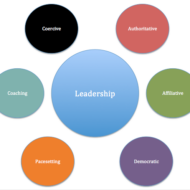
One of the key concepts of leadership is that everyone has innate leadership skills that can be ‘polished’ and developed. In excellent organizations, everyone, regardless of title or position, is encouraged to act like a leader. One of the principles of effective leadership is “to make sure that other people will be willing to follow you. Unfortunately, management education doesn’t place enough emphasis on leadership skills.” The functions of a leader can be defined as follows: 1. Taking the initiative – A leader initiates all actions necessary for the purpose of warranting the health and growth of the enterprise in a competitive economy. 2. He identifies group goals 3. He represents the organization 4. He acts as an arbitrator 5. To assign reasons for his actions 6. To interpret the objectives of organization 7. To guide and direct the organization 8. To encourage team work 9. He manages the organization Top 50 Quotes That Show the Road to Success This exemplary leadership model by kouzes and posner will give you a fair idea on how a leader should set behavioral and performance standards in an organization. Leadership Styles Every leader has his own style that can be defined as a leader‘s behavior towards group members. It refers to the pattern of behavior which a leader embraces in influencing the behavior of his subordinates in the organizational context. Different leadership styles can be categorized as follows. 1. Autocratic Leadership Autocratic leadership is also known as authoritarian, directive, leader centered or monothetic style. Under this style, leader concentrates all authority in himself, instructs a subordinate as to what to do, how to do it, when to do it etc. He also exercises close supervision and control over his subordinates. There are three categories of autocratic leaders a. Strict Autocrat – A strict autocrat believes on negative authority and gives orders which the subordinates must accept. He may also use his powers to disperse rewards to his group. b. Benevolent Autocrat – The benevolent style aids in accomplishing high productivity in many situations and he can develop effective human relationship. His motivational style is usually positive. c. Manipulative Autocrat – A manipulative autocrat leader is one who makes the subordinates feel that they are participating in decision making process even though he has already taken the decisions. 2. Participative Leadership This style is also called as democratic, consultative, group centered or ideographic style. A participative leader is one who consults and welcomes his subordinates to participate in decision making process. Under this style, subordinates are freely allowed to communicate with the leader and also with their fellow subordinates and take their own initiative. 3. Laissez Faire or Free-rein Leadership Under this style of leadership, the leader mostly depends upon the group and its members to establish their own goals and make their own decisions. The leader is passive and assumes the role of just another member in the group. Only very little control is exercised over group members. This style is also known permissive style of leadership. This style is appropriate only in certain situations where the manager can leave a choice to his groups. A leader is supposed to possess these discretionary skills required at different times and during interaction with different people… Qualities of a successful leader The following are the major innate qualities in a successful leader. 1. Physical features like height, weight, health and appearance 2. Intelligence 3. Emotional stability 4. Human relations 5. Empathy 6. Objectivity 7. Motivating skills 8. Technical skills 9. Communicative skills 10. Social...

Posted by Managementguru in Organisational behaviour, Principles of Management
on Mar 1st, 2014 | 0 comments
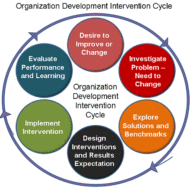
Organizational Development Training and development is an important aspect of human resource development. However the traditional methods and approach of T&D has its own limitations in that the focus is on individual development and behavior modification. This has seldom produced organizational development and hence in 1960’s an integrated approach called the ‘OD’ or organizational development was developed. Meaning and definition of organizational development (o.d.) “A process used to enhance both the effectiveness of an organization and the well being of its members through planned interventions.” OD is the systematic application of behavioral science knowledge for the purpose of improving productivity, efficiency, effectiveness and overall health of the total organization. The applied interventions attempt to modify the beliefs, assumptions, values, attitudes and standards of both the individuals and groups thereby transforming the organizational culture for the betterment of system as a whole. FEATURES OF ORGANIZATIONAL DEVELOPMENT: HUMANISM: The focus is on the employees, their attitude and inter-personal relationships. An organization is a network of people whose emotions, outlook and cohesiveness are more important than monetary and other physical aspects because it is they who take the organization to the next higher level. This is made possible by open communication, free and frank discussions of problems with employees by the managers, inter-personal trust and above all, sense of belongingness, comradeship and team spirit. PROBLEM-SOLVING NATURE: The purpose of an OD intervention is to solve a problem. The employees themselves are given the opportunity to identify the problem by Survey Feedback and find a suitable solution through analysis. This is a cyclic process and also called as “Action Research”. SYSTEMS APPROACH: OD is concerned with not the structure or persons per se, but with the interplay of structure and persons. LEARNING THROUGH PARTICIPATION: The participants of the learning process are none other than the employees. They unlearn old things and learn new things by identifying, analyzing and finding the right solution to the bottlenecks. TOP MANAGEMENT SUPPORT AND INVOLVEMENT: OD intervention is successful only when top management involvement is full-fledged and ensures participation from all levels of managers and all departments in such an exercise. MULTIPLE INTERVENTIONS: Intervention takes place at various levels, individual as well as group and the purpose is molding desirable work culture and leadership styles suitable for the organization. ROLE OF CONSULTANT: Employing an external consultant will be more appropriate as he is less susceptible to influences and more objective. He acts as the change agent facilitating co-ordination and stimulation. CONTINGENCY PLANS: Alternate plans are also devised if in case the original plan fails; the idea is one that of trial and error, hence the need for contingency plans and approach to OD problem. RENSIS LIKERT’S OD FRAMEWORK: Rensis Likert’s 4 system OD framework aims at moving towards truly participative system. Care and caution must be adhered to steer the system gradually from where the organization now works. He also introduced diagnostic analysis to find what causes the current problem. His three part diagnostic analysis includes: A. OUTPUT CAUSES: Low productivity, absenteeism, declining profit B. INTERVENING CAUSES: Organization structure, control, policy and leadership C. ROOT CAUSES: Attitude, motivation level, empowerment and organization culture Tips for Organization Development OD CULTURE: “The OD paradigm values human and organizational growth, collaborative and participative processes and a spirit of enquiry.” Brown and Covey have made some attempts to identify OD values from the following: Norms and Values: Respect for people: People are the most important of all resources. So giving due respect and importance to people induces the creativity and innovation in them. Trust and Support: Trust, openness and supportive climate improve organization culture and empowerment. Power Equalization: This emphasizes hierarchical authority, control and centralization. Confrontation: Do not...
Posted by Managementguru in Organisational behaviour, Principles of Management
on Mar 1st, 2014 | 0 comments
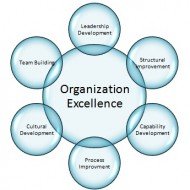
Organisational development is not an overnight transformation; it is indeed a gradual process that has to be implemented systematically and in tandem with the external environment. Listed here are some of the relevant organizational development techiniques or interventions that help employees to become more productive. A. Sensitivity Training The notion is to change the attitude and behaviour of individuals involved in the group rather than the technical skill or knowledge. The term sensitivity refers to the psychological aspect of human mind that has to be shaped to act in accordance with the expectations of the group. One’s own weakness is exposed and members understand how others react towards them. Stress is on Group Dynamics and tackling inter-relationship problems. The idea is to improve the behaviour of people in order to maintain smooth inter-personal relationship without anybody’s power or influence. Members are encouraged to have an open, heart to heart talk to develop mature relationship. Employee Engagement & Retention The Process: Sensitivity group is a small discussion group without any leader. The trainer raises a question and allows the members to proceed with the discussion, the focus being feelings and mutual respect. There is no set task or agenda and members try to analyse the immediate problem by having open discussion instead of applying logic and rationale. Free and frank discussions lead the members through periods of shock, anger, frustration, hostility, all for the better understanding of one another. Improve People Management and Build Employee Engagement Feedback includes videotape of the proceedings and guidance from the trainers. Members unlearn old things through shock and change the present behaviour to improve their behaviour pattern. Individual emotions and inter-relationship pattern are primarily focused upon in sensitivity training. Sensitivity training borders on psychotherapy where the emotions as well as body language are taken into consideration. The expressions may be any one of the following: 1. Gestures 2. Screaming 3. Physical contact B. Survey Feedback Here the discrepancies among a group are weeded out using questionnaires, which identify the difference in perceptions amongst the same working family, group or department. The data collected is tabulated and distributed for taking part in the deliberations. This forms the basis for further discussions. Discrepancies if any can be sorted out by open discussions with all concerned, defending and opposing till a consensus is arrived at. Here the focus is on ideas and not on persons who put up those ideas. C. Process Consultation A firm may either seek the support of 1. Expert from within the organisation: Though he might be knowing the crux of the problem, his emotional involvement might block him from seeing the problem in the right perspective. Moreover the outcome of the result might be a ‘biased one’ due to internal politics. 2. An outside expert: This person with his vast knowledge, experience and similar problem encounters may have the know-how of resolving the problem but may lack the necessary insight of that particular problem. The organisation must see to that process consultation is done through an external expert with the needed support provided by the authorities from within the organisation. D. Team Building Team building is attempted at the group or inter-group level. The objective is to improve co-ordination thereby improving the performance as a group. 1. Goal setting 2. Development of inter-personal relations 3. Role analysis to identify roles and responsibilities 4. Team process analysis are the key features of team building. E. Inter Group Development One of the major challenges for firms involved in development is tackling inter departmental conflicts. Such dysfunctional conflicts may exist between a. Line and staff b. Production and materials c. Finance and production What is Group Dynamics? As sensitivity...
Posted by Managementguru in Financial Management, Principles of Management
on Feb 28th, 2014 | 0 comments
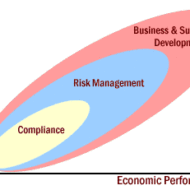
There is no Business Success Without Risk What is the Risk of Taking a Chance in a Business Activity? Business is often viewed as a game or a gamble in which success is always at risk. Think about it, risk is present in every sphere and aspect of our lives and even when you are not running a business. So why the fuss? A thorough knowledge and research of the business activity you are about to perform will give you the needed confidence to go about it. A true business man is an entrepreneur who treats risk as an opportunity rather than a challenge. Business organizations are started with a single purpose, to make profit and then more profit. Only when the organizations grow, there comes the awareness and necessity to think about stakeholders’ interest and working towards a social cause. Initial stages definitely pose threats for the very survival of the organization. Risk is an inherent part of a business as you are not sure about the outcome of your business activity. What are the Chances or Probability? We talk more about probability and chance outcomes when you deal with a particular product. Retail segment is one area where the risk of duplication is high and people have to be cautious and careful in order to protect their copyrights and symbols from being replicated. Mild inflations can benefit the market but recessions put you in doldrums especially if you are dependent on a wholesaler or a manufacturer. Risk can aspect itself in the following ways: Economically- Attrition and effects of global economy Legally- Labor laws and enactments Socially- Expectations from the public in general Government rules and regulations- Government policies and export duties Stakeholder expectations- Wealth maximization and assured profits Environmental – Need to comply with changing standards like waste affluent treatment plants Political scenario- Effects due to changing governments Risk and Uncertainty Risk and uncertainty go hand in hand and you need a risk management template or a model for your reference to solve or manage risks. The first and foremost step would be to identify the risks in your sphere of business activity. Risk documentation or creating a risk profile is an inevitable move for a new organization. This prepares the organization mentally to face challenges in a structured manner and reduces disorientation. It is very important to keep in mind the organisation’s objectives while documenting the risk profile to keep your focus unaltered. Risks evolve continuously and it is the responsibility of the top management to be in line with the market economy to manage the adverse conditions that come in the way. How to Manage Risks? Risk management is an ongoing and continuous process and it cannot be looked upon as a distinct area to be managed by a set of individuals. In a small and upcoming organization the responsibility lies on the shoulders of each and every individual to self assess, evaluate and manage risks and find the right kind of solution that will not be detrimental to the core objectives of the organization. Bigger organizations can afford to have expert opinion by commissioning PROFESSIONALS to identify, assess and manage risks. An overall and broad perspective of risk is what has been analysed here. There are numerous possibilities of risks, whether big or small in magnitude, affecting an organization. A thorough study of the field you are about to venture into, the pros and cons of the business activity, time of launch are few things that will help you to analyse what the market niche warrants for and act accordingly. In further segments, let us look into the factors of risk, identifying and...
Posted by Managementguru in Business Management, Financial Management, Principles of Management, Project Management
on Feb 28th, 2014 | 0 comments
What is Business Risk? It is a term that explains the difference between the expectation of return on investment and actual realization. In CAPITAL BUDGETING, several alternatives of investments are examined before taking an investment decision and only then the Managing Director of the firm along with financial executives gear up for investing in a project that is sound and feasible. Even then the project may not become viable owing to the fluctuations in the economic environment. Money Manipulation So, the million dollar question arises, whether to invest and if invested, will it fetch me profit? See, you cannot have the cake and eat it too. Risk factor prevails in all kinds of environment and we try to over react in a business arena since it involves huge investments. But remember, MONEY WILL MULTIPLY IF YOU MANIPULATE IT WITH CARE. Business firms commit large sums of money each year for capital expenditure. It is therefore essential that a careful FINANCIAL APPRAISAL of each and every project which involves large investments is carried out before acceptance or execution of the project. These capital budgeting decisions generally fall under the consideration of highest level of management. Factors of risk to be considered before investing: Time value of money Pay back period Rate of return on investment(ROI) Uncertainties in the market Cost of debt Cost of equity Cost of retained earnings Factors to be monitored after investing: Maximising profit after taxes Maximizing earnings per share Maintaining the share prices Issue of dividends Ensuring management control Financial structuring Cost of capital refers to the opportunity cost of the funds to the firm I. e., the return on investment to the firm had it invested these funds elsewhere. Servicing the debt and Danger of Insolvency While making the decisions regarding investment and financing, the Finance Manager seeks to achieve the right balance between risk and return. If the firm borrows heavily to finance its operations, then the surplus generated out of operations should be sufficient to “SERVICE THE DEBT” in the form of interest and principal payments. The surplus would be greatly reduced to the owners as there would be heavy Debt Servicing. If things do not work out as planned, the situation becomes worse, as the firm will not be in a position to meet its obligations and is even exposed to the “DANGER OF INSOLVENCY“. Working Capital Management Considering all these factors, we have to come to the conclusion that FINANCIAL MANAGEMENT is like the BACKBONE of a business firm and WORKING CAPITAL MANAGEMENT will be the blood flow infused into the body. Risks are inherent in a business environment whose management is quite possible with the right kind of farsightedness and planning. Luck does not favor anybody who is poor in planning and lack hard...