Posted by Managementguru in Financial Management, Principles of Management
on Feb 20th, 2014 | 0 comments
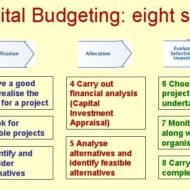
Capital Budgeting- Long Term Resource Planning What is Capital Budgeting? Capital Budgeting refers to the process of planning expenditures that give rise to revenues or returns over a number of years. The process of investment analysis is essential to have a sustainable advantage in the competitive market and to stabilize the profits through resourceful strategic business units. The firm’s management must be on the alert to explore the opportunities present in the market. Obsolete product lines and changes in consumer tastes may present additional problems to a business enterprise affecting the profitability and growth. When a firm decides to venture into projects that demand huge investments, the management has to scrutinize the economic feasibility of such projects. The process of capital investment is also crucial because the projects are for the most part irreversible. Say, for example, if a business firm purchases a special type of machinery, and after installation, if the firm reverses its decision to sell the merchandise due to some technical reasons, it will have only a very small second hand value. Business firms based on the cash flow of the project and the capital recovery period do long-term investment. Why do firms opt for capital budgeting. The reasons may be: To replace worn out equipments that will affect the production efficiency To replace obsolete equipments to install new and more efficient ones To expand production facilities in lieu of increasing demand for the firm’s products and to capture new markets To divest the surplus funds from other business units and to rotate the funds, as idle funds will not generate any revenue To develop new products Research and development Investments made to comply with government regulations, such as projects undertaken to meet government’s health and safety regulations, pollution control and to satisfy other legal requirements. People Involved The proposals for new projects come from the internal environment, such as department heads, executives, employees and of course the management. Experts in product development, marketing research, industrial engineering examine the investment proposals and they may regularly meet with the heads of other divisions in brainstorming sessions to zero in on the proposals. This free course from Udemy is Ideal for people interested in entrepreneurship, fintech, big data, startups, finance, private equity, VCs, & investing. https://www.udemy.com/crowdfund-investing-101-the-basics-of-equity-crowdfunding/ Departments Involved While the firm’s top management makes the final say or decision to undertake or not a major investment project, the process is likely to involve most of the firm’s divisions. Each department has to present its view on the feasibility and viability of the project. The marketing department- on the demand for the new or modified products that the firm plans to sell The production, engineering, personnel and purchasing departments- on the estimation and cost of the investment projects The financing department on- how the required investments funds have to be raised. Thus, the process of expenditure analysis can truly be said to integrate the operation of all the major divisions of the...

Posted by Managementguru in Business Management, Economics, International Business, Principles of Management
on Feb 16th, 2014 | 0 comments

The factors that affect the economic environment of business are listed below. Macro Environment The management of a firm is influenced and affected by many factors that exist in the external environment, also called as macro environment. These are beyond the scope of business control and affect the functioning of a business enterprise. Factors of External Environment that Affect Business These factors may present themselves in the form of opportunities or threats and it is the responsibility of a manager to identify the changes in the external environment, be it, social, economic, political, legal, technological, demographic or ecological and devise action plans accordingly, to suit the changing demands and needs of the macro environment. Buying Power of People The most important and prime factor that affects a firm’s operations and its basic survival is the economic factor. Economy of a country is prosperous only when it is self sufficient and withstands the pressure of inflation or recession. Businesses can flourish only if there is a regular demand for the products manufactured. Economic Factors that Affect Demand The buying power of people and their willingness to pay are also important economic factors that affect demand. In developing countries, people concentrate on “saving” rather than spending, where the economy is showing steady growth. For instance in India, people invest their money in gold and land,both being considered as solid appreciating disposable income,assets. Why do we turn to nonprofits, NGOs and governments to solve society’s biggest problems? Michael Porter admits he’s biased, as a business school professor, but he wants you to hear his case for letting business try to solve massive problems like climate change and access to water. Why? Because when business solves a problem, it makes a profit — which lets that solution grow. Watch the Video Disposable Income The ability of people to buy, largely depends on their employment, income tax and price of the product. The disposable income of people in developing countries is very meager and it further decreases if the rate of tax increases. Ability to Buy This also affects his or her ability to buy. If his concentration is on “saving”, again his ability to purchase is restricted. Even if the individual has the purchasing power, there is no assurance that he or she will buy, it all depends on their willingness to buy. The purchasing power parity of developing countries is very low when compared to developed countries. Role of Technology In recent times, technology also has played an enormous role in bringing an array of new products into the market, and has improved man’s preference for better products. For a business firm, it is very difficult to predict people’s preference as well as changes in their preferences. It needs a great deal of market research and regular updations. If the prices are in decreasing trend, people will not buy the product immediately; they will wait for some more time to derive maximum benefit or value out of their purchase. So, people’s perception about the market economy, social influences and changing preferences definitely affect the willingness to buy. Competitive Market Managing the competition proves to be a tougher task for each and every individual business firm. In today’s modern high flying business environment, people always expect value added services for the products purchased. Business organisations are in a position to compete for customer’s interest as well as income. Firms think of price reductions, aggressive promotional efforts, attractive offers, differentiated product offerings and customer service as competitive tools to have a sustainable and distinctive advantage over others. Offering new product designs, attractive packing, extended credit facilities, free door delivery and fast and competent repair services...
Posted by Managementguru in Business Management, Human Resource, Principles of Management
on Feb 15th, 2014 | 0 comments

It all began with ADAM SMITH (1776), the Scottish economist when he lashed out against the abuses of monopoly and mercantilism. He highlighted that productivity was a result of specialization, division of work and exchange. We witness the evidence of managerial practices right from the Sumerian age as early as 5000 B.C., from their written records to administer the governmental and commercial activities. Koutilys’a ARTHASASTHRA and Thiruvalluvar’s THIRUKKURAL have spelt out management principles in a coherent way that suits any time period. MILESTONES IN THE DEVELOPMENT OF MANAGEMENT THOUGHT: 5000 B.C SUMERIANS RECORD KEEPING 4000 B.C EGYPTIANS PLANNING,ORGANISING AND CONTROLLING 500 B.C GREEKS SPECIALISATION 1800 ELI WHITNEY MASS PRODUCTION MADE POSSIBLE 1822 CHARLES BABBAGE PRODUCED DIFFERENCE MACHINE,A FORERUNNER OF TODAY’S COMPUTER 1911 F.W.TAYLOR SCIENTIFIC MANAGEMENT 1916 HENRI FAYOL MANAGEMENT FUNCTIONS 1943 ABRAHAM MASLOW MOTIVATION MODEL 1954 PETER DRUCKER POPULARISED MBO-MANAGEMENT BY OBJECTIVES 1961 RENSIS LIKERT CONTINGENCY LEADERSHIP PRE-SCIENTIFIC MANAGEMENT SCHOOL Management is as old as civilization and it is a separate entity by itself. The full boom of management was witnessed with the advent of INDUSTRIAL REVOLUTION in Europe in the late 18th century. There was mass exodus of people to urban cities in search of jobs due to mechanisation and there arose a necessity to manage people. Initially they were treated as slaves by the owners but later the link factor called “Managers” came into the picture to negotiate and solve issues between the union and management. Important contributors to the management theories Robert Owen: He introduced a system of open rating for workers’ work on a daily basis. He insisted that improving the lives of the working individuals through labor welfare measures was the only way to increase productivity. Charles Babbage: He was a visionary who could foresee scientific management. His difference engine or the modern day computer has made people’s lives easy and has replaced manual operations with machines. Captain Henry Metcalfe: He formed the Bureau of Personal Administration in New York Introduced time cards and material cards Fredrick Winslow Taylor: Founder of scientific management and is called the “Father of scientific management.” He emphasized on the need for management planning and standardization of tools and materials, the former to gauge the capability of men and machine and the latter to save time and increase productivity. He was one of the founders of “Time and Motion study.” His theory was based on the following assumptions: · Production planning and control is the main function of an organization · Insisted on functional foremanship · Time study as the basis for arriving standard time · Standardisation of all tools and parts · The use of ‘slide-rules’ and similar time saving implements · Inroduced ‘time-cards’ for workmen · The ‘differential rate system of wages Henry Gantt: He proposed the Gantt Chart, a visual method to compare production output with time it took to complete a task. This is considered to be a forerunner of today’s PERT-PROGRAMME EVALUATION and REVIEW TECHNIQUE). He also developed · Work quota systems · Bonus systems for workers or managers Objectives of Scientific Management · To ensure continuous employment opportunities for the work force · To gauge market tendencies · To render workers a high standard of living; this motivates them to contribute more · To increase the income of the workers · To assure a socially agreeable condition of working environment · Proper selection, training, assignment, transfer and promotion of workers · To develop self-confidence and self-respect among workers through opportunity and participation · To promote justice through elimination of discrimination in wage-rates · To eliminate causes of friction and to promote understanding, tolerance and the spirit of team-work-Espirit de...
Posted by Managementguru in Business Management, Principles of Management
on Feb 15th, 2014 | 0 comments

Functions of Management MANAGEMENT FUNCTIONS The objective of this topic is to make students understand the functions of management and the role of managers in an organization. The five basic management functions are listed below: · PLANNING · ORGANISING · STAFFING · LEADING · CONTROLLING PLANNING: The managerial activities aid in selecting the objectives, examine and forecast changes, develop policies, procedures and choose future course of action from among alternatives. Planning proceeds from “Where we are” to “Where we want to go.” Planning activities are 1. Analysing the current situation (also called the SWOT Analysis) 2. Anticipating or predicting the future based on the analysis 3. Determination of organizational objectives to be achieved 4. Deciding on the action plan 5. Evolving proper strategies 6. Pooling the resources (physical, financial and monetary) to accomplish enterprise objective ORGANISING: It is a process which integrates people and tasks; In order to achieve their tasks people are given sufficient authority, tools and information. Organising activities include 1. Specification of job responsibilities 2. Grouping of jobs into respective work units 3. Allocation of resources STAFFING: Human resource management is one of the key areas that decides the success of a firm’s activity. Staffing involves the selection of “Right person for the right job.” The activities are 1. Recruitment 2. Selection 3. Training and Development 4. Compensation 5. Promotion 6. Evaluation and 7. Rewarding people to achieve enterprise goals. LEADING: Leadership is the set of interpersonal behaviors that influence people to contribute to the organization and group goals. The activities under this category are 1. Providing proper direction 2. Guidance and Motivation 3. Clarity in communication to the work force CONTROLLING: This is a process that is necessary to keep track of the performace of individuals by setting some standards for direction. The activities include 1. Establishing performance standards enabling the work force to achieve the goals (both short term and long term) 2. Enhancing the employee performance through performance appraisal or rating of work 3. Comparison of performance against the standards to identify deviation or work problems and take corrective measures 4. Bench marking is one of the management techniques that facilitates an organization to uplift its performance levels to the best of industry standards and also catch hold of the strengths of the competitors and rectify the weaknesses prevailing in one’s own firm. CO-ORDINATION: It is regarded as a key function of a manager to bring in harmony among individuals and an effort towards accomplishment of goals. 1. Marginal decision making and 2. Sub Optimisation are some of the new approaches developed in the field of decision making. MANAGERIAL SKILLS: Skill is the resultant effect of knowledge, experience and expertise. It is the ability of an individual to perform a task which is obvious from the results he/ she shows. There are 3 kinds of skills that a manager should possess in order to excel. 1. The Conceptual Skill: Assessing a situation and acting accordingly depicts the manager’s perceiving ability of the abstract elements in force. A manager has to improve this kind of skill as he moves up the ladder in the management level or let us say that he can move up the ladder only if he possesses this kind of skill. · Management Consultants · Managing Director of a firm · President of a company · Economists · Startegists are conceptual analytic experts 2. The Technical Skill: This skill is purely based on one’s knowledge and on the job experience. This is needed at a lower level of management · Computer Operators · Engineers · Accountants · Machine Operators possess this kind of skill 3. The Human Relations Skill: This...
Posted by Managementguru in Business Management, Principles of Management
on Feb 15th, 2014 | 0 comments

Management is more than just overseeing tasks—it’s the art and science of turning vision into reality. Whether you’re running a small business, leading a team, or scaling a global enterprise, management touches every corner of an organization. From planning and decision-making to coordination and control, its scope is vast and dynamic. It spans across functions like finance, marketing, operations, and human resources, adapting to changing environments and evolving goals. Understanding the scope of management helps us grasp how organizations thrive, how leaders steer progress, and how systems stay aligned with purpose. Management determines the very survival of the organization Management concepts are applied in both business and non-business organizations In countries like USA the demand for management consultants is widespread and they have more clients from 1) Government 2) Hospitals 3) Universities 4) Schools 5) Professional associations 6) Community agencies etc. In India it is sad to see that only graduates coming out of reputed business schools being placed in the cream of positions by the corporates and others who pass out from the so called second grade institutes struggling to establish themselves. Many institutes offer management courses in the undergraduate and graduate levels for name’s sake, fail to implant the core purpose and perspective of the concepts of management in the minds of individuals. Also lack of expert faculty who have wide exposure and industry experience make the course dull and lifeless. Key Aspects of Scope of Management Management is said to be “Universal” and applied to all the organizations of the society, whether it is large or small, profit making or non-profit making, and a manufacturing or service enterprise Managing is the key social function and management is the effective, integrative,constitutive, determining, and differential organ of the society Management is the organ of leadership, direction and decision in a business enterprise and responsible for producing the results. Management has evolved as the most lucrative academic discipline by itself offering huge scope for the graduates to perform and excel as teachers. Management faculty are in great demand all over the world and are as well compensated for their services. New disciplines of management like Public Health, Health care, Information Technology, Labor management are gaining importance Effective management is aimed at improved productivity (efficient people produce effective results-so ‘RIGHT PEOPLE FOR THE RIGHT JOB’ becomes essential). The society has various facets like government, suppliers, local community, competitors, unions, stockholders, customers etc. The manager is the spokesperson in-charge of negotiating and spending much of his time to predict and influence the future environment and take pro-active measures. This is the managerial function relating to the environment....