Posted by Managementguru in Human Resource, Motivation, Organisational behaviour, Principles of Management, Training & Development
on Mar 31st, 2014 | 0 comments
Human Behavior- A Psychodynamic Approach In any organization, utmost importance is given to human resource management. Handling or manipulating other resources like physical, financial or production is at your discretion. When it comes to managing your employees, there you go! You start feeling the pinch. Man is like a “live wire” and if you don’t possess the mastery to understand and utilize the power behind his psyche, then you are at a loss and you are not capable of what is called “the wizard touch”. Maintaining the Employee Morale: The main problem with your subordinates or even with yourself might be boosting up of morale. Always keeping yourself in a cheerful proposition will take you to greater heights, as it helps you to achieve your goals faster. Human strength lies in self belief which is his reserved store of strength, the one which he never utilizes or not allowed to utilize to the fullest extent possible. A bureaucratic or autocratic manager should understand the fact that when human mind is given a chance to explore with full freedom instead of following orders it comes out with the greatest ideas; which may prove fruitful to your organization in a big way. Make Your Work-force Dynamic: If a person wants to become successful in a business venture, he should possess the fire of unfailing enthusiasm and the nerve to face the adversities that come in his way. Life is a game and so is business. You can play the game fearlessly when you are backed up by like minded individuals who will carry on your fire to the next level. So it is important on your part to prepare your subordinates to adapt to the different dimensions of the business atmosphere and make them more dynamic. Human mind has the power to grasp things faster than what we assume it to be. Even average performers can be transformed into star performers when, The work itself is appealing, yielding and useful The work has scope for independent activities The Work defines goals or targets The social atmosphere created by the manager is warm Innovative ideas are welcome Empathy on part of the manager The Power of Relaxation: Another important aspect for the betterment of human psyche is relaxation. A relaxed mind can achieve things hundred times better. People who are always on the run have the feeling that they have not accomplished much. If you keenly observe, only 8 hours of productive work is done every day. In order to accomplish whatever you have in your agenda, you definitely need to relax and plan. The art of resting the mind and the power to dismiss all worries and exhaustion is probably the winning formula. The employer who secures the goodwill of his employees can accomplish more with less effort and exhaustion. Try to bring out the creativity of your subordinates to make the climate of your firm cordial and the attitude...

Posted by Managementguru in Business Management, Entrepreneurship, Labor Management, Operations Management, Principles of Management
on Mar 31st, 2014 | 0 comments
Operations Research-Emphasizing the need of Math in Management Business is all about “demand versus supply”. And as is always the case, industries operate in a tight situation, with limited resources and heavy demand, trying to make the ends meet. The production of required quantity with the available resources needs an approach that is quantitative and logical as well. This can be obtained by weighing the odds and choosing the right kind of decision that suits your business plan, be it production, distribution, marketing, selling or any business situation, where there is a need to compare and contrast between alternating decisions, to arrive at an optimal solution. High end mathematical concepts in Operations: Operations research comes into the picture in such situations, wherein, high end mathematical concepts and models are applied to problem situations, to first define the problem and then extract the best possible solution by quantifying the resources available. Quantitative data is then converted into linear equations to maximize the productivity and profit. Profit maximization is generally aimed by most of the firms that operate with limited potential and operations research helps to achieve this through optimal use of the available resources. Application of Scientific Methods: The emphasis is on application of scientific methods, use of quantitative data, goals and objectives and determination of the best means to reach them. Once the data is collected, it is carefully evaluated and the relationship among data is established, which helps in defining the problems and goals. The problem is represented logically to decide the course of action. Say, for example, Linear Programming represents each and every problem situation in the form of a linear equation and tries to allocate resources in an optimal fashion. Alternate decisions are evaluated and the decision that yields the best result in terms of productivity and profit is considered. Measure of Effectiveness: How do you measure profit? The measure of effectiveness will be determining the rate of return on investment, and every possible solution can be weighed against this measure. Theories of probability are also used to predict the success rate of the combinations of variables executed in different ways. But one has to understand that only some variables are controllable and others are not. Say, if the economy experiences inflation or recession, your predictions will undergo a drastic review in purview of the fluctuations in the economy. Similarly availability of labor is always a constraint, either labor is not available or they demand more pay. Simplex Methods: Since voluminous data is involved, computers with multi processors are used to manipulate the data. Mathematical tools like simplex methods, integer programming, graphical methods, transportation and assignment techniques, simulations, game theory and queuing theory can be very well applied to solve complex problem situations with ease. Today’s business world demands more sophistication in terms of technical updations. Evolution of Opeartions Research Techniques: Operations Research dates back to the Second World War period, and the accelerated growth of this discipline in recent years can be attributed to the fact that, researchers have found this useful in solving economic and political problems too. At the same time, critics point out that, application of operations research proves advantageous only to those people who are accustomed to the usage of rapid computing machines and understand the complex mathematical formulae and relationships. Note: Energy: The oil industry was one of the earlier users of operations research techniques to help manage their refinery processes, and operations research technologies are heavily used by all the major oil companies. Manufacturing: Manufacturing organizations continue to use operations research to optimize factory operations. Transportation: Operations researchers execute logistics for air traffic control, trucking, and railroads. Real-time dispatching and delivery truck...
Posted by Managementguru in Business Management, Change management, Decision Making, Principles of Management, Training & Development
on Mar 31st, 2014 | 0 comments
Evaluating the Importance of Decision Making Successful decision making is one that is devoid of any ambiguity or tentativeness. Although there is a wide range of choice and alternative techniques to arrive at a decision, timely decision making is what adds value to the decision. The objective is to execute the action plan immediately to avoid delays that might prove costly in terms of productivity. Defensive behavior of managers: Managers who are the key figures to make decisions sometimes play defense to avoid action, blame or change. They exhibit a variety of defensive behaviors which is a wasted effort; this also makes the workers lethargic in their attitude. Avoiding action is considered to be the best political strategy. Some managers always talk about the rules and regulations that have been followed for ages in that company and want every action to be rigidly adhered to the precedence and neither allows nor admits the need to consider the nuances of a particular case. Policies and Procedures: Policies and procedures are of course the prerogative of the top level management, but it is the duty of the manager to suggest reforms in those policies that are obsolete by bringing it to the perusal of the ultimate authorities. How long will you sing the same song “The rules clearly state that”! Also don’t try to pass the buck or play duals, that clearly showcases your inability to handle things and nobody nowadays is prepared to believe false pretense. Expectation of Sub-Ordinates from the Superiors: Subordinates look up to their superiors for support as well as quick solutions for problems of any kind that comes their way; only a person who is quick in reacting to situations with presence of mind and consideration is well liked by and approved of. If you distance yourself from problems or try to prolong a task in lieu of your inability to make a decision, in the short run it might prove helpful in covering up making you look busy and productive. But what happens in the long run? It leads to organizational rigidity and stagnation in terms of productivity and a sag in the morale of the employees. Fifty Models for Strategic Thinking Playing it Safe is not Always Safe: Playing safe is not always safe. Some managers always like to lead a team that has taken up viable projects with a high probability of success. There is no pain but lots of gain. This tactics makes you devoid of risk taking -which according to me is the prime and supreme quality that a manager or a team leader must possess or at least try to develop. Also taking a neutral position in #conflict situations makes you a dull leader and not a person to be much sought after. What is the result of Poor Decision Making? The first and foremost thing that managers have to understand and admit is that, poor decision making is the root cause of failed course of action. They should have the guts to admit and take up the responsibility for the negative outcome and not to seek some strategically helpless defense mechanisms. Making others a scapegoat for your helplessness doesn’t shield you for long but puts you in the defending territory forever. Ddefensiveness delays decisions, affects organizational success, sets a bad precedence, increased group conflicts, interpersonal tensions and leads to unreliable evaluations. The long and short of the discussion clearly highlights the importance of recruiting not only a qualified manager but a committed and reliable person who has the ability to take risks and tackle crisis situations with ease and steer the organization smoothly without any hitches by greasing it...
Posted by Managementguru in Organisational behaviour, Principles of Management, Strategy
on Mar 31st, 2014 | 0 comments
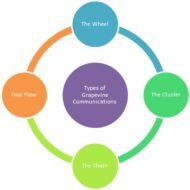
What is Grapevine? In every organization there exists an informal channel of communication called the grapevine in operation. It is called so because it stretches throughout the organization in all directions irrespective of the authority levels. Organizational Benefits that come along with Grapevine It is quite natural for a group of people working together to be interested in one another and talk about appointments, promotions, retrenchments or even domestic affairs. Some people derive extraordinary pleasure from gathering such ‘secret’ information and transmitting it to others. They are the leaders who control the grapevine. Soon this info reaches everybody and becomes an ‘open secret.’ Grapevine is more a product of a situation than of a person. Certain situations like insecurity of service, uncertainty over promotions, special increments to a colleague, certain innovations in the organization that are likely to affect the job prospects of the employees, are sure to activate the leaders of the grapevine that instantly spreads all kinds ofrumors in the organization. Communication Network of an Organization: The channel’s network is in a horizontal fashion as the communication is only between the workers of the same level of hierarchy. Apprehensions experienced by workers on matters like promotions and retrenchments become an obsession with them. Talking about them may not alleviate their fears, but it certainly provides them emotional relief. The existence of the grapevine proves that the workers are interested in their associates. The very fact they talk among themselves helps to promote organizational solidarity and cohesion. The management should work up this kind of situation to their advantage. How? Well, all information cannot be transmitted to the employees through the official channels. If there is some useful information unsuitable for being transmitted through official channels, it can be done through grapevine. The speed with which information is transmitted through the grapevine is just remarkable. Spot the Key Persons: The management should try to spot out the key persons involved in this process and keep them well informed to block harmful rumors reaching the employees. Also the grapevine can be used as an “acid test “to check the pulse of the employees. If there is any false rumor the management should immediately use the official channels to contradict and to dispel the fears from the minds of the employees. Grapevine might be Harmful Too: One of the major drawbacks of the grapevine is that it may spread baseless or distorted news which may sometimes prove harmful even to the employees. The information is sometimes incomplete leading to ambiguities. The swiftness with which the grapevine transmits information may even be damaging, before the management becomes aware of it and can take any rectifying steps. How to Handle the Rumor-Mongers? If the workers are associated with decision-making, the rumor-mongers will be automatically frustrated. If the workers are already aware, say, that the plant is to be modernized but the modernization process is not going to involve any retrenchments, the arrival of new machinery and engineers will not cause any undue apprehensions among them. Thus the harmful effects of the grapevine can be successfully counteracted. Organisations should indulge themselves in sending positive signals to the employees to win their trust and...
Posted by Managementguru in Business Management, Entrepreneurship, Human Resource, Organisational behaviour, Principles of Management, Training & Development
on Mar 30th, 2014 | 0 comments

What are Values and Beliefs in an Organization? Organizational values are the guiding principles that define ethical behavior, decision-making, and corporate culture. In 2025, with AI integration, sustainability goals, and hybrid work models influencing businesses, values must evolve while staying authentic. Infosys Narayana Murthy on Value System “Our team was unique in its commitment to a strong value system. We believed in putting the interest of the company ahead of our own. We upheld ethical business practices and legal integrity. A robust value system is what distinguishes long-term players from others.” The emergence of ESG (Environmental, Social, and Governance) factors has reinforced the importance of ethical leadership. Core Values of a Future-Ready Organization Organizations in 2025 are actively reshaping core values to suit the dynamic business environment. These values guide employee behavior and corporate strategies: Customer-Centricity – Personalization and data-driven customer experience Employee Well-being – Work-life balance in remote and hybrid settings Competitiveness & Agility – Rapid adaptation to AI & automation Diversity & Inclusion – Creating equitable workplaces Innovation – Fostering technological advancements Sustainability – Environmentally responsible business practices Growth Mindset – Continuous learning and skill development Ethical Governance – Transparent and fair leadership Data Security & Privacy – Compliance with digital regulations Team Collaboration – Strong networks despite digital transformation Beyond Definition: How to Put Values into Action A value-driven company does not just define principles—it integrates them into daily operations, employee training, and leadership policies. Gamification of corporate learning, AI-assisted HR frameworks, and transparent communication drive successful implementation. Leading by Example: Imitation as a Behavioral Catalyst Leadership sets the tone for company culture. Employees subconsciously emulate the behaviors of their leaders, much like students learning from teachers. In 2025, AI-driven mentorship programs enable leaders to inspire teams remotely. Interactive training modules reinforce value-based decision-making. Imitation remains a cornerstone in shaping the workforce, but with enhanced digital engagement. Coercion is NOT the Right Approach: Ingraining Values from Day One Rather than enforcing values through rigid policies, organizations must instill them naturally. Values should be embedded in hiring strategies – Recruit for cultural alignment. Leadership training must focus on emotional intelligence – Influence without coercion. AI-driven behavioral analytics help detect gaps in value adherence early. With AI-enhanced work environments, molding employees to value-driven approaches becomes seamless. Influencing Employees the Right Way: The Role of Every Individual Each role in an organization contributes to reinforcing core values and ensuring long-term success: Clerical Staff – Maintain efficiency and ethical compliance. Supervisors – Organize, control, and enforce value alignment in teams. Managers – Define success, overcome obstacles, and inspire strategic thinking. Senior Leaders – Keep the organization focused on sustainable profitability. Executives – Drive innovation while navigating complexities with integrity. With AI tools and data-driven leadership, maintaining value alignment is easier than ever. Performance of Value-Oriented Organizations in 2025 Companies that prioritize values consistently outperform competitors due to trust, strong employee engagement, and sustainable innovation. Reliance Industries Limited exemplifies value-driven leadership with customer satisfaction at its core. Global firms integrate ESG and AI ethics into corporate strategies, reinforcing long-term credibility. To scale new heights in business, organizations need: ✅ Strong-willed leadership ✅ Adaptive strategies ✅ Sustainability-driven policies ✅ Digital transformation readiness ✅ Passion for innovation Maintaining integrity comes at a price, but organizations with strong values reap exponential rewards in brand reputation, employee loyalty, and customer...