Posted by Managementguru in Business Management, Human Resource, Labor Management, Organisational behaviour, Principles of Management, Strategy
on Mar 18th, 2014 | 0 comments
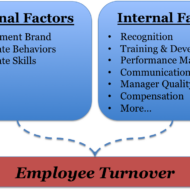
Smart Retention Strategies: Before going into the details of how to handle attrition, the first thing you must understand and realize is this. Each person working for you will have different expectations, perspectives and demands about his job, work environment and compensation respectively. Right at the time of recruiting and selecting the employee, his ideas must be taken into consideration and then it becomes the prerogative of the management whether to hire the person for that particular job. So the first step will be the right person for the right job, giving due importance to the anticipation of the employee who is going to become a member of your business family. Udemy Best Sellers:New Manager Training in Essential SkillsLeadership: Practical Leadership Skills Need for Open Conversation: In case of a small firm or company, it is easy for the manager to have a one on one conversation with each employee to settle his score of grievances then and there. Managers must have an open conversation without room for any ambiguity in the minds of his workers. The manager should try to protect the interest of the employees by representing their demands to the management at the right time. Many employees quit their positions because they have a nagging feeling at the back of their minds that their immediate boss is not the right kind of person to whom they can look up to and ask for support. In big corporates it is not easy to go for a one on one approach. A unique corporate culture that Trains the employees to have an uniform approach to all the systems of routineLed by an effective leader who controls and monitors the behavior and attitude of the workersPossesses sound management practices that make the employees come out with their suggestions freely and induce them to participateProvides satisfactory compensationIncorporates an open door policy catering to the different needs of people and also to the different levels of management, will help the managers to have a healthy relationship with the employees. Human Wants and Needs: Human wants are unlimited and when one want is satisfied, we want more of the same or yet another of a higher order. Approach your workforce to satisfy their craving either in terms of compensation or recognition which will also help to retain your workforce to a greater extent. There should be room for growth, especially for entrepreneurial minds and minds that have parallel thinking. Pic Courtesy: CuteHR Self-Motivation is the Key: Although motivation brings cheer amongst your workforce, self-motivated employees produce better results. Job satisfaction is a relative term; it differs with individuals, some like challenges and some are easily satisfied with an increase in salary quotient. A comprehensive appraisal on the personality of your workforce will give you a clear picture of the IQ (Intelligence Quotient) and EI (Emotional Intelligence) range of your employees which helps in designating employees in the appropriate slots. Such human rationing saves you a lot of time, energy and money as the employees are guaranteed satisfaction in their jobs. Contracts and Agreements: Contracts and agreements bind the employees to the firm only legally. How is that going to help you in terms of productivity? If one of your employees is going to work with discontent, he becomes a problem source spreading the same kind of feeling to others working with him. So it is also necessary for the management to spot out these problem persons either to bring them back into the groove or fire them without any further delay. Rising costs of living and unemployment ratios are really of economic concern, but still we find employees just like that quitting...

Posted by Managementguru in Business Management, Human Resource, Labor Management, Principles of Management
on Mar 10th, 2014 | 0 comments
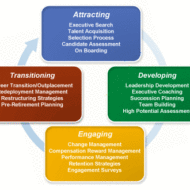
Dimensions of Human Resource Management I would like to brief you on some of the key aspects that mark the paradigm shift in the HR environment towards better management prospects. 1. The Human Resource function has shifted its focus to a much wider canvas that includes Empowerment of EmployeesRestructuring the Organisation and so on. 2. A range of HR sub-systems are involved in Planning The NumbersTypes And Skills Of HrEnsuring Their AvailabilityPlacing In The Right JobPromoting And Nurturing Their Mental HealthHelping Them Develop Special Talent And Skills 3. Human Resource is considered as an “investment” and no more an “expenditure”. Investment in TrainingRe-Training AndContinuous Learning On The Job develops the skills and competences of managers and employees and prove to be an useful investment. 4. The concepts of Learning Organisations AndTeam-Building serves a basis for “Competitive advantage” and “Motivating the employees.” 5. Values that are stressed upon are Co-OperationHarmonisationSynergyTrustBeing Pro-ActiveCollaboration 6. Strategy: VisionMissionObjectivesGoals– How these can be achieved? The techniques that are basically holistic in nature can solve the purpose. Such techniques involve SEWA– Self mastery, Empathy for workers, Worker-directedness and Achievement in performanceABO-Action by Objective Nine Dimensions of an Effective HR Department: What is the reputation of the HR department?What are the criteria (deliverables) that shape HR work?What is the mission or strategy of the capabilities – focused HR department?How is the HR department organised? How does HR facilitate the definition and creation of organisation capabilities?How do we make better HR investment and choices?How do we create HR practices?How does HR go about doing its work? What do HR professionals need to be, know, and do to be effective? Let us make a sincere comparison between the past and the present in terms of HR perspective These techniques produce performers who find their way through any set of given problems, manage themselves and lead the team to a stae of self- realisation. Old model vs New model 1. Job was the basic unit/ Team is the basic unit 2. Relations with environment there handled by the individuals/ Densely networked with environment 3. Information flow was vertical/ now it is vertical, horizontal and holistic 4. Many layers of management / Organisations have become flat 5. Emphasis on structures/ Emphasis on process and literally virtual organisations have evolved 6. Career path upward and linear/ career path lateral and flexible 7. Standardised evaluation and reward system/ Customised evaluation and reward system 8. Ethnocentric/ International 9. Single strong culture/ Multicultural and diversity of viewpoints and...
Posted by Managementguru in Human Resource, Labor Management, Training & Development
on Mar 9th, 2014 | 0 comments
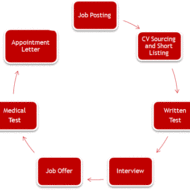
HR Selection Process and Techniques Following the process of recruitment is selection, where the management has to select the right employees at the right time. The intention is to choose appropriate candidates for the unfilled spots and to avoid commitments to those whom the management thinks will not work well. The best qualified individuals from the pool find their place whose qualifications match the job specifications. What is the Selection Process in Human Resource Management? Selection process depends upon the · Size of the company · Nature of the business · Kind and Number of persons to be employed · Government regulations to be followed etc. The process includes 1. Collection of data about the candidate’s qualification 2. Experience 3. Physical and mental ability 4. Nature and Behavior 5. Aptitude and the like Steps in Scientific Selection Process: A. Job Analysis: This is the basic step for finding the right candidate and each organization should lay down job analysis, job description and job specification with clarity in order to lure the right candidates for selection. B. Recruitment: Process of searching for prospective employees and stimulating them to apply for jobs in the organization. C. Application Form: This is also known as the application blank. This facilitates collecting detailed information from the prospective employees regarding their age, gender, family details, qualification, skills, experience, achievements etc. This is widely used to screen employees at the preliminary level. D. Written Examinations: are conducted to gauge the · Mathematical ability · Aptitude · Reasoning · Knowledge in various disciplines · General Knowledge and · English language abilities of the candidates. E. Preliminary Interview: This is suitable to eliminate the undesirable and unsuitable candidates and also to gather personal information from the candidates on a one to one basis. F. Group Discussion: Group discussions help the management to pick out bright candidates from among the group members and also the ability of each individual to adjust to the group. Each group is expected to analyze, interpret and find alternate solutions and select the best solution for a particular case study or subject matter. G. Tests: To further assess the skills of the employees the management conducts different kinds of tests. H. Final Interview: This is the most essential step in the process of selection. The interviewer matches the information obtained about the candidate through the application with that of his own observation and questioning. · Informal · Formal · Planned · Patterned · Non-Directive · Depth · Stress · Group and · Panel interviews are some of the types of interviews conducted in accordance with the job requirement. Also See: Interview Preparation Tips I. Medical Examination: Certain jobs require certain physical qualities like clear vision, perfect hearing, unusual stamina, tolerance of hard working conditions, clear tone etc. J. Reference Checks: The personnel department will engage in checking reference if the candidate passes all the tests and found suitable for the job. What kind of Companies the Employees are Attracted to – Here is an interesting infographic on “How to Attract the Perfect Employee”...
Posted by Managementguru in Business Management, Labor Management, Organisational behaviour
on Mar 7th, 2014 | 0 comments
People Management and Trade Unions Need for Trade Unions Why do employees join trade unions is an important question. Most of the workers are members of any one of the trade unions. One of the major objectives of trade unionism is to promote industrial democracy. This objective is achieved when trade union is an organization of the workers, for the workers and by the workers”. In practice this rarely happens and instead unions become an oligarchy. Union leaders by and large, show authoritative behavior with less participation, openness and transparency. Decision-making is centralized, elections are often postponed and positions are filled repeatedly by nominations. Rank and file is pampered with promises and seldom gets near to decision-making process. Positions get worse when unions are guided by outside leaders and regulated by the policies of political parties. Ideology of Trade Unions Absence of democratic leadership reduces the effectiveness of trade unions and prevents the development of trade union leadership from among the workers within the industries. In due course, trade unions become obsessed with political ideology or personal interest ousting the welfare of the workers. Before we move on to the functions of trade unions, let us understand the reasons for the existence of such organizations. To get a common platform to air ones views, aims, ideas and feelings and obtain recognition and status among fellow workers. Make use of the principle of unity for the purpose of securing good working conditions, higher economic compensations, better career prospects and welfare needs. Security of employment and protection against calamity of accident, death and social security after retirement. Restrict management action which is against the interest of the workers. Functions of a Trade Union The internal functions of a labor union includes better wage claim, to ensure better working conditions, reasonable work etc.,The external functions include conducting night school, games, sports and other recreational activities. These two functions may be grouped as economic and social functions. Many unions try to capture political power through election, so that they can influence upon the programmes and policies of government in favor of labor. This function is known as political function. Under the legal functions, the interpretation of law takes the major share. A jist of the main purpose of trade organizations: To improve the standard of living and working condition of the workers. To protect the security of workers’ employment. To ensure better health, reasonable working hours and welfare measures. To improve the political status. To raise the vocational status. To bring better participation in the management. To inculcate the feeling of self respect and confidence among worker force. To bring industrial peace and harmony. As long as unionism is considered as an anathema by the management, there will be lack of harmony and mutual trust between the management and labor force. Management must not consider labor unions as a legal obligation as it does not develop faith and goodwill. Instead the union has to be viewed as a partner in trade to live with and work with. Union must also recognize that work is worship and the survival and success of organization depends on the very survival and success of the workforce. Once the team spirit is built up no unreasonable demands will be raised and union leaders must view strikes and lock outs as last resorts to put pressure on management. The Trade Unions Act, 1926– An act to provide for the registration of Trade Unions and in certain respects to define the law relating to registered Trade...
Posted by Managementguru in Business Management, Decision Making, Principles of Management, Productivity
on Feb 26th, 2014 | 0 comments
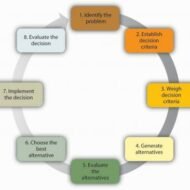
The Process of Decision Making There is a need to broaden our understanding about decision-making process. Decision making is not an independent entity and relies upon many other factors like precedence, social processes and random eventualities. It has three components; identification of the issue, the possible course of action and choosing the best amongst the choices of action available. The decision-making process is continuous since the business environment is dynamic and constantly poses challenges to the decision makers. Organizations are viewed as “Garbage can models” of decision making, in which actions, decisions and outcome are randomly mixed in the flow of events. With this introduction let us proceed to know more about the nature and types of decision making. NATURE OF DECISION-MAKING: 1. It is closely related to solving problems and issues 2. It is associated with all the important management functions like planning, organizing and controlling 3. Fayol and Urwick feels that decision-making is concerned only to the extent that it affects delegation and authority 4. Chester I Bernard in his “Functions of the Executive” says that the process is nothing but narrowing down of choice 5. Herbert A Simon considers decision-making as a process of intelligence, design and choice activities 6. According to Peter Drucker, it is a central part of the management process THE DECISION-MAKING PROCESS: The following steps are involved in the process of decision-making Recognizing the problem: Think about this; if there is a decline in the sales volume of your company or say if the value of your stock decreases, you are forced to make decisions to manage the contingency. In such situations, the first step would be to recognize or identify the problem area. A problem identified is half done. In this instance, the reason might be competitor strength or lack of necessary investment in the key strategic business units. Deciding priorities among the problems: A manager need not and cannot look after all the problems prevailing in the organization. He should know how to delegate authority and the responsibility that goes along with it. Subordinates can be entrusted with the handling of small and trivial problems while the manager can handle very important ones that might affect the functioning of the firm. He should ask the following questions to diagnose the situation. 1. What is the real problem? 2. What are the causes and effects of the problem? 3. Is this problem very important? 4. Can sub-ordinates handle this problem? 5. Which is the most pressing problem to be solved? Diagnosing the problem: Now the manager must start diagnosing the problem. Each and every individual has a different perspective and perceive the problem from a different angle. This depends upon the background orientations and training. The right way of approach for any manager would be to systematically analyze the problem for identifying the alternative courses of action. Developing alternative courses of action: This step involves creativity and innovative capabilities as the manager has to think from all possible angles and directions. Managers holding senior corporate positions are exposed to more of this kind of atmosphere where they are forced to make quick decisions in accordance with what the situation demands. Outside expert consultants are also put into use by some companies for developing choice alternatives. The following are the five PSYCHOLOGICAL STEPS for developing alternatives: 1. Saturation– A manager must be thoroughly familiar with the problem 2. Deliberation– Analyzing the problem from several points of view 3. Incubation– Temporarily switching off the conscious search to relax for the purpose of clear thinking 4. Illumination– A flash of light may occur after sometime giving him the right insights and ideas. 5. Accommodation– The ideas are made into a concrete proposal Evaluating the alternatives: The pros and cons of each and every choice is thoroughly subjected to scrutiny in terms of cost, time, risk, results expected, deviations anticipated...