Posted by Managementguru in Business Management, Change management, Human Resource, Organisational behaviour, Principles of Management
on Mar 20th, 2014 | 0 comments
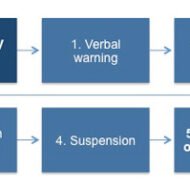
Organizational Discipline – A Way of Life Organizational Discipline: Discipline is the force that prompts individuals or groups to observe rules, regulations, standards and procedures deemed necessary for an organization. Discipline is one word that instills fear in the minds of individuals. The very word sounds autocratic when uttered by your boss and creates a feeling that you are being forcibly controlled. If you do not live up to the expectations of the management, definitely you are going to get listed for disciplinary action. Why is that discipline always gets enforced to gain obedience?Why people get intimidated when subjected to disciplinary action?Why streamlining your behavior becomes so difficult some times? Have you ever given a thought on how we always try to put the blame on management for being a father figure? We have to see things from a broader perspective. When you work for somebody, it is their prerogative to develop some rules and standardize some norms which they think is suitable for the mode of operations. Policies and procedures are formulated for the effective functioning of the organization. It is your responsibility to make them satisfied with your conduct to gain trust and confidence. Organizations are real time schools where you can learn a lot about proper social behavior and develop high standards of discipline. Learning Induces Change in Behavior Learning, an ongoing process is a wonderful experience and individuals must use the opportunity to fit themselves well in the human network when they work for big corporates. The objective of discipline is “orderly behavior”. How many of you maintain a cordial relationship with your peers in the organization?Are you sure they are not talking behind your back for some unpleasant quality of yours?Are you alienating yourself from the rest of the group? Self appraisal is the best way to rank yourself against various critical factors of interpersonal relationship with your team members. Things which we have to consider that might be the causes for indiscipline and misconduct stems from psychological, social and personality oriented factors. Absenteeism Pic Source: Dominion Systems Absenteeism is one thing that no superior can withstand as it directly affects the productivity and vitality of the company. The reasons if presented are weird, he becomes more agitated. Dishonesty is not a thing to be tolerated by the management. Insubordination also causes clashes between the executives and the employees as their “egos are battered.” Carrot and Stick Policy Considering from the employees’ point of view, the carrot and stick policy of the management alone do not make them committed to the firm. Challenging tasks, sense of participation, favorable work climate etc. makes them more responsible and faithful. Immediate rewards and recognitions are more appealing than deferred benefits like pension or gratuity. The emotional aspects of the employees must not be handled in a conservative but in a flexible manner by the management. This will create a feeling of trust and openness between the two. Democracy Hard and fast rules may not solve the purpose when there is no room for any humanism or democracy. This might even be the cause for employees to work against the interests of the company. This leads to disciplinary actions which prove hectic to both the parties. The management on its part has to definitely shed its autocratic attitude and adapt to more participative style of leadership. Personnel department has to play their administrative role in acting as a link factor between the employees and their superiors. Although managers exercise the authority of punishment, it is the HR department’s duty to develop proper procedures of administration of discipline and assist the management in conducting enquiries and solicit the cooperation...

Posted by Managementguru in Change management, Decision Making, Entrepreneurship, Human Resource, Leadership, Principles of Management
on Mar 19th, 2014 | 0 comments
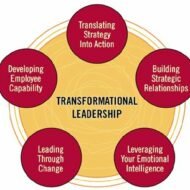
Transformational Leadership What is Transformational Leadership: a leadership approach that causes change in individuals and social systems. Humans generally prefer to have a serene life without much hitches or hurdles in the way. Even if they are to witness a problem situation, they tend to pull themselves away from the scene of action to avoid consequences that may lead to complications at a later date. Very few are bestowed with qualities that make them appear exceptional to the eyes of ordinary men and women. Such people bring wonderful transformations in the lives of people, who willingly follow the leader and support the cause. Need for Transformational Leaders: In business environment, there has always been this debate, whether transformational leaders show success! But it has to be kept in mind that each component of transformational leadership has relevance for improving the decision-making process. In comparison, individually considerate leaders make sure that all parties to the problem are heard. Intellectually stimulating leaders reformulate with followers, colleagues, or superiors into more familiar and concrete terms, what may have begun as fuzzy. Inspirational leaders increase confidence and raise aspiration levels, that the problem can be solved once its causes have been determined. Decision-Making Styles: Leaders with idealized influence show their concern about the problem and the need for its solution. The common thread that emerges from the discussion on decision-making is that decision making styles may be primarily viewed as being based on logic or feeling and instincts. The rational and intuitive decision-making styles are generally considered in conjunction since they represent two ends of a continuum as observed through most studies. While making decisions, transformational leaders are more likely to Be proactive to incipient problems, anticipating the emergence of problems more frequently and farther in advance. Incremental, taking small steps toward problem solving without waiting for a guarantee of complete success. Willing to look at a problem in a larger context and longer time frame. Encouraging of search and choice that take into account the wider context of the larger organization and outside environment rather than limiting the search to the immediate neighborhood of the problem. Quick to react to emergent problems. Seeking information informally for making their decisions rather than prescribed by organizational rules. Practicing walk-around management to promote the upward flow of communication and information. Making decisions involving higher payoffs at higher risks rather than decisions that favor exploitation and achieve lower payoffs at lower risks. Willing to take failure in their stride. Rationale in Making Decisions: The rational style of making decisions is deliberate, analytical, and logical assessing the long-term effects of decisions and having a strong fact-based orientation. The intuitive style is feeling-oriented and based on internal ordering of information. Such decisions are made quickly. The dependent style is characterized by use of support from others while delay and denial characterize the avoidance style. The spontaneous style displays a strong sense of immediacy and an interest in getting through the decision-making process as quickly as possible. A transformational leader would more likely to make decisions rationally after considering carefully all the facts and information and spending a considerable time over the decision-making process. Transformational leadership will be positively related to rational, spontaneous and dependent decision-making styles, and will be negatively related to intuitive and avoidance decision making. The interaction effect of rational and dependent decision making styles on transformational leadership will be...
Posted by Managementguru in Change management, Economics, International Business, Principles of Management
on Mar 15th, 2014 | 0 comments
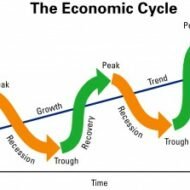
Factors That Influence Global Economy The industrial and business environment of developing countries has been subjected to a sea of changes owing to the economic reforms and policies in the light of globalization, privatization and liberalization. A long term economic vision is necessary for these countries to establish themselves in the global market which facilitates the process of becoming self sufficient in due course of time. Let me present you with a synopsis of how this change can happen and how countries are adapting themselves in lieu of the global economic boom. Multi Brand Retail Markets: Many multinational companies have acquired and are trying to acquire a major part of equity in multibrand retail markets of the host country and sometimes they opt for Joint ventures to factorize the economy of scale which also proves to be a win-win situation for both the parties. Developing countries have altered their economic views on foreign direct investment and are very liberal in their attitude in providing with the necessary licenses. The entry of multinational companies and their potential investment has even altered core sectors like power, oil and telecommunications. Moreover, the benefit of cheap labor, economic subsidies for the start of operations in economically backward regions lures foreign investors. Rush of Entrepreneurship: There is a rush of entrepreneurship in the developing countries, in the form of setting up of small scale industries, cottage industries for which liberal subsidies are provided by the governments to encourage the act of entrepreneurialism. Also people want to go for diversification, mergers and acquisitions in the wake of global competition. Capital Markets’ Role: Capital markets have gained new buoyancy. The rapid growth of stock market and its influence over the international economic scenario have made foreign brokers to keenly follow the market changes for potential investment. The one striking feature of the economy of developing countries is that, it is a self made economy and withstands the pressures of the business cycle, such as recession and inflation, unlike foreign markets that have failed to stabilize their markets owing to what is called sub prime lending, a plan that has failed to achieve the desired economic growth. Instead of making the capital market alive with fresh infusions of funds, it has left many banks and financial institutions bankrupt. Banking Sector: Banking sector has scaled to greater heights and has come under a competitive environment. Deregulation of interest rates to attract potential investors, new technology, products and aggressive marketing usher in new competition; disinvestment of government equity in nationalized banks have made banks to operate as commercial institutions and their services get marketed as branded consumer products. Financial services have emerged as a new business and funding options are aplenty increasing the chances of raising capital. This has evolved as a separate and major source of business fetching revenue to the service providers. Private Sector: Private sector is gaining importance in countries like India, where they have entered all the core industries like oil, mining, telecommunications, road building, railways, ports, civil aviation etc. This serves as a revenue source for the government and this kind of economic restructuring has brought a wave of enthusiasm amongst the potential investors. Imports have become an entrepreneurial activity and are out of the government domain and this has been facilitated by relaxation of licensing hassles. These are some of the recent trends in the developing countries that have captured the interest of multinational...
Posted by Managementguru in Business Management, Change management, International Business, Principles of Management
on Mar 7th, 2014 | 0 comments

GLOBALIZATION AND INTERNATIONAL MANAGEMENT Management as a concept has transcended all geographical boundaries and cultures to gain significance. International management has extended itself beyond traditional management practices reflecting different perspectives influenced by cultural diversity and conflicting social forces. The issue of cultural diversity is used to argue that it is divergence that is taking place and not convergence. The emphasis is on the national culture that acts as a key determinant in management behavior. National and regional differences may become one of the most crucial problems for management-in particular for the management of multinational, multicultural organizations, whether public or private. International Managers: Organizations are on the look out for international managers who could transcend themselves nationally to fit into any location for a specific job consideration. Managers are expected to live abroad and run the overseas division or company They are also sent to complete temporary assignments of limited duration, like plant installation and sales missions Companies aim at developing an international manager who can overcome a limited set of national and cultural boundaries, such as euro-manager, middle eats manager. Expatriates: Companies prefer to have their managers as expatriates, owing to the lack of availability of skills in the host country, to prevent dilution of control, to safeguard the overseas investment and to increase performance. But organizations also have to give a second thought about the cost involved in transferring the expatriates, recruitment and issues regarding legal restrictions. International managers have to possess the following skills to compete in the global environment. Technical expertise and experience Sound financial skills People skills, especially cultural empathy, team-building and motivation Intellectual skills, seeing the big picture, thinking macro not micro Emotional maturity, being adaptable,independent,sensitive to national culture,confident,having self awareness to overcome prejudice Having ambition, drive, persistence, stamina and energy. Focus of Global Organizations: Global organizations employ several techniques to develop international managers. They focus on in-house language, culture courses and tailored development programmes for host country managers, imparting education courses with an international base. International firms are also concerned about the power, politics, conflicting priorities, view points existing in the international scenario and they have to confront with coalition of vested interests. To cope, and more importantly to survive, in an organization, there is a growing view that managers have to become politically competent. De-Centralization: Decentralization is the key factor that is going to decide the developing trend of organizations in the years to come. A smaller, but more highly skilled, group of managers will assume an “expanded role” in clearly defined strategic business units. They will be given greater control over resources, technical, financial and human, and be expected to utilize those resources to achieve broad objectives and performance targets. A trend may develop where there is a shift by individuals away from the objective of managing a team of people towards a search for autonomy, creativity, growth and accountability for oneself, if the organizations fail to suitably reward the managers and present them with suitable career...
Posted by Managementguru in Change management, Human Resource
on Feb 28th, 2014 | 0 comments
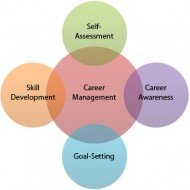
Career Management How to go about Career Management? Career Management is very essential which facilitates smooth transitions from one level to the next higher level in a profession. You cannot decide what to do unless you know what you are going to do or where you want to be tomorrow. Long term personal goals and professional goals are elemental in setting overall targets. According to Stephen P.Robbins, career is “a sequence of life positions occupied by a person during the course of a lifetime. Setting Goals for an Effective Career Your goals may be Long term Short term Personal or Professional Consider if you are goals are Realistic Whether you possess the skill set Achievable within the set time limit (duration) Based on these goals it is important to make long term and short term career plans. Also write down your Experience Skills and Qualification All these basic but vital things will give you a clear picture as to where you stand and what has to be done to improve your skills. Pic Courtesy: Cupcakes and Cashmere EYE Openers While Setting Personal Career Targets A. What do you want to accomplish from two or three years from now? B. What developments and knowledge can make this possible? C. How do you want to prepare yourself to achieve these targets or in what way you want to improve your skills? D. Is there a necessity for check points in the middle of the progress to make the necessary revisions? Tips to Manage Diversifying Careers Adaptability and flexibility are vital to reduce the stress of redundancy. Anticipate the changes and be prepared for anything at any time Look at the ‘Job Loss’ as an opportunity to pursue a new career that interests you. Career Planning A career will be satisfactory only when it interests the person and provides challenge and not by mere compensation or reward. Each organization should plan and help the individual, but every individual should take interest in his career. Career planning entails evaluating abilities and interests and considering alternative career development activities. The process results in Decisions to enter a certain occupation Join a particular organization Accept or decline new job opportunities{relocations, promotions or transfers} Leave an organization for another job or recruitment. Effects of Career Planning In corporate companies, a typical career planning program might include 1. Career counseling by members of the HR department 2. Workshops to help employees evaluate their skills, abilities, and interests to decide on their career development plans 3. Self directed programs to help the workforce guide their own careers through self-assessment and 4. Communication of job opportunities through job postings, videotapes and publications. One has to remember that career counseling may increase the pressure for managers and in turn the organization, as employees either become anxious about their present level of performance and chances for career advancement or they might use the opportunity to demand more from the firm in terms of pay, promotions etc., Key Career Issues of Employees Dual-career couples: When both husband and wife work, their earnings and stress are in surplus Stressors: Children under the age of six need parental care , but the amount of quality time of parents with that of the children is not at all balanced and this causes a heavy stress for both sides emotionally. Work schedule stressors: This increases as a person rises in an organization, job demands increase, with long hours of work and travel, but little time for family and vacation. Relocation: The increase in the number of dual career couple poses problems for many companies when they try to relocate...