Posted by Managementguru in Change management, Organisational behaviour
on Feb 23rd, 2014 | 0 comments
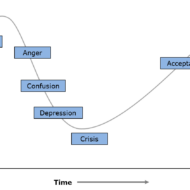
Resistance to change should be considered as a good sign and can be compared to fever while there is a bodily infection. It creates a platform for the firm to find out the causes for resistance and hence the solution. Causes for Resistance to Change Individual Resistance A. Economic factors: When pay is tied up with productivity, resistance arises. B. Habit: It is the habit of humans to resist anything new. C. Fear of the unknown: Freshers always have a feeling of insecurity and uncertainty when they join an organization. D. Change affects emotions and sentiments: People are disturbed both emotionally and sentimentally when there is a change. E. Lack of clarification: People interpret change in different ways; so there is a need for the organization to clarify as to the nature of the change and its implied consequences or implications. F. For the sake of opposing: Illogical and weird opinions are given by the employees just for the sake of opposing. Resistance to change Organizational Resistance A. Built-in-Mechanism: People working in groups experience shock when there is a structural change introduced in the system as they are tuned to a set of rules and procedures. B. Group norms: This also acts as a strong source of resistance acting as a constraint C. Threat to expertise: Technological innovations pose new threats everyday to the non-technical persons D. Threat to established power relationship: If the powers are re-assigned amongst the managerial cadre there arises unrest E. Threat to established resource allocation: Budget reallocations are resisted by departments that are not favored How to Overcome Resistance to Change? Education and Communication: The logic of change must be conveyed to the employees in a convincing manner and full facts must be communicated without an iota of doubt. Participation: It becomes difficult for individuals or groups to resist change when they are made to act as change agents Facilitation and Support: Change agents can offer counseling, training etc to pacify the employees Use of Group Force: Groups can exert more pressure on attitudes, values and behavior and hence, if the group cohesiveness is strong, the change is easier to achieve. Leadership for Change: A strong leader-manager can create a climate for psychology support from subordinates Negotiation: The key persons or individuals whom the management think are potential change agents can be rewarded and brought to the negotiating table Manipulation: Twisting information, creation of false rumors, withholding undesirable information are some of the tactics of manipulation that decrease the intensity of resistance to change. Coercion: Application of force that includes threats of transfers, delay in promotions, negative performance evaluation can decrease the resistance and also the credibility. Manipulation and coercion must be considered as last options to reduce the pressure as generally people will welcome any change that is positive and beneficial to the organization in the long run. It is the responsibility of the management to project the change in a gradual and convincing manner to the...

Posted by Managementguru in Business Management, Change management, Marketing, Organisational behaviour, Strategy
on Feb 18th, 2014 | 0 comments
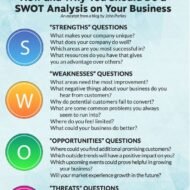
SWOT and Synergy SWOT Analysis On the basis of its resources and behavior, an organization develops certain strengths and weaknesses which when combined lead to synergistic effects. Such effects manifest themselves in the form of organizational competencies. It is necessary for a firm to look for and develop factors that adds to its strength, as strength is considered to be an inherent capacity which an organization can use to gain strategic advantage. Pic Courtesy: Clickfunnels A weakness, on the other hand, is an inherent limitation or constraint which creates a strategic disadvantage for the organization. Financial strength, for example, is a result of availability of financial sources and efficient rotation of funds. A weakness in the operations management area might be a result of inappropriate plant location, obsolete plant layout and technology. It has to be noted that an organization cannot enjoy the privilege of having only strengths and devoid of any weaknesses. Then the performance level would become saturated to the point of monotony and there exists no scope for growth or improvement. Only when presented with challenges, any functional area exhibits synergy, as strengths and weaknesses do not exist in isolation but combine within a functional area, and also across different functional areas. Synergy Synergy is needed at all levels for better productivity. Say, within a functional area like marketing, synergistic effort may occur when the product, pricing, distribution and promotional aspect support each other, resulting in higher level of marketing synergy. The same when happens at an even higher level, leads to operating synergy, say, for example, synergistic efforts between marketing and production department to decide on the production forecast and pricing. Distinctive competence helps a firm to develop strategic advantage that leads to comprehensive growth and development. Limitations of SWOT: A SWOT analysis can over emphasize internal strengths and overlook external threats It can be static and may ignore the changing circumstances It might give undue importance to a single strength or an element of strategy A strength is not necessarily a source of strategic advantage. Amazon.in...