Posted by Managementguru in Human Resource, Interview Questions, Principles of Management, Training & Development
on Mar 8th, 2014 | 0 comments
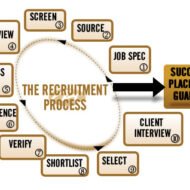
Recruitment Process Recruitment refers to that process carried on by the company to attract suitable candidates possessing the appropriate characteristics to help the organization reach its objectives. According to Byars and Rue, “recruitment involves a pool of people from which qualified candidates for job vacancies can be chosen.” The basic purpose is to develop a group of potentially qualified people. Recruitment Policy: The policies of recruitment are derived from the personnel policies of the organization where the company has to give due importance to government reservations, quotas, policies regarding sons of the soil, personnel policies of other organizations regarding merit, internal sources, social responsibility in absorbing minority sections, women etc. Sources of Recruitment: INTERNAL SOURCES: This include 1. Present permanent employees 2. Present temporary/ casual employees 3. Retrenched or retired employees 4. Dependents of deceased, disabled, retired and present employees. Why internal source is considered to be a better choice? To motivate the present employees To improve the morale aspect “Known devils are better than unknown angels”-The credibility of the present employees are well known and they can be judged easily Loyalty and sense of belongingness is there on the part of current employees The employees become highly committed when they are given a chance as they tend to shoulder more responsibility Employees’ psychological needs, economic needs for promotion and higher income can be satisfied Cost of selection can be minimized Similarly cost of training, induction, orientation, period of adaptability to the organization gets reduced Trade unions are happy Social responsibility towards the employees are discharged Good understanding and co-operation extended by co-workers Stability of employment is assured EXTERNAL SOURCES: 1. Educational and training institutes 2. Private employment agencies/exchanges 3. Public employment exchanges 4. Professional associations 5. Data banks 6. Casual applicants 7. Similar organizations 8. Trade Unions 9. Social media networking sites like Facebook and Linked in offer a huge platform for both recruiters and job seekers to find the best possible match. Why external source is considered to be a better choice? · The suitable candidates with skill set, knowledge and talent are generally available · Latest knowledge, skill, innovations or creative talent can be infused into the organization · Candidates can be selected without any pre- conceived notions or reservations · The cost shelled out for these external sources are minimum since they are placed in minimum pay scale · Expertise, excellence and experience in other organizations can be easily brought into the organization · Human resources mix can be balanced with different background, experience, skill etc. · Existing personnel will also broaden their personality · Quality of human resource will improve in the long run by development of unique culture RECRUITMENT TECHNIQUES: The management has to contact the prospective employees through various means and stimulate them for applying to the post prescribed. A. Promotions: This is a good technique to stimulate internal employees as they will be willing to shoulder more responsibilities if they are assured of promotions B. Transfer: If employees are transferred to the places of their choice, it will stimulate them C. Recommendations of the present employees: Management can contact, persuade the outsiders to apply for job in the organization through the recommendations to the candidates by the present employees, trade unions etc. D. Scouting: This is another way of recruiting where the representatives of a particular organization are sent to various sources of recruitment to motivate the prospective candidates to apply for the jobs. The representatives provide the necessary information about the company and clarify doubts of the candidates. E. Advertising: Though the popular and widely accepted way of recruitment, still it proves to be one-way communication. Newspapers, Magazines of all types, television and internet are the possible sources of advertising channels and internet marketing leads the rest. The technique of advertising should...

Posted by Managementguru in Business Management, Organisational behaviour, Principles of Management
on Mar 7th, 2014 | 0 comments
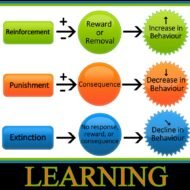
Reinforcers and Behaviour Changes Reinforcers induce and enhance the association between the cue and the expectancy. This leads to increased performance levels and positive attitude development. This is an effective and efficient strategy that has been proved to be successful. Reinforcement is inevitable for learning process and in a dynamic corporate business environment, unlearning the old things and learning and adapting oneself to satisfy the needs of the changing environmental and economic factors is the critical success factor that serves as the backbone of the success of the company. Significance of Learning: Learning is not the only attribute that gets enhanced by reinforcers; as a result there is a repetition of desirable behavior that helps in maintaining the consistency, cordiality and climate of the organization. Reinforces increase the strength of response leading to desirable or undesirable consequences depending upon the kind of reinforcer, which might be a reward or a punishment. Either way it elicits response that gets strengthened in course of time. Mindset of People: The management side that is the deciding authority has to come to clear terms with the kind of treatment applicable on specific situations; say for instance when there is a need to complete a project in the stipulated time or achieve quantifiable targets which may prove very challenging or increase the production capacity in order to retain a major market share. Whatever be the case, the morale of the workers down the line, executives who coordinate the process, the managers who manage and report has to be maintained in the highest order. The mind set of the people working for you is very important as it encompasses the quality of work done, commitment to duty and determination to reach the target on time. Rewards: Rewards always make people happy and are found to be positively reinforcing. If you feel that monetary rewards are always a better stimulus, you are wrong. Money is always considered to be a reward; to consider it as a reinforcer cannot be neglected but at the same time it definitely is not a positive reinforcer.Feedback on performance is rated high on the reinforcer scale which takes you to the next level as a performer. Modern organizations have understood the system’s anomaly that gives undue importance to the huge amount of data that speaks volumes about people and their merits and achievements. Is it really enough to know things about people? People expect feedback about their performance and people with some degree of achievement definitely have an intense desire to know how they are doing? The more specific your feedback is, better the impact and greater the delay between the performance and feedback, the less the effect. Work Environment: The work environment itself can serve as a very good positive reinforcer provided there is freedom of expression, liberty to participate and an open door policy adopted by the managers and superiors. The top level management must take utmost care to design the reward system in such a way that it warrants fairness and equity. Employees are motivated to go for self appraisals with goal setting that is the biggest reinforcer of all times. Recognition: Recognition, rewards and praise tend to boost the ego of individuals which you can work it up to your advantage. Punishment is one of the most used and convenient but least understood and badly administered aspect of learning and reinforcing. Punishment equally alters the behavior of your subordinates which becomes more complex in course of time. Positively dealing with your subordinates by giving them one more chance, of course with a warning might serve the purpose. If punishments modify the behavior...
Posted by Managementguru in Business Management, Principles of Management, Training & Development
on Mar 7th, 2014 | 0 comments

MBO BY PETER DRUCKER Peter Ferdinand Drucker was an influential writer, management consultant, and self-described “social ecologist. Harvard Business Review honored Drucker in the June 2004 with his seventh McKinsey Award for his article, “What Makes an Effective Executive”, the most awarded to one person. The Concept of MBO: Management by objectives was a concept introduced by the doyen of management, Peter Drucker. This concept involves formulation of objectives for the entire organization and which are then broken down into divisional, departmental and finally individual objectives. Objectives are decided on the basis of mutual consultation between managers and employees at the departmental and divisional levels and thus it can be appropriately called an integration of top down and bottom up approaches in management. The specific aim is to make the employees participate in decision making and thus motivate them to perform better. Management by objectives follows a step-by-step procedure that ensures the feasibility of the action plans decided upon. Realistic and achievable plans are set. Activities to be preformed are identified. Logical relationship between the sequences of activities is laid down. Time frame and cost frame are fixed. Resources to be allocated are decided upon. Salient features of the process: Self control and Self direction: The workers exhibit keen self control in that, they self appraise their performance that results in intrinsic motivation. Setting short goals and periodical review to match the current performance with the expected standards greatly boosts the performance of each and every individual and gives him the necessary drive to accomplish the assigned tasks. Periodic progress review: This helps to correct errors and deviations if any. This review is done by managers of higher levels in a constructive way and adequate counseling and guidance can be given to the subordinates to bridge the shortfall if any, in performance. This is possible only when there exists a mutual understanding between the superior and subordinates to find reasons and solve problems together. Reviews need not necessarily pinpoint errors but also revise future plans and actions. The major emphasis of management by objectives lies in its result oriented approach. What is the relationship between management by objectives and motivation? Motivation of an employee can be brought about by financial incentives such as bonus, increments, pay and perks or non-financial incentives such as recognition, appreciation and additional responsibilities. But nothing can equal self-motivation which makes an employee perform with aplomb. As management by objectives is directly linked with goal-setting, performance becomes better and better as the goals are set at a higher level. It involves complete participation from the employees’ end and when specific goals are set by mutual consent of workers and management, the results are magnificent. Many firms practice management by objectives to promote harmony and sense of belonging in the minds of employees as a result of which there is remarkable improvement in performance and productivity. The focus is on improving the job design and work module to make the jobs more meaningful, interesting and...
Posted by Managementguru in Business Management, Organisational behaviour, Principles of Management
on Mar 6th, 2014 | 0 comments
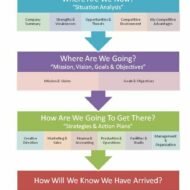
The Management Planning Process We have heard of “Master Plans” being structured and engineered to give astounding results that is purely systematic in approach and masterly in execution. Planning facilitates to make use of the opportunities that are available in the environment to make it to the top. Opportunity Analysis is nothing but, an awareness of the factors in the external environment; understanding of the strength and weaknesses of the organization. This is the first step of planning where we have to scrutinize the market, competition, customers’ preferences, tastes, our strengths and weaknesses. Establishing Objectives is another criterion that ensures “Where we want to be, and what we want to accomplish and when”. What are Objectives? Objectives are set for the organization and each subordinate is also entrusted with them. Objectives lay emphasis on goal setting which normally emanates from the top, but it may also originate from the bottom. Management by objectives is a great concept that involves all the employees working for the organization to be a part of goal setting and decision making. Planning Premises: Premises are “Assumptions” about the ‘environment.’ It involves identification of critical factors of the environment that affect the planning. Examples of critical factors are government policies, tax rates, business cycle development, economic indicators, economic forecasts etc. No body can precisely predict the environment factors precisely and make an accurate forecast. However one can fairly predict the critical factors required for the plan. Identifying Alternatives is very significant in a corporate business environment as every plan has got a set of alternative course of action. A reasonable number of alternatives can be developed for a plan. Evaluating Alternatives and Selecting the Best: A reasonable number of alternatives can be evaluated on the basis of the principle of limiting factor. The limiting factors may be costs, time, manpower and other resources. By applying techniques of operations research, every alternative can be evaluated. For e. g. alternative ‘A’ may benefit the organization in the short term but may be more expensive and alternative ‘B’ may benefit in the long run but may be less expensive. If one wants to earn immediate profits by spending more money he can choose alternative ‘A’. If the limiting factor is cost, he is forced to choose alternate plan ‘B’. Planning is not complete with selecting the best alternative; a set of derivative plans are developed to support the basic plan. For example an educational institution might like to own a fleet of buses, for which derivative plans for selection has to be made- training of drivers and maintenance staff are supportive plans for the main plan-procurement of buses. Developing budgets completes the planning course of action and budget is referred in financial terms and they are required to control the plans. Planning is the Prime Function: Planning is the prime function of all as it precedes all functions. 1. The objectives must be clear, verifiable and attainable. 2. Planning premises are vital to the success of planning as they supply information related to future like probable competitive behavior, general economic conditions, capital and material availability, government control etc. 3. All the critical factors are clearly and thoroughly analyzed and taken into consideration. One should be able to identify clearly the critical factors that limit the attainment of the goal. It could be costs, time, manpower or any other resources. 4. In a practical business situation, one should be clearer in identifying these factors, only then the selection of the best alternative is possible. 5. Any decision taken in a plan is valid for a particular period i.e., the plan may be short term or long-term, the commitment principle...
Posted by Managementguru in Business Management, Organisational behaviour, Principles of Management
on Mar 6th, 2014 | 0 comments
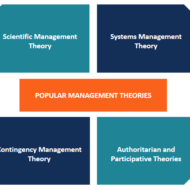
Theory of Management History and Evolution To understand the concept of management, a recap of its history and its slow but steady evolution is absolutely necessary. After the advent of machines, thanks to the industrial revolution of the eighteenth century, management has become an entity by itself. Pic Courtesy: Management Theories Since business activity is increasing by leaps and bounds globally, a more organized set up is called for, which has led to the development of different management concepts. Whether you consider management an art or a science, one definite thing is that, science and art complement each other and not mutually exclusive. Management gurus like Peter Drucker, Henry Fayol, Taylor and others have classified the essential features of management, for the benefit of the industry. Theory comes first followed by practice. Management knowledge certainly improves your style of working. How long do you think, luck, intuition or experience can be relied on, without a scientific knowledge of management. It is a thought to be pondered. Hypotheses Practical experimentation and analysis of theoretical hypotheses, yield better results and in course of time you tend to gain more scientific knowledge. Management is a process of planning, organizing, staffing, leading and controlling. Picture Courtesy: Technofunc.com The management process is applicable to all kinds of organizations and firms, be it a private firm, a government institution, a hospital, a school, a college, an university and other financial, profit making or non profit making NGO’s. This clearly indicates that management is a process that involves individuals who work in groups to accomplish their objectives in an effective and efficient manner. Levels of Management Does management pertain only to the top level management? A big no! It applies to managers at all levels. It is a chain reaction and a successful management totally depends on the synergistic activities of the people belonging to that organization. So, care must be taken by the managers to create and design an internal environment that is conducive for the smooth operations of the firm thus increasing the productivity. This does not mean that the external environment can be overlooked. A manager has to respond to the periodic changes, be it social, technological, economic or political in the external environment also. Management styles Management is a must for every organization and the style of management may vary according to the nature and size of business. Large organizations now-a-days prefer a “flat structure“, as it brings their employees closer and reduces the span of management, thus making communication faster. The more the number of levels, the more the conflict and improper communication. Although management pervades the entire organization, it is the duty of the top management cadre to initiate and maintain consistency in the process of management. All managers (by the term “manager “which is a much generalized term, we denote persons who hold authority to get things done; he may be a financial, administrative, human resource or a production executive) have a common aim, that is to create surplus. To increase productivity, create a suitable environment for the effective performance of their group and to solve crisis situations, they must be capable of seeing the “big picture”. Recent Developments A sea of changes has swept the theory of management area in recent times, owing to the development of different approaches. Management theory is criticized to have all the characteristics of a jungle as numerous management practitioners have recorded their findings in the management history. This led to severe confusion as to what management is, and how things should be organized; however, in modern corporate business world, the managerial activity is directed towards growth, thanks to the...