Posted by Managementguru in Business Management, Organisational behaviour, Principles of Management
on Mar 3rd, 2014 | 0 comments
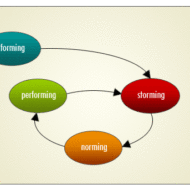
Group Dynamics Any effective group has three core activities: 1. Accomplishing its goals 2. Maintaining itself internally 3. Developing and changing in ways that improves its effectiveness. Let us now try to understand the various dimensions of an effective group that facilitate the above mentioned three core elements to function properly which provide a sense of direction to the productive group. a) Group goals: Must be clearly understood. Be relevant to the needs of the group members. Highlight the positive inter dependence of members. Evoke from every member a high level of commitment to their accomplishment. b) Communication: Must communicate their ideas and feelings accurately and clearly. Effective two way communication is mandatory for interaction c) Participation and Leadership: All should participate and all should be listened to. Share responsibilities that eases the burden. Increases the cohesiveness of the group. d) Appropriate decision making procedure: Balance between time and member resources. Flexible decision making to suit the needs of the situation. e) Power and Influence: · Should be equal · Based on expertise, ability and access to information and not on authority · Coalitions must be formed between group members on the basis of mutual influence and interdependence. f) Conflicts: · Are to be encouraged as they promote involvement in the group’s work, improve quality and creativity in decision making. · Minority opinions should be accepted and used g) Group Cohesion: · Needs to be high · Level of acceptance, support, and trust among the members decide how cohesive the group is h) Problem Solving: · Problems should be resolved with minimal energy and permanently · Existence of problems must be found out quickly and solutions should improve the effectiveness of group behavior i) Inter-personal effectiveness: · Needs to be high · It is a measure of how all the consequences of your behavior match your intention. ⇓ Picture Courtesy: 6 WAYS TO DEVELOP A WINNING TEAM CULTURE Group Cohesiveness: This is defined as the average resultant force acting on members to remain in a group. The characteristics or criteria that determine group cohesiveness are as follows: 1. Degree of dependency on the group: The greater the number of individual needs are satisfied, the greater the cohesiveness. 2. Size: If the size of the group interaction is low, it results in low cohesiveness. If the size of the group is small, the members tend to have free and more interaction, leading to high level of cohesiveness and vice versa. 3. Homogeneity: Where the interests and background of the group is similar, you find greater cohesiveness. 4. Outside pressure: Outside pressure minimizes internal conflicts leading to high cohesiveness. You find people responding with greater cohesiveness during times of natural disaster and calamities. 5. Competition: Competition between the members of the same group or intra group competition reduces cohesiveness but competition members of different groups or inter-group competition increases cohesiveness. Group Cohesiveness can be encouraged by the following ways: · Make the group smaller · Encourage agreement with group goals · Increase the time members spend together · Stimulate competition with other groups · Give rewards to groups rather than to a single member · Physically, isolate the group. ...

Posted by Managementguru in Business Management, Principles of Management
on Mar 3rd, 2014 | 0 comments
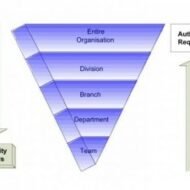
Centralization and De-Centralization Concepts CENTRALIZATION: The term “centralization” has several meanings: Centralization of Performance: Say, if the operations of a company is restricted to a single geographical location, it characterizes centralization of performance. Departmental Centralization: Specialized activities are carried out by a single department, say, maintenance of a whole plant, staff recruitment by HR department etc., Centralization as an aspect of management: This implies restricted delegation and exclusivity of decision-making by the top management. According to Allen, “Centralization is the systematic and consistent reservation of authority at central point in an organization.” According to Weihrich and Koontz, “Centralization (as an aspect of management) is the tendency to restrict delegation of decision-making. What are the special circumstances that force the managers to reserve authority and centralize decision making powers? 1. To facilitate personal leadership 2. To provide for integration 3. To handle emergencies 4. To utilize resources effectively and instantaneously. DECENTRALISATION: It is the tendency to disperse decision making authority in a structured and organized manner. It can be viewed as a philosophy rather than a principle where-in “discretion” plays a major role in deciding which decisions to push down into the organization structure and which to hold near the top. Capital expenditure, Investment analysis and major policy decisions have to be dealt with, by the top management. It is the systematic effort to delegate to the lowest levels of authority except that which can be exercised at central points. TYPES OF DECENTRALIZATION: Three approaches to the concept are: 1. PROFIT CENTRES 2. COST EXPENSE CENTRES 3. INVESTMENT CENTRES Profit Centre: Here the organization is split into divisions on a “product basis” and is given full authority to handle its own scheduled operations, right from placing orders to negotiating the sale of its finished products. Cost Expense Centre: Whenever it is easy to determine the cost of operations, cost centres are established. Cost centres run on “budgets” which acts as a control tool to run the units within the specified budgetary limits. Investment Centre: Useful in the case of big multi-product enterprises where product performance is measured by decentralizing the investment aspect. Each strategic business unit is responsible for the acquisition, use and disposition of fixed resources. Advantages of Decentralization: Managers and executives are relieved form excessive work pressure Even low level employees are involved in decision making thus bringing the decision making process closer to the scene of action. It facilitates product-diversification Creates an opportunity for learning Ensures effective control When a big organization is divided into relatively smaller units, it becomes flexible and also effects close control. Disadvantages of Decentralization: · Conflict arises between people belonging to different levels of the organization · Rising cost · Lack of co-ordination between production and marketing departments · No defined leadership Contingency Factors in Decentralizing: 1. Organizational goals 2. Organizational size 3. Geographical dispersion 4. Technical complexity of tasks 5. Time frame of discussions and decisions 6. Subordinates’ take on issues 7. Planning and control procedures 8. Environmental factors 9. Knowledge and experience of managers Effective Decentralization can be accomplished by · Establishing appropriate centralization · Developing efficient managers · Proper provision for communication and co-ordination · Establishing adequate controls Top management must be willing to delegate authority towards decision making; Middle management must be willing to accept responsibility that is being delegated. Only then effective decentralization is...
Posted by Managementguru in Business Management, Organisational behaviour, Principles of Management, Training & Development
on Mar 1st, 2014 | 0 comments

Performance Appraisal is considered to be the most significant and indispensable tool for an organization. It is a measure of the employees’ performance levels in terms of the specific job’s requirement. It is a process employed for the purpose of placement, selection for promotions, providing financial rewards and other actions which require differential treatment among the members of a group. Purpose of Performance Appraisal Douglas McGregor says “Formal appraisal plans are designed to meet three needs, one of the organization’s and the other two of the individual namely, Performance appraisal methods facilitate systematic judgments to decide on the salary increases, transfers, demotions or terminations. They serve as a yard stick for an employee as to where he stands in the performance rating queue in the eyes of management and how he needs to adapt or improve himself regarding behavior, attitude, skills or job knowledge. They are used as a means to train and counsel each and every employee by the respective superiors. Performance appraisal can also be termed as Merit rating Behavioral assessment Employee evaluation Personnel review Progress report Staff assessment Service rating. According to Levinson, it definitely provides adequate feedback to each individual for his performance and also serves as a means for changing behavior. Prime Objectives of Performance Appraisal Helps to maintain manpower inventory of an organization which includes quantity and quality, to identify the training needs and aspirations of the work force. To determine increments and provide a reliable index in promotions and transfers to positions of greater responsibility. To improve individual as well as group development by determining the performance standard and motivating the employees to perform well. Providing support to employees who are not able to focus and to bring them back into the groove. The Process of Evaluation Establishment of performance standards. Communicating the same to employees. Aquiring information through personal observation and statistical reports from the respective departments. Appraising and judging the future potential growth and advancement. Identifying the deviation between the actual and standard performance levels. Discussion with the employee for subsequent improvement or corrective action. Appraisal Summary 1. Personnel Background covering the following details are collected Age Family background Marital status Children Education Specialization and degrees Office held Work history Social accomplishments Honors and awards Professional or trade organization membership Publications Special limitations Family problems Hobbies and recreational activities 2. Nature of Work: Job performance and personal qualification Technical performance Level of motivation in current position Intelligence as reflected on the job Emotional stability Leadership skills 3. Overall Performance Rating: Recommended action Knowledge Skill Attitude Methods of Performance Appraisal Traditional methods: These rely upon evaluating an individual’s creativity, intelligence, drive, dependability, leadership potential, initiative and organizing capability which are more of personal in nature. Modern methods: These include ranking method, graphic rating scales, forced choice description method, critical incident and 360 degree evaluation methods. The 360-degree appraisal method is employed in big corporate companies where the individual’s overall performance is appraised by his colleagues, boss, customers, suppliers and stake holders. Management by objectives, management by exception , self appraisal and human asset accounting are other methods used for appraisal. Problems that may arise during performance appraisal Halo Effect: It is a tendency to let the assessment of an individual’s any one trait to influence the evaluation of that person on other specific traits. The Central Tendency problem: It assigns average rating to all the employees in order to avoid commitment. Similarity error: This occurs when the evaluator evaluates other persons based on ‘self perception’, that is if he perceives himself to be adventurous or daring he may evaluate others looking for that same trait which he possesses. How to make appraisal successful? The superior must be well trained and a composed person to judge without error or personal...
Posted by Managementguru in Organisational behaviour, Principles of Management
on Mar 1st, 2014 | 0 comments
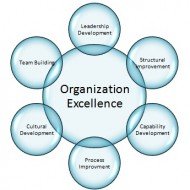
Organisational development is not an overnight transformation; it is indeed a gradual process that has to be implemented systematically and in tandem with the external environment. Listed here are some of the relevant organizational development techiniques or interventions that help employees to become more productive. A. Sensitivity Training The notion is to change the attitude and behaviour of individuals involved in the group rather than the technical skill or knowledge. The term sensitivity refers to the psychological aspect of human mind that has to be shaped to act in accordance with the expectations of the group. One’s own weakness is exposed and members understand how others react towards them. Stress is on Group Dynamics and tackling inter-relationship problems. The idea is to improve the behaviour of people in order to maintain smooth inter-personal relationship without anybody’s power or influence. Members are encouraged to have an open, heart to heart talk to develop mature relationship. Employee Engagement & Retention The Process: Sensitivity group is a small discussion group without any leader. The trainer raises a question and allows the members to proceed with the discussion, the focus being feelings and mutual respect. There is no set task or agenda and members try to analyse the immediate problem by having open discussion instead of applying logic and rationale. Free and frank discussions lead the members through periods of shock, anger, frustration, hostility, all for the better understanding of one another. Improve People Management and Build Employee Engagement Feedback includes videotape of the proceedings and guidance from the trainers. Members unlearn old things through shock and change the present behaviour to improve their behaviour pattern. Individual emotions and inter-relationship pattern are primarily focused upon in sensitivity training. Sensitivity training borders on psychotherapy where the emotions as well as body language are taken into consideration. The expressions may be any one of the following: 1. Gestures 2. Screaming 3. Physical contact B. Survey Feedback Here the discrepancies among a group are weeded out using questionnaires, which identify the difference in perceptions amongst the same working family, group or department. The data collected is tabulated and distributed for taking part in the deliberations. This forms the basis for further discussions. Discrepancies if any can be sorted out by open discussions with all concerned, defending and opposing till a consensus is arrived at. Here the focus is on ideas and not on persons who put up those ideas. C. Process Consultation A firm may either seek the support of 1. Expert from within the organisation: Though he might be knowing the crux of the problem, his emotional involvement might block him from seeing the problem in the right perspective. Moreover the outcome of the result might be a ‘biased one’ due to internal politics. 2. An outside expert: This person with his vast knowledge, experience and similar problem encounters may have the know-how of resolving the problem but may lack the necessary insight of that particular problem. The organisation must see to that process consultation is done through an external expert with the needed support provided by the authorities from within the organisation. D. Team Building Team building is attempted at the group or inter-group level. The objective is to improve co-ordination thereby improving the performance as a group. 1. Goal setting 2. Development of inter-personal relations 3. Role analysis to identify roles and responsibilities 4. Team process analysis are the key features of team building. E. Inter Group Development One of the major challenges for firms involved in development is tackling inter departmental conflicts. Such dysfunctional conflicts may exist between a. Line and staff b. Production and materials c. Finance and production What is Group Dynamics? As sensitivity...
Posted by Managementguru in Economics, Entrepreneurship, Human Resource
on Mar 1st, 2014 | 0 comments

Entrepreneurship in Developing Economies Entrepreneurial development is a complex process of change. It has been recognized as an important ingredient of economic development. The development of entrepreneurial activity depends upon the closely interlinked economic, social, cultural, religious and psychological variables. Developing countries of late have adopted a deliberate policy of promoting and encouraging small enterprises as a strategy, for the overall development of their countries. Practical Problems Faced by Developing Countries The numerous problems confronted by developing countries such as, a high rate of population growth, a relatively low rate of economic growth, a low level of capital income with nearly fifty percent of the population subsisting below the poverty line and mounting increase in the figures of educated unemployed-all these check the growth of entrepreneurial activities. Countries have to plan realistically, mobilize and harness resources, have control over factors of growth and development and give direction to the development process. Naturally then, the national and economic goals will be focused towards: Production and productivity to be increased in the primary, secondary and tertiary sectors Maximum harnessing and utilization of material and human resources Solving problems of unemployment Having a check on population growth Equitable distribution of wealth and income To increase the purchasing power parity To increase the gross national product To increase the real per capita income Improving the quality of life Industrial Development The larger scope and potential to achieve these goals lie in the development of the industrial sector of the national economy, and the only alternative to raise the level of living is development of industries. Here, we are not merely concerned with certain quantum of growth and development in the industrial field. Theoretically, the desired quantum of industrial development could be supported by a few large investments and capital intensive units run by a small number of big entrepreneurs. But what is envisaged is to have the same quantum of industrial development with a wider spread consisting of large number of small entrepreneurs all over the country. This would result in development of small scale and tiny sector industries all over the country and would generate employment opportunities to the educated unemployed, skilled people and other potential entrepreneurs from various segments of the society. Scenario of Asian Countries Most of the Asian countries like India and China are encouraging and promoting entrepreneurial development leading to industrial and economic development. India is now a hot spot for automobiles and its accessories. Being a cost-effective core market for auto components sourcing for global auto makers, the automotive sector is a potential sector for entrepreneurs. Entrepreneurs are risk bearers, find resources and fill market gaps that would be missed by larger, more bureaucratic organizations. Entrepreneurs improve the social welfare of a country by harnessing dormant, previously overlooked talent. Surplus manpower which is considered a great liability can be converted into assets once those with potential are selectively groomed for self-employment and enterprise formation, leading to further job...