Posted by Managementguru in Business Management, Organisational behaviour
on Feb 25th, 2014 | 0 comments
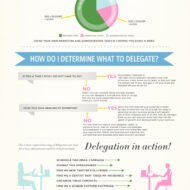
Before embarking on the subject let us find out what delegation is and how the process occurs in an organization. What is Delegation: A manager or a superior cannot think of doing all the jobs by himself. It becomes therefore necessary to delegate some of the jobs to his subordinates to ease the pressure and assign the required authority to carry on with those tasks. This downward pushing of authority is called delegation of authority. Art of Delegation Delegation takes place when one person gives another person the right to perform work on his behalf and in his name. It is the process of entrusting part of the work by the superior to his subordinates. How to Master the Art of Delegation? PROCESS OF DELEGATION 1. Step one is Assigning Responsibility: The superior directs the subordinate to perform a task with due assistance and training. 2. Step two is Granting Authority: To accomplish the task some authority has to be given to the subordinate to procure the essential resources from the organization like materials, equipment, labor etc., 3. Step three is Creating Accountability: The subordinate is expected to accomplish the task within the stipulated time period and report to the manager regarding the acquisition, use and replacement of resources. ADVANTAGES OF DELEGATION It reduces the work pressure of the manager Leads to better decisions Speeds up decision making It improves the morale of the employees Creates a feeling of mutual trust between the superior and subordinates Helps to create a formal organization structure BARRIERS TO EFFECTIVE DELEGATION Fear of being exposed: Some superiors fear that their weaknesses might be exposed Difficulty in briefing the actual requirement- depends on the quick wit of the employees Lack of confidence in subordinates Fear of loss of power“I am OK you are OK “ attitude of the managers PRINCIPLES OF DELEGATION OF AUTHORITY Principle of Delegation by Results Expected: The authority assigned to the subordinates should be sufficient enough to ensure their ability to accomplish the results expected.Principle of Absoluteness of Responsibility: One has to understand that responsibility can never be delegated and that the superiors are responsible for the activities of their employees and the performance of the employees has to be absolute towards their superior’s expectations.Principle of Parity for Authority and Responsibility: There should be a perfect balance between assigned authority and responsibility. One cannot be held responsible for a task where he has limited authority and too much of authority with too little responsibility can prove to be dangerous.Principle of Unity of Command: If there is a single superior to listen to, conflicts will be greatly reduced and it will be easy for the subordinate to have a personal rapport with the superior.Authority Level Principle: A manager who has the authority to make certain decisions must necessarily use his discretion and should not try to overlook or pass it on to the top management.Principle of Functional Definition: The objectives, tasks, responsibility and authority must be clearly stated to the individuals involved to facilitate improved performance to accomplish enterprise objectives. Managers fail because of poor delegation. Their personal attitude comes to the forefront which makes things quite difficult. Lack of receptiveness: Some managers are not open to ideas and suggestions from the other endWillingness to let go: A superior must have the willingness to delegate authority for positions which he had left long ago.Willingness to trust subordinates: A trustful attitude makes the proceedings smoothWillingness to establish and use broad controls: The superior must establish some standards to which the objectives or tasks can be compared to and control mechanisms must be installed for evaluation purposes. Feedback from subordinates is the most important criterion that determines the effective functioning of the organization. HOW TO MAKE DELEGATION EFFECTIVE? Right person for the right jobGive sufficient authorityFree flow of informationEstablish proper controlsReward the subordinatesMake the nature and scope of the tasks clearMake the subordinate understand...

Posted by Managementguru in Business Management, Operations Management, Principles of Management
on Feb 24th, 2014 | 0 comments
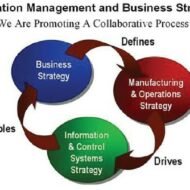
The management of conversion or transformation process which accepts inputs and delivers usable goods and services is what is called “operations management.” The inputs may be in the form of, capital, material, labor, technology, information, machines etc. The process takes place in an effective and efficient manner through operations planning, design, management and control. Don’t forget to download the 3 page Project Planner Printable at the end of this post 👇🏻 Absolutely Free Earlier it was called, production or manufacturing management. Since operation is a general term in a productive environment whose output may be goods or services, the term operations management has become more appropriate. The Aim of a Good Operational Management Would be High level of productivityCompetitive cost and qualityTimely deliveryProducing goods as per the requirements of the consumer, that is customer oriented.Flexibility and responsiveness in the production of goods and services Production or operation in the three important sectors of an economy, namely, agriculture, industry and service, creates national wealth and serves as an index for the growth of that economy. One has to understand the link between operations management and other functional areas to appreciate its scope. The goals of the operations strategy has to necessarily be in tandem with the overall corporate strategy to accomplish the goals of a firm. Scope of Operations Management From marketing department, cues regarding customer preference and market segmentation in terms of product, price and volume are supplied to the production department, based on which the production planning is concluded. From Research and development comes the product design and process technology. Human resource is an integral part of production process and also a crucial input. Man power planning by the human resource department plays a major role in recruiting, selecting, training, evaluating and empowering labor force. Operations Strategy The great diversity in products and services available in the market should be taken into consideration before deciding on your operations strategy. At one end we have custom made products that are designed and manufactured to suit the specific needs of the consumers. For instance, custom made shoes, shirts, suits, furniture etc. Here the emphasis is on quality and delivery where the customer is not very much bothered about the price. At the other end manufacturers go for highly standardized products that are available “off the shelf.” Say, home appliances, detergents, soaps etc., here the product differentiation is very minimal and the focus is on competitive pricing as the material is available in plenty. Economy of Scale A customized product would require a manufacturing set up that can handle a wide variety of general products. The sequence of operations for each product would vary in the manufacturing system making a customized product. So, a process oriented manufacturing system is designed, where similar facilities doing similar operations are grouped together and departmentalized. Standardized products go for a product focused manufacturing system, to reduce the “through put” time as large volumes are required. To be cost effective, each product should have a dedicated line of production to take advantage of the “economy of scale.” Intermediate types of products also find their place in the market and they are produced in a production layout that has a mix of product and process orientation. Here a whole range of products and services are created for the benefit of the customers. In a long term basis, manufacturers should aim to develop new technology, environmentally viable products, increase R and D activity, update skills of work force and managers and focus on development of new products, process and innovations....
Posted by Managementguru in Accounting, Management Accounting
on Feb 14th, 2014 | 0 comments
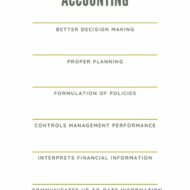
The basic objective of management accounting is to assist the management in performing its functions effectively. The functions of the management are planning, organizing, directing and controlling. What is Management Accounting? Management accounting also is known as managerial accounting and can be defined as a process of providing financial information and resources to the managers in decision making. Management accounting helps in the performance of each of these functions in the following ways: Provides data: Management accounting serves as an important source of data for management planning. The accounts and documents are a store-house of a vast quantity of data about the past progress of the enterprise, facilitating forecasts for the future. Modifies data: The accounting data required for managerial decisions is properly collected and classified. For example, purchase figures for different months may be classified to know total purchases made during each period product-wise, supplier-wise and territory-wise. Analyses and interprets data: The accounting data is probed meaningfully for effective planning and decision-making. For this purpose the data is presented in a comparative form. Ratios are calculated and likely trends are projected. Serves as a means of communication: Management accounting provides a means of communicating management plans upward, downward and outward through the organization. Initially, it means identifying the feasibility and consistency of the various segments of the plan. At later stages it keeps all parties informed about the plans that have been agreed upon and their roles in these plans. Facilitates control: Management accounting helps in translating given objectives and strategy into specified goals for attainment by a specified time and secures effective accomplishment of these goals in an efficient manner. All this is made possible through budgetary control and standard costing which is an integral part of management accounting. Uses qualitative information: Management accounting does not restrict itself to financial data for helping the management in decision making but also uses such information which may not be capable of being measured in monetary terms. Such information may be collected form special surveys, statistical compilations, engineering records, etc. Take the Quiz and Check Your Accounting IQ! 1. The financial statement that reports the revenues and expenses for a period of time such as a year or a month is the Balance Sheet Income Statement Statement Of Cash Flows 2. The financial statement that reports the assets, liabilities, and stockholders’ (owner’s) equity at a specific date is the Balance Sheet Income Statement Statement Of Cash Flows 3. Under the accrual basis of accounting, revenues are reported in the accounting period when the Cash Is Received Service Or Goods Have Been Delivered 4. Under the accrual basis of accounting, expenses are reported in the accounting period when the Cash Is Paid Expense Matches The Revenues Or Is Used Up 5. Revenues minus expenses equals __________ 6. Resources owned by a company (such as cash, accounts receivable, vehicles) are reported on the balance sheet and are referred to as __________ 7. Assets are usually reported on the balance sheet at which amount? Cost Current Market Value Expected Selling Price 8. Obligations (amounts owed) are reported on the balance sheet and are referred to as __________ 9. Liabilities often have the word __________ in their account title. 10. Unearned Revenues is what type of account? Asset Liability Stockholders’ (Owner’s) Equity Scroll Down to Know the Right Answers: ↓ ↓ ↓ ↓ ↓ 1. Income Statement 2, Balance Sheet 3. Service or Goods have been delivered 4. Expense matches the revenue or is used up 5. Net income 6. Assets 7. Cost 8. Liabilities 9. Payable 10. Liability Here are some very resourceful online courses on accounting from udemy – Give it a try: 1. Accounting & Financial Statement...