Posted by Managementguru in Entrepreneurship, Human Resource
on Mar 1st, 2014 | 0 comments
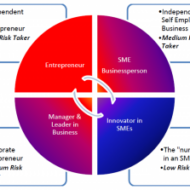
The Spirit of Entrepreneurship In the modern competitive business environment, not all graduates of various disciplines like engineering, management and the like can aspire for white collar jobs. The recent global recession has made the prospective job seekers think twice about working in foreign countries. Self employment has become the order of the day. Being your own boss is truly inspiring and motivating at least in theory. When it comes to reality, we need to know exactly what does it take to become an entrepreneur by starting a small business or taking over the business run by your predecessors. Why we need more entrepreneurs? Various avenues have been opened up thanks to communication and transportation that has brought the world under a single huge umbrella. Also small industries face minimum risk as the investments are marginal and they have the liberty to try a number of innovations like combination of new products new materials new methods of production new markets new sources of materials and even New forms of organization. Being a competitor in an open market, minimum profit and constant revenue inflow are assured and also they can enjoy the benefit of minimum fluctuation in the product price as it is determined by the market and not by individuals. Want to know 10 Daily Habits of Most Successful Entrepreneurs? Scope of entrepreneurial activity: Either you can be a subsidiary to large scale business or you can engage yourself in supply of repair services with small engineering establishments or you can go for small cottage industry businesses like cutlery, furniture, jewelry, fruit canning, soap making etc., Being fairly labor intensive, you can provide economic solution by creating employment and income opportunities in urban and rural areas with relatively low cost of capital investment. Business process outsourcing has been in recent times the magic happening in countries like India, China etc., where the foreign investors take advantage of cheap labor, time and efficient communication skills of the population. Knowledge process outsourcing has also become popular and it stands as a testimony of the rising power of Asian countries over the west. “Small is beautiful” and you can make it big in the small scale business industry if you are Innovative and productive Provide personalized services to the customers Identify and target the right markets This ensures “WINNING THE GAME OF BUSINESS“. An economy grows only when it has large number of enterprises accelerating the economic growth prospects of that particular country. The export policies of all nations have become more flexible owing to globalization, liberalization and...

Posted by Managementguru in Entrepreneurship, Human Resource
on Feb 25th, 2014 | 0 comments

Who is an entrepreneur? An entrepreneur is one with long term vision, creativity, uniqueness and the most conspicuous feature is undoubtedly his risk taking ability. He embarks on uncertain investments and also possesses an unusually minimal level of uncertainty aversion. He always comes out with brilliant business ideas since he is open to new information available in the rapidly changing business environment; this also facilitates self-directed and independent decisions aiding in quick growth maximization of the business enterprise. Attention Bloggers! Sponsor a post on Managementguru to boost your visibility, drive traffic, and build authority with our engaged business community! #SponsoredPosts #BloggingCommunity Contact Us Concept of Entrepreneurship Entrepreneurship is all about action that involves opportunity exploitation and venture creation. The concept of entrepreneurship is becoming increasingly popular in developing countries as it tends to promote economic growth of a nation. “No entrepreneur, no development,” is the kind of significance attached with entrepreneurialism. Who is an Entrepreneur Though entrepreneurship is an individual’s free choice activity, it emerges and functions in a social and cultural setting. An entrepreneur must be prudent in choosing a business activity that will be supported and valued by the society and that which improves his economic standards. Consumers are always on the look-out for a product or a service that is different but unique. This proves to be an advantage for an entrepreneur to exploit the unexplored niches of the market segment. An entrepreneur has to observe and act upon opportunities that are unusual but promising. He has to study the pros and cons of a project in terms of capital investment, plant layout, production facility, labor availability, market proximity, demography, people’s preference and economic viability. The distinct features of an entrepreneur for a better understanding: Persistence and perseverance Resourcefulness to take the business activity to the next level Eternal quest for knowledge Quality conscious Systematic planning Self-confidence Daring Crisis management with ease Persuasion –capability to convince the customers and others Strategy king Excellent communication skills Proficiency in a variety of subjects and disciplines To them , work is passion Nonchalance and the like. It is the combination of body of knowledge, set of skills and cluster of appropriate motives that makes an entrepreneur a star performer. He is the pivot about which all other factors of production, productive resources and techniques revolve. Innovativeness, risk taking ability and proactiveness are the three dimensions fundamental to the concept of entrepreneurship. Entrepreneurship is a way of thinking, reasoning and acting that is opportunity obsessed (Timmons). Lakshmi Mittals and Warren Buffets belong to this category where in they have created value through recognition of business...
Posted by Managementguru in Economics, International Business
on Feb 16th, 2014 | 0 comments

Economic Growth Strategies A Purview on Economic Growth Strategies for Developing Countries A developing country is one where the per capita income is low relative to that of fully developed countries. In human terms developing countries typically have major population percentage with poor health, low levels of literacy, inadequate dwellings and meager diets. The key to development rests on four fundamental factors namely human resources, natural resources, capital formation and technology. Human resources: A lot of poor countries are forever running hard just to stay in place. Even as a developing nation’s GDP rises, so does its population. So it becomes a mammoth task for such nations to overcome poverty with birth rates so high. Equitable distribution of wealth cannot happen in an economy unless and until it becomes self sufficient. One strategy will be to curb the population, even if such actions run against prevailing religious norms. Strategies for Developement Economic planners in developing countries lay great emphasis on the following strategies of development with regard to human capital: Control disease and improve health and nutrition Improve education, reduce illiteracy and train workers Above all, do not underestimate the importance of human resources. Literate people are knowledgeable and resourceful; their analytical skills help them to weigh the pros and cons of specific social situations that affect their standards of living. Asian countries like India and China with exploding population figures are in a situation to invest their human capital for productive purposes. Pinning Your Way to Profit With Pinterest Natural Resources: Some developing nations with meager endowments of natural resources such as land and minerals have to divide the available resources among the dense population. Perhaps the most valuable of all the resources would be arable land, as most of the people in developing countries employ themselves in farming, which is the primary economic activity. Hence the productive use of land with appropriate conservation, fertilizers and tillage will go- far in increasing a poor nation’s output. More over land ownership patterns are a key to providing farmers with strong incentives to invest in capital land’s yield. When farmers own land, they are more willing to make improvements, such as irrigation systems and undertake appropriate conservation practices. The governments have to think in these lines if their economy is based on agricultural activity: Farmers should be appraised about modern farming techniques and provided with farming equipments and fertilizers at subsidized rates. Note:-nothing should be given as free as freebies make them lethargic and unmotivated. Much of cultivable lands are being destroyed for commercial purposes which have to be checked. Power generation and supply should be copious and uninterrupted as farming, solely is dependent on availability and usage of ground water. Pumping of water is done through jet pumps and electric motors. Budding population can make a marked difference in the field of farming, as it is impossible for a nation to generate white collar jobs for everyone and it definitely elevates the capacity of youth from being mere employees to that of owners. Organic farming has found a place for itself in international market and human capital of developing nations can be employed in research and development of new strains that will facilitate to capture the global market. Capital formation: Rates of productive capital formation are low in developing countries because of deprived income; little can be saved for the future. The financing of growth in poor countries has always been an unstable link in the productive mechanism. Countries should definitely have a balanced and cautious approach when they plan to finance ambitious development programmes as they will be forced to borrow heavily from other developed countries or the World Bank. Technological change and innovations: This is...