Posted by Managementguru in Business Management, Organisational behaviour, Principles of Management, Training & Development
on Mar 7th, 2014 | 0 comments
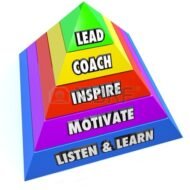
Performance Optimization Through Effective Management An organization is a network of people striving to achieve their targets. So it is a wise thing to synchronize their activities in-order to enhance the harmony and build a strong team as well that protects the network from crumbling by means of mutual trust and behavior. It is imperative for the management to define the structure and hierarchy as well as the techniques that help the organization to efficiently function. Here are some means to make your organization to function efficiently and you’re your team stand apart from the crowd. Training of Subordinates: The better the training of subordinates, the fewer the number of necessary supervisors. Well trained subordinates require not only less of their manager’s time but also less contact with their managers. ‘On the job’ training programmes have found to be more effective in industries which are labor intensive. Coaching and mentoring improve the understanding and efficiency of the workforce and help them to maximize their effort and in turn productivity. Clarity of Delegation of Authority: The most serious symptom of poor organization affecting the span of management is inadequate or unclear authority delegation. If a manager clearly delegates authority to perform a well defined task, a well trained subordinate can get it done with the minimum of manager’s time and attention. But if the subordinate’s task is not clearly defined, either the task will not be performed or it will be a colossal waste of time for the manager to supervise and guide the subordinates’ effort. Clarity of Plans: The character of a subordinates‘ job is defined by the plans to be put into effect. If these plans are well defined, if they are workable, if the authority to undertake them has been delegated, and if the subordinate understands what is expected, little of a supervisor’s time will be required. Such is often the case with a production supervisor, who bears the responsibility of achieving targets within the stipulated time period. If the plans cannot be drawn accurately, subordinates must do much of their own planning where they may lack direction. On the other hand if the superior has setup clear policies to guide decisions and has made sure they are consistent with the operations and goals of the department, work becomes simple and easy for the subordinates to follow. Communication Techniques: If every plan, instruction, order or direction has to be communicated by personal contact and every organization change or staffing problem has to be handled orally, it slows down the managerial activity. The ability to communicate plans and instructions clearly and concisely also tends to increase a manager’s span. At the same time the subordinate’s job is greatly facilitated by superiors who can express themselves well. A manager’s casual easy style may please subordinates, but it reduces the effective span of management and lowers morale as well. Amount of Personal Contact Needed: Many situations cannot be completely handled with written reports, memorandums, policy statements, planning documents and other communication techniques that do not involve personal contact which an executive find it valuable. There are other situations in which the best way of communicating a problem, instructing a subordinate, or “getting a feel” of how people really think is to spend time in personal contact . The high percentage of time spent in meetings and committees might be reduced some what by better training, better policy making and planning, clearer delegation, more thorough staff work, better control system and objectives standard. Studies have revealed that, effective spans were narrower at lower and middle levels of organization but were increased at upper levels and size had little...

Posted by Managementguru in Business Management, Organisational behaviour, Principles of Management
on Mar 6th, 2014 | 0 comments
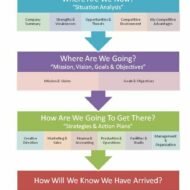
The Management Planning Process We have heard of “Master Plans” being structured and engineered to give astounding results that is purely systematic in approach and masterly in execution. Planning facilitates to make use of the opportunities that are available in the environment to make it to the top. Opportunity Analysis is nothing but, an awareness of the factors in the external environment; understanding of the strength and weaknesses of the organization. This is the first step of planning where we have to scrutinize the market, competition, customers’ preferences, tastes, our strengths and weaknesses. Establishing Objectives is another criterion that ensures “Where we want to be, and what we want to accomplish and when”. What are Objectives? Objectives are set for the organization and each subordinate is also entrusted with them. Objectives lay emphasis on goal setting which normally emanates from the top, but it may also originate from the bottom. Management by objectives is a great concept that involves all the employees working for the organization to be a part of goal setting and decision making. Planning Premises: Premises are “Assumptions” about the ‘environment.’ It involves identification of critical factors of the environment that affect the planning. Examples of critical factors are government policies, tax rates, business cycle development, economic indicators, economic forecasts etc. No body can precisely predict the environment factors precisely and make an accurate forecast. However one can fairly predict the critical factors required for the plan. Identifying Alternatives is very significant in a corporate business environment as every plan has got a set of alternative course of action. A reasonable number of alternatives can be developed for a plan. Evaluating Alternatives and Selecting the Best: A reasonable number of alternatives can be evaluated on the basis of the principle of limiting factor. The limiting factors may be costs, time, manpower and other resources. By applying techniques of operations research, every alternative can be evaluated. For e. g. alternative ‘A’ may benefit the organization in the short term but may be more expensive and alternative ‘B’ may benefit in the long run but may be less expensive. If one wants to earn immediate profits by spending more money he can choose alternative ‘A’. If the limiting factor is cost, he is forced to choose alternate plan ‘B’. Planning is not complete with selecting the best alternative; a set of derivative plans are developed to support the basic plan. For example an educational institution might like to own a fleet of buses, for which derivative plans for selection has to be made- training of drivers and maintenance staff are supportive plans for the main plan-procurement of buses. Developing budgets completes the planning course of action and budget is referred in financial terms and they are required to control the plans. Planning is the Prime Function: Planning is the prime function of all as it precedes all functions. 1. The objectives must be clear, verifiable and attainable. 2. Planning premises are vital to the success of planning as they supply information related to future like probable competitive behavior, general economic conditions, capital and material availability, government control etc. 3. All the critical factors are clearly and thoroughly analyzed and taken into consideration. One should be able to identify clearly the critical factors that limit the attainment of the goal. It could be costs, time, manpower or any other resources. 4. In a practical business situation, one should be clearer in identifying these factors, only then the selection of the best alternative is possible. 5. Any decision taken in a plan is valid for a particular period i.e., the plan may be short term or long-term, the commitment principle...
Posted by Managementguru in Business Management, Organisational behaviour, Principles of Management, Strategy
on Mar 5th, 2014 | 0 comments
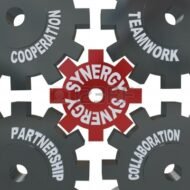
Synergy in Management Synergy: The interaction of two or more agents or forces so that their combined effect is greater than the sum of their individual effects. Synergy is the latest BUZZ WORD in the corporate business world. Synergy is the sum total of individual resources that which creates an enhanced effect greater than that of the sum total. Shall I simply say “1+1>2”! It is really amazing how much you can accomplish when it doesn’t matter who gets the credit. Teamwork divides the task and doubles the success. Unity is Strength: Synergy unites the people of an organization as a team and it serves like “BLINKERS FOR HORSES” to reach the goal of the firm without any conflicts amongst the team members. It is a managerial science and the role of top management in synergizing the employees plays a vital role in the success of the organization. As the old saying goes “Unity is Strength” and the new world aspires “Sky is the Limit”. By integrating the team members, having a smooth relationship with labor unions and management staff, a firm can achieve its overall objectives and mission in a very short span of time. Cordial Industrial Relation paves the way for the functioning of the firm without a hitch. Developing Systems for all core areas: The top management has to create “SYSTEMS” for all the core areas; Policies, procedures, rules and regulations, norms etc.,shall serve the common purpose of controlling and guiding all the employees of a firm creating a perfect ambience for efficient performance. The general managers should be the pillars of a firm who shoulder the responsibility of implementing these systems in an objective manner and not in a subjective manner. Scope: Synergy also has its scope outside the organization. The managers should be able to connect themselves with customers, banks, trade associations and also the government with ease. The weather of your firm depends on the psychology of your persona and the collective efforts of your team. If you want your firm to be SUCCESSFUL and UNIQUE, you have to POOL ALL YOUR RESOURCES, be it human, physical, financial or intangible. The competitiveness enjoyed by your firm to capture and win the market marks your strength; the limitations or restrictions that mar the growth of your firm can be overcome by the SYNERGISTIC BOOSTER that you administer into the minds of your employees. Integration is the key word that leads to DISTINCTIVE COMPETENCE, a strength that cannot be copied by other organizations which helps you to make your organization more productive and...
Posted by Managementguru in Business Management, Organisational behaviour, Principles of Management
on Mar 3rd, 2014 | 0 comments
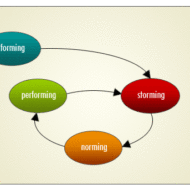
Group Dynamics Any effective group has three core activities: 1. Accomplishing its goals 2. Maintaining itself internally 3. Developing and changing in ways that improves its effectiveness. Let us now try to understand the various dimensions of an effective group that facilitate the above mentioned three core elements to function properly which provide a sense of direction to the productive group. a) Group goals: Must be clearly understood. Be relevant to the needs of the group members. Highlight the positive inter dependence of members. Evoke from every member a high level of commitment to their accomplishment. b) Communication: Must communicate their ideas and feelings accurately and clearly. Effective two way communication is mandatory for interaction c) Participation and Leadership: All should participate and all should be listened to. Share responsibilities that eases the burden. Increases the cohesiveness of the group. d) Appropriate decision making procedure: Balance between time and member resources. Flexible decision making to suit the needs of the situation. e) Power and Influence: · Should be equal · Based on expertise, ability and access to information and not on authority · Coalitions must be formed between group members on the basis of mutual influence and interdependence. f) Conflicts: · Are to be encouraged as they promote involvement in the group’s work, improve quality and creativity in decision making. · Minority opinions should be accepted and used g) Group Cohesion: · Needs to be high · Level of acceptance, support, and trust among the members decide how cohesive the group is h) Problem Solving: · Problems should be resolved with minimal energy and permanently · Existence of problems must be found out quickly and solutions should improve the effectiveness of group behavior i) Inter-personal effectiveness: · Needs to be high · It is a measure of how all the consequences of your behavior match your intention. ⇓ Picture Courtesy: 6 WAYS TO DEVELOP A WINNING TEAM CULTURE Group Cohesiveness: This is defined as the average resultant force acting on members to remain in a group. The characteristics or criteria that determine group cohesiveness are as follows: 1. Degree of dependency on the group: The greater the number of individual needs are satisfied, the greater the cohesiveness. 2. Size: If the size of the group interaction is low, it results in low cohesiveness. If the size of the group is small, the members tend to have free and more interaction, leading to high level of cohesiveness and vice versa. 3. Homogeneity: Where the interests and background of the group is similar, you find greater cohesiveness. 4. Outside pressure: Outside pressure minimizes internal conflicts leading to high cohesiveness. You find people responding with greater cohesiveness during times of natural disaster and calamities. 5. Competition: Competition between the members of the same group or intra group competition reduces cohesiveness but competition members of different groups or inter-group competition increases cohesiveness. Group Cohesiveness can be encouraged by the following ways: · Make the group smaller · Encourage agreement with group goals · Increase the time members spend together · Stimulate competition with other groups · Give rewards to groups rather than to a single member · Physically, isolate the group. ...
Posted by Managementguru in Business Management, Financial Management, Principles of Management
on Feb 21st, 2014 | 0 comments
Every business organisation’s aim is to make profit and more profit. Does it end there? What should be the real motive behind running an organization? Profit maximization alone does not help the organization to firmly plant its feet in the business environment, as the success of an organization in the long run is decided by many critical factors like, market share, value of the company shares, market stand, image etc. So, shall we say, let wealth maximization be the goal of any organization, which focuses on increasing the “earnings per share” of the share holders. What is Profit Maximization? Profit maximization does not take into consideration, the interest of share holders or stake holders, who ought to be the ultimate beneficiaries. Concentrating on short term profits confines a firm and limits its scope and growth whereas; value creation is something that the management should aim for, as it helps to increase the “net worth” of a company. Mere price versus output calculations make firms to operate in a profitable manner, but it should never be the only objective of a firm, as it has the moral and social responsibility to patronize its shareholders by increasing the net worth of the company. Underlying Logic While maximizing profit, a firm either produces maximum output for a given amount of input, or uses minimum input for producing a given output. Thus the underlying logic for profit maximization is efficiency. Under perfect competitive market conditions, profit serves as a perfect measure for the performance of a firm. If profit is the motive of a firm, it fails to consider the time value of money which is an important criterion that decides the success of a firm, and also it values benefits received today and after a period as the same. Moreover the uncertainty factor is there to be considered too. Firms always prefer to have smaller but surer profits rather than larger benefits but less certain. Impact of Taxes When we talk about profits, the next indispensable factor will be the taxes that demand a portion of your profit. Maximizing profits after the payment of taxes facilitates the firm to increase the net profit ratio to serve the best interests of the owners. But, this also fails to maximize the economic welfare of the owners, as it does not take into account, the timing and uncertainty of the benefits. Wealth maximization is the ideal alternative that is consistent with the survival goal and also with the personal objectives of managers such as recognition, power, status and personal wealth. The Right Balance between Risk and Return Mangers while deciding on investment options, seek to achieve a right balance between risk and return. If the firm borrows heavily to finance its operations, care should be taken to ensure that, the rate of return on investment should be sufficient enough to support the payment of interests on borrowings and also to repay the principal. If the firm is not able to “service the debt” there is a danger of the firm becoming bankrupt or insolvent. The firm’s investment and financing decisions are unavoidable and continuous. In order to make rational decisions, the firm must have a goal, which is nothing but the “shareholder’s wealth maximization” which is theoretically logical and operationally...