Posted by Managementguru in Business Ethics, Business Management, Decision Making, Principles of Management, Strategy
on Mar 11th, 2014 | 0 comments
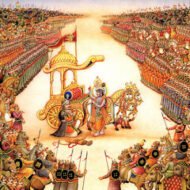
VEDIC MANAGEMENT AND LEADERSHIP INDIAN MANAGEMENT AND VEDIC LEADERSHIP From time immemorial, vedic scriptures and Upanishads have inspired people to acquire knowledge and wisdom about management principles and practices. Great spiritual leaders like Adisankara believed to be the reincarnation of Lord Shiva, Shri Krishna, the reincarnation of Lord Mahavishnu ,Lord Buddha, Shri Ramakrishna Paramahamsa have spoken of the infinite realities of life . The Philosophy of Unlearning: It is really amazing to know that these teachings though popular for their philosophical perspective also are a source of inspiration for management philosophy. These scriptures are excellent guides for attaining focus and help us to unlearn old school of thought and rejuvenate us with proper perspective and approach. Inspiration from Bhagavat Gita: Most of us would have heard about this quote from the Bhagavat Gita- “Do your duty without expectations”- “The fruits of which will be reaped automatically.” I used to wonder if this is possible, but all business men and entrepreneurs will definitely go by this since it proves to be the highest business philosophy too. Businesses thrive when done with a perfect vision , backed up by strong policies and ethical procedures. Adisankara: Adhi sankara has already paved the way for “Equality among the masses” when he realized and reiterated that people cannot be and should not be discriminated based on their caste and creed. His life span was very short-he was hardly 32 years when he left this world, but his preachings are there to stay forever. He was definitely a natural leader in presenting his views with clarity that serve as an eternal guide for mankind. Lord Krishna – A Magnificient Leader: Leaders ought to be natural and inspire people to follow them willingly. Lord Krishna was such a magnificient leader of Dwabara yuga who was a mentor for the Pancha pandavas and Gauravas too. The sad part of the story was Gauravas were not willing or not wise enough to utilise the services of Lord Krishna. We miss many viable business opportunities by oversight like Duryodana, the leader of Gauravas- he was a great warrior but not a good listener. “To be heard, you have to first listen,” I think this is the first step in the process of management Progress is impossible without change and those who are not willing to change cannot change anything. How true these words of George Bernardshaw are! Leaders of next century need to have better adaptive capabilities, cross-functional expertise, a positive attitude towards unlearning and re learning and also develop leadership of various levels of organization. What do Vedic Scriptures say? Coming back to vedic scriptures, they direct the mankind towards purifying the mind so that it becomes the hot seat of infinite energy leading to higher levels of strategic thinking and performance. The problem with us is that we always tend to correlate spirituality with renunciation of worldly life- It is not that; making the energy chakras inside our body live and active is the saarams ( essence) taking us to a heightened level in terms of thinking and action. To be a good leader your health should be fine in three key areas 1. Mental health Intelligence and creativity at its best Increased self-actualisation and self-confidence Greater ability to focus Higher levels of moral judgement Reduced anxiety and depression 2. Physical health Reduced need (or no need) for seeing the doctor for treatment Decreased risk factor for disease Reduction of high blood pressure Decreased alcohol consumption and drug abuse Stress reduction Prevention of ageing and increased longevity Note: It has been scientifically proved that by reciting GAYATHRI MANTRA and performing Sandhya vandanam, which is a natural yoga or pranayama method, your life...

Posted by Managementguru in Decision Making, Principles of Management, Project Management
on Mar 7th, 2014 | 0 comments

Fundamental Aspect of a Project Planning is the fundamental aspect of any management system as it sets the direction or pathway, which the firm has to follow in order to accomplish the goals and objectives of an organization. In a project management or a process management, planning is the key function followed by preparation of a proposal or a report that analyses and defines the resources necessary to carry on the project. This project report can then be sent for evaluation by an expert consultant to determine the feasibility and viability of the project. Organising to Get the Desired Result A project undertaken has to be meticulously planned and organized to achieve the desired result in the given time frame. One has to understand that a project differs from a process in that, it involves fixed time fame and cost frame. Say,for instance, your firm is rewarded with a project to design ERP solutions for a big corporate company. What will be step one? You will try to gather all the details regarding organization structure and hierarchy, people involved and their designations, availability of physical resources, whether the corporate firm is technically equipped, product portfolio, strategic business units and their viability, distribution channels and so on., As one is aware, enterprise resource solution software integrates production, marketing and human resource departments to facilitate even flow of information and quick execution of orders without any time delay. Picture Courtesy: Project Management and Leadership Champions Data Collection Data collection is inevitable and has to be precise to attain your set goals. The next logical step will be deciding the time frame and allocating resources (human and other physical resources) to carry on the project. If you feel that the delivery deadline cannot be met with, you have to immediately inform your sponsors about the time delay and extend your time frame for the project to materialize. On -Time Delivery Projects that involve production and delivery of goods depend on the manufacturing cycle time and delivery lead time. Implementation becomes a cake walk if your business plan has incorporated, 1) well laid down step by step procedures, 2) leverage for uncertainty in the external environment and 3) focus on proper communication. Communicating the entire project plan as per the intentions to the people concerned is very vital for the success of a project, because people should understand, what needs to be done, what is one’s role, and the strategies evolved by the management. PERT and CPM Program evaluation and review techniques (PERT) and critical pathway method are some of the tools that help in ascertaining the progress rate of projects. These tools help in identifying specific milestones and activities that are to be carried out in a sequential manner and also to estimate the time required for each activity, with a help of a network diagram. A very interesting and simple video explaining how to determine project duration using critical path…. Success of a project management is determined by Decision making ability Communication skills Negotiation techniques and Time management skills, of the project manager and also depends on how well it protects the interests of the stakeholders involved. A project is a comprehensive team effort with the budget and time well within the scope of the...
Posted by Managementguru in Business Management, Labor Management, Organisational behaviour
on Mar 7th, 2014 | 0 comments

People Management and Trade Unions Need for Trade Unions Why do employees join trade unions is an important question. Most of the workers are members of any one of the trade unions. One of the major objectives of trade unionism is to promote industrial democracy. This objective is achieved when trade union is an organization of the workers, for the workers and by the workers”. In practice this rarely happens and instead unions become an oligarchy. Union leaders by and large, show authoritative behavior with less participation, openness and transparency. Decision-making is centralized, elections are often postponed and positions are filled repeatedly by nominations. Rank and file is pampered with promises and seldom gets near to decision-making process. Positions get worse when unions are guided by outside leaders and regulated by the policies of political parties. Ideology of Trade Unions Absence of democratic leadership reduces the effectiveness of trade unions and prevents the development of trade union leadership from among the workers within the industries. In due course, trade unions become obsessed with political ideology or personal interest ousting the welfare of the workers. Before we move on to the functions of trade unions, let us understand the reasons for the existence of such organizations. To get a common platform to air ones views, aims, ideas and feelings and obtain recognition and status among fellow workers. Make use of the principle of unity for the purpose of securing good working conditions, higher economic compensations, better career prospects and welfare needs. Security of employment and protection against calamity of accident, death and social security after retirement. Restrict management action which is against the interest of the workers. Functions of a Trade Union The internal functions of a labor union includes better wage claim, to ensure better working conditions, reasonable work etc.,The external functions include conducting night school, games, sports and other recreational activities. These two functions may be grouped as economic and social functions. Many unions try to capture political power through election, so that they can influence upon the programmes and policies of government in favor of labor. This function is known as political function. Under the legal functions, the interpretation of law takes the major share. A jist of the main purpose of trade organizations: To improve the standard of living and working condition of the workers. To protect the security of workers’ employment. To ensure better health, reasonable working hours and welfare measures. To improve the political status. To raise the vocational status. To bring better participation in the management. To inculcate the feeling of self respect and confidence among worker force. To bring industrial peace and harmony. As long as unionism is considered as an anathema by the management, there will be lack of harmony and mutual trust between the management and labor force. Management must not consider labor unions as a legal obligation as it does not develop faith and goodwill. Instead the union has to be viewed as a partner in trade to live with and work with. Union must also recognize that work is worship and the survival and success of organization depends on the very survival and success of the workforce. Once the team spirit is built up no unreasonable demands will be raised and union leaders must view strikes and lock outs as last resorts to put pressure on management. The Trade Unions Act, 1926– An act to provide for the registration of Trade Unions and in certain respects to define the law relating to registered Trade...
Posted by Managementguru in Business Management, Organisational behaviour, Principles of Management
on Mar 3rd, 2014 | 0 comments
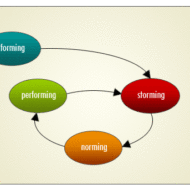
Group Dynamics Any effective group has three core activities: 1. Accomplishing its goals 2. Maintaining itself internally 3. Developing and changing in ways that improves its effectiveness. Let us now try to understand the various dimensions of an effective group that facilitate the above mentioned three core elements to function properly which provide a sense of direction to the productive group. a) Group goals: Must be clearly understood. Be relevant to the needs of the group members. Highlight the positive inter dependence of members. Evoke from every member a high level of commitment to their accomplishment. b) Communication: Must communicate their ideas and feelings accurately and clearly. Effective two way communication is mandatory for interaction c) Participation and Leadership: All should participate and all should be listened to. Share responsibilities that eases the burden. Increases the cohesiveness of the group. d) Appropriate decision making procedure: Balance between time and member resources. Flexible decision making to suit the needs of the situation. e) Power and Influence: · Should be equal · Based on expertise, ability and access to information and not on authority · Coalitions must be formed between group members on the basis of mutual influence and interdependence. f) Conflicts: · Are to be encouraged as they promote involvement in the group’s work, improve quality and creativity in decision making. · Minority opinions should be accepted and used g) Group Cohesion: · Needs to be high · Level of acceptance, support, and trust among the members decide how cohesive the group is h) Problem Solving: · Problems should be resolved with minimal energy and permanently · Existence of problems must be found out quickly and solutions should improve the effectiveness of group behavior i) Inter-personal effectiveness: · Needs to be high · It is a measure of how all the consequences of your behavior match your intention. ⇓ Picture Courtesy: 6 WAYS TO DEVELOP A WINNING TEAM CULTURE Group Cohesiveness: This is defined as the average resultant force acting on members to remain in a group. The characteristics or criteria that determine group cohesiveness are as follows: 1. Degree of dependency on the group: The greater the number of individual needs are satisfied, the greater the cohesiveness. 2. Size: If the size of the group interaction is low, it results in low cohesiveness. If the size of the group is small, the members tend to have free and more interaction, leading to high level of cohesiveness and vice versa. 3. Homogeneity: Where the interests and background of the group is similar, you find greater cohesiveness. 4. Outside pressure: Outside pressure minimizes internal conflicts leading to high cohesiveness. You find people responding with greater cohesiveness during times of natural disaster and calamities. 5. Competition: Competition between the members of the same group or intra group competition reduces cohesiveness but competition members of different groups or inter-group competition increases cohesiveness. Group Cohesiveness can be encouraged by the following ways: · Make the group smaller · Encourage agreement with group goals · Increase the time members spend together · Stimulate competition with other groups · Give rewards to groups rather than to a single member · Physically, isolate the group. ...
Posted by Managementguru in Human Resource, Training & Development
on Feb 28th, 2014 | 0 comments
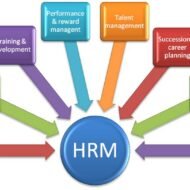
Definitions of Human Resource Management: 1. “A series of integrated decisions that govern employer-employee relations. Their quality contributes to the ability of organisations and employees to achieve their objectives.” (Milkovich & Boudreau, 1997). 2. “Concerned with the people dimension to management. Since every organisation comprises people, acquiring their services, developing their skills, motivating them to higher levels of performance and ensuring that they continue at the same level of commitment to the organisation are essential to achieving organisational goal. This is true, regardless of the type of organisation: viz. government, business, education, health, recreation, or social action.” (Decenzo & Robbins, 1989). 3.”The planning, organising directing and controlling of the procurement, development, compensation, integration, and maintenance of human resource to the end those individual, organisational, and social objectives are accomplished.” (Flippo, 1984). 4. “The organisation function that focuses on the effective management, direction, and utilisation of people; both the people who manage produce and market and sell the products and services of an organisation and those who support organisational activities. It deals with the human element in the organisation, people as individuals and groups, their recruitment, selection, assignment, motivation, empowerment, compensation, utilisation, services, training, development, promotion, termination and retirement.”(Tracey,1994 ) Knowledge Workers Human resource management is therefore understood as the all significant art and science of managing people in an organisation. Increasing research output in behavioral sciences, new trends in managing ‘knowledge workers’ and advances in training methodology and practices have led to substantial expansion of the scope of human resource management function in recent years. HRM is not just an arena of personnel administration anymore but rather a central and pervasive general management function involving specialised staff as assistants to main line managers. Managing employee relationships is the role of the Human Resource department Human Resource Management is a process of valuing and developing people at work, this includes: Recruitment and selection Employee communication and engagement (participation) to increase employee retention Training and development Leadership WHAT IS YOUR GREATEST WEAKNESS Labour turnover & staff retention Labour turnover refers to the proportion of a workforce that leave during a period of time (usually one year) Labour turnover = number of staff leaving during the period x 100 average number of staff Staff retention refers to the ability of a firm to keep its workers. The disadvantages of having a large proportion of staff leaving each year include: The cost of recruiting replacement workers The cost of training the new workers Loss of productivity whilst replacements are found Loss of experienced workers Negative impact on reputation WHAT IS YOUR GREATEST STRENGTH Methods to control turnover: 1. Financial methods of motivation Bonuses Profit share Fringe benefits 2. Non financial methods of motivation Employee engagement and empowerment Training and development Promotion opportunities 3. Improved Human Resource Management procedures Four Fundamental Principles of HRM: Human Resource is the organisation’s most important asset; Personnel policies should be directed towards achievement of ENTERPRISE goals and strategic plans; Corporate culture exerts a major influence on achievement of excellence and must therefore be strengthened with consideration of employee welfare. Whilst integration of corporate resources is an important aim of HRM, it must also be recognised that all organisations are ‘pluralist societies’ in which people have differing interests and concerns, which they defend and at the same time function collectively as a cohesive group. →Evolution of...