Posted by Managementguru in Human Resource, Interview Questions, Strategy, Training & Development
on May 30th, 2014 | 0 comments
How Do You Answer the Job Interview Question – What is Your Greatest Strength “If you fail to prepare, then be prepared to fail”- This saying hundred percent fits the rule of the game when it comes to job interview. Spade-work is absolutely essential: – about the company in which you are seeking a position, key members involved in the making of the company, the culture and other prospects. FIQ’s of JIQ’S: Let us look at some of the common and frequently asked questions in interviews and try to understand what the interviewer expects your answer to be. Try to gauge the underlying purpose of the question in relevance to the job being applied for and please also realize the fact that interviews are acid-tests to estimate your personality as a whole; not simply your knowledge, skills and experience. What do they mean by strength? Strength is nothing but what you are good at. Say, you might be good at singing, you might be good at ballet dancing, and you might be good at even eaves-dropping! But is it a pleasant or an appreciable attribute to be discussed when it comes to your job interview? Always remember when asked about your strengths, you have to pin-point the qualities that are needed to complete the task you might be assigned for, in case you are selected. Everything in relation to the job position you are trying to acquire. Understand Employers’ Perspective and Satisfy Their Expectation: Neither be blunt nor blatant, try to give a big picture of all your experiences in the previous jobs as an impressive package and make the interviewer feel that you will definitely be an asset to the company. If it is a sales manager position, you might want to explain precisely how you completed your sales targets ahead of time, how you increased the growth rate of your company in a time-bound fashion and how you pulled your team through tough situations. If you are naturally good at communicating, no probs, but if not, it is better to have a list mentally prepared of your greatest strengths prior to an interview. By communicating, I don’t mean to say talking but making your point noted or reaching across. If you are a fresher, you have nothing to lose by being bold and assertive as it will only add to your experience. All mistakes are experiences which teach us “how not to perform a task” or “how not to behave in a particular situation”. Here is a list of the 10 most desirable traits that all employers love to see in their employees: A proven track record as an achiever…especially if your achievements match up with the employer’s greatest wants and needs. Intelligence…management “savvy”. Honesty…integrity…a decent human being. Good fit with corporate culture…someone to feel comfortable with…a team player who meshes well with interviewer’s team. Likeability…positive attitude…sense of humor. Good communication skills. Dedication…willingness to walk the extra mile to achieve excellence. Definiteness of purpose…clear goals. Enthusiasm…high level of motivation. Confident…healthy…a leader. Courtesy – http://dev.fyicenter.com Not everybody has all these qualities imbibed in them; it all lies in your expression of interest to learn those qualities which you are slightly lacking and enhance those qualities which you are already good at. It is that spark of enthusiasm makes you all different and more prospective than your competitors. With this question, the interviewer seeks to find out if: • Your strengths align with the company’s needs • You can do the job and perform like a rock star • You are the best person for the job — no need to hold out for someone better • You have...

Posted by Managementguru in Change management, Human Resource, Organisational behaviour
on May 20th, 2014 | 0 comments
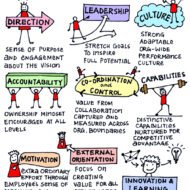
Organizational Climate – An Analogy Organizational climate is a measure of the feel of the internal environment of an organization which is perceived by an outsider and/or an employee according to their business with the organization. Organizational climate has a great effect on employees’ behavior. If the climate of an organization is open and friendly, employees feel relaxed and if it is very formal, then such a comfort level may not be felt. Climate for an organization is somewhat like personality for a person. “Just as every individual has a personality that makes him/her unique, an organization has a climate that clearly distinguishes its personality from other organizations. Human religionists introduced the concept of organizational climate in the late 1940’s. Now this has become a very useful metaphor for thinking about and describing the social aspects of a firm. Some definitions: “A set of characteristics that describe an organization and that i. Distinguish one organization from another ii. Are relatively enduring over a period of time and iii. Influence the behavior of people in the organization.” – Forehand and Gilmber “A mutually agreed internal (or molar) environmental description of an organization’s practices and procedures.” – Benjamin Schneider (1975) “A relatively ending quality of the internal environment that is experienced by the members, which influences their behavior and can describe in terms of values of a particular set of characteristics of the organization.” – Renato Tagiuri (1968) Features: It is an abstract and intangible concept. But it exercises a significant impact on the behavior and performance of organization members. It is the perceived aspect of organization’s internal environment. It refers to the relatively enduring characteristics which remain stable over a period of time. It gives a distinct identity to organization and differentiates it from others. It is a total expression of what the organization is. It is the summary perception which people have about organizations. It is a multi-dimensional concept. It consists of all organizational factors – authority pattern, leadership pattern, communication pattern, control etc. Elements of Organizational Climate: Individual Autonomy: The extent to which employees are entrusted with to make decisions, the degree to which they are free to manage themselves and have the freedom to exercise their responsibility come under the purview of individual autonomy. Position Structure: It means the extent of direct supervision, formalization and centralization in an organization. Reward Orientation: The degree to which an organization rewards individuals for hard work or achievement. It will be high when an organization orients people to perform better and rewards them for doing so. Task Orientation: If the outlook of the top management is task oriented, the employees will have to speed up the pace of work to please their bosses. Relations Orientation or Consideration: Here the climate is conducive and supportive where the managers are relations-oriented while dealing with their sub-ordinates. The needs and aspirations of the workers will be given due importance resulting in enhanced team spirit. Job Satisfaction: The workers feel happy if the jobs are designed to allow the worker to use their innovative skills. Morale: Morale represents a composite of feelings, attitude and sentiments of organizational members towards the organization, superiors and fellow workers. If it is high, there will be an atmosphere of co-operation and if it is low, there will be conflicts and poor co-operation among the workers. They will also feel dis-oriented in their work. Control: The control systems may be either rigid or flexible. An impersonal or bureaucratic atmosphere is seen in the former situation where the scope of self-regulation will be minimum. DOWNLOAD THE PDF...
Posted by Managementguru in Operations Management, Principles of Management, Technology
on May 12th, 2014 | 0 comments
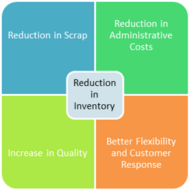
Just in Time Manufacturing Concept JIT Philosophy: With the progression in product-process technologies and the hybrid manufacturing systems, the Japanese have been perfecting a manufacturing system called ‘Just in Time’ or ‘JIT’. This JIT operating system is nothing but a production strategy that strives to improve business return on investment by reducing in-process inventory and associated carrying costs. The JIT purchasing system has emphasis on timing to supply materials just in time for use on the factory floor. Equally important emphasis is given to close and long term relationship with a few suppliers. The suppliers in JIT manufacturing are geographically closely located. Specifications: Producing and delivering finished goods ‘just in time’ to be sold Partly finished goods ‘just in time’ to be assembled into finished goods Parts ‘just in time’ to go into partly finished goods Materials ‘just in time’ to be made into parts. Loose specifications instead of rigid product specifications are used which leads to best use of supplier specialization and expertise for low cost and better quality. Frequent deliveries (daily deliveries) of small lots of exact quantities required are supplied directly to the shop floor avoiding large inventories, paper work and double inspection. The JIT system underlines the mutual confidence between buyer and supplier and long term relationship. This leads to investment by the supplier for the benefit of the buyer in terms of plant and equipment for improvement of quality, reduction of cost and shortening manufacturing lead times. Where does the responsibility lie? ‘The responsibility for the quality rests with the manufacturer of the part’ is the principle behind this Japanese practice. The primary responsibility for quality is transferred from quality control department to the production department. The quality control is considered a line function rather than staff function. The processes are designed to have less specialization on the part of workers. The physical layout is arranged in such a way that workers can operate two or three machines effectively and thereby become multifunctional. Good Quality First Time Every Time: Workers are organized in small closely linked groups thereby building team work. The production for each stage is planned in small lot sizes just meeting the needs of the subsequent stage. The system is such that even if one item produced is substandard, it would affect subsequent processes causing shortages and exposing the process or worker who has produced substandard item. This acts as a great motivator to produce good quality first time, every time. This also heightens the awareness among the workers about the inter dependence of processes. Taiichi Ohno, Father of the Toyota Production System saw this as an attribute rather than a problem. He used an analogy of lowering the water level in a river to expose the rocks to explain how reducing inventory showed where production flow was disrupted. Once bottle necks were exposed, they could be rectified or removed. Since one of the main barriers was rework, lowering inventory shoved each shop to improve its own quality. Just-in-time is a means to improving performance of the system, not an end. The result of the Japanese manufacturing system is quite pervasive in the areas of: Reduction in inventory Reduction in scrap Reduction in work Reduction in indirect costs Reduction in spare Reduction in administrative costs Increase in motivation of workers Increase in quality Better response to customers Better system flexibility and quicker response. What is kanban? Kanban is Japanese for “visual signal” or “card.” Toyota line-workers used a Kanban (i.e., an actual card) to signal steps in their manufacturing process. The system’s highly visual nature allowed teams to communicate more easily on what work needed to be done and when. It...
Posted by Managementguru in Business Management, Decision Making, Marketing, Operations Management, Project Management
on May 7th, 2014 | 0 comments
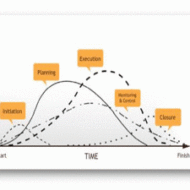
Project Formulation and Project Life Cycle What is a Project? “A temporary endevour leading to a product / service or result ” A project is any series of activities and tasks that: • Have a specific objective to be completed within certain specifications • Have defined start and end dates; • Have funding limits (if applicable); and • Consume resources (i.e. money, time, equipment). Characteristic Features of a Project: • Has a mission or a set of objectives. Once the mission is achieved the project is treated as completed. • Has to terminate at some time or the other (temporary in nature) • The project is one single entity and its responsibility is assigned to one single agency. • Calls for team-work, the members of the team may come from different organizational units, different disciplines, and geographic regions. • Has a life cycle represented by growth, maturity and decay. • Is unique and no two projects are similar, even though the plants set up are identical. The organizations, the infrastructure, the location and the people make the project unique. • Change is a natural phenomenon with every project throughout its life span. Some changes may not have any major impact, but some may change the very nature of the project. • The happenings during the life cycle of a project are not fully known at any stage. As time passes, the details are finalized successively. • Is always customer-specific. The requirements and constraints within which a project must be executed are stipulated by the customer. • Is a complex set of things. Projects vary in terms of technology, equipment and materials, machinery and people, work ethics and organizational culture. • A substantial portion of the work in a project is done by sub-contracting. The greater the complexity of a project, the greater will be the extent of work performed by subcontractors. • Is exposed to risk and uncertainty and the extent of these depend upon how the project moves through the various stages in its life span. • A well defined project has lesser risk and uncertainty, whereas an ill-defined project faces greater degree of risk and uncertainty. Project Life Cycle: The Project Life Cycle refers to a series of activities which are necessary to fulfill project goals or objectives. The different phases are as follows: a) Concept or initialization phase In this phase, the project idea emerges and the #management decides on the need for a project. A project which is well conceived can be later implemented successfully. b) Project Definition Phase •The techno-economic viability of the project is checked •The technical configuration of the project is identified •The performance requirements, sub-systems, key equipments etc.- purchased •The cost estimates with limits are identified •Schedule of implementation is identified c) Growth or Organisation Phase Organizations, during this phase, undertake the following actions: a) Establishing the infrastructure and enabling services for the project b) Project engineering and design c) Setting up Project Organization and staffing d) Appointing a project manager e) Preparing schedules and budgets f) Obtaining necessary licenses and clearances from the Government g) Raising finance h) Developing systems and procedures for monitoring and reviewing project progress i) Procedures for inviting tenders and awarding contracts j) Site preparation and development k) Procuring equipment and materials l) Work packaging This phase covers both paper work connected with project planning and also implementation activities. Planning is necessary to avoid crisis management; it makes the implementation phase to run smoothly. d) Implementation Phase The activities include: 1) The preparation of specifications for major equipment and machineries, 2) Placing orders with vendors for the supply of...
Posted by Managementguru in Business Management, Decision Making, Human Resource, Organisational behaviour, Principles of Management
on Apr 19th, 2014 | 0 comments

Business Policies – Framing and Execution Business policies are the keystone in the arch of management and the life-blood for the successful functioning of business, because without well-laid down policies, there cannot be lasting improvements in the economic condition of the firm and labor-management relations. A policy is a positive declaration and a command to its followers. It translates the goals of an organization into selected routes and provides the general guidelines that prescribe and proscribe programmes, which in turn, dictate practices and procedure. Attainment of Objectives: Buisness policies are general statement of principles for the attainment of objectives which serve as a guide to action for the executives at different levels of management. They pave a broad way in which the sub-ordinates tread along towards accomplishing their objectives. Hierarchy: For each set of objectives at each level, there is a corresponding set of policies. The Board of Directors determine the basic overall corporate policiesThe top management decides on the executive corporate policiesManagers decide on the departments / divisional policiesMiddle managers handle the sectional policies Consistent Decisions contributing to the Objectives: The policies delimit the area within which a decision has to be made; however, they do allow some discretion on the part of the man on the firing line, otherwise, they would be mere rules. At the same time too much of discretion in policy matters may prove harmful to the accomplishment of organizational objectives and hence it is generally within limits. Mutual Application: Policies in general are meant for mutual application by sub ordinates. They are fabricated to suit a specific situation in which they are applied, for they cannot apply themselves. Unified Structure: Policies tend to predefine issues, avoid repeated analysis and give a unified structure to other types of plans, thus permitting managers to delegate authority while maintaining control. Policies for all Functional Areas: In a well-structured and managed organization, policies are framed for all functional levels of management. Corporate planningMarketingResearch and DevelopmentEngineeringManufacturingInventoryPurchasePhysical DistributionAccountingFinanceCostingAdvertisingPersonal SellingSpecial Promotion, are some areas that require clear-cut policies. Clear-Cut Guidelines: Policies serve an extremely useful purpose in that they avoid confusion and provide clear-cut guidelines. This enables the business to be carried on smoothly and often without break. They lead to better and maximum utilization of resources, human, financial and physical, by adhering to actions for...