Posted by Managementguru in Business Management, Labor Management, Organisational behaviour
on Mar 7th, 2014 | 0 comments
People Management and Trade Unions Need for Trade Unions Why do employees join trade unions is an important question. Most of the workers are members of any one of the trade unions. One of the major objectives of trade unionism is to promote industrial democracy. This objective is achieved when trade union is an organization of the workers, for the workers and by the workers”. In practice this rarely happens and instead unions become an oligarchy. Union leaders by and large, show authoritative behavior with less participation, openness and transparency. Decision-making is centralized, elections are often postponed and positions are filled repeatedly by nominations. Rank and file is pampered with promises and seldom gets near to decision-making process. Positions get worse when unions are guided by outside leaders and regulated by the policies of political parties. Ideology of Trade Unions Absence of democratic leadership reduces the effectiveness of trade unions and prevents the development of trade union leadership from among the workers within the industries. In due course, trade unions become obsessed with political ideology or personal interest ousting the welfare of the workers. Before we move on to the functions of trade unions, let us understand the reasons for the existence of such organizations. To get a common platform to air ones views, aims, ideas and feelings and obtain recognition and status among fellow workers. Make use of the principle of unity for the purpose of securing good working conditions, higher economic compensations, better career prospects and welfare needs. Security of employment and protection against calamity of accident, death and social security after retirement. Restrict management action which is against the interest of the workers. Functions of a Trade Union The internal functions of a labor union includes better wage claim, to ensure better working conditions, reasonable work etc.,The external functions include conducting night school, games, sports and other recreational activities. These two functions may be grouped as economic and social functions. Many unions try to capture political power through election, so that they can influence upon the programmes and policies of government in favor of labor. This function is known as political function. Under the legal functions, the interpretation of law takes the major share. A jist of the main purpose of trade organizations: To improve the standard of living and working condition of the workers. To protect the security of workers’ employment. To ensure better health, reasonable working hours and welfare measures. To improve the political status. To raise the vocational status. To bring better participation in the management. To inculcate the feeling of self respect and confidence among worker force. To bring industrial peace and harmony. As long as unionism is considered as an anathema by the management, there will be lack of harmony and mutual trust between the management and labor force. Management must not consider labor unions as a legal obligation as it does not develop faith and goodwill. Instead the union has to be viewed as a partner in trade to live with and work with. Union must also recognize that work is worship and the survival and success of organization depends on the very survival and success of the workforce. Once the team spirit is built up no unreasonable demands will be raised and union leaders must view strikes and lock outs as last resorts to put pressure on management. The Trade Unions Act, 1926– An act to provide for the registration of Trade Unions and in certain respects to define the law relating to registered Trade...

Posted by Managementguru in Business Management, Organisational behaviour, Principles of Management
on Mar 7th, 2014 | 0 comments
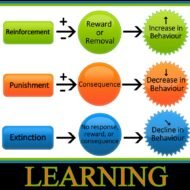
Reinforcers and Behaviour Changes Reinforcers induce and enhance the association between the cue and the expectancy. This leads to increased performance levels and positive attitude development. This is an effective and efficient strategy that has been proved to be successful. Reinforcement is inevitable for learning process and in a dynamic corporate business environment, unlearning the old things and learning and adapting oneself to satisfy the needs of the changing environmental and economic factors is the critical success factor that serves as the backbone of the success of the company. Significance of Learning: Learning is not the only attribute that gets enhanced by reinforcers; as a result there is a repetition of desirable behavior that helps in maintaining the consistency, cordiality and climate of the organization. Reinforces increase the strength of response leading to desirable or undesirable consequences depending upon the kind of reinforcer, which might be a reward or a punishment. Either way it elicits response that gets strengthened in course of time. Mindset of People: The management side that is the deciding authority has to come to clear terms with the kind of treatment applicable on specific situations; say for instance when there is a need to complete a project in the stipulated time or achieve quantifiable targets which may prove very challenging or increase the production capacity in order to retain a major market share. Whatever be the case, the morale of the workers down the line, executives who coordinate the process, the managers who manage and report has to be maintained in the highest order. The mind set of the people working for you is very important as it encompasses the quality of work done, commitment to duty and determination to reach the target on time. Rewards: Rewards always make people happy and are found to be positively reinforcing. If you feel that monetary rewards are always a better stimulus, you are wrong. Money is always considered to be a reward; to consider it as a reinforcer cannot be neglected but at the same time it definitely is not a positive reinforcer.Feedback on performance is rated high on the reinforcer scale which takes you to the next level as a performer. Modern organizations have understood the system’s anomaly that gives undue importance to the huge amount of data that speaks volumes about people and their merits and achievements. Is it really enough to know things about people? People expect feedback about their performance and people with some degree of achievement definitely have an intense desire to know how they are doing? The more specific your feedback is, better the impact and greater the delay between the performance and feedback, the less the effect. Work Environment: The work environment itself can serve as a very good positive reinforcer provided there is freedom of expression, liberty to participate and an open door policy adopted by the managers and superiors. The top level management must take utmost care to design the reward system in such a way that it warrants fairness and equity. Employees are motivated to go for self appraisals with goal setting that is the biggest reinforcer of all times. Recognition: Recognition, rewards and praise tend to boost the ego of individuals which you can work it up to your advantage. Punishment is one of the most used and convenient but least understood and badly administered aspect of learning and reinforcing. Punishment equally alters the behavior of your subordinates which becomes more complex in course of time. Positively dealing with your subordinates by giving them one more chance, of course with a warning might serve the purpose. If punishments modify the behavior...
Posted by Managementguru in Business Management, Principles of Management, Training & Development
on Mar 7th, 2014 | 0 comments
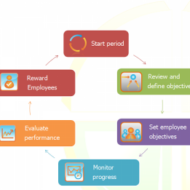
MBO BY PETER DRUCKER Peter Ferdinand Drucker was an influential writer, management consultant, and self-described “social ecologist. Harvard Business Review honored Drucker in the June 2004 with his seventh McKinsey Award for his article, “What Makes an Effective Executive”, the most awarded to one person. The Concept of MBO: Management by objectives was a concept introduced by the doyen of management, Peter Drucker. This concept involves formulation of objectives for the entire organization and which are then broken down into divisional, departmental and finally individual objectives. Objectives are decided on the basis of mutual consultation between managers and employees at the departmental and divisional levels and thus it can be appropriately called an integration of top down and bottom up approaches in management. The specific aim is to make the employees participate in decision making and thus motivate them to perform better. Management by objectives follows a step-by-step procedure that ensures the feasibility of the action plans decided upon. Realistic and achievable plans are set. Activities to be preformed are identified. Logical relationship between the sequences of activities is laid down. Time frame and cost frame are fixed. Resources to be allocated are decided upon. Salient features of the process: Self control and Self direction: The workers exhibit keen self control in that, they self appraise their performance that results in intrinsic motivation. Setting short goals and periodical review to match the current performance with the expected standards greatly boosts the performance of each and every individual and gives him the necessary drive to accomplish the assigned tasks. Periodic progress review: This helps to correct errors and deviations if any. This review is done by managers of higher levels in a constructive way and adequate counseling and guidance can be given to the subordinates to bridge the shortfall if any, in performance. This is possible only when there exists a mutual understanding between the superior and subordinates to find reasons and solve problems together. Reviews need not necessarily pinpoint errors but also revise future plans and actions. The major emphasis of management by objectives lies in its result oriented approach. What is the relationship between management by objectives and motivation? Motivation of an employee can be brought about by financial incentives such as bonus, increments, pay and perks or non-financial incentives such as recognition, appreciation and additional responsibilities. But nothing can equal self-motivation which makes an employee perform with aplomb. As management by objectives is directly linked with goal-setting, performance becomes better and better as the goals are set at a higher level. It involves complete participation from the employees’ end and when specific goals are set by mutual consent of workers and management, the results are magnificent. Many firms practice management by objectives to promote harmony and sense of belonging in the minds of employees as a result of which there is remarkable improvement in performance and productivity. The focus is on improving the job design and work module to make the jobs more meaningful, interesting and...
Posted by Managementguru in Business Management, Organisational behaviour, Principles of Management
on Mar 6th, 2014 | 0 comments
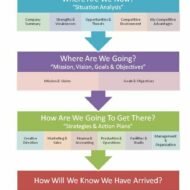
The Management Planning Process We have heard of “Master Plans” being structured and engineered to give astounding results that is purely systematic in approach and masterly in execution. Planning facilitates to make use of the opportunities that are available in the environment to make it to the top. Opportunity Analysis is nothing but, an awareness of the factors in the external environment; understanding of the strength and weaknesses of the organization. This is the first step of planning where we have to scrutinize the market, competition, customers’ preferences, tastes, our strengths and weaknesses. Establishing Objectives is another criterion that ensures “Where we want to be, and what we want to accomplish and when”. What are Objectives? Objectives are set for the organization and each subordinate is also entrusted with them. Objectives lay emphasis on goal setting which normally emanates from the top, but it may also originate from the bottom. Management by objectives is a great concept that involves all the employees working for the organization to be a part of goal setting and decision making. Planning Premises: Premises are “Assumptions” about the ‘environment.’ It involves identification of critical factors of the environment that affect the planning. Examples of critical factors are government policies, tax rates, business cycle development, economic indicators, economic forecasts etc. No body can precisely predict the environment factors precisely and make an accurate forecast. However one can fairly predict the critical factors required for the plan. Identifying Alternatives is very significant in a corporate business environment as every plan has got a set of alternative course of action. A reasonable number of alternatives can be developed for a plan. Evaluating Alternatives and Selecting the Best: A reasonable number of alternatives can be evaluated on the basis of the principle of limiting factor. The limiting factors may be costs, time, manpower and other resources. By applying techniques of operations research, every alternative can be evaluated. For e. g. alternative ‘A’ may benefit the organization in the short term but may be more expensive and alternative ‘B’ may benefit in the long run but may be less expensive. If one wants to earn immediate profits by spending more money he can choose alternative ‘A’. If the limiting factor is cost, he is forced to choose alternate plan ‘B’. Planning is not complete with selecting the best alternative; a set of derivative plans are developed to support the basic plan. For example an educational institution might like to own a fleet of buses, for which derivative plans for selection has to be made- training of drivers and maintenance staff are supportive plans for the main plan-procurement of buses. Developing budgets completes the planning course of action and budget is referred in financial terms and they are required to control the plans. Planning is the Prime Function: Planning is the prime function of all as it precedes all functions. 1. The objectives must be clear, verifiable and attainable. 2. Planning premises are vital to the success of planning as they supply information related to future like probable competitive behavior, general economic conditions, capital and material availability, government control etc. 3. All the critical factors are clearly and thoroughly analyzed and taken into consideration. One should be able to identify clearly the critical factors that limit the attainment of the goal. It could be costs, time, manpower or any other resources. 4. In a practical business situation, one should be clearer in identifying these factors, only then the selection of the best alternative is possible. 5. Any decision taken in a plan is valid for a particular period i.e., the plan may be short term or long-term, the commitment principle...
Posted by Managementguru in Business Management, Organisational behaviour, Principles of Management
on Mar 6th, 2014 | 0 comments
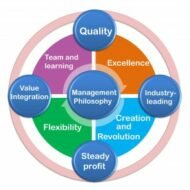
Corporate Philosophy of Management CORPORATE PHILOSOPHY OF MANAGEMENT calls for creating a framework of values, beliefs and ethical standards which are considered to be vital for an effective management. They must be embedded in formal and informal philosophical statements which are then communicated to the fraternity of that organization. From a broader perspective, the LEADER has to have a VISION as to where he is heading his company in the next three to four years. Corporate Objectives provide vision as well as direction and map for bold decisions to be taken regarding NEW MARKETS MARKET SHARE PRODUCTS SERVICES etc. , Now the organization is in a position to decide and prioritise the VALUES AND COMPETENCIES it expects from its managers. For example, if the situation favors the business expansion to new markets, say, European or Asian, then an organization has to develop competence in areas like LANGUAGE AND CULTURE, besides marketing and business skills. Different Philosophies of Management: Well, you might have been inspired with JAPANESE PHILOSOPHY OF MANAGEMENT, EASTERN OR WESTERN PHILOSOPHY OF MANAGEMENT t. But what is the fun? If you don’t have A SOUND MANAGEMENT PHILOSOPHY of your own, to simply put it, you don’t have a broad set of principles to back up your management development process which is a generic one. Ideally speaking, you should be able to develop a concrete SYSTEM that is made up of FOOL PROOF policies and procedures; try to develop a professional team of executives who can take up your vision to the next level; these measures will prove worthwhile in the long run. You are left without any choice but to develop “truly” INTERNATIONAL MANAGERS who could transcend nationally and the location of any specific job consideration. This is what Ideal management philosophy means to me, A holistic vision of the future A solid set of principles(values, beliefs) Sound policy definition Management development programmes Autonomy to my work force Always “yes “to new technology Development of women managers Flexible leadership Social responsibility Contribution to the growth of my Country’s economy Strategic Perspective: Major environmental shifts now demand a more strategic perspective from those who manage and lead in organizations; “GLOBALISING” in the quest for major market share brings in new opportunities for growth and prosperity. Organizations are now espousing values that regard people, not as costs to be minimized, but AS “ASSETS TO BE MAINTAINED AND DEVELOPED.” An open systems approach of management is likely to overcome many of the problems created by the piecemeal approach. Instead of looking at management development in isolation, see it as an integral part of a wider organizational system that takes care of the processes through which people working for the firm take care of themselves leading to self...