Posted by Managementguru in Business Management, Operations Management
on Feb 24th, 2014 | 0 comments

Design of an Ideal Plant Layout Approach to proper layout: When a new plant is erected, a good deal of expertise is used by management for executing the design of an ideal plant layout. A comprehensive approach with regard to the placement of machineries, location of stores, inspection cabins, tool rooms, maintenance wings, receiving and shipping departments, toilets, canteens and other handling equipments, is necessary for achieving quick and smooth production at the least cost. There is no set pattern of layout for all plants. What is suitable for a giant plant will not be fit for a small factory. What goes well with a processing industry may not match a job industry. But, the basic principles governing a plant layout are more or less the same. Cost of Production: The all time concern of big industries is the ever rising cost of production. Their priority would be mass production or continuous production to factorise the economy of scale. This is possible where industries are involved in producing highly standardized products. Industries involved in the production of customized or specialized products, catering to premium customers, cannot go for mass production since it is not a feasible option. They have to dedicate separate lines of production for different products. Invariable of the type of production, all industries need to cut down their costs wherever possible. The only possible solution is to design a suitable layout that facilitates uniform and minimum movement of materials thus avoiding wastage, minimization of production delays and avoidance of bottlenecks. An ideally laid plant layout reduces manufacturing costs through reduced materials handling, reduced personnel and equipment requirements and reduced in-process inventory. It is amazing how industries in Japan have mastered the art of employing Just-in-time concept, which focuses on continuous improvement and increases the rate of return on investment by reducing the in-process inventory and associated costs. The importance of plant layout would be better appreciated if one understands the influence of an efficient layout on the manufacturing function. An efficient plant layout would definitely incorporate the following aspects: Economies in handling-cut down material handling costs that account for 30-40 percent of the manufacturing cost Effective use of available space-especially in urban areas, where every inch of available space is an asset. Minimization of production delays-on time delivery schedules and speedy execution will help. Improved quality control-to reach expected standards of production Minimum equipment investment-by planned machine balance and location Identification and rectification of bottlenecks-don’t allow materials to pile up at any place of production, don’t allow workers to be lethargic, keep the machines in the best of condition to speed up operations. Better production control-facilitated by a planned layout Better supervision-a good plant layout enables the supervisor to have a hawks eye on the entire shop floor Improved utilization of labor-process flow should be planned in such a way that workers should be equipped all the time without any lull Improved employee morale-by providing better working conditions, employee facilities, increased earnings, reduced accidents etc. , Scope for Expansion: A good plant layout must also have scope for expansion or revision in future. Even best layouts become obsolete over a period of time, so revisions ranging from minor alterations to a complete dismantling of the existing structure and installation of a new layout become necessary from time to time. Manufacturers, who are keen to survive the global competition, must consider revising their layouts which should fall in line with technological and market...

Posted by Managementguru in Labor Management, Operations Management
on Feb 23rd, 2014 | 0 comments

What is Operations Management and Why is it Important? Operation is that part of as organization, which is concerned with the transformation of a range of inputs into the required output (services) having the requisite quality level. Management is the process, which combines and transforms various resources used in the operations subsystem of the organization into value added services in a controlled manner as per the policies of the organization. The set of inter-related management activities, which are involved in manufacturing certain products, is called as production management. If the same concept is extended to services management, then the corresponding set of management activities is called as operations management. What is Production? Production is defined as ‘the step-by-step conversion of one form of material into another form through chemical or mechanical process to create or enhance the utility of the product to the user’. Thus production is a value addition process. At each stage of processing, there will be value addition. Pic Courtesy: Minds.com Edwood Buffa defines production as ‘a process by which goods and services are created’. Some examples of production are: manufacturing custom-made products like, boilers with a specific capacity, constructing flats, some structural fabrication works for selected customers, etc., and manufacturing standardized products like, car, bus, motor cycle, radio, television, etc. Characteristics of a Production System 1. Production is an SYSTEMATIZED activity, so every production system has an objective. 2. The system transforms the various inputs to useful outputs. 3. It WORKS IN TANDEM with the other organisation systems. 4. There exists a feedback about the activities, which is essential to control and improve system performance. Evolution of Production Management Why Operations Management is Important? Increases productivity of every organization Leads to economic growth and development Helps employees to receive high wages Earns profit for a company Also plays a strategic role in a firm’s competitive success Want to Learn Some Interesting Operations Management Terms? Capacity planning—The process of determining the production capacity needed by an organization to meet changing demands for its products. Different types of capacity exist. For example, design capacity is the maximum amount of work that an organization is capable of completing in a given period; effective capacity is the maximum amount of work that an organization is capable of completing in a given period due to constraints such as quality problems, delays, and material management. Efficiency—Performing activities at the lowest possible cost. Enterprise resource planning (ERP)—Large, sophisticated software systems used for identifying and planning the enterprise-wide resources needed to coordinate all activities involved in producing and delivering products. Forecasting—The process of predicting future events, including product demand. Just-in-time—A philosophy designed to achieve high-volume production through elimination of waste and continuous improvement. Lean systems—Sometimes synonymous with just-in-time, it is a philosophy that takes a total system approach to creating efficient operations through the elimination of waste. Location analysis—Identifying the best location for facilities. Mass customization—The ability of a firm to highly customize its goods and services at high volumes through its operations management function. Product design—The process of deciding on the unique and specific features of a product. Process selection—The process of identifying the unique features of the production process that will give the product its unique characteristics. Process selection typically goes hand in hand with product design, as we need to create a process that gives rise to the particular product design desired. An excellent product design is worthless if a process for its creation cannot be developed. Productivity—A measure of how efficiently an organization converts inputs into outputs. It is usually measured by a ratio of output divided by input. Productivity is essentially a scorecard of how efficiently resources are used and a measure of...
Posted by Managementguru in Accounting, Financial Accounting
on Feb 21st, 2014 | 0 comments
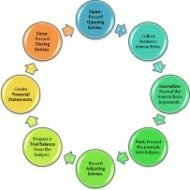
Characteristics and Objectives of Accounting What is Accounting: According to American Institute of Certified Public Accountants (AICPA), “Accounting is the art of recording, classifying and summarizing in a significant manner and in terms of money transactions and events which are, in part at least, of a financial character and interpreting the results thereof.” American Accounting Association (AAA) has defined accounting as “the process of identifying, measuring and communicating economic information to permit informed judgements and decisions by users of the information.” Characteristics of Accounting: i. Accounting is the art of recording and classifying different business transactions. ii. The business transactions may be completely or partially of financial nature. iii. Generally the business transactions are described in monetary terms. iv. In accounting process, the business transactions are summarized and analyzed so as to arrive at a meaningful interpretation. v. The analysis and interpretations thus obtained are communicated to those who are responsible to take certain decisions to determine the future course of business. The Small Biz Doers’ Guide to Small Biz Accounting Objectives of accounting: a. To record the business transactions in a systematic manner. b. To determine the gross profit and net profit earned by a firm during a specific period. c. To know the financial position of a firm at the close of the financial year by way of preparing the balance sheet d. To facilitate management control. e. To assess the taxable income and the sales tax liability. f. To provide requisite information to different parties, i.e., owners, creditors, employees, management, Government, investors, financial institutions, banks etc. ...
Posted by Managementguru in Financial Management, Principles of Management
on Feb 20th, 2014 | 0 comments
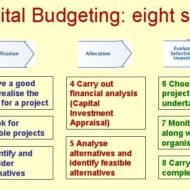
Capital Budgeting- Long Term Resource Planning What is Capital Budgeting? Capital Budgeting refers to the process of planning expenditures that give rise to revenues or returns over a number of years. The process of investment analysis is essential to have a sustainable advantage in the competitive market and to stabilize the profits through resourceful strategic business units. The firm’s management must be on the alert to explore the opportunities present in the market. Obsolete product lines and changes in consumer tastes may present additional problems to a business enterprise affecting the profitability and growth. When a firm decides to venture into projects that demand huge investments, the management has to scrutinize the economic feasibility of such projects. The process of capital investment is also crucial because the projects are for the most part irreversible. Say, for example, if a business firm purchases a special type of machinery, and after installation, if the firm reverses its decision to sell the merchandise due to some technical reasons, it will have only a very small second hand value. Business firms based on the cash flow of the project and the capital recovery period do long-term investment. Why do firms opt for capital budgeting. The reasons may be: To replace worn out equipments that will affect the production efficiency To replace obsolete equipments to install new and more efficient ones To expand production facilities in lieu of increasing demand for the firm’s products and to capture new markets To divest the surplus funds from other business units and to rotate the funds, as idle funds will not generate any revenue To develop new products Research and development Investments made to comply with government regulations, such as projects undertaken to meet government’s health and safety regulations, pollution control and to satisfy other legal requirements. People Involved The proposals for new projects come from the internal environment, such as department heads, executives, employees and of course the management. Experts in product development, marketing research, industrial engineering examine the investment proposals and they may regularly meet with the heads of other divisions in brainstorming sessions to zero in on the proposals. This free course from Udemy is Ideal for people interested in entrepreneurship, fintech, big data, startups, finance, private equity, VCs, & investing. https://www.udemy.com/crowdfund-investing-101-the-basics-of-equity-crowdfunding/ Departments Involved While the firm’s top management makes the final say or decision to undertake or not a major investment project, the process is likely to involve most of the firm’s divisions. Each department has to present its view on the feasibility and viability of the project. The marketing department- on the demand for the new or modified products that the firm plans to sell The production, engineering, personnel and purchasing departments- on the estimation and cost of the investment projects The financing department on- how the required investments funds have to be raised. Thus, the process of expenditure analysis can truly be said to integrate the operation of all the major divisions of the...
Posted by Managementguru in Business Management, Decision Making, Leadership, Startups, Strategy
on Feb 19th, 2014 | 0 comments
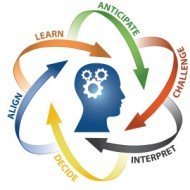
Effective Strategy Generation Why effective strategy generation is necessary? A business enterprise has to generate strategic alternatives and determine the effectiveness of its strategic decisions in order to be successful in the market. Various approaches to strategy formulations exist and it is a real complex phenomenon in that, a wrong strategic execution may produce irreparable consequences which may prove detrimental to the survival of the firm. The method of strategy formation usually follows the traditional approach, based on rational and normative disposition. Sometimes different thought processes may also serve as basic premises for the evolution of new strategies. Intuition: The strategy evolves in the mind of the chief executive without ever being explicitly stated and without the aid of formal procedures. Personal judgment also backs up this process. People with excellent intuition are often remembered for their imagination, drive and expansive vision leading to corporate growth and prosperity. To look into the future with such creativity and brilliance is the basic premise of this approach. Disjointed Incrementalism: This approach towards strategy making reflects an attitude of management having strong preference to act only when there is a need or only when forced to, and then considering a few convenient alternatives involving only small, non-disruptive changes in the organization. This approach is followed by firms that enjoy a pretty decent profit margin in the existing business and possess an exclusive niche in the market; they will not be ready to come out of their cocoons for fear of failure. The firm cannot take the risk of setting unrealistic goals deviating away from the status quo. Pic Courtesy: Account Manager Tips Entrepreneurial Approach: Systematic risk-makers and takers who look for and find opportunities belong to this category. Entrepreneurs view challenges as opportunities and not as problems. Key factor approach: This approach is based on determining the really significant factors that are important in the success of a particular business and concentrating major decisions on it. Say, for instance, a quality product at relatively low price may be a critical factor for a business firm. But eventually it has to achieve this in order to capture the market whence the same critical factor becomes unique to the company and adds value. Integrated approach: Analyzing the present internal and external conditions Identifying and evaluating the present strategy Search for strength and weaknesses viewed within the present strategy and environment Considering changes in the present strategy Generating alternatives unified to resolve the problems and exploit the opportunities Developing alternative unified strategies by combining the various alternatives in each of the problem and opportunity area Evaluation of unified strategy in terms of the enterprise objectives and choosing the strategy that best satisfies the objectives. Strategy formations should conform and comply with the changes in the external environment and the change called for may be in the strategy itself or in the implementation of the...