Posted by Managementguru in Economics, Financial Management, Sales
on Feb 14th, 2014 | 0 comments

Demand and Supply in Different Markets Demand Criteria Since the analysis of a business firm is central to managerial economics, we are primarily interested in the demand for a commodity faced by a firm. The demand for a commodity faced by a firm depends on the size of the market, industry demand for the commodity, the form in which the market is organized and the number of firms in the industry vying for the same set of resources and customers. Demand Curve The market demand curve for a commodity shows the various quantities of the commodity demanded in the market per time period at various alternative prices of the commodity, while holding everything else constant. The curve is negatively sloped, indicating that price and quantity are inversely related. The things held constant in drawing a market demand curve for a product are the number of customers in the market, consumer’s income, the prices of related commodities and tastes. Types of Markets Monopoly and Perfect Competition Coming back to the form of a business firm, at one end there exist the monopolist (the sole producer of a commodity for which there are no good substitutes), and at the other end, perfect competition, where there are a large number of firms producing a homogenous product and each firm is too small to affect the price of the commodity by its own actions. In such a case, each firm is a price taker unlike the monopolist who is a price maker thanks to the product exclusivity factor. Oligopoly In oligopoly there are only a few firms in the industry producing either a homogenous or differentiated product. Since there are only a few firms, the pricing, advertising and other promotional behavior of each firm greatly affect the other firms in the industry and evoke imitation or duplication. We witness many industrial giants fighting for their market share in the respective industrial domains. Monopolistic In monopolistic competition, there are many firms selling a differentiated product. As the name implies, monopolistic competition has elements of both competition and monopoly. The monopoly element arises because each firm’s product is somewhat different from other firm’s products that facilitate the firms to have some degree of control over the price. Although we try to establish an inverse relationship between price and demand, the other side of the coin shows a different picture in that, as the income levels of a consumer is on an increasing trend, his or her purchasing power increases. Consumers tend to purchase more of most commodities like automobiles, housing, travel and so on, when the income rises. There are some goods, however of which the consumer purchases decline as income rises- for example, maize and similar cheap foods as the consumer has the power to buy goods with better quality and there is no need for a compromise. Demand is one of the most important aspects of managerial economics, since a firm would not be established or survive if a sufficient demand for its product did not exist or could not be created. A firm could have the most efficient production techniques and the most effective management, but still without a demand for its product that is sufficient to cover all production and selling costs over the long run, it simply could not survive. Demand is thus essential for the creation, survival and profitability of a...

Posted by Managementguru in Economics, Financial Management
on Feb 14th, 2014 | 0 comments
Introduction to the basic concepts of managerial economics and how it helps in managerial decision making. Managerial economics is concerned with various micro and macro-economic tools and analysis which can be used in managerial decision making to solve business problems.
Posted by Managementguru in Accounting, Management Accounting
on Feb 14th, 2014 | 0 comments

Advantages of Management Accounting It helps to increase the efficiency of all functions of management.It helps in target-fixing, decision-making, price-fixing, selection of product-mix and so onForecasting and Budgeting help the concern to plan the future and financial activities.Various tools and techniques provide reliability and authenticity to carry out the business functions.It is useful in controlling wastage and defects.It helps in complete communication between all levels of management.It helps in controlling the cost of production thus increasing the profit percentage.It is proactive-analyses the governmental policies and socio-economic scenario which helps to assess the external environmental impacts on the organization. Limitations of Management Accounting It is concerned with financial and cost accounting. If these records are not reliable, it will affect the effectiveness of management accounting.Decisions taken by the management accountant may or may not be executed by the management..It is very expensive. Only big concerns can adopt this method of accounting.New rules and regulations are to be framed, hence there is a possibility of opposition from the employees.It is only in the developing stage.It provides only data and not decisions.It is a tool to the management and not an alternative of management. These are the advantages and limitations of management accounting. Characteristics of management accounting Following are the characteristic features of management accounting: First and foremost characteristic is that it provides the necessary information to the management. It might be any data- numbers, gross profit, net profit, comaparitive financial statements, profit and loss account etc.,It is purely analytical.The interpretations help the management in timely decision-making.It adopts a selective technique to arrive at the results.Helps to chart-out the future course of action.Also helps to know the present financial condition of the firm and the respective implications on the stake holders. Various tools of management accounting: MARGINAL COSTINGSTANDARD COSTINGBUDGETARY CONTROLRATIO ANALYSISFUND FLOW ANALYSISCASH FLOW ANALYSIS...
Posted by Managementguru in Accounting, Management Accounting
on Feb 14th, 2014 | 0 comments
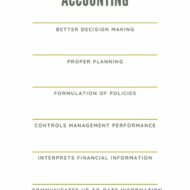
The basic objective of management accounting is to assist the management in performing its functions effectively. The functions of the management are planning, organizing, directing and controlling. What is Management Accounting? Management accounting also is known as managerial accounting and can be defined as a process of providing financial information and resources to the managers in decision making. Management accounting helps in the performance of each of these functions in the following ways: Provides data: Management accounting serves as an important source of data for management planning. The accounts and documents are a store-house of a vast quantity of data about the past progress of the enterprise, facilitating forecasts for the future. Modifies data: The accounting data required for managerial decisions is properly collected and classified. For example, purchase figures for different months may be classified to know total purchases made during each period product-wise, supplier-wise and territory-wise. Analyses and interprets data: The accounting data is probed meaningfully for effective planning and decision-making. For this purpose the data is presented in a comparative form. Ratios are calculated and likely trends are projected. Serves as a means of communication: Management accounting provides a means of communicating management plans upward, downward and outward through the organization. Initially, it means identifying the feasibility and consistency of the various segments of the plan. At later stages it keeps all parties informed about the plans that have been agreed upon and their roles in these plans. Facilitates control: Management accounting helps in translating given objectives and strategy into specified goals for attainment by a specified time and secures effective accomplishment of these goals in an efficient manner. All this is made possible through budgetary control and standard costing which is an integral part of management accounting. Uses qualitative information: Management accounting does not restrict itself to financial data for helping the management in decision making but also uses such information which may not be capable of being measured in monetary terms. Such information may be collected form special surveys, statistical compilations, engineering records, etc. Take the Quiz and Check Your Accounting IQ! 1. The financial statement that reports the revenues and expenses for a period of time such as a year or a month is the Balance Sheet Income Statement Statement Of Cash Flows 2. The financial statement that reports the assets, liabilities, and stockholders’ (owner’s) equity at a specific date is the Balance Sheet Income Statement Statement Of Cash Flows 3. Under the accrual basis of accounting, revenues are reported in the accounting period when the Cash Is Received Service Or Goods Have Been Delivered 4. Under the accrual basis of accounting, expenses are reported in the accounting period when the Cash Is Paid Expense Matches The Revenues Or Is Used Up 5. Revenues minus expenses equals __________ 6. Resources owned by a company (such as cash, accounts receivable, vehicles) are reported on the balance sheet and are referred to as __________ 7. Assets are usually reported on the balance sheet at which amount? Cost Current Market Value Expected Selling Price 8. Obligations (amounts owed) are reported on the balance sheet and are referred to as __________ 9. Liabilities often have the word __________ in their account title. 10. Unearned Revenues is what type of account? Asset Liability Stockholders’ (Owner’s) Equity Scroll Down to Know the Right Answers: ↓ ↓ ↓ ↓ ↓ 1. Income Statement 2, Balance Sheet 3. Service or Goods have been delivered 4. Expense matches the revenue or is used up 5. Net income 6. Assets 7. Cost 8. Liabilities 9. Payable 10. Liability Here are some very resourceful online courses on accounting from udemy – Give it a try: 1. Accounting & Financial Statement...
Posted by Managementguru in Accounting, Management Accounting
on Feb 14th, 2014 | 0 comments
The main aim of management accounting is to help an organization in its functions of planning, directing, controlling and areas of specialization included within the admit of management accounting. The main concern of management accounting is to provide necessary quantitative and qualitative information to the management for planning and control. For this purpose it draws out information from accounting as well as non-accounting sources. Hence, its scope is quite vast and it includes within its fold almost all aspects of business operations.