Posted by Managementguru in Change management, Decision Making, Entrepreneurship, Human Resource, Leadership, Principles of Management
on Mar 19th, 2014 | 0 comments
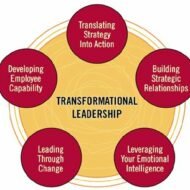
Transformational Leadership What is Transformational Leadership: a leadership approach that causes change in individuals and social systems. Humans generally prefer to have a serene life without much hitches or hurdles in the way. Even if they are to witness a problem situation, they tend to pull themselves away from the scene of action to avoid consequences that may lead to complications at a later date. Very few are bestowed with qualities that make them appear exceptional to the eyes of ordinary men and women. Such people bring wonderful transformations in the lives of people, who willingly follow the leader and support the cause. Need for Transformational Leaders: In business environment, there has always been this debate, whether transformational leaders show success! But it has to be kept in mind that each component of transformational leadership has relevance for improving the decision-making process. In comparison, individually considerate leaders make sure that all parties to the problem are heard. Intellectually stimulating leaders reformulate with followers, colleagues, or superiors into more familiar and concrete terms, what may have begun as fuzzy. Inspirational leaders increase confidence and raise aspiration levels, that the problem can be solved once its causes have been determined. Decision-Making Styles: Leaders with idealized influence show their concern about the problem and the need for its solution. The common thread that emerges from the discussion on decision-making is that decision making styles may be primarily viewed as being based on logic or feeling and instincts. The rational and intuitive decision-making styles are generally considered in conjunction since they represent two ends of a continuum as observed through most studies. While making decisions, transformational leaders are more likely to Be proactive to incipient problems, anticipating the emergence of problems more frequently and farther in advance. Incremental, taking small steps toward problem solving without waiting for a guarantee of complete success. Willing to look at a problem in a larger context and longer time frame. Encouraging of search and choice that take into account the wider context of the larger organization and outside environment rather than limiting the search to the immediate neighborhood of the problem. Quick to react to emergent problems. Seeking information informally for making their decisions rather than prescribed by organizational rules. Practicing walk-around management to promote the upward flow of communication and information. Making decisions involving higher payoffs at higher risks rather than decisions that favor exploitation and achieve lower payoffs at lower risks. Willing to take failure in their stride. Rationale in Making Decisions: The rational style of making decisions is deliberate, analytical, and logical assessing the long-term effects of decisions and having a strong fact-based orientation. The intuitive style is feeling-oriented and based on internal ordering of information. Such decisions are made quickly. The dependent style is characterized by use of support from others while delay and denial characterize the avoidance style. The spontaneous style displays a strong sense of immediacy and an interest in getting through the decision-making process as quickly as possible. A transformational leader would more likely to make decisions rationally after considering carefully all the facts and information and spending a considerable time over the decision-making process. Transformational leadership will be positively related to rational, spontaneous and dependent decision-making styles, and will be negatively related to intuitive and avoidance decision making. The interaction effect of rational and dependent decision making styles on transformational leadership will be...

Posted by Managementguru in Business Management, Human Resource, Organisational behaviour, Principles of Management, Training & Development
on Mar 19th, 2014 | 0 comments
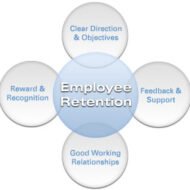
New Paradigms in Employee Retention What is Employee Retention: It refers to the various policies and practices which let the employees stick to an organization for a longer period of time . It refers to the ability of an organization to retain its employees. HRM Practices: A company to ground itself successfully in the chosen field of activity should adhere to sound human resource management practices, as it is firmly believed that human resource is an asset and investment in human capital paves way for comprehensive development. Many firms fail, in spite of being resourceful in terms of capital, infrastructure and technology. The reason shall be attributed to ineffective handling of human skills or misappropriation of human potential. Human resource management involves not only in recruiting and selecting the right people but also empowering them by suitable training to enhance their technical skills and expertise to perform tasks. The Purpose of Training: Training ultimately aims at converting theorists to performers and orients itself towards accomplishing the enterprise objectives. Big corporate companies concentrate on talent acquisition from the pool of fresh graduates and experienced hands in the IT industry as well. They create a lively corporate atmosphere with “an intelligence network” contributing to the success of the organization. Recruitment and Selection: If you have a feeling that, recruitment and selection are mere procedures to be followed for the sake of selection of human resource, kindly change that notion. These are the crucial steps which determine the fate of your organization. People from different disciplines form a team to achieve the goals and objectives of your organization. Leading a group with such diversity is a feat in itself. Selecting knowledge workers whom you believe will achieve your corporate mission and devising the human resource practices in accordance with their work-life balance will yield great results. Training Programmes: Training programs are developed for different spheres of activity by experienced trainers under the guidance of the top management. Proper training to the trainees ensures maximum work done in minimum time. Training not only makes individuals more informative and knowledgeable but also action buffs. Learning is a key process in training that brings about the desired change in behavior. Corporate companies are also concerned about the career prospects of employees working for them, as they are very well aware of the fact that providing lateral and vertical growth prospects for their workers is the only possible way to retain them. Another way for employee retention is to offer compensation on par or higher than industry standards and periodic review of their pay or compensation in accordance with the performance standards. This method of evaluation is suitable only for companies where workers are highly self motivated and have the capability to understand what it takes to reach the next level in their career ladder. Flexi-Timings: Flexibility is introduced in work life by some of the big corporates who try to visualize the practical problems faced by their employees, particularly women, who come to work. They offer “flexi-timings” in work and support by running “crèche” to nurture new borns. It has been proved that a small siesta after lunch improves the brain activity. The HR policies formulated by the management must encompass all the elements needed for a holistic vision, mission and business growth. This can be made possible by maximizing the efficiency of human capital that adds value to the organization. Note: Companies will also continue to remain generous with pay packages but the big change will be that they will invest a lot more in training and development. “Acquiring talent is much more expensive than grooming...
Posted by Managementguru in Human Resource, Organisational behaviour, Principles of Management, Training & Development
on Mar 19th, 2014 | 0 comments
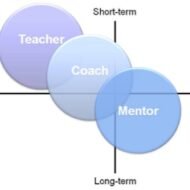
Coaching and Mentoring are the two strategic pillars of a business organisation without which the employees would be mere robots working without job satisfaction. The Definition. A coach is someone who provides guidance to a client on their goals and helps them reach their full potential. A mentor is someone who shares their knowledge, skills and/or experience, to help another to develop and grow. Objectives of Coaching The main purpose of coaching is to develop the employee as an effective perfomer. It involves the following: 1) Helping him to realise his potential as a manager. 2) Helping him to understand himself – his strengths and his weaknesses. 3) Providing him an opportunity to acquire more insight into his behaviour, and analyse the dynamics of such behaviour. 4) Helping him to have better understanding of the environment. 5) Increasing his personal and inter-personal effectiveness through effective feedback. 6) Encouraging him to set goals for further improvement. 7) Encouraging him to generate alternatives for dealing with his problems and prepare an action plan. 8) Helping him to review in a non-threatening way his progress in achieving various objectives. 9) Providing empathetic atmosphere for sharing and discussing his tensions, conflicts, concerns and problems. Download this Coaching Goals planner that will help you in measuring the outcome effctively. 👇 Coaching-Goals-PlannerDownload Objectives of Mentoring The main purpose of mentoring is to provide opportunity to young people to share their concerns and get both moral support and guidance for their development. It involves the following : 1) Establishing a relationship of trust 2) Modeling beahviorual norms for the young person 3) Listening to the person’s concerns and problems 4) Helping him to search alternative solutions for the problems 5) Sharing own relevant experiences 6) Responding to his emotional needs, without making him depend on the mentor 7) Developing long-lasting, personal, and informal relationship. Who is your most trusted advisor when it comes to important issues affecting your business? A small stats in percentage. Fellow business owner – 31Business coach – 24Family member – 18Accountant – 8Employee – 6Consultant – 4Friend – 3Lawyer – 2Other – 4 In which areas would a business coach have the most impact for your business? Strategic planning – 31PR / Marketing / Social media – 14Leadership – 11Succession planning – 9Managing change – 8Profitability – 8Productivity – 7Employee relations – 5Other – 7 Five Tips for Coaching Employees Define your role as a coach Create a safe environmentHelp them define and verbalize their answers, directions and actions. 2. Listen to what is said Be curious, Seek to understand“Tell me more….” “What’s happening….” 3. Observe what is heard and seen Focus on just the factsShare what you observe providing a judgement-less summary.“Here is what I heard you say….”“So it sounds like you are or want to….” 4. Validate what is felt -share the emotion and acknowledge it 5. Empower what is possible – Forward the thinking, explore, options showing faith and optimism. If you are like most of us, you are constantly striving for more engaged employees. Engagement not only leads to higher job satisfaction and lower turnover but also increases productivity and revenue. But how do we boost engagement among our teams? The answer is through coaching. 80% of those who have received coaching report positive impact in areas such as work performance, communication skills, well-being and business management strategies. Download this Achieving Goals Planner to form an idea about effective habits. 👇 Achieving-Goals-PlannerDownload 65% of employees in a strong coaching culture are highly engaged. Organisations with strong coaching cultures report revenues above those of their industry peer group and report higher employee engagement. While more and more organisations are using coaches as a key strategy...
Posted by Managementguru in Decision Making, Human Resource, Principles of Management, Project Management, Training & Development
on Mar 19th, 2014 | 0 comments

Crafting a solid career plan is the cornerstone of professional success and personal fulfillment. Whether you’re just starting out or aiming to advance your career, a well-thought-out plan provides clarity, direction, and motivation. In this guide, we’ll explore practical steps to help you devise a career plan that aligns with your passions and goals. Have you ever thought about how to gain insight into yourself? Well, it is high time, if you really want to make it to the top of your career path and it is supposed to be the best personal strategy. Setting up of long-range plans helps you to formulate your career strategies accordingly. To reach the destination, you need to have clear travel plans. Likewise, devising your career plans is inevitable to reach the ultimatum in your work environment. Following is a Five step chart to help you create a solid career plan Self-Evaluation What do you enjoy? What are your priorities? Strengths and weaknesses? Name the things you want from a job? Skills Analysis What are your qualifications and experience? What are your key strengths and skills? What are your biggest achievements to date? What are your areas of development/ which area of interest excites you the most? Set your direction The broad industries that really appeal to you. The types of roles that would suit you best. How these options match your personal preferences? Key skills you’ll need to develop. Commit to a time frame Make milestones for the next six, twelve, eighteen months. How will you achieve your training and education goals? How will you gain additional skills and experience needed? How will you expand your network, and by when? Review your career plan Now you know your goals and how to achieve them, monitor your progress at least every six months to stay on track. The Following Tenets Will Infuse Some Confidence to Those Who Want to Achieve Set your goals high Never settle for less Never under estimate yourself You are born to achieve something You are different from others You possess that “in thing” that is going to take you places Career advancement is something that is not the sole proprietorship of the managerial cadre. It applies to anyone who has the “will” to learn and move forward. One’s attitude towards time, achievement, change, material things, work etc., determines the extent to which he is prepared to pursue his career with a long-range plan. Decision Making Another important aspect of career planning is the tough preposition of decision making. If a qualified and experienced manager is adept in all areas of management, naturally he gets confused as to “which way to go”, when presented with a chance to take up another job, in pursuit of better career prospects such as pay or promotions. People sometimes tend to resist career planning for the fear of making decisions and sometimes due to the fear of failure of achieving goals in the new set up, which might be a big blow to their ego. This dilemma of choosing a goal is commonly noticed in students who want to pursue higher education. Since it involves not only decision making but also determines their capability to be successful in the chosen field of activity. If an individual wants to become a doctor, he or she has to give up to pursue other opportunities, say, to become a lawyer or an engineer. Commitment Furthermore, career advancement means more involvement and commitment, which makes you a quick learner. And in the process to achieve your goals, you become well versed in the area of specialization, however complex the subject or situation may be. Psychology has its role to play in career planning...
Posted by Managementguru in Human Resource, Principles of Management, Training & Development
on Mar 18th, 2014 | 0 comments
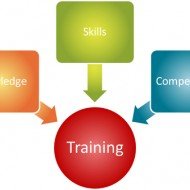
Employee Training – Train Your #Employees to Tone up their Spirit What is Training & Development: process to obtain or transfer #knowledge, #skills and abilities needed to carry out a specific activity or task. Human Resource training is not at all a complex process; with the right kind of supervisors, who impart training and their subordinates being enthusiastic about learning, it seems to be quite an easy job. But, some firms fail to achieve the desired productivity, in spite of good training programmes and availability of efficient workers. The biggest problem being, the failure to impart relevant training, by identifying and analyzing the training needs which too often is not the case. To be successful, firms have to adopt a systematic approach to training process. Training fills the gap between what someone can do and what he should be able to do. The first aim of training is to ensure that, as quickly as possible people can reach an acceptance level in their jobs. Training then builds on this foundation by enhancing skills and knowledge as required to improve performance in the present job or to develop potential for the future. Steps involved in systematic approach of training: 1) Identifying and analyzing training needs: Training should always fall in line with the #objectives of the organization to be achieved and it should be relevant to the context. Running training programmes just for the sake of running it, without defining the purpose, or sending the trainees for a workshop that has nothing to do with what the trainees really need to learn -all these are inappropriate methods of training and it makes the trainees lose their focus and direction. Another problem you will meet in the off-the job training is that, transferring the knowledge to action in the work place. If the objectives are not specified and appraised properly to the trainees, they will not be able to satisfy your expectations. So, a thorough analysis of what people need to know as trainees at different functional levels proves useful in saving much time and labor of the firm. 2) Job analysis-a basis for identification of training needs: The basis for training starts from job analysis, where the organization has to be quite prudent about its specifications and expectations well defined. The indicated specifications may be about, Knowledge -what the worker needs to know in terms of professional, technical, technological, commercial aspects. Skills-Manual, intellectual, perceptual, analytical or social which depends on the nature of the job. A top level employee needs to possess more analytical skills backed up by rational thinking, whereas a lower level employee is only expected to deliver his technical skills properly. Attitudes: The disposition to behave or to perform in accordance with the requirement of the work. This is one of the most important aspects that is neglected by most of the organizations by sheer oversight. If a customer is not properly received in a boutique shop or a restaurant, think what will be the response and reaction of the customer? If a worker does not pay due respect to his superior or boss, what are the chances of his career advancement? Whether it is a production environment or a market environment, firms must teach the trainees to conform to the guidelines regarding #attitude. 3) Prepare your training plans based on the objectives: Decide on the content of the course, as established by job and task analysis and information from performance appraisals. Decide on the training techniques, which may be, Job instruction On-the -job training Coaching Lecturing Computer based training Action learning Interactive video etc., which are a combination of on- the job and off-the job training...