Posted by Managementguru in Business Management, Operations Management, Principles of Management
on Feb 24th, 2014 | 0 comments
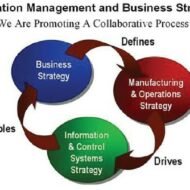
The management of conversion or transformation process which accepts inputs and delivers usable goods and services is what is called “operations management.” The inputs may be in the form of, capital, material, labor, technology, information, machines etc. The process takes place in an effective and efficient manner through operations planning, design, management and control. Don’t forget to download the 3 page Project Planner Printable at the end of this post 👇🏻 Absolutely Free Earlier it was called, production or manufacturing management. Since operation is a general term in a productive environment whose output may be goods or services, the term operations management has become more appropriate. The Aim of a Good Operational Management Would be High level of productivityCompetitive cost and qualityTimely deliveryProducing goods as per the requirements of the consumer, that is customer oriented.Flexibility and responsiveness in the production of goods and services Production or operation in the three important sectors of an economy, namely, agriculture, industry and service, creates national wealth and serves as an index for the growth of that economy. One has to understand the link between operations management and other functional areas to appreciate its scope. The goals of the operations strategy has to necessarily be in tandem with the overall corporate strategy to accomplish the goals of a firm. Scope of Operations Management From marketing department, cues regarding customer preference and market segmentation in terms of product, price and volume are supplied to the production department, based on which the production planning is concluded. From Research and development comes the product design and process technology. Human resource is an integral part of production process and also a crucial input. Man power planning by the human resource department plays a major role in recruiting, selecting, training, evaluating and empowering labor force. Operations Strategy The great diversity in products and services available in the market should be taken into consideration before deciding on your operations strategy. At one end we have custom made products that are designed and manufactured to suit the specific needs of the consumers. For instance, custom made shoes, shirts, suits, furniture etc. Here the emphasis is on quality and delivery where the customer is not very much bothered about the price. At the other end manufacturers go for highly standardized products that are available “off the shelf.” Say, home appliances, detergents, soaps etc., here the product differentiation is very minimal and the focus is on competitive pricing as the material is available in plenty. Economy of Scale A customized product would require a manufacturing set up that can handle a wide variety of general products. The sequence of operations for each product would vary in the manufacturing system making a customized product. So, a process oriented manufacturing system is designed, where similar facilities doing similar operations are grouped together and departmentalized. Standardized products go for a product focused manufacturing system, to reduce the “through put” time as large volumes are required. To be cost effective, each product should have a dedicated line of production to take advantage of the “economy of scale.” Intermediate types of products also find their place in the market and they are produced in a production layout that has a mix of product and process orientation. Here a whole range of products and services are created for the benefit of the customers. In a long term basis, manufacturers should aim to develop new technology, environmentally viable products, increase R and D activity, update skills of work force and managers and focus on development of new products, process and innovations....

Posted by Managementguru in Accounting, Economics
on Feb 17th, 2014 | 0 comments
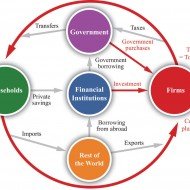
National Accounting Concepts Why knowing about national accounting concepts is important? National income data are of great importance for the economy of a country. In modern days they are regarded as the accounts of an economy, which are known as social accounts. Social accounts tell us how the aggregate of a nation’s revenue, output and product result from the income of different individuals, products of industries and transactions of international trade. National policy formulations: The computation of national income forms a basis for a nation to develop its policies for important spheres of action such as employment policies, monetary policies and fiscal policies that determine the growth of an economy. These figures enable us to know the direction which the industrial output, investment, saving etc. take and proper measures can be adopted to bring the economy on the right path. Facilitates Planning: Gross Domestic Product Gross National Product Net Domestic Product Net National Product Per Capita Income Disposable Personal Income All these factors comprise the national income and indicate the money value of the flow of goods and services available annually in an economy. Also this statistics helps a nation for proper economic planning. The per capita income refers to the earning capacity of individuals in an economy and more the per capita income, higher is the economic welfare of a country. Uncontrolled population growth and unemployment are major reasons for low per capita income. The wealth cannot be evenly distributed owing to high birth rates and low mortality rates and making the ends meet with the available scant resources becomes a major problem for developing countries. Distribution of income From the data pertaining to wages, rent, interest and profits, we learn of the disparities in the incomes of different sections of the society. Similarly the regional distribution of income is revealed. It is only on the basis of these that the government adopts measures to remove inequalities in income distribution and attempts at regional equilibrium. There have been differences of opinion regarding ‘nation’ in the concept of national income. In the calculation process, the term ‘nation’ has to be defined exactly as to whether it is the geographical entity of the country to be taken up for computing national income or the incomes earned by the nationals including those residing abroad. Further, since everything has to be equated to the money value, services produced in the economy out of love for humanity cannot be brought under the term national income. Besides, there is an overlapping of occupations, especially in the rural sector of certain countries, which makes it difficult to know about incomes from various...
Posted by Managementguru in Business Management, Principles of Management
on Feb 15th, 2014 | 0 comments

Functions of Management MANAGEMENT FUNCTIONS The objective of this topic is to make students understand the functions of management and the role of managers in an organization. The five basic management functions are listed below: · PLANNING · ORGANISING · STAFFING · LEADING · CONTROLLING PLANNING: The managerial activities aid in selecting the objectives, examine and forecast changes, develop policies, procedures and choose future course of action from among alternatives. Planning proceeds from “Where we are” to “Where we want to go.” Planning activities are 1. Analysing the current situation (also called the SWOT Analysis) 2. Anticipating or predicting the future based on the analysis 3. Determination of organizational objectives to be achieved 4. Deciding on the action plan 5. Evolving proper strategies 6. Pooling the resources (physical, financial and monetary) to accomplish enterprise objective ORGANISING: It is a process which integrates people and tasks; In order to achieve their tasks people are given sufficient authority, tools and information. Organising activities include 1. Specification of job responsibilities 2. Grouping of jobs into respective work units 3. Allocation of resources STAFFING: Human resource management is one of the key areas that decides the success of a firm’s activity. Staffing involves the selection of “Right person for the right job.” The activities are 1. Recruitment 2. Selection 3. Training and Development 4. Compensation 5. Promotion 6. Evaluation and 7. Rewarding people to achieve enterprise goals. LEADING: Leadership is the set of interpersonal behaviors that influence people to contribute to the organization and group goals. The activities under this category are 1. Providing proper direction 2. Guidance and Motivation 3. Clarity in communication to the work force CONTROLLING: This is a process that is necessary to keep track of the performace of individuals by setting some standards for direction. The activities include 1. Establishing performance standards enabling the work force to achieve the goals (both short term and long term) 2. Enhancing the employee performance through performance appraisal or rating of work 3. Comparison of performance against the standards to identify deviation or work problems and take corrective measures 4. Bench marking is one of the management techniques that facilitates an organization to uplift its performance levels to the best of industry standards and also catch hold of the strengths of the competitors and rectify the weaknesses prevailing in one’s own firm. CO-ORDINATION: It is regarded as a key function of a manager to bring in harmony among individuals and an effort towards accomplishment of goals. 1. Marginal decision making and 2. Sub Optimisation are some of the new approaches developed in the field of decision making. MANAGERIAL SKILLS: Skill is the resultant effect of knowledge, experience and expertise. It is the ability of an individual to perform a task which is obvious from the results he/ she shows. There are 3 kinds of skills that a manager should possess in order to excel. 1. The Conceptual Skill: Assessing a situation and acting accordingly depicts the manager’s perceiving ability of the abstract elements in force. A manager has to improve this kind of skill as he moves up the ladder in the management level or let us say that he can move up the ladder only if he possesses this kind of skill. · Management Consultants · Managing Director of a firm · President of a company · Economists · Startegists are conceptual analytic experts 2. The Technical Skill: This skill is purely based on one’s knowledge and on the job experience. This is needed at a lower level of management · Computer Operators · Engineers · Accountants · Machine Operators possess this kind of skill 3. The Human Relations Skill: This...
Posted by Admin in Accounting, Management Accounting
on Jan 29th, 2014 | 0 comments
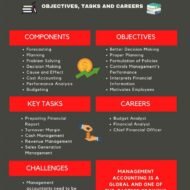
Management accounting combines accounting, finance and management with the leading edge techniques needed to drive successful businesses. The process of preparing management reports and accounts that provide accurate and timely financial and statistical information required by managers to make day-to-day and short-term decisions