Posted by Managementguru in Entrepreneurship, Human Resource
on Mar 1st, 2014 | 0 comments
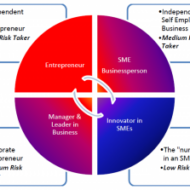
The Spirit of Entrepreneurship In the modern competitive business environment, not all graduates of various disciplines like engineering, management and the like can aspire for white collar jobs. The recent global recession has made the prospective job seekers think twice about working in foreign countries. Self employment has become the order of the day. Being your own boss is truly inspiring and motivating at least in theory. When it comes to reality, we need to know exactly what does it take to become an entrepreneur by starting a small business or taking over the business run by your predecessors. Why we need more entrepreneurs? Various avenues have been opened up thanks to communication and transportation that has brought the world under a single huge umbrella. Also small industries face minimum risk as the investments are marginal and they have the liberty to try a number of innovations like combination of new products new materials new methods of production new markets new sources of materials and even New forms of organization. Being a competitor in an open market, minimum profit and constant revenue inflow are assured and also they can enjoy the benefit of minimum fluctuation in the product price as it is determined by the market and not by individuals. Want to know 10 Daily Habits of Most Successful Entrepreneurs? Scope of entrepreneurial activity: Either you can be a subsidiary to large scale business or you can engage yourself in supply of repair services with small engineering establishments or you can go for small cottage industry businesses like cutlery, furniture, jewelry, fruit canning, soap making etc., Being fairly labor intensive, you can provide economic solution by creating employment and income opportunities in urban and rural areas with relatively low cost of capital investment. Business process outsourcing has been in recent times the magic happening in countries like India, China etc., where the foreign investors take advantage of cheap labor, time and efficient communication skills of the population. Knowledge process outsourcing has also become popular and it stands as a testimony of the rising power of Asian countries over the west. “Small is beautiful” and you can make it big in the small scale business industry if you are Innovative and productive Provide personalized services to the customers Identify and target the right markets This ensures “WINNING THE GAME OF BUSINESS“. An economy grows only when it has large number of enterprises accelerating the economic growth prospects of that particular country. The export policies of all nations have become more flexible owing to globalization, liberalization and...

Posted by Managementguru in Business Management, Decision Making, Principles of Management
on Feb 26th, 2014 | 0 comments
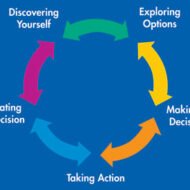
METHODS OF DECISION MAKING A. Marginal income or Cost analysis: This method is used to compare additional revenues arising from additional costs. Break even point is that point in which the cost equals revenue and it can be defined as a no loss, no gain situation. Profit can be enjoyed by a firm only when the revenue exceeds cost that is after crossing the break even point. A manager must have all the necessary data pertaining to total cost and its various components in order to arrive at a decision. B. Cost-effective analysis: This tries to find out the cheapest way in reaching the objective or shall we say the greatest value for expenditure. Mass production facilitates in factorizing the economies of scale where the objective is oriented towards output and sustained availability of the product year round. C. Experience: The mistakes committed become great lessons in due course of time generally and this holds good for managers involved in making crucial decisions. It ensures right decisions to be taken in similar situations. But one has to remember that decisions are inclined to make an impact on future events. So, it is up to the manager to take the right kind of decisions using his intuitions as well as experience. The late chairman of SIMPSONS GROUP, Anantharamakrishnan was very intuitive and under his leadership the organization touched new heights and diversified its activities like never before. Note: Anantharamakrishnan is remembered for his successful business practices, efficient management of the labour unions and for triggering the growth of the automobile industry of Chennai which has earned the city the epithet “Detroit of India”. As a result he himself came to be remembered as the “Henry Ford of South India.” Courtesy: Wikipedia D. Experimentation: Why people go for test-marketing? Because when the factors are intangible, you have to try out every alternative only through experiments or trail and error. Market surveys and questionnaires are useful tools when it comes to launching of a new product in the target market. E. Research and analysis: This involves the application of tools and techniques of operations research to the process of decision making based on mathematical functions. Risk-analysis and Decision-trees are the other methods used that illustrate decision points, chance events, and probability of each course of action. TYPES OF DECISIONS: · Routine and Strategic: Routine- regular decisions involving day to day affairs of the firm- leave procedures, work atmosphere. Strategic decisions are central to the firm’s operations- price fixing, product elimination etc. · Individual and Group decisions: Managers at the top level are inclined to take individual decisions and some important inter-departmental decisions may be taken up by members of the respective groups. · Programmed and Non-programmed decisions: Decision taken by the low-level personnel which are regular and repetitive in nature are programmed-late attendance, medical compensation etc., Non-repetitive and unusual decisions like mergers and acquisitions, collaboration agreements belong to the non-programmed category. · Simple and Complex decisions: Where the problem is simple but the outcome has a high degree of certainty are called mechanistic or routine decisions. Where the problem is simple but the outcome has a low degree of certainty are judgmental in nature. Where the problem is complex and the outcome has a high degree of certainty are analytical and where the problem is complex but the outcome has low degree of certainty are adaptive decisions. MAKING EFFECTIVE DECISIONS: · Timing of decisions: A new product only if introduced into the market at the right time will be a success for which the manager should select the appropriate time for taking the decisions. · Effective communication: The decisions taken should be communicated down the line for effective implementation. · Top management support: The support of top management is indispensable for effective decision-making since it...
Posted by Managementguru in Business Management, Decision Making, Principles of Management, Productivity
on Feb 26th, 2014 | 0 comments
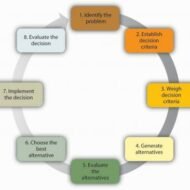
The Process of Decision Making There is a need to broaden our understanding about decision-making process. Decision making is not an independent entity and relies upon many other factors like precedence, social processes and random eventualities. It has three components; identification of the issue, the possible course of action and choosing the best amongst the choices of action available. The decision-making process is continuous since the business environment is dynamic and constantly poses challenges to the decision makers. Organizations are viewed as “Garbage can models” of decision making, in which actions, decisions and outcome are randomly mixed in the flow of events. With this introduction let us proceed to know more about the nature and types of decision making. NATURE OF DECISION-MAKING: 1. It is closely related to solving problems and issues 2. It is associated with all the important management functions like planning, organizing and controlling 3. Fayol and Urwick feels that decision-making is concerned only to the extent that it affects delegation and authority 4. Chester I Bernard in his “Functions of the Executive” says that the process is nothing but narrowing down of choice 5. Herbert A Simon considers decision-making as a process of intelligence, design and choice activities 6. According to Peter Drucker, it is a central part of the management process THE DECISION-MAKING PROCESS: The following steps are involved in the process of decision-making Recognizing the problem: Think about this; if there is a decline in the sales volume of your company or say if the value of your stock decreases, you are forced to make decisions to manage the contingency. In such situations, the first step would be to recognize or identify the problem area. A problem identified is half done. In this instance, the reason might be competitor strength or lack of necessary investment in the key strategic business units. Deciding priorities among the problems: A manager need not and cannot look after all the problems prevailing in the organization. He should know how to delegate authority and the responsibility that goes along with it. Subordinates can be entrusted with the handling of small and trivial problems while the manager can handle very important ones that might affect the functioning of the firm. He should ask the following questions to diagnose the situation. 1. What is the real problem? 2. What are the causes and effects of the problem? 3. Is this problem very important? 4. Can sub-ordinates handle this problem? 5. Which is the most pressing problem to be solved? Diagnosing the problem: Now the manager must start diagnosing the problem. Each and every individual has a different perspective and perceive the problem from a different angle. This depends upon the background orientations and training. The right way of approach for any manager would be to systematically analyze the problem for identifying the alternative courses of action. Developing alternative courses of action: This step involves creativity and innovative capabilities as the manager has to think from all possible angles and directions. Managers holding senior corporate positions are exposed to more of this kind of atmosphere where they are forced to make quick decisions in accordance with what the situation demands. Outside expert consultants are also put into use by some companies for developing choice alternatives. The following are the five PSYCHOLOGICAL STEPS for developing alternatives: 1. Saturation– A manager must be thoroughly familiar with the problem 2. Deliberation– Analyzing the problem from several points of view 3. Incubation– Temporarily switching off the conscious search to relax for the purpose of clear thinking 4. Illumination– A flash of light may occur after sometime giving him the right insights and ideas. 5. Accommodation– The ideas are made into a concrete proposal Evaluating the alternatives: The pros and cons of each and every choice is thoroughly subjected to scrutiny in terms of cost, time, risk, results expected, deviations anticipated...
Posted by Managementguru in Business Management, Strategy
on Feb 17th, 2014 | 0 comments
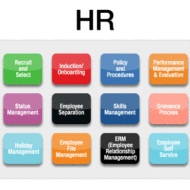
What are Policies? Business activities should be based on some solid principles that serve as guidelines for direction. These principles are nothing but policies which help a business firm in attaining its goal. Policy does not tell a person exactly what to do, but it does point out the direction in which to go. While objectives are goals or ends to be sought, policies are a general rule of action which helps in attaining a goal. Policy Statements Statements released by corporate firms generally highlight the major policies behind their action. For instance, if a firm says that its aim is to provide the customers with products that are competitive in terms of quality, price, weight and contents, it tries to sum up the recurring problems in the industry and assures the customers that it will serve the customers in the true spirit of business. What is the meaning of Policy Formulation? Policies are generally formulated by the officials of the top management cadre, as policies reflect the mode of thought and principles underlying the activities of an organization. Policies guide a firm in the following aspects. Thinking Decision making Conduct of business Enterprise operations Problem solving So, it is evident that each policy contains two components, a “principle” and a “rule of action”. Corporate policies are statements of directions, guidance for corporate thinking, corporate behavior and action, and therefore cover a very broad area. Such policy formulations are made in the light of challenges posed from the external environment exposing the strengths and weaknesses of the organization. Here are some key corporate policies that companies often prioritize to ensure smooth operations, compliance, and a healthy workplace culture: Code of Conduct and Ethics Policy: Sets standards for professional behavior, integrity, and ethical practices within the organization. Equal Opportunity and Non-Discrimination Policy: Ensures a workplace free from discrimination and promotes diversity and inclusion. Workplace Safety Policy: Outlines measures to ensure employee safety, including adherence to health and safety regulations. Leave and Attendance Policy: Defines rules for work hours, attendance, leave entitlements, and time-off procedures. Data Protection and Privacy Policy: Details the handling of sensitive personal and corporate information, ensuring compliance with data protection laws. Anti-Harassment and Bullying Policy: Establishes guidelines to prevent and address harassment, fostering a respectful work environment. Whistleblower Policy: Provides employees a secure way to report unethical or illegal activities without fear of retaliation. Compensation and Benefits Policy: Describes salary structures, incentives, bonuses, and benefits offered to employees. Employee Grievance Policy: Offers a clear procedure for resolving employee concerns and disputes. Corporate Social Responsibility (CSR) Policy: Focuses on the company’s commitments to social, environmental, and ethical responsibilities. IT and Cybersecurity Policy: Provides rules for using company technology and safeguards against cyber threats. Confidentiality and Non-Disclosure Policy: Protects sensitive company information from unauthorized sharing....
Posted by Managementguru in Accounting, Financial Accounting, Financial Management
on Feb 13th, 2014 | 0 comments

The purpose of accounting is to provide the information that is needed for sound economic decision making. The main purpose of financial accounting is to prepare financial reports that provide information about a firm’s performance to external parties such as investors, creditors, and tax authorities.