Posted by Managementguru in Business Management, Organisational behaviour, Principles of Management
on Mar 2nd, 2014 | 0 comments
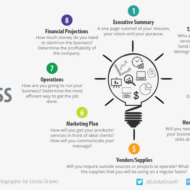
Your business structure will affect a lot of factors – You can start with an initial business structure and change it as your business thrives. But first and foremost you need a solid business plan that details your mission, vision and purpose. These 7 steps in planning will guide you through and give your project a headstart. The business plan cheatsheet is given in a pictorial form for your benefit. ☝️ A. Opportunity Analysis: SWOT analysis– the analysis of strength and weaknesses, opportunities and threats in the external environment is the first and foremost step in planning. The target market, competitor strength, internal weaknesses, customer’s preferences are some of the key areas to be focused. B. Setting objectives: Where we want to be, and what we want to accomplish and when are answered in this step. Each and every employee of the organization has to be apprised about the enterprise objectives in order to achieve the expected or desired result. Management by objectives is one of the proven methods where-in the objectives are set by the subordinates themselves under the guidance of their superior and periodical reviews are conducted to check whether the set objectives are accomplished within the stipulated time. C. Developing Premises: The critical factors that affect the planning process are analyzed thoroughly. Say, government policies, business cycle trends, economic indicators, inflation, tax rates etc are analyzed and the plans are developed based on these premises. D. Identifying Alternatives: It is better to have an alternate plan or plans which helps in deciding the alternate course of action. Alternatives identification is a technique used for identifying different methods or ways of accomplishing the work of the project. For example, brainstorming might be used to discover alternative ways of achieving one of the project objectives. E. Evaluating Alternatives and selecting the suitable plan: The limiting factors can be set as a criterion for evaluating the alternatives. The limiting factors may be cost, time, manpower and other resources. Operations research helps in the assessment of alternatives and selecting the best. Think about this, if plan A fetches you more profit but proves to be expensive and plan B fetches you consistent profit and less expensive, what will be your choice? Even banks look into the fund flows of different projects submitted by clients and select the ones that proves to fetch consistent returns on the long run. F. Formulating Supportive plans: Download this Business Planner Printable which comes in handy when you want to weigh your choices👇 Business-Journal-Planner-1Download Derived plans are those that stem from the main ones that support the basic plan. Recruiting and inducting may be the basic plan of a HR department but training and development is the supporting plan that gives shape to the basic plan. G. Developing Budgets: Budget is referred in financial terms and they are required to control plans. There is always a constraint for resources and hence it is the responsibility of a manager to decide on the investment in a particular plan that will tide away the risk of the...

Posted by Managementguru in Organisational behaviour, Principles of Management
on Mar 1st, 2014 | 0 comments
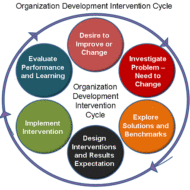
Organizational Development Training and development is an important aspect of human resource development. However the traditional methods and approach of T&D has its own limitations in that the focus is on individual development and behavior modification. This has seldom produced organizational development and hence in 1960’s an integrated approach called the ‘OD’ or organizational development was developed. Meaning and definition of organizational development (o.d.) “A process used to enhance both the effectiveness of an organization and the well being of its members through planned interventions.” OD is the systematic application of behavioral science knowledge for the purpose of improving productivity, efficiency, effectiveness and overall health of the total organization. The applied interventions attempt to modify the beliefs, assumptions, values, attitudes and standards of both the individuals and groups thereby transforming the organizational culture for the betterment of system as a whole. FEATURES OF ORGANIZATIONAL DEVELOPMENT: HUMANISM: The focus is on the employees, their attitude and inter-personal relationships. An organization is a network of people whose emotions, outlook and cohesiveness are more important than monetary and other physical aspects because it is they who take the organization to the next higher level. This is made possible by open communication, free and frank discussions of problems with employees by the managers, inter-personal trust and above all, sense of belongingness, comradeship and team spirit. PROBLEM-SOLVING NATURE: The purpose of an OD intervention is to solve a problem. The employees themselves are given the opportunity to identify the problem by Survey Feedback and find a suitable solution through analysis. This is a cyclic process and also called as “Action Research”. SYSTEMS APPROACH: OD is concerned with not the structure or persons per se, but with the interplay of structure and persons. LEARNING THROUGH PARTICIPATION: The participants of the learning process are none other than the employees. They unlearn old things and learn new things by identifying, analyzing and finding the right solution to the bottlenecks. TOP MANAGEMENT SUPPORT AND INVOLVEMENT: OD intervention is successful only when top management involvement is full-fledged and ensures participation from all levels of managers and all departments in such an exercise. MULTIPLE INTERVENTIONS: Intervention takes place at various levels, individual as well as group and the purpose is molding desirable work culture and leadership styles suitable for the organization. ROLE OF CONSULTANT: Employing an external consultant will be more appropriate as he is less susceptible to influences and more objective. He acts as the change agent facilitating co-ordination and stimulation. CONTINGENCY PLANS: Alternate plans are also devised if in case the original plan fails; the idea is one that of trial and error, hence the need for contingency plans and approach to OD problem. RENSIS LIKERT’S OD FRAMEWORK: Rensis Likert’s 4 system OD framework aims at moving towards truly participative system. Care and caution must be adhered to steer the system gradually from where the organization now works. He also introduced diagnostic analysis to find what causes the current problem. His three part diagnostic analysis includes: A. OUTPUT CAUSES: Low productivity, absenteeism, declining profit B. INTERVENING CAUSES: Organization structure, control, policy and leadership C. ROOT CAUSES: Attitude, motivation level, empowerment and organization culture Tips for Organization Development OD CULTURE: “The OD paradigm values human and organizational growth, collaborative and participative processes and a spirit of enquiry.” Brown and Covey have made some attempts to identify OD values from the following: Norms and Values: Respect for people: People are the most important of all resources. So giving due respect and importance to people induces the creativity and innovation in them. Trust and Support: Trust, openness and supportive climate improve organization culture and empowerment. Power Equalization: This emphasizes hierarchical authority, control and centralization. Confrontation: Do not...
Posted by Managementguru in Business Management, Decision Making, Principles of Management
on Feb 26th, 2014 | 0 comments
METHODS OF DECISION MAKING A. Marginal income or Cost analysis: This method is used to compare additional revenues arising from additional costs. Break even point is that point in which the cost equals revenue and it can be defined as a no loss, no gain situation. Profit can be enjoyed by a firm only when the revenue exceeds cost that is after crossing the break even point. A manager must have all the necessary data pertaining to total cost and its various components in order to arrive at a decision. B. Cost-effective analysis: This tries to find out the cheapest way in reaching the objective or shall we say the greatest value for expenditure. Mass production facilitates in factorizing the economies of scale where the objective is oriented towards output and sustained availability of the product year round. C. Experience: The mistakes committed become great lessons in due course of time generally and this holds good for managers involved in making crucial decisions. It ensures right decisions to be taken in similar situations. But one has to remember that decisions are inclined to make an impact on future events. So, it is up to the manager to take the right kind of decisions using his intuitions as well as experience. The late chairman of SIMPSONS GROUP, Anantharamakrishnan was very intuitive and under his leadership the organization touched new heights and diversified its activities like never before. Note: Anantharamakrishnan is remembered for his successful business practices, efficient management of the labour unions and for triggering the growth of the automobile industry of Chennai which has earned the city the epithet “Detroit of India”. As a result he himself came to be remembered as the “Henry Ford of South India.” Courtesy: Wikipedia D. Experimentation: Why people go for test-marketing? Because when the factors are intangible, you have to try out every alternative only through experiments or trail and error. Market surveys and questionnaires are useful tools when it comes to launching of a new product in the target market. E. Research and analysis: This involves the application of tools and techniques of operations research to the process of decision making based on mathematical functions. Risk-analysis and Decision-trees are the other methods used that illustrate decision points, chance events, and probability of each course of action. TYPES OF DECISIONS: · Routine and Strategic: Routine- regular decisions involving day to day affairs of the firm- leave procedures, work atmosphere. Strategic decisions are central to the firm’s operations- price fixing, product elimination etc. · Individual and Group decisions: Managers at the top level are inclined to take individual decisions and some important inter-departmental decisions may be taken up by members of the respective groups. · Programmed and Non-programmed decisions: Decision taken by the low-level personnel which are regular and repetitive in nature are programmed-late attendance, medical compensation etc., Non-repetitive and unusual decisions like mergers and acquisitions, collaboration agreements belong to the non-programmed category. · Simple and Complex decisions: Where the problem is simple but the outcome has a high degree of certainty are called mechanistic or routine decisions. Where the problem is simple but the outcome has a low degree of certainty are judgmental in nature. Where the problem is complex and the outcome has a high degree of certainty are analytical and where the problem is complex but the outcome has low degree of certainty are adaptive decisions. MAKING EFFECTIVE DECISIONS: · Timing of decisions: A new product only if introduced into the market at the right time will be a success for which the manager should select the appropriate time for taking the decisions. · Effective communication: The decisions taken should be communicated down the line for effective implementation. · Top management support: The support of top management is indispensable for effective decision-making since it...
Posted by Managementguru in Business Management, Strategy
on Feb 18th, 2014 | 0 comments
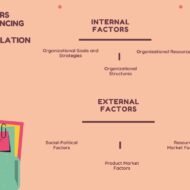
The basic factors that influence policy formulation are 1. The objectives of a business firm 2. Its management structure 3. Economic and financial resources available to it at a particular point of time 4. Attitudes, social values and norms of the top management 5. Fiscal and monetary policies of the government 6. Policies of sister concerns and business associations 7. Government regulations and control measures 8. Public opinion and expectations from business etc. You can never evade your responsibility towards the society and your policies must incorporate statements that reflect your interest in the welfare of the society. In corporate business environment, where voluminous business activity is carried on, corporations have very well understood the fact that, acquisition and utilization of resources from the society has to be repaid in the form of contributions to societal welfare. Otherwise their image might get tarnished. Moral and ethical values of a society also influence the mind set of business persons. In countries like India, where people ardently follow traditions and customs, a business person hailing from such a family will definitely try to maintain minimum ethical standards both in personal as well as business environments. Policy Aspects: Business policies cover all the functional areas such as production, marketing, personnel and finance aspects. Major policies pertaining to overall objectives, procedures and control affect the organization as a whole. Minor policies on the other hand, cover relationship in a segment of an organization, with considerable emphasis on details and procedures. Such policies are an outgrowth of major policies and preserve their unity of purpose. They meet the day-to-day requirements of the departments and are generally decided at the sectional and departmental levels. Various Corporate Policies: Strategic business policies cover aspects such as product-mix, promotion-mix, market-mix, administrative policies etc.; HR policies cover a wide range of aspects such as pay, promotions, recruitment, selection, induction, training and development, pension, disciplinary action, quality of work life and so on. So, to attain clear-cut objectives, firms need related business policies, in the absence of which, the firm may lose grip and direction in the overall management of the...