Posted by Managementguru in Principles of Management, Training & Development
on Feb 22nd, 2014 | 0 comments

Benefits of Training to Employees Why training is needed for an Employee? Increases Confidence Training creates a feeling of confidence in the minds of employees, who feel comfortable while handling newer challenges. It gives a feeling of safety and security to them at the work place. New Skills Training develops skills, which serves as a valuable personal asset of a worker. It remains permanently with the worker himself. Career advancement The managers can develop their skills to take up higher challenges and work in newer job dimensions. Such an exercise leads to the career development of the employees, who can move up the corporate hierarchy faster. Higher Earnings Higher earnings are a consequence of career development. A highly trained employee can command high salary in the job market and feel more contended. Resilience to change In the fast changing times of today, training develops adaptability among workers. The employees feel motivated to work under newer circumstances and they do not feel threatened or resist any change. Such adaptability is essential for survival and growth of an organization in the present times. Increased Safety Trained workers handle the machines safely. They also know the use of various safely devices in the factory, thus, they are less prone to accidents. Use these popular and handy HR Quotes in your Blogs, Books, Journals, Presentations, Tweets, Facebook posts, Pinterest boards and Instagram posts. EVALUATION PHASE Training Evaluation Once you’ve implemented a training program based on careful needs analysis, how can you be sure that your training translates into real performance improvements? Evaluation can be used to determine whether the training program achieves its objectives. Evaluation can also assess the value of training, identify improvement areas, and identify unnecessary training that can be eliminated. Need for Evaluation Many training professionals agree that evaluation is important to successful training, but few conduct complete and thorough evaluations. Evaluation can seem anti-climatic to the excitement and creativity of creating a new course. Don Kirkpatrick’s 4 Levels of Evaluation One of the most widely used model for evaluating training programs is one that was proposed in 1959 by Donald L. Kirkpatrick. The model maintains that there are four levels to meas ure the quality or effectiveness of a training course. Don Kirkpatrick’s 4 levels of evaluation is the basis of discussion on evaluation of the effectiveness of training programs. Level 1 measures the learner’s reaction to the training program. Level 2 measures learning that has occurred. Level 3 measures changes in behavior on the job as a result of the training program. Level 4 measures the results of the training program as it affects the company’s bottom line. Each level has its advantages and disadvantages. It is important to plan the evaluation process, as the training is being planning. It is important to consider all levels at the outset, even though only one or two levels may be used ultimately. http://www.kirkpatrickpartners.com/OurPhilosophy/TheNewWorldKirkpatrickModel/tabid/303/Default.aspx Design of a Training Programme Some of the typical steps in designing a training programme are: Identification of training needs. Setting training objectives. Organizational set-up for training. Training operations. Evaluation of...

Posted by Managementguru in Principles of Management, Training & Development
on Feb 22nd, 2014 | 0 comments
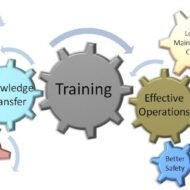
Benefits of Training to Employers The employers invest in training because they secure several benefits out of the exercise, which can be summed up as under: Faster learning of new skills Training aids the employers to lessen the learning time of their employees and accomplish higher standards of performance. The employees need not waste time in learning by observing others. If a formal training programme exists in the organization, the qualified instructors will help the new employees to acquire the skills and knowledge to do specific jobs quickly. Increased productivity Training increases the skill of the new employee in while performing a particular job. An increased skill level usually helps in increasing both quantity and quality of output. Training can be of great help even to the existing employees. It helps them to increase their level of performance on their present job assignments and prepares them for future assignments. Standardization of procedures Training can help the standardization of operating procedures, which can be learnt by the employees. Standardization of work procedures makes high levels of performance rule rather than exception. Employees work intelligently and make fewer mistakes when they possess the required know-how and skills. Lesser need for supervision. Trained employees need lesser supervision. Training does not eliminate the need for supervision, but it reduces the need for detailed and constant supervision. A well-trained employee can be self-reliant in his/her work because s/he knows what to do and how to do. Under such situations, close supervision might not be required. Economy of operations Trained personnel will be able to make better and economical use of the materials and the equipment and reduce wastage. Also, the trained employees reduce the rate of accidents and damage to machinery and equipment. Such reductions can contribute to increased cost savings and overall economy of operations. Higher morale The morale of employees is increased if they are given proper training. A good training programme shapes employees’ attitudes towards organizational activities and generates better cooperation and greater loyalty. With the help of training, dissatisfactions, complaints, absenteeism and turnover can also be reduced among the employees. Thus, training helps in building an efficient and co-operative work force. Managerial Development The top management can identify the talent, who can be groomed for handling positions of responsibility in the organizations. Newer talent increases the productivity of the organizations. By providing opportunity for self-development, employees put in their best effort to contribute to the growth of the...
Posted by Managementguru in Human Resource, Organisational behaviour, Principles of Management, Training & Development
on Feb 22nd, 2014 | 0 comments
Objectives of Training The objectives of training is different according to the employees belonging to different levels of organization. The objectives depend on the nature of the organization where training has to be provided, the skills desired and the current skill levels. 1. To increase the knowledge of employees or workers in doing specific jobs. 2. To scientifically and systematically impart new skills to the human resources so that they learn quickly. 3. To bring about change in the attitudes of the workers towards fellow workers, supervisor and the organization. 4. To improve the overall performance of the organization. 5. To make the employees handle materials, machines and equipment efficiently and thus to avoid wastage of time and resources. 6. To reduce the number of accidents by providing safety training to employees. 7. To prepare employees for higher jobs by developing advanced skills in them. 8. The basic objective of training however is to establish a match between man and his job. 9. The training is designed to improve knowledge, skills and attitude and thus equip the individual to be more effective in his present job or prepare him for future assignments. From the point of view of an organization individual growth is a means to organized effectiveness. The objectives of training can be summarized as follows: – 1. Induction : – Training constitutes a significant entry into the company’s way of life. Organizations have to provide induction training to all employees entering the organization to let them know, 1. What is company’s culture? 2. How does structure function? 3. What are policies & rules of organization? 4. What are designs of freedom or limits of behavior? 2.Updating :-A significant objectives of training is to prevent the Obsolescence of the employees by updating their skills & knowledge. 3.Preparing for future Assignments. 4.Improvement in Performance: Training will be an important aid to managers for developing themselves as well as their subordinates. It is not a substitute for development on the job, which comes from doing, experiencing, observing, giving and receiving feedback and coaching. Training can bring about an improvement in a person’s: Knowledge Skills Attitude, there by raising his potential to perform better on the job. 5. Growth Training is also focused towards developing people for higher levels of responsibility thereby reducing the need for recruiting people from outside. This would have the effect of improving the morale of the existing employees. 6.Organizational Effectiveness Training provides a means for bringing about organizational development. It can be used for strengthening values, building teams, improving inter-group relations and quality of work life. The ultimate objective of training in the long run is to improve the company’s performance through people performing...
Posted by Managementguru in Organisational behaviour, Principles of Management
on Feb 22nd, 2014 | 0 comments
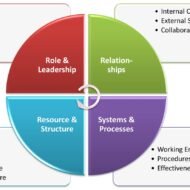
Organizational change is concerned with making things different and change agent is a person or group of persons who act as catalysts to bring about change. Say, managers and outside expert consultants can be called as change agents. What is Organizational Change? This is how you have to Strategise in order to Win Organizational development refers to the overall development of an organization in terms of improving the ability of that organization in tandem with the needs of the external environment and involves a system oriented approach to change. Recommended: Resourceful Guide on Organizational Development from Maryville University titled ” Organizational Development Guide: Definition, Process & Development Models “ Organizational change: All the elements of a social system like people, formal organization, informal organization, operational environment, communication, decision making and patterns of co-operation are bound to change when there is change in the external environment but this gives rise to a positive pressure which acts like a self-correcting mechanism to modify and set right the bottle-necks or loop-holes in the working system. Causes For Change Work force: The increasing awareness and educational qualification among the workforce is responsible for the attitude change. You can expect loyalty from workers above fifty but not workers who fall under the age category thirty. This is because their loyalty is oriented towards their career and not to the employer. Technology change: Internet, telecommunication systems, computers, robotics, flexible manufacturing operations have created a great impact on the working style of firms and necessitated the work force to be tech-savvy in order to survive in the job market. Economic, social, political, and physical environmental changes: Economic– Business cycles, inflation, recession, stock market crashSocial– Changing life styles and preferences of customers is the keyPhysical– Consumers, suppliers, employees, union, shareholders and the governmentPolitical– Political decisions affecting the market, pressure, legal hassles:- all these affect the working of a firm. Changes in competition: Global economy has brought big players from countries like USA, Japan, Germany and the like to compete in the same market and successful organizational are those who have adapted to competitive environment. When we talk about organizational change, we emphasize on “PLANNED CHANGE OR DELIBERATE CHANGE” in order to suit ourselves to the changing environment. Otherwise, according to Darwin’s theory of “Survival of the fittest” you will fade away in due course of evolution. This Infographic clearly reveals the fact that “It is not the strongest of the species that survive, nor the most intelligent, but the one most responsive to...
Posted by Managementguru in Accounting
on Feb 21st, 2014 | 0 comments
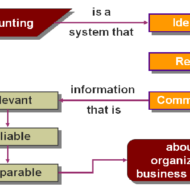
Functions of Accounting: a. Recording: Accounting records business transactions in terms of money. It is essentially concerned with ensuring that all business transactions of financial nature are properly recorded. Recording is done in journal, which is further subdivided into subsidiary books from the point of view of convenience. b. Classifying: Accounting also facilitates classification of all business transactions recorded in journal. Items of similar nature are classified under appropriate heads. The work of classification is done in a book called the ledger. c. Summarizing: Accounting summarizes the classified information. It is done in a manner, which is useful to the internal and external users. Internal users interested in these informations are the persons who manage the business. External users of information are the investors, creditors, tax authorities, labor unions, trade associations, shareholders, etc. d. Interpreting: It implies analyzing and interpreting the financial data embodied in final accounts. Interpretation of the data helps the management, outsiders and shareholders in decision making. Limitations of Accounting: Accounting information is expressed in terms of money. Non monetary events or transactions, however important, are completely omitted. Fixed assets are recorded in the accounting records at the original cost, that is, the actual amount spent on them plus all incidental charges. In this way the effect of inflation (or deflation) is not taken into consideration. The direct result of this practice is that balance sheet does not represent the true financial position of the business. Accounting information is sometimes based on estimates; estimates are often inaccurate. Accounting information cannot be used as the only test of managerial performance on the basis of more profits. Profit for a period of one year can readily be manipulated by omitting such costs as advertisement, research and development, depreciation and so on. Accounting information is not neutral or unbiased. Accountants calculate income as excess of revenues over expenses. But they consider only selected revenues and expenses. They do not, for example, include, cost of such items as water or air pollution, employee’s injuries, etc. Accounting Made Easy Accounting like any other discipline has to follow certain principles, which in certain cases are contradictory. For example current assets (e.g., stock of goods) are valued on the basis of cost or market price whichever is less following the principle of conservatism. Accordingly the current assets may be valued on cost basis in some year and at market price in another year. In this manner, the rule of consistency is not followed...