Posted by Managementguru in Business Management, Decision Making, Marketing, Operations Management, Project Management
on May 7th, 2014 | 0 comments
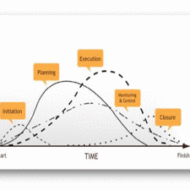
Project Formulation and Project Life Cycle What is a Project? “A temporary endevour leading to a product / service or result ” A project is any series of activities and tasks that: • Have a specific objective to be completed within certain specifications • Have defined start and end dates; • Have funding limits (if applicable); and • Consume resources (i.e. money, time, equipment). Characteristic Features of a Project: • Has a mission or a set of objectives. Once the mission is achieved the project is treated as completed. • Has to terminate at some time or the other (temporary in nature) • The project is one single entity and its responsibility is assigned to one single agency. • Calls for team-work, the members of the team may come from different organizational units, different disciplines, and geographic regions. • Has a life cycle represented by growth, maturity and decay. • Is unique and no two projects are similar, even though the plants set up are identical. The organizations, the infrastructure, the location and the people make the project unique. • Change is a natural phenomenon with every project throughout its life span. Some changes may not have any major impact, but some may change the very nature of the project. • The happenings during the life cycle of a project are not fully known at any stage. As time passes, the details are finalized successively. • Is always customer-specific. The requirements and constraints within which a project must be executed are stipulated by the customer. • Is a complex set of things. Projects vary in terms of technology, equipment and materials, machinery and people, work ethics and organizational culture. • A substantial portion of the work in a project is done by sub-contracting. The greater the complexity of a project, the greater will be the extent of work performed by subcontractors. • Is exposed to risk and uncertainty and the extent of these depend upon how the project moves through the various stages in its life span. • A well defined project has lesser risk and uncertainty, whereas an ill-defined project faces greater degree of risk and uncertainty. Project Life Cycle: The Project Life Cycle refers to a series of activities which are necessary to fulfill project goals or objectives. The different phases are as follows: a) Concept or initialization phase In this phase, the project idea emerges and the #management decides on the need for a project. A project which is well conceived can be later implemented successfully. b) Project Definition Phase •The techno-economic viability of the project is checked •The technical configuration of the project is identified •The performance requirements, sub-systems, key equipments etc.- purchased •The cost estimates with limits are identified •Schedule of implementation is identified c) Growth or Organisation Phase Organizations, during this phase, undertake the following actions: a) Establishing the infrastructure and enabling services for the project b) Project engineering and design c) Setting up Project Organization and staffing d) Appointing a project manager e) Preparing schedules and budgets f) Obtaining necessary licenses and clearances from the Government g) Raising finance h) Developing systems and procedures for monitoring and reviewing project progress i) Procedures for inviting tenders and awarding contracts j) Site preparation and development k) Procuring equipment and materials l) Work packaging This phase covers both paper work connected with project planning and also implementation activities. Planning is necessary to avoid crisis management; it makes the implementation phase to run smoothly. d) Implementation Phase The activities include: 1) The preparation of specifications for major equipment and machineries, 2) Placing orders with vendors for the supply of...

Posted by Managementguru in Decision Making, Project Management, Strategy
on May 4th, 2014 | 0 comments
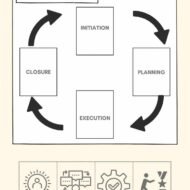
In many segments that rely on a culture of project management, the project officially begins with the official approval of the project, which is not so in the development sector, where the project life more commonly begins with a Project Identification and Screening Phase. The seed of a project arises merely as an idea – a need or opportunity that is weighed, scrutinized, and eventually developed into a project which is managed through the project life cycle. The most critical question one has to ask would be ‘Are we doing the right project?’ Because a problem well understood is half done. Let us Cruise Through the Ideas in Project Identification and Screening Search for New Ideas What are the objectives? *Brainstorm to generate alternative solutions. -Emerging market trends. –SWOT analysis. -Other constraints *Shortlist candidate ideas for detailed scrutiny. Motivation Projects are a means to accomplish -Individual or family objectives -Organizational objectives -National or global objectives Project Identification begins in response to the specific need or the objectives Objectives To increase profitsTo minimize threats of lossesTo become more competitiveTo provide help after a disasterTo train people in a new areaTo reduce pollution in DelhiTo become a successful entrepreneur Download this project planner template to effectively conduct your projects 👇 Minimal-and-Elegant-Project-Planner-TemplateDownload Swot Analysis A tool that detects the strengths, weaknesses, opportunities and threats of an organization. In particular, SWOT is a basic, straightforward model that measures what an organization can and cannot do as well as its probable opportunities and threats. The method of SWOT analysis is to take the information from an environmental analysis and distinguish it into internal (strengths and weaknesses) and external issues (opportunities and threats). Once this is over, SWOT analysis determines what may assist the firm in accomplishing its objectives, and what obstacles must be overcome or minimized to achieve desired results. • Objectives • Experience • Resources • Environment pressures -Keeping these factors in mind an analysis of strengths, weaknesses , opportunities and threats is made to identify and select suitable projects. STRENGTHS • Experience and expertise • Financial position • Capital raising capability • Industrial contacts • Foreign collaborations WEAKNESSES • Newer unfamiliar technologies • Inability to raise huge investments • Lack of experience • Lack of trained personnel • Inability to forecast market trends OPPORTUNITIES • Emerging technologies • New products with new markets • New processes with better features • Special financing schemes • Government and other incentives THREATS • Competitors • Poor state of the economy • Outdated technology • Unprofessional management skills • New products and services BRAINSTORMING • A good means to generate new project ideas • Focus on uninhibited participation by a group • Listing of ideas without suppressing creativity at source • List of ideas subjected to screening and evaluation subsequently Download this meeting notes planner template to effectively conduct your project meetings 👇 Pink-Yellow-Gradient-Project-Meeting-Notes-PlannerDownload SCREENING OF IDEAS Poor Fair Good Vgood Excellent (1) (2) (3) (4) (5) Weight •Cost * 20% •Risk * 30% •Return * 40% •Hazard * 10% •(score = 2×0.2+3×0.3+4×0.4+2×0.1= 3.1) CRITERIA IN SCREENING PROJECTS • Investment • Rate of return • Risk • Likely profit • Payback • Similarity to existing business • Expected life • Flexibility • Environment impact • Competition Let us look at the following example – Reducing Vehicular Pollution in Delhi Ideas Generated in Brain Storming Restrict registration of new vehiclesEnforce strict emission regulations for vehiclesBan diesel run vehicles on roadIntroduce MRTS – Mass Rapid Transport System for the cityEncourage use of car poolsGrow more trees/ green belts in the cityDeclaring no traffic zones in the cityBan vehicles with an age of ten or more years from plying on the roads These and...
Posted by Managementguru in Architecture and Interior Design, E Sale Point
on May 3rd, 2014 | 0 comments
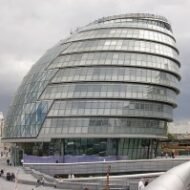
Blobitecture, also referred to as “blob architecture” or “blobism“, refers to modern structures with an amorphous, blob-like shape. Blobitecture arose in the course of the nineteen nineties when CAD methods have been first being designed for architects and interior designers. The term ‘blob architecture’ was coined by architect Greg Lynn in 1995 in his experiments in digital design with metaball graphical software. Soon a range of architects and furniture designers began to experiment with this “blobby” software to create new and unusual forms. Blob architecture has given the world some of its most memorable and distinctive buildings, such as the experience music project in Seattle. Blobitecture is built to emulte nature, which is why it is considered to be organic architecture. Read on: A comprehensive guide on the 25 most popular interior design styles from Happy DIY Home – your first step to finding a style that suits, with 25 of the most popular interior design styles broken down and explained, with simple steps for you to follow to realise in your own home. This is a fantastic powerpoint presentation on this new idea, one of its kind – adding a new dimension to the imagination of architects. Created by budding architects of our team, this will open many new gates of imagination to the world of architecture. Buy this wonderful presentation to build your knowledge…. FOLLOW THIS LINK TO DOWNLOAD THE PRODUCT…. BLOBITECTURE...
Posted by Managementguru in E Sale Point
on May 2nd, 2014 | 0 comments
This PDF on GRE verbal / vocabulary enlightens you with almost all ‘A’ series words covered. Given in the form of posters for your easy understanding and practice, it will definitely serve as a ready reckoner whenever needed. Planning to release the next PDF on ‘B’ series again with the complete list of words that’ve appeared in the past GRE papers. Lilting tips to crack GRE verbal… Learning Vocabulary can be Fun – Your vocabulary is absolutely vital to mastering the verbal section of the GRE test. One part of this will include the Sentence Completion section, which makes up about a quarter of your overall score. You also improve GRE vocabulary through talking. When you talk to somebody your mind is more alert than when you are studying alone. That is because you are using two senses instead of one. FOLLOW THIS LINK TO BUY THE INEVITABLE GUIDE AND CRACK GRE GRE Vocabulary Guide – Top 120 Words in ‘A’...
Posted by Managementguru in E Sale Point
on May 1st, 2014 | 0 comments

Buy One Get One Free… Buy One Presentation and Get One Absolutely Free Pay the price to understand accounting basics and get free resource material on accounting conventions… What is “What you possess” and Who is “Who is liable”. We have given you the accounting basics in the simplest manner to understand and execute. Accounting becomes a cake-walk when you place the right elements at the right places for which you need to be have a grip on the basics. Along with this, you are entitled for a free presentation on “Accounting Conventions and Concepts” which outlines the three fundamental conventions of accounting namely, Convention of consistency, Convention of full disclosure and Convention of conservatism. We assure you will be benefited with these presentations… Follow the link to download the product …. PPT on Basics of Accounting and Free Resource Material on Accounting Conventions…...