Posted by Managementguru in Business Management, Decision Making, Human Resource, Principles of Management, Strategy
on Mar 23rd, 2014 | 0 comments

Strategy implementation is the transformation of chosen strategy into organizational action so as to achieve strategic goals and objectives. The journey towards success is a saga or penance, where your effort and concentration is focused only on achieving the goal. It can be compared to the blinkers of a horse to give direction and avoid distractions. Proper resource planning is the key factor that gives a practical shape to your strategies. The available resources should be put into optimum use. Corporate Resource Planning: Resource planning at the corporate level comprehensively covers the planning for physical resources, human resources, financial and intangible or intellectual resources like patents, copyrights, technology, trademark etc., at the macro level of the firm. These are needed for the corporates to achieve their vision and also give direction to the departments at the functional level. These resources are allocated after giving due consideration to the industry’s cycle position, competitor strength, technological changes in the industry, market share and the type of competition in the industry. Economic Models with Value Additions: For instance, automobile owners have tapped the customer psychology and are concentrating more on producing bug cars that is very appealing to the upper middle class families, since a four wheeler is more comfortable and safe to drive, well within the budget range, ideal for a nuclear family and at the same time serves the purpose of a status symbol. So, these car manufacturers become direct competitors for two wheeler producers. Even if say, 25 to 30 percent of two wheeler population is shifted to four wheeler usage it is a huge success to the car manufacturers. Tata Nano car, a brain child of Ratan Tata is one of its kind. He has capitalized on the middle class Indian frame of mind to go for economic models with value additions. “Nothing is permanent except change”, so in this fast moving business arena all business persons are subjected to the necessity of thinking new, if not big. Corporates concentrate more on their strategic business units which serve as functional units and also a part of an organization, say a factory or a showroom. The resources for each of these business units have to be planned. The human resource department has to play its part in a promising way as human personnel are the critical success factors of an organization that manipulate other resources efficiently. Product and Process Innovations: Product and process innovations are the need of the hour and corporates are spending huge amounts on research and development of new products and processes. It has to be kept in mind that the innovations have to reach the markets quickly in order have an edge over your competitors. Identify your strength Tap the unidentified needs of the consumer Allocate management responsibility for each task Set your priorities by resource rationing Test your key assumptions Whether your product is acceptable in the market Whether the technology is updated All of these help you in forming a strategic platform upon which strategic implementation is done. Rational and realistic assumptions are the basic premises on which your decisions have to be based. Adequate finance, machinery and maintenance, labor force, marketing mix, your product strength, critical success factors of your organization, everything has to be thoroughly analyzed and put into action for successful strategic implementation. Related Videos… Alternative Competitive Advantage Introduction to Strategic...

Posted by Managementguru in Business Management, Decision Making, Organisational behaviour, Principles of Management, Strategy
on Mar 23rd, 2014 | 0 comments
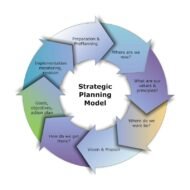
Strategic Evaluation: concerns mainly the analysis and judgment of interventions at the level of strategic goals. One of the noteworthy aspects of strategic evaluation consists of the verification of the adopted strategy with respect to the current and likely social and economic situation. How a firm has performed over time and relatively to its competitors, can be determined with the help of the following quantitative measures. Market price of the sharesMarket shareEarnings on capital employedDividend ratesReturn on equityGrowth in sales volumeProduction costs and efficiencyDistribution costs and efficiencyEmployee turnover, absenteeism, and satisfaction indices. Since there is a high correlation between progress and these indicators, we can say that a firm is successful if majority of the factors show a positive signal. But in reality, one cannot expect a business firm to satisfy all the above mentioned criteria, as performance is also affected by unexpected variations in the external environment. One has to trade-off between the positive and negative indicators and find suitable ways to enhance the performance levels. Effectiveness of a Strategy: The strategic importance of any particular criterion may not remain the same at different points of time. The short run and long run effectiveness of strategy cannot be evaluated using the same criteria. There may be difficulties in computation and different methods of computation that may be encountered in measurement. These factors serve as the bases for firms to identify the elements of success. Yet another way of performance evaluation is to identify critical factors that may be regarded as symptoms of decline and can be treated as early warning signals during the implementation of strategy. If they indicate the necessity of a turnaround or retrenchment strategy, the firm should definitely go for a suitable action without further delay. Such factors may be: Declining profit marginDeclining market shareRapidly increasing debtDeclining working capitalIncreasing managerial turnover What is the Need for Strategic Evaluation? You might be curious to know, what is the need for a strategic evaluation at all in the first instance? See, business firms and corporate companies are always in a position to execute their action plans in the wake of severe competition and retention of market share. A plan without a strategy is like life without a soul and decision making is solely dependent upon strategic inputs. Turnaround Strategy The need for feedback, appraisal and reward, check on the validity of strategic choice congruence between decisions and intended strategy all these help in successful culmination of strategic management process and create inputs for new strategic planning. What’s the difference between Strategy and Tactic? The evaluation need not be based only on quantitative terms, but also on qualitative aspects such as: internal consistency, consistency with the environment, appropriateness of the strategy in the light of available resources, acceptability of the degree of risk involved in the strategy, appropriateness of the time horizon of the strategy...
Posted by Managementguru in Business Ethics, Business Management, Organisational behaviour, Principles of Management, Strategy
on Mar 23rd, 2014 | 0 comments
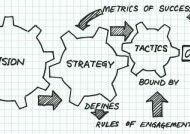
Tactics or Strategy – Ethical Considerations Give a man a fish everyday, his appetite is sated. Teach him how to fish; you have fulfilled his appetite for an entire life time. This is strategy. To make it work, to make the impossible, possible. There is no drawn out template for success or for that matter strategy. But both of them go together when the right strategy is used at the right time and you can bang on your target. Neither the same strategy fits the bill for everybody. Your smart approach to that particular situation backed up by your knowledge and experience does the magic. It cannot be taught, it comes from within when the situation warrants for action. It is more like “Survival of the fittest”, if you want to retain your niche in this business world you act fast and think wise. Tactics: How many of you are bold enough to think differently to make a difference, to make others feel your presence. Never implement tactics which is short lived and don’t make your presence felt either by imitation or by unethical competitor criticism. That will paint a greasy picture on your firm. That is of course strategy but cheap strategy. But always be on the run to know your competitors’ weaknesses and shortcomings which will make you improve your product or service. That is acceptable business practice where competitor spying gives us an edge in terms of identifying unexploited niches of the market. Resort to Constructive Strategies: Strategies must always be constructive and it assures success in the long run. Tactics or gimmicks will prove to be fruitful only for a short while and that is not your aim also. Will you be satisfied if you are able to sell your product or service as hot cakes only for a season! Is that going to cover your profit margin for the entire accounting year? True, strategies are always associated with making profits, boosting up the sales, for retaining the market share and maximizing the share value. But it should also make your business perennial and viable. Strategic Framework: Many of us forget that strategies are applicable in every activity of a firm that forms a compact framework which gives your business a solid foundation upon which you can build your empire of success without looking back. Right from framing your vision, mission, policies, procedures and programmes including recruitment, selection, training, evaluation and empowering your employees, strategies play their role in giving clarity and direction to the firm. Long-Term Planning: Although strategies are meant for long term planning, a periodic review and appraisal of the company’s strategies to all the employees concerned is a must to keep them informed. Strategies are secrets but not to the employees of your organization. Strategies are born out of compulsion, a compulsion to survive in the market and have an edge over others. So they must be meticulously planned after brain storming sessions and expert consultations. Sometimes even a small idea suggested by one of your employees might become the basis for a turnkey operation. So keep your eyes and ears open and also be open minded to accept ideas even from the lowest level as they are your pillars of strength and they know the pulse of the market and people better. Strategic Action Plans: Success is not a cake walk, it has to be achieved with great hardships and the taste of success will be sweeter. Strategies are formulated in every step of your business plan, remember it is an ongoing process; you have to revitalize your strategies every now and then to be in the scene, to make...
Posted by Managementguru in Business Management, Decision Making, Marketing, Organisational behaviour, Principles of Management, Project Management, Strategy
on Mar 22nd, 2014 | 0 comments
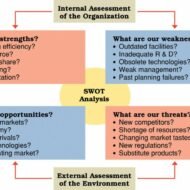
What is Swot Analysis and how to do a Swot Analysis Perfectly? Strategy formulation is an integral part of management decision making as strategies come to our risk whilst there are fluctuations in the external environment. A management expert will tell you rightly that strategies are not templates constructed for a specific purpose as they are formulated based on broad policies of a particular organization and have to be in tandem with the enterprise objectives. Nevertheless a CEO will find himself in situations where he might be forced to make instantaneous strategic decisions irrespective of the nature of the problem, only considering the magnitude of the situation. SWOT AND SYNERGY EQUATIONS Significance of SWOT Analysis: The analysis subjectively evaluates the impact of internal and external factors for a business objective. Internal processes and resources are considered strengths and weaknesses (S and W, respectively). External factors affecting the business and industry are considered opportunities and threats (O and T, respectively). An evaluation of these factors develops a strategic perspective that includes the competitive landscape and current market conditions. Need for Alternate Strategic Decisions: Lately we are witnessing a number of multinational giants going in for Joint Ventures and Collaboration. What is the root cause for such alternate strategic decisions? What happened to the value of the “Brand Image” of the organization or the “Profit Margins” which kept the company going? Well, this is where we have to look into the structure of their operations and most importantly the modality formulated to reach their ultimate objectives. Definitely, there would have been a big dent somewhere in the top management notch, failing to see through the obvious. Market Research is Inevitable for Decision Making: Situations change and we even experience this in our day to day lives, where decision making becomes very difficult at times; further we push the situation to extreme limits and make it worse. Planning is the very basis of our life that facilitates smooth functioning and change for the better. In big corporates, decision making is by and large the responsibility of the top management and they pass on the instructions down the line. It is but natural that the chairman and board of directors should make all the important decisions as they are the potential capital investors. Market research is another area that deserves mention at this juncture without which business persons cannot think of kicking off trade as it will be a sheer waste of money and time. Understanding the pulse of the market and your target customers always help in shaping up the right strategies concerning New product launch Consumer Preference Price determination Product modification etc., Test marketing is one of the strategies followed by many multi national companies while they launch their new products or wish to introduce variations in their product range. THE IMPORTANCE OF DECISION-MAKING Strategies are based on organizational policies and policies have to confer to the objectives and goals of the organization. The top management team should be a set of professional experts who should be able to gauge the existing as well as future trends of the market based on political, legal, environmental and economic changes and sketch their action plans accordingly. Decentralising decision making and delegating the authority as and when needed are also fine strategies to gain co-operation from your employees and to bring co-ordination in the entire business...
Posted by Managementguru in Business Management, Marketing, Organisational behaviour, Principles of Management, Strategy
on Mar 22nd, 2014 | 0 comments
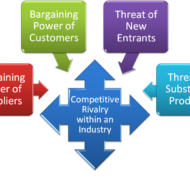
PORTER’S FIVE FORCES Porter’s five forces analysis-draws upon industrial organization (IO) economics to derive five forces that determine the competitive intensity and therefore attractiveness of a market. Survival of the Fittest: True to Darwin’s theory “Survival of the fittest”, only competitive firms survive in the business market, provided, they have made the right strategic choice by comprehensively analyzing their position in the industry. Every organization is part of the industry and almost all of them face competition. Thus, industry and competition are the vital considerations for making a strategic choice. All the firms in a particular industry vie for the same set of customers by offering identical or similar products with minor variations. The analysis of the external environment in relation to the context of industry attractiveness thus becomes essential. A Critical Evaluation of Michael Porter’s Five Forces Framework Industrial Analysis: Industry analysis helps a firm to also fix long range plans, by gauging long term growth opportunities present if any. Strategic choice is nothing but, to screen all possible strategic alternatives followed by narrowing down the choice to the best suited and feasible alternatives and ultimately choosing an optimum strategy. To explain it in more clear terms, let us look at this example. Say, if there are three big players of car manufacturers in an automobile industry. Each follows their own strategic style to capture the market. What are the threat factors? Threat can be in the form of four-wheeler manufacturers like trucks and jeeps, but these cannot be competitively priced. Threat can be in the form of suppliers who dominate the industry by having a grip on the supply of components, sub-assemblies and accessories. Threat in the form of new entrants, but the growth might be restricted due to government regulations. A thorough analysis of the automobile industry thus made can make things clear to the firm, as to where they stand in terms of market share, what are their strengths and weaknesses, who pose a threat, what are the potential opportunities for growth and to tap market segments whose needs are unidentified. Still, it will be a seller’s market where the buyers have no bargaining power. On the other hand, if the weather does not favor its growth, the firm has to immediately decide on its next course of action, calling for diversification. The possible threats for a firm can come from five directions as mentioned below: Potential threat from new firms entering the market Threat from substitutes available in the market Threat from competitors Bargaining power of the suppliers Bargaining power of the buyers The structure and dynamics of an industry has to be analyzed in order to determine the intensity of competition and profitability. As the market is very dynamic, it becomes mandatory for firms to evolve strategies embracing a modern approach, with emphasis on reappraisal of existing strategy in the light of changing external conditions and formulation of alternative...