Posted by Managementguru in Accounting, Management Accounting
on Feb 14th, 2014 | 0 comments
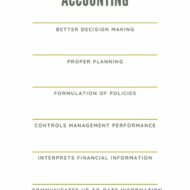
The basic objective of management accounting is to assist the management in performing its functions effectively. The functions of the management are planning, organizing, directing and controlling. What is Management Accounting? Management accounting also is known as managerial accounting and can be defined as a process of providing financial information and resources to the managers in decision making. Management accounting helps in the performance of each of these functions in the following ways: Provides data: Management accounting serves as an important source of data for management planning. The accounts and documents are a store-house of a vast quantity of data about the past progress of the enterprise, facilitating forecasts for the future. Modifies data: The accounting data required for managerial decisions is properly collected and classified. For example, purchase figures for different months may be classified to know total purchases made during each period product-wise, supplier-wise and territory-wise. Analyses and interprets data: The accounting data is probed meaningfully for effective planning and decision-making. For this purpose the data is presented in a comparative form. Ratios are calculated and likely trends are projected. Serves as a means of communication: Management accounting provides a means of communicating management plans upward, downward and outward through the organization. Initially, it means identifying the feasibility and consistency of the various segments of the plan. At later stages it keeps all parties informed about the plans that have been agreed upon and their roles in these plans. Facilitates control: Management accounting helps in translating given objectives and strategy into specified goals for attainment by a specified time and secures effective accomplishment of these goals in an efficient manner. All this is made possible through budgetary control and standard costing which is an integral part of management accounting. Uses qualitative information: Management accounting does not restrict itself to financial data for helping the management in decision making but also uses such information which may not be capable of being measured in monetary terms. Such information may be collected form special surveys, statistical compilations, engineering records, etc. Take the Quiz and Check Your Accounting IQ! 1. The financial statement that reports the revenues and expenses for a period of time such as a year or a month is the Balance Sheet Income Statement Statement Of Cash Flows 2. The financial statement that reports the assets, liabilities, and stockholders’ (owner’s) equity at a specific date is the Balance Sheet Income Statement Statement Of Cash Flows 3. Under the accrual basis of accounting, revenues are reported in the accounting period when the Cash Is Received Service Or Goods Have Been Delivered 4. Under the accrual basis of accounting, expenses are reported in the accounting period when the Cash Is Paid Expense Matches The Revenues Or Is Used Up 5. Revenues minus expenses equals __________ 6. Resources owned by a company (such as cash, accounts receivable, vehicles) are reported on the balance sheet and are referred to as __________ 7. Assets are usually reported on the balance sheet at which amount? Cost Current Market Value Expected Selling Price 8. Obligations (amounts owed) are reported on the balance sheet and are referred to as __________ 9. Liabilities often have the word __________ in their account title. 10. Unearned Revenues is what type of account? Asset Liability Stockholders’ (Owner’s) Equity Scroll Down to Know the Right Answers: ↓ ↓ ↓ ↓ ↓ 1. Income Statement 2, Balance Sheet 3. Service or Goods have been delivered 4. Expense matches the revenue or is used up 5. Net income 6. Assets 7. Cost 8. Liabilities 9. Payable 10. Liability Here are some very resourceful online courses on accounting from udemy – Give it a try: 1. Accounting & Financial Statement...

Posted by Managementguru in Accounting, Management Accounting
on Feb 14th, 2014 | 0 comments
The main aim of management accounting is to help an organization in its functions of planning, directing, controlling and areas of specialization included within the admit of management accounting. The main concern of management accounting is to provide necessary quantitative and qualitative information to the management for planning and control. For this purpose it draws out information from accounting as well as non-accounting sources. Hence, its scope is quite vast and it includes within its fold almost all aspects of business operations.
Posted by Managementguru in Accounting, Financial Accounting, Management Accounting
on Feb 14th, 2014 | 0 comments

Accounts are Classified as Follows Accounts in the names of persons are known as “Personal Accounts” Accounts in the names of assets are known as “Real Accounts” Accounts in respect of expenses and incomes are known as “Nominal Accounts” Personal Accounts It deals with accounts relating to persons, firms, companies and man-made institutions. It is further classified into three categories as shown below. NATURAL PERSON’S A/C : e.g- David, Customer ARTIFICIAL PERSON’S A/C : e.g- Banks, firms, companies REPRESENTATIVE’S A/C : e.g- Capital, Drawings Real Accounts These are accounts of assets or properties. Assets may be tangible or intangible. Real accounts are impersonal which are tangible or intangible in nature. Eg:- Cash a/c, Building a/c, etc are Real Accounts related to things which we can feel, see and touch. Goodwill a/c, Patent a/c, etc Real Accounts which are of intangible in nature. Nominal Accounts These accounts are impersonal, but invisible and intangible. Nominal accounts are related to those things which we can feel but cannot see and touch. All “expenses and losses” and all “incomes and gains” fall in this category. Eg:- Salaries A/C, Rent A/C, Wages A/C, Interest Received A/C, Commission Received A/C, Discount A/C, etc. Debit and Credit: Each accounts have two sides – the left side and the right side. In accounting, the left side of an account is called the “Debit Side” and the right side of an account is called the “Credit Side”. The entries made on the left side of an account is called a “Debit Entry” and the entries made on the right side of an account is called a “Credit Entry”. Golden Rules of Book-Keeping Personal Accounts: DEBIT THE RECEIVER & CREDIT THE GIVER Real Accounts: DEBIT WHAT COMES IN & CREDIT WHAT GOES OUT Nominal Accounts: DEBIT ALL EXPENSES AND LOSSES & CREDIT ALL INCOME AND GAINS What is an Accounting Equation? It is a statement of equality between the debits and the credits. It explains that the assets of a business are always equal to the total of liabilities and capital. It is also called the balance sheet equation. Assets = Liabilities + Capital A = L + C ASSETS ARE THE TOTAL VALUE OF PROPERTIES OWNED BY THE BUSINESS LIABILITIES ARE THE RIGHTS OF THE THIRD PARTIES TO THE PROPERTIES OF THE BUSINESS OR THE AMOUNT DUE BY THE BUSINESS TO THE THIRD...
Posted by Managementguru in Accounting, Financial Accounting
on Feb 14th, 2014 | 0 comments
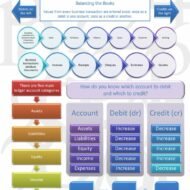
Double Entry System of Book Keeping Accounting is not to be feared Accounting is a subject that is intertwined with our day-to-day lives yet people think it is quite a complicated subject to deal with. The fancy of the subject is such, that many of us fail to understand that it is quite simple, un-complicated and all it talks about is balance. Rather than barging into equations that make us grip with fear, let us start with the basic question of WHAT=WHO? “What” deals with whatever we have in hand or otherwise ASSETS and “Who” deals with the claims, both other’s claims and our own claims on the product we have in hand. Other people’s claims are known as LIABILITIES and our own claim on the product is called Owner’s equity. Now if we take “WHAT=WHO”, it can be translated into the following equation ASSETS= LIABILITIES+OWNER’S EQUITY Accounting: Get Hired Without Work Experience UNDERSTAND WHAT = WHO What = Who Stuff = Who Assets = Who Assets = Who Has Claim Assets = Claims Assets = Other People’s Claims + My Claims Assets = Liabilities + My Claims Assets = Liabilities + My Equity Assets = Liabilities + Owner’s Equity Simple Equation to Remember There are two types of claims: other people’s claims and my claims. Assets = Other People’s Claims + My Claims Claims are also referred to as equities. Assets = Other People’s Equities + My Equity. Accountants have a fancy word for other people’s equities. These are known as liabilities. Assets = Liabilities + My Equity Because I am the owner, we will call My Equity Owner’s Equity. Assets = Liabilities + Owner’s Equity This is the formal equation of accounting. The structure of accounting is based on this one perspective. Accounting students memorize it. And try to decipher it. You are way ahead of the game because you understand that what = who! WHAT ARE ASSETS AND LIABILITIES Assets are on the left of the Big T. Asset accounts increase with debits. Liabilities and Owner’s Equity are on the right of the Big T. They increase with credits. Income ultimately increases owner’s equity so it behaves like owner’s equity: it increases with a credit. Expenses increase with debits. The best way to improve your expertise in accounting procedure is to practice; in due course your hand movement and thought process start synchronizing. Examples of Asset accounts – Vehicles, Furniture, Cash Examples of Liabilities accounts- Accounts payable, Owner’s equity Purchasing a TV- Example ASSETS (what) = LIABILITIES + OWNER’S EQUITY (who) Say if you invest Rs.5,000 as down payment from your end and take a loan of Rs.20,000 from the bank to purchase the product. Now, the bank has a claim on your asset to the extent of Rs.20,000 and your claim is Rs.5000. Here liability is Rs.20,000 and Owner’s equity is Rs.5,000. On the asset side we have a TV worth Rs.25,000 You can see that the value of the asset is equal to the value of liabilities, i.e., what = who. ASSETS = LIABILITIES + OWNER’S EQUITY 25,000 = 20,000 + 5,000 Just how you see a hand with five fingered palm on one side and five fingered nails on the other side, this accounting equation has two different perspectives to strike a balance between assets and liabilities. The Big Balancing ‘T’ The Big Balancing ‘T’ BIG “T” FOR PRODUCT PURCHASE WHAT (ASSET) VEHICLES (Rs.25,000) = WHO (LIABILITIES) ACCOUNTS PAYABLE (Rs.20,000) + PAID IN CAPITAL (Rs.5,000) Do I Debit or Credit? When we receive cash for completing a consulting job we know that cash has increased so we debit cash. The corresponding account...
Posted by Managementguru in Accounting, Financial Accounting, Management Accounting
on Feb 13th, 2014 | 0 comments

Bookkeeping involves organizing and managing all business transactions in a company.
Bookkeeping is the recording, on a day-today basis of the financial transactions and information pertaining to a business. Bookkeeping provides the information from which accounts are prepared but is a distinct process, preliminary to accounting.