Currently Browsing: Branding
Posted by Managementguru in Branding, Marketing, Sales, Social Media
on Jul 14th, 2023 | 0 comments

In today’s fiercely competitive business landscape, standing out from the crowd is critical for success. Effective marketing plays a pivotal role in capturing the attention of your target audience and differentiating your business from competitors. This blog post will explore the art of marketing and provide actionable strategies to help your business rise above the noise. Understanding Your Audience Understanding your audience is the foundation of effective marketing. Take the time to carry out in-depth market research and gather valuable insights about your target customers. Start by identifying demographic information such as age, gender, location, and income level. Dig deeper to uncover psychographic details like their interests, values, lifestyle choices, and pain points. Make use of various research methods, including surveys, interviews, and social media monitoring, to gather information about your audience. Look for patterns among your existing customers and use this data to develop comprehensive buyer profiles. These profiles serve as hypothetical depictions of your ideal clients, which allow you to better tailor your marketing messages to resonate with their specific needs and desires. Building a Strong Brand Identity A strong brand identity sets your business apart from the competition and leaves a lasting impression on your audience. It encompasses various elements such as your brand name, logo, tagline, color palette, typography, and tone of voice. Start by defining your brand’s values, mission, and unique selling proposition. Craft a compelling brand story that reflects the essence of your business and communicates your values in an authentic and relatable manner, and consistently use this story across all marketing channels to build a cohesive and memorable brand experience. Lastly, design a visually appealing workplace that reflects your values and resonates with your target audience. Creating Engaging Content Creating engaging content is a key component of effective marketing. It involves developing high-quality, valuable, and relevant content that captures the attention of your target audience and encourages them to take action. Start by understanding the pain points, interests, and needs of your audience, and tailor your content to address those effectively. Use a mix of formats such as blog posts, videos, infographics, podcasts, and interactive content to cater to different learning preferences and engage your audience across various channels. Focus on providing informative and actionable content that solves problems, educates, and entertains your audience. For example, a construction company could craft blog posts around popular topics, such as picking the right steel erection services for your needs, to share knowledge and to help them become seen as a thought-leader in their market. Remember to tell compelling stories that resonate with your target customers, showcasing how your products or services can enhance their lives or solve their challenges, to increase your brand identity. Crafting a Unique Value Proposition Your value proposition is the unique value that you offer to your customers. It is the answer to the question, “Why should customers choose your business over competitors?” To craft a compelling value proposition, consider the key benefits and solutions your product or service provides. Identify the primary pain points your target audience faces and emphasize how your product or service addresses those pain points. Highlight the unique features, quality, convenience, or affordability that sets your business apart, and use clear and concise language to communicate your value proposition, making it easy for your audience to understand and remember. Try to test different value propositions and refine them based on customer feedback and market response. A well-crafted value proposition not only differentiates your business but also creates a strong motivation for customers to choose your products or services. Leveraging Digital Channels In today’s digital age, leveraging digital channels is vital for marketing success. Establish a...

Posted by Managementguru in Branding, Marketing, Startups
on Jun 20th, 2023 | 0 comments
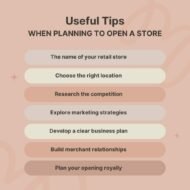
Whether you have been running a successful online business for some time now and are looking to expand to a physical store or else have grand plans to start a retail business from scratch, then you have most definitely clicked on the right article. Here are the top four useful tips when planning to open a store to help you on your journey to success. 1. Your Name is Your Brand Firstly, even if you have already been operating under a business name online, when opening a store, your name becomes much more closely linked to the products and services you offer and represents your entire brand, so you need a strong business name moving forward. From the perspective of the customer, your brand name needs to hold meaning, and for branding purposes, you also need to ensure the name is short and snappy, making it much more memorable and easier to work with when designing advertising materials. Furthermore, make sure you conduct a thorough internet search before you finalize your name to ensure there is no similarly-named business, regardless of industry, in your local area and, ideally, in the country. 2. Hire a Professional Roof Contractor Even if you have already taken several personal tours around your new unit and have asked more than one expert to look at the space’s suitability, it is still strongly advisable to hire a professional contractor to take a look at the roof. Ask around for a reputable and established commercial roofing St. Louis company, who will not only talk you through any issues they find with the current roof but also advise you on aftercare and maintenance points should any work be conducted. 3. Focus on Vendor Business Relationships When opening a retail store, regardless of whether you are an experienced business owner or not, the more connected you are to the other companies and stores in and around your own store’s location, the better. As you will already know, there is a wide plethora of potential challenges that small business owners could face, especially in the first few weeks and months of opening and as such, the relationships you strive to build between your business and others can make a huge difference to your chances of success and longevity for the future. 4. Organize a Grand Opening No matter the nature of your business and, indeed, whether you plan to be open every day and for long business hours or else intend on a part-time opening basis to judge the number of customers you have, a grand opening is the only way to put your new store’s name on the map. Media coverage, including any neighborhood newsletters and your local newspaper, as well as the local radio, is a fantastic way of drumming up interest in your new store. Of course, publicizing your new store on social media is also another affordable and effective publicity...
Posted by Managementguru in Branding, Marketing, Quotes and Quotes Only
on Dec 16th, 2022 | 0 comments
Branding through story telling is one of the effective ways to create an impact on your customers. Businesses and brands of all sizes should use the potent influence of story telling. We have compiled 30 branding and story telling quotes for your benefit. ❝ A brand is no longer what we tell the consumer it is – it is what consumers tell each other it is. 💡 Scott Cook ❝ Your brand is a story unfolding across all customer touch points. 💡 Jonah Sachs ❝ Brand is the sum total of how someone perceives a particular organisation. Branding is about shaping that perception. 💡Ashley Friedlein ❝ A brand for a company is like a reputation for a person. You earn reputation by trying to do hard things well. 💡 Jeff Bezos ❝ Brand is just a perception, and perception will match reality over time. 💡 Elon Musk ❝ It takes 20 years to build a reputation and five minutes to ruin it. If you think about that, you’ll do things differently. 💡 Warren Buffett ❝ A brand is a promise. A good brand is a promise kept. 💡 Muhtar Kent ❝ The most successful marketer becomes part of the lives of their followers. They follow back. They wish happy birthday. They handle problems their customers have with products or service. They grow their businesses and brands by involving themselves in their own communities. 💡 Marsha Collie ❝ You too are a brand. Whether you know it or not. Whether you like it or not. 💡 Marc Ecko, fashion designer, entrepreneur, and artist ❝ If people believe they share values with a company, they will stay loyal to the brand. 💡 Howard Schultz, former CEO of Starbucks ❝ Satisfaction is a rating. Loyalty is a brand. 💡 Shep Hyken, customer service and experience expert and best-selling author ❝ Products are made in a factory, but brands are created in the mind. 💡 Walter Landor, branding pioneer ❝ Design is the silent ambassador of your brand. 💡 Paul Rand, art director and graphic designer ❝ Your personal brand serves as your best protection against business factors you can’t control. 💡 Dan Schawbel, bestselling author and founder of research and advisory firm Millennial Branding ❝ Your brand is the single most important investment you can make in your business. 💡 Steve Forbes, Editor-in-Chief of business magazine Forbes. ❝ Your personal brand is a promise to your clients… a promise of quality, consistency, competency, and reliability. 💡 Jason Hartman, founder and CEO of Platinum Properties Investor Network ❝ Personal branding is no longer reserved just for senior executives or sales leaders; it’s for all employees at all levels and in all functions. ❝ Define what your brand stands for its core values and tone of voice, and then communicate consistently in those terms.” 💡 Simon Mainwaring ❝ Good brands reflect the histories of the time and the group of people that made them. They cannot be easily copied. They cannot be recycled. A brand is like an artist’s signature. 💡 Richard Branson ❝ Branding is about so much more than what people see. Its about how you make people feel. 💡 Kimberly Haydn ❝ Sales will make you money today. Branding will make you money for years. 💡 Business Facts ❝ Make the customer the hero of your story. 💡 Ann Hadley ❝ Your business is the body. Your brand is the soul. ❝ A good brand should be felt as well as seen. ❝ A mission statement sets the tone for your entire brand story. ❝ A brand becomes a brand when it is consistent ❝ People do not buy goods and...
Posted by Managementguru in Branding, Business Ethics, CSR
on Nov 14th, 2022 | 0 comments
Ethics is knowing the difference between what you have a right to do and what is right to do. Tell us what do you think about Elon Musk’s Business Decision? This is a classic case for an ethical debate. Tesla CEO Elon Musk has been facing criticism for his plan to charge Twitter users USD 8 a month to get or keep a verified account. pic.twitter.com/3t5ahItE5z— Elon Musk (@elonmusk) November 8, 2022 He shared a hilarious meme in which he claims, while people are happy to pay $8 for a Starbucks coffee but complain about paying for a Twitter verification tick. He then shared another photo of a $58 sweatshirt. pic.twitter.com/kGncG7Hs3M— Elon Musk (@elonmusk) November 2, 2022 Visit our Gumroad Shop where we offer great digital products that will aid you in completing your projects both at workplace and home front. Planner printables, Inspirational Quotes, Checklists for all genres, DIY Ideas, Business Ebooks and much more…Our motto is “Maximum Value at Affordable Prices.” Professional code of ethics will encompass the following IntegrityAttitudeKnowing your limitsBeing fairBeing true to yourselfLeading by exampleAlways trying your hardestSeeking constant improvementBeing open mindedBeing grateful Read on – Famous examples of Social Enterprises Business ethics is the code of conduct imposed on employees or members of certain profession. Examples include punctuality, time management, confidentiality and transparency. While personal ethics govern a person’s whole life, it might be a good place to start -since it lays the foundation that helps the individuals to project the same values into their work practices. There is a saying that inspires me to the core – “If people don’t know you for your work ethic, you ain’t working.” Integrity gives you real freedom because you have nothing to fear since you have nothing to hide. What are the differences between these three? Charity – Non profit, not generating revenue or profit Social Enterprise – A combination of business and social goals, but with emphasis on the latter. Profit is reinvested in community or company. For Profit Company – Profit maximizing company, CSR and social impact considered add-ons to the core business agenda. So, lets talk about social business. What is a Social Business? A business that is designed and created to solve a social or an environmental problemA non dividend business The 7 principles behind a social business shall be Social and environmental issue is the business objectiveFinancial and economic stabilityInvestors get back their investment amount onlyOnce investments are paid back, the profits are reinvested for expansionEnvironmentally consciousWorkforce gets market wage with better working conditionsDoing it with joy Let’s find out how to create an ethical framework Define your core values early onIntegrate ethics in your hiring processLead by exampleCreate a culture of openness and welcome dissentCraft values everyone can ownLearn from immediate peers or distant modelsRemember that institutional character is fragileKnow your limits as a leaderEstablish an independent board Now brands talk so much about sustainability and being eco friendly. While it is manadatory for us to recycle the resources for the well being of forthcoming generations and to reduce pollution, how many businesses are truly satisfying their social reponsibilty is a million dollar question. Shop Local I personally feel “supporting local small businesses” is a genuine and direct way of contributing to the society as a responsible individual. 7 Reasons To Shop Local And Support Small Businesses – This is a great read as to why you should consider shopping local instead of big chain...
Posted by Managementguru in Branding, How To, Marketing
on Oct 20th, 2022 | 0 comments
What is an Ideal Logo? An ideal logo is distinct, appropriate, practical, graphic, and basic in form, and it expresses the intended message of the owner. An effective logo typically has an idea or “meaning” that conveys the desired message. What Element of the Logo is Crucial? Identifiable. Your logo must, above all, be quickly recognised as part of your brand. It should unmistakably convey the principles and products of your company. Consider how the use of colour and type might affect how the design is perceived. What Exactly are Minimal Logos? A minimalist logo eliminates superfluous colours and decorations to produce a mark that is at least as powerful as a complex design. Don’t mistake minimalism for an unfinished or basic appearance. Although simple, minimalist logos are not simplistic. Why do Businesses use Simple Logos? Instant Recognition Is a Strength of Minimalist Logos Wordmarks that stand on their own attract attention and have a strength that excessive imagery lacks. This design approach produces a contemporary aesthetic that can develop and expand with the business by strictly using text and large fonts. Are Minimalist Logos Good? The research suggests that minimalist logos aren’t effective because they do not convey what the business does. Minimalist logos, according to the research, do not translate to making a brand more profitable. For new firms who seek the advantages of both a distinctive typography and a distinctive symbol, combination logos are wonderful. Abstract logos use graphic components to convey a message. Customers are more likely to recall abstract logo forms since the human brain is stronger at remembering distinctive designs. What are 3 Things a Logo Should be? Appropriate – The tone of a logo should be appropriate. It doesn’t have to say all that much.Distinctive and Memorable – It must be different enough to stick with us. The “doodle test” ought to be successful.Simple – Logos are exhibited in a variety of mediums and sizes. It needs to be able to be produced in every pixel size. Because of this, a good logo is one that is incredibly, incredibly simple. The 9 Types of Logos 1. Wordmarks/logotypes As their logo will show on all of their marketing materials, wordmarks are a wonderful option for businesses with memorable names or those looking to spread their name throughout the world. 2. Lettermarks/monogram logos For companies with a decent level of brand recognition already, letterform logos are a wise choice. Otherwise, it could be difficult to persuade people to recognise and remember the name of your business. Long-named brands can also benefit from them. 3. Letterforms It’s usual practise for brands to utilise their name’s abbreviation. If you’re working within such parameters, you could wish to follow tradition and design a lettermark logo. For companies with lengthy names who wish to make a condensed version more memorable, lettermarks are a popular option. 4. Logo symbols/Brand marks/Pictorial marks Finding the ideal illustration for your logo symbol might be difficult, especially if your company is still relatively new. It may take some time for customers to remember your logo and associate it with your business, and you may grow, change, and add new products as time goes on. Utilizing these kinds of logos has the benefit of establishing a powerful tone of voice. A cleverly created logo can become quite memorable if your business becomes well known. 5. Abstract Logo Marks If you decide to create this style of logo, make sure you’ve established your brand identity and know exactly what you want to communicate to your target audience. Additionally, for international firms whose names don’t translate well into multiple languages, an abstract logo mark can be...