Posted by Managementguru in Marketing, Principles of Management, Project Management, Strategy, Technology
on Mar 25th, 2014 | 0 comments
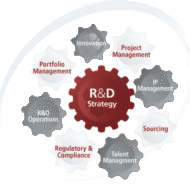
Research and Development – Strategic Key for Competitive Advantage Product Innovation and Process Improvement: With the increasing pace of liberalization and ferocity of competition in the corporate business world, it is mandatory for the firms to invest in research and development activities to sustain in the market. In most of the developing countries, scant attention has been paid to research and development activities. A survey indicates that countries like Japan and United States of America spend 2.8 percent of their Gross National Product on R and D, while it is a mere 0.9 percent of the Gross Domestic Product in the case of some Asian countries. What role does research & development play in the industry and economy? Why it is important for the developing countries to invest more on R and D? In spite of the tax rebate offered by most of the governments for R and D, why industries don’t contribute much to indigenous research? Global Competition: It becomes difficult for business organisations to compete in national and international markets both on quality and cost fronts, primarily because of absence of strong base in science and technology. Third world nations are used to buying technology from developed nations, that make them dependent and technology starved. Limited resource is another problem faced by these business firms, the allocation of which becomes difficult owing to rising costs. Invasion of Multinational and Trans national Giants: Another serious aspect to be considered is the invasion of multinational and transnational giants in every sector due to liberalization, globalization and privatization policies of the developing nations. This leads to panic in the industry, as a result of which, the business firms either go for forged alliances or infuse large amounts of funds into R and D activities hurriedly, both of which is a futile exercise to protect themselves from the onslaught of transnational companies. Science and Technological Advancement: The wiser move for the business firms to withstand the competition on an international level, would be to build their empires on a sustainable basis, by honoring the scientific and technological efforts. A thorough knowledge of all the research activities progressing around the world proves useful in managing their activities and operating with limited resources. This demands a long term plan that will support, strengthen and nurture the specified area of science base selected for research and development. Research Management: A well devised research management programme will help the business firms to formulate short and long term technical plans that aid in the research programme. It is very important for a country to encourage the budding population to become more research oriented, that will help the nation prosper in terms of science and technology, besides which, it also helps in the growth of one’s own economy. Chanakya’s 7 Secrets of Leadership The Research and Development strategic management lays emphasis on formulating plans, that support the short and long term objectives of a business firm, by employing innovative minds in the process and periodically reviewing and restructuring strategies in the light of changing demands of the society. The focus of an R and D manager should be on appraisal of technological and competitive environment, assessment of corporate strengths and weaknesses and making strategic decisions, while formulating R and D...

Posted by Managementguru in Business Management, Decision Making, Marketing, Organisational behaviour, Principles of Management, Project Management, Strategy
on Mar 22nd, 2014 | 0 comments
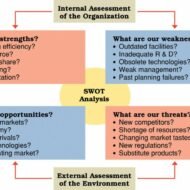
What is Swot Analysis and how to do a Swot Analysis Perfectly? Strategy formulation is an integral part of management decision making as strategies come to our risk whilst there are fluctuations in the external environment. A management expert will tell you rightly that strategies are not templates constructed for a specific purpose as they are formulated based on broad policies of a particular organization and have to be in tandem with the enterprise objectives. Nevertheless a CEO will find himself in situations where he might be forced to make instantaneous strategic decisions irrespective of the nature of the problem, only considering the magnitude of the situation. SWOT AND SYNERGY EQUATIONS Significance of SWOT Analysis: The analysis subjectively evaluates the impact of internal and external factors for a business objective. Internal processes and resources are considered strengths and weaknesses (S and W, respectively). External factors affecting the business and industry are considered opportunities and threats (O and T, respectively). An evaluation of these factors develops a strategic perspective that includes the competitive landscape and current market conditions. Need for Alternate Strategic Decisions: Lately we are witnessing a number of multinational giants going in for Joint Ventures and Collaboration. What is the root cause for such alternate strategic decisions? What happened to the value of the “Brand Image” of the organization or the “Profit Margins” which kept the company going? Well, this is where we have to look into the structure of their operations and most importantly the modality formulated to reach their ultimate objectives. Definitely, there would have been a big dent somewhere in the top management notch, failing to see through the obvious. Market Research is Inevitable for Decision Making: Situations change and we even experience this in our day to day lives, where decision making becomes very difficult at times; further we push the situation to extreme limits and make it worse. Planning is the very basis of our life that facilitates smooth functioning and change for the better. In big corporates, decision making is by and large the responsibility of the top management and they pass on the instructions down the line. It is but natural that the chairman and board of directors should make all the important decisions as they are the potential capital investors. Market research is another area that deserves mention at this juncture without which business persons cannot think of kicking off trade as it will be a sheer waste of money and time. Understanding the pulse of the market and your target customers always help in shaping up the right strategies concerning New product launch Consumer Preference Price determination Product modification etc., Test marketing is one of the strategies followed by many multi national companies while they launch their new products or wish to introduce variations in their product range. THE IMPORTANCE OF DECISION-MAKING Strategies are based on organizational policies and policies have to confer to the objectives and goals of the organization. The top management team should be a set of professional experts who should be able to gauge the existing as well as future trends of the market based on political, legal, environmental and economic changes and sketch their action plans accordingly. Decentralising decision making and delegating the authority as and when needed are also fine strategies to gain co-operation from your employees and to bring co-ordination in the entire business...
Posted by Managementguru in Business Management, Entrepreneurship, Human Resource, Organisational behaviour, Principles of Management, Startups
on Mar 22nd, 2014 | 0 comments
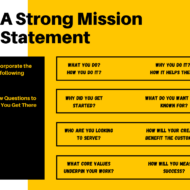
Why mission statements are important? Before going into that, let me first briefly tell you what a mission statement is. Contact Us for Promotions & Partnerships Firms in corporate business arena perform different business activities to earn profit as well as to retain their market share and stand. How does the general public know what they are up to? Is it really necessary for the firms to expose the nature of their activities to outsiders! Well, by explicitly defining the mission of your company, you stand a chance to gain identity, character and image and there is nothing to lose. A mission statement defines the basic reason for the existence of the organization and it clearly reflects your corporate philosophy. The management’s actions also might reflect their mission, in which case the mission statement is not explicitly defined and sometimes it could be deduced from the press statements released by the CEO. Whether defined or not defined, each and every organization has a definite mission that is clearly communicated to all the employees for action. When defined, it also serves as a means to highlight the firm’s social responsibility. Following are the Distinct Characteristics that a Mission Statement Should Possess It should be precise: The mission should neither be narrow as to restrict the activities of an organization nor too broad to make the situation pointless. It should be crystal clear: It should be clear enough to lead to action and not high-sounding and adhere to cheap publicity. It should be feasible: The actions mentioned must be well within the reach of the company and should not be impossible. It should be realistic and achievable. As, credibility is involved, firms must exercise caution when they release their mission statements. Feasibility mainly depends on the resources available that facilitate the firm to work towards the mission. It should be motivating: Motivating both for the employees and the society. Employees must identify themselves with the organization and feel proud that it is worth working for the firm and customers should take pride in associating themselves with that firm. It should be distinctive: It should project your distinctive competence to sustain competitive advantage. Say, if you own a garment shop, you should talk about the range of clothes that you can offer for different sections of the society and you can name yours a “Family Shoppe”, so that people will understand the nature of your business. It should indicate major components of strategy: If the aim of your company is stability, growth, diversification or concentration, all those can be included in your mission statement. It should also indicate how objectives are to be accomplished: The time period, production target, product specialization, product or process differentiation, everything can find their place in mission statements for the benefit of the society and self. Strategic management involves intelligent and timely decision making and mission statements are nothing but components of strategic planning that help the managers to lead the firm with some distinct “ideology” in the form of mission statements. Some Interesting Mission Statements Google’s mission is to organize the world’s information and make it universally accessible and useful. Nike-“Crush Reebok.” Wal-Mart-“To give ordinary folk the chance to buy the same thing as rich people.” Walt Disney-“To make people...
Posted by Managementguru in Change management, Human Resource, Principles of Management, Project Management, TQM, Training & Development
on Mar 22nd, 2014 | 0 comments
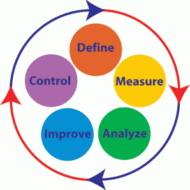
Zero defect achievement – Striving towards perfection! What is TQM: Quality management is all about being proactive and concepts like total quality management and six sigma of recent origin reiterate the fact that hundred percent error free performance is possible the first time and every time. This is what is called as zero defect achievement which most of the companies at corporate level are headed for. The intention is to strive for perfection in work, the way an archer aims for the bull’s eye on a target. It is time for people to cast off their conservative and archaic business practices and think out of the box to enjoy a sustainable competitive advantage driven by quality. Zero defects seek top performance standards the first time and every time. Management scholars offer several suggestions to improve the zero defects programme: The idea of zero defects programme has to be communicated through out the organization right from the top to the bottom level including managers, supervisors and workers. This would harmonize the functions of line and staff. Prerequisites needed for the programme have to be determined and made available. The culture and climate of the firm should be conducive to accomplish the programme. Explain in simple terms about the functions to be accomplished. Design some solid system of recognition. Set up a time schedule as time lines are very important when it comes to product delivery. Spot all the bottlenecks and remove them. Training is absolutely essential– the skill set and mind set of the employees have to be attuned to the goals of the venture. Mock training and rehearsals are helpful. Standardization is the key to the success of this programme. Bench Marking: Total quality management is a process contributing towards quality and bench marking is a means to achieve high quality performance by setting some top notch industry performers as reference points or standards. It is a continuous systematic process employed by a business enterprise to develop business and working processes that integrate the best practices available in the industry. Bench marking is a crucial element in the process of quality management. Quality is one field of production, which reflects the ethical viewpoint and approach of business firms towards the society and other investors or stakeholders. Bench marking is a modus operandi used to: Identify and define customer requirements Plan and establish effective goals and objectives Develop time measures of productivity Become more competitive Determine industry’s best practice The initial step is to decide what is to be bench marked-the product, services, customers or business processes in various departments. The second phase of action is to identify and select your competitors who will set the necessary precedence. With that as reference, decide on your company’s strategies by making meaningful and valid comparisons. Judge the competitor strengths and weaknesses and compare them with that of your own to get a clear picture of your current performance levels and capabilities. This will give you a clear indication on the action plans to be developed and implemented in a phased manner by your organization. Quality management is likely to happen only when all the employees of the organization work as a team with unified principles. Quality demands deep commitment and responsibility from the members of organizations. It calls for intense training to imprint the perception of quality in the minds of...
Posted by Managementguru in Human Resource, Principles of Management, Project Management, Training & Development
on Mar 22nd, 2014 | 0 comments
Assessment centers Some companies run a series of prolonged selection procedures (assessment centers) each lasting one or two days, and sometimes longer. Usually these are after the first round of interviews and before making the final selection, but they can be used as an initial selection process. They are usually held either on company premises or in a nearby hotel, and are measured by many employers to be the fairest and most accurate method of selecting staff. This is because they give a number of different selectors a chance to see you over a longer period of time than is possible with a single interview, and the chance to see what you can do, rather than what you say you can do, in a variety of situations. Assessment Centers typically include a number of elements. Social/informal events, where you get a chance to meet variety of people, including other candidates, the selectors, recent graduates and senior management. This is an excellent opportunity for you to find out more about the organization and to ask questions in a more informal or social setting. Information sessions, which provide more details about the organization and the roles available. Listen carefully, as it is likely to be more up-to date than your previous research. If you are unclear about anything, ask. It is often good to have a question prepared for these sessions, but make sure it is a sensible question and not one that has already been covered. Asking inappropriate questions just to get noticed does not impress the selectors. Tests and exercises designed to exhibit your potential. Selectors at assessment centers measure you against a set of competencies, and each exercise is carefully designed to assess one or more of these areas. Do not worry if you think that you have performed badly at any stage; it is more than likely that you will have the chance to compensate later on. It is also worth remembering that you are being assessed against these competencies and not against the other candidates, so rather than trying to compete against them, make sure that you demonstrate the qualities the organization is looking for. Remember that assessment centers are extremely expensive to run and that you have already come a long way to be invited – you may have as much as a one in six chance of being selected. Vestibule Training Vestibule training creates a miniature of the department for which the training program is carried on. It utilizes machinery similar to that in operation on the production floor. Qualified instructors, usually highly skilled operators or supervisors, are provided to conduct the program in this special section. Here the new employees are given a course of training in the particular machines they will be required to use and on the exact work they will do when they become a part of the regular production force. {In the early 1800s, factory schools were created, due to the industrial revolution, in which workers were trained in classrooms within the factory walls. The apprentice system was inadequate due to the number of learners that had to be trained as the machines of the Industrial Revolution increased the ability of the factory to produce goods. The factory owners needed trained workers quickly because there was a large demand for the produced goods. Towards the end of the 1800s, a method that combined the benefits of the classroom with the benefits of on-the-job training, called vestibule training, became a popular form of training. The classroom was located as close as conditions allowed to the department for which the workers were being trained. It was furnished with the same machines...