Posted by Managementguru in Accounting, Decision Making, Management Accounting, Project Management
on Apr 1st, 2014 | 0 comments
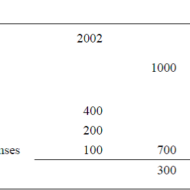
ACCOUNTING AND DECISION MAKING – IDENTIFYING THE PROBLEM SITUATION Learn accounting and finance basics so you can effectively analyze business data to make key management decisions. Business owners are faced with countless decisions every business day. Managerial accounting information provides data-driven input to these decisions, which can improve decision-making over the long term. Fig 1.1- ACCOUNTING INFORMATION FOR A SINGLE PRODUCT The above illustration clearly depicts that there has been a loss of Rs.100 in one year’s time for this particular product. The reason can be attributed to the increase in the “cost of goods” whereas other expenses have remained the same in both the years. For a single product manufactured, the problem is identifiable and solvable. But when the organization is producing a range of products, you need to apply some accounting technique by which the product losing money is identified and suitable measures are taken to cut down the escalating cost. Fig 1.2- Accouning Information for a Product Range The above illustration compares and contrasts the relationship of three products a company manufactures. It is seen that products P1 and P2 are doing well. Though the cost of sales has gone up for P1 and P2, the sales volume has also increased thus increasing the gross profit over the period of time. Here the product that has to be dealt with is P3 whose sales volume has drastically gone down, yet with the same cost of sales. When there is an increase in cost of sales, two things have to be considered. Identifying the problem-product Either cut down the production cost or increase the selling-price if the product has a real demand in the market. Uses of Accounting Data: Accounting information helps the management to arrive at make or buy decisions, to outsource production of certain components to cut down or control costs, to expand the production, to increase the sales volume or to downsize their project capacity. Techniques like Break-Even Analysis, Costing and Budgeting aid in going for the right production-mix, marketing-mix and sales target plans for the respective financial years. Aggregate Planning: As we all know planning is the key to the future and financial planning has to be given utmost importance for a production process. Aggregate planning involves translating long-term forecasted demand into specific production rates and the corresponding labor requirements for the intermediate term. It takes into consideration a period of 6 to 18 months, breaking it into work modules weekly or monthly and planning for the specific period in terms of men, material and...

Posted by Managementguru in Business Management, Change management, Human Resource, Organisational behaviour, Principles of Management, Project Management
on Mar 30th, 2014 | 0 comments
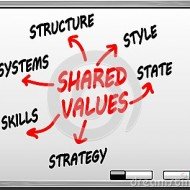
Effective people are preferred to rather than efficient people as the former does the right thing and the latter does things right. Redesigning your workplace not only refers to the infrastructure but also the internal factors that might affect the productivity of your firm. Big corporate firms generally face challenges in the form of Lack of co-operation between subunitsIncreasing complaints from the customersRising Operating costsDip in the moraleMajor changes in technology All these signs are indications of a not so enterprising organizational climate. And it calls for quick decision making regarding introducing some changes that bring some positive development in terms of improved efficiency and increase in productivity. Redesigning Workplace in Response to Exogenous Factors Growth of Organizations The challenges mentioned above may make an organization’s existing structure, management practice or its culture obsolete for the new situation. Growth of an organization should be a result of collaborative effort of all the units of an organization and it is objective and not subjective. An organization is comprised of different elements which interact in deciding the organizational effectiveness. The task or goal, technology, structure, people and the internal and external environment of the firm; all these coexist and hold the firm together. Be it a school, a hospital, a union, a club or a business enterprise the interactive nature of these elements make the process of managing very difficult. Medical tourism and business travel are becoming more popular in Asian countries as it increases the scope of collaboration of industries that can coexist to enjoy a win-win situation. Who is an Effective Manager ? An effective manager anticipates these challenges and proactively initializes a planned change. He strategically prepares the organization to be subject to planned change by manipulating the structure, technology and behavior. Understanding the dimensions of change helps him to manage change better as people are always resistant to change. Modern enterprises right from the start have to install and implement “systems” that are technologically most modern and hire suitable people who are techno-savvy; Because technology rules the world and the development of new software programmes and hardware components feed on themselves every day. Developing an Organization as a Whole Behavior of people is unpredictable but controllable. Individually oriented training and development programmes does not prove much to the benefit of the organization as it creates apprehensions in the minds of the individual that are related to the culture and attitude of his superior and subordinates. The idea of developing the organization as a whole through team building is a better perspective as it renews the enthusiasm of people working for you and as a team they feel more cohesive and adhered. Synergy plays its role in improving the interpersonal relationship amongst the team members. Firms are becoming more modern in their outlook. For instance, a showroom whose purpose is to showcase your products also provides entertainment by its aesthetic value. Only if the customer is impressed by the artistic way of your exhibit, will he enter your showroom. Change is inevitable and it improves the health of an organization. The focus should be on “total system change” and the orientation is towards achieving desired results as a consequence of planned activities. Flat Organizational Structure You would have come across the latest buzz word “flat organizational structure”. This is designed in order to bridge the gap between front line employees and the executive level. If there is only few levels of management, the process of communication is more effective, the art of delegation becomes mandatory and need for participation in the decision making process involves all the employees which in turn reduces bureaucracy. There is no set pattern...
Posted by Managementguru in Business Management, Change management, Principles of Management, Project Management, Technology
on Mar 25th, 2014 | 0 comments

Perhaps the most striking influence of technology is found on society. Practically every area of social life and the life of every individual have been, in some sense or the other, changed by the development in technology. AI in Marketing Artificial intelligence (AI) is reshaping how businesses engage with marketing. By analyzing data, personalizing content, and automating tasks, AI is truly revolutionizing the marketing landscape. Personalization One of the key benefits of AI in marketing is its capability to tailor content for each individual customer. Leveraging AI-driven algorithms, companies can craft personalized experiences that truly connect with their audience. Predictive Analytics AI can assist businesses in making more precise predictions regarding consumer behavior. By examining data from previous interactions and purchases, AI can uncover patterns and trends, enabling companies to make better-informed decisions. Visual Search AI-powered visual search is changing the way consumers search for products online. By analyzing an image, AI can identify the product and show similar items for purchase. This makes the online shopping experience more intuitive and seamless. Technology reaches people through business Preferences of people are constantly changing, and this has pushed the business firms to the point, where innovation has become the need of the hour. The new discoveries would remain idle as mere ideas if there were no laboratories to transform the ideas into creations. Technology reaching people through business is one part of the theory. The economic prosperity of a nation depends on technology. High expectations of consumers People are used to technological innovations and breakthroughs and they want variety in every kind of purchase they make. New varieties of products, safer and more comfortable, free from pollution, are to be produced and supplied to affluent sections. This calls for a massive investment in research and development. In countries like Japan, much importance is attached to product design, quality, sophistication, delivery schedules and prices. High expectations need not be considered as problems by business persons but treated as an opportunity to satisfy their customer group. System complexity Technology has resulted in complexity. Modern machines work faster and better, no doubt. However, if there is a technical problem, the presence of an expert is needed to repair the machinery. Again, investment in machinery adds to the cost of capital and hence the merchandise has to be purchased form reliable sources. Social change The change in the technological process undoubtedly has its effect on the society. First, there is a change in the social life, with mobile populations drifting about in search of new centers of employment. If it happens to be an agricultural economy, the result of such a drift would prove disastrous, with society being socially uprooted. Sometimes such a drift may result in new geographical distribution of population. Technological change also brings considerable changes in the family, lifestyle and attitude. The way we cook, communicate, use media and work are all affected by technology. Technological Phases and the Social Systems they Create There are five stages of technological development. Each stage leaves a distinct influence on work and on social system. Sequential progress is made from the lowest level to the highest level, in such a way that these five stages roughly represent the progress of civilization throughout history. Although one phase of technology tends to dominate a nation’s activities at a particular time, other phases will be often practiced at the same time. Technology means change and more change. It forces changes on people whether they are prepared for it or not. In modern history, it has created what is called future shock, which means that change comes so fast and furious that it approaches the limits of human...
Posted by Managementguru in Marketing, Principles of Management, Project Management, Strategy, Technology
on Mar 25th, 2014 | 0 comments
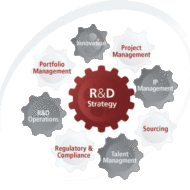
Research and Development – Strategic Key for Competitive Advantage Product Innovation and Process Improvement: With the increasing pace of liberalization and ferocity of competition in the corporate business world, it is mandatory for the firms to invest in research and development activities to sustain in the market. In most of the developing countries, scant attention has been paid to research and development activities. A survey indicates that countries like Japan and United States of America spend 2.8 percent of their Gross National Product on R and D, while it is a mere 0.9 percent of the Gross Domestic Product in the case of some Asian countries. What role does research & development play in the industry and economy? Why it is important for the developing countries to invest more on R and D? In spite of the tax rebate offered by most of the governments for R and D, why industries don’t contribute much to indigenous research? Global Competition: It becomes difficult for business organisations to compete in national and international markets both on quality and cost fronts, primarily because of absence of strong base in science and technology. Third world nations are used to buying technology from developed nations, that make them dependent and technology starved. Limited resource is another problem faced by these business firms, the allocation of which becomes difficult owing to rising costs. Invasion of Multinational and Trans national Giants: Another serious aspect to be considered is the invasion of multinational and transnational giants in every sector due to liberalization, globalization and privatization policies of the developing nations. This leads to panic in the industry, as a result of which, the business firms either go for forged alliances or infuse large amounts of funds into R and D activities hurriedly, both of which is a futile exercise to protect themselves from the onslaught of transnational companies. Science and Technological Advancement: The wiser move for the business firms to withstand the competition on an international level, would be to build their empires on a sustainable basis, by honoring the scientific and technological efforts. A thorough knowledge of all the research activities progressing around the world proves useful in managing their activities and operating with limited resources. This demands a long term plan that will support, strengthen and nurture the specified area of science base selected for research and development. Research Management: A well devised research management programme will help the business firms to formulate short and long term technical plans that aid in the research programme. It is very important for a country to encourage the budding population to become more research oriented, that will help the nation prosper in terms of science and technology, besides which, it also helps in the growth of one’s own economy. Chanakya’s 7 Secrets of Leadership The Research and Development strategic management lays emphasis on formulating plans, that support the short and long term objectives of a business firm, by employing innovative minds in the process and periodically reviewing and restructuring strategies in the light of changing demands of the society. The focus of an R and D manager should be on appraisal of technological and competitive environment, assessment of corporate strengths and weaknesses and making strategic decisions, while formulating R and D...
Posted by Managementguru in Business Management, Decision Making, Marketing, Organisational behaviour, Principles of Management, Project Management, Strategy
on Mar 22nd, 2014 | 0 comments
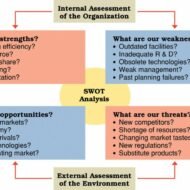
What is Swot Analysis and how to do a Swot Analysis Perfectly? Strategy formulation is an integral part of management decision making as strategies come to our risk whilst there are fluctuations in the external environment. A management expert will tell you rightly that strategies are not templates constructed for a specific purpose as they are formulated based on broad policies of a particular organization and have to be in tandem with the enterprise objectives. Nevertheless a CEO will find himself in situations where he might be forced to make instantaneous strategic decisions irrespective of the nature of the problem, only considering the magnitude of the situation. SWOT AND SYNERGY EQUATIONS Significance of SWOT Analysis: The analysis subjectively evaluates the impact of internal and external factors for a business objective. Internal processes and resources are considered strengths and weaknesses (S and W, respectively). External factors affecting the business and industry are considered opportunities and threats (O and T, respectively). An evaluation of these factors develops a strategic perspective that includes the competitive landscape and current market conditions. Need for Alternate Strategic Decisions: Lately we are witnessing a number of multinational giants going in for Joint Ventures and Collaboration. What is the root cause for such alternate strategic decisions? What happened to the value of the “Brand Image” of the organization or the “Profit Margins” which kept the company going? Well, this is where we have to look into the structure of their operations and most importantly the modality formulated to reach their ultimate objectives. Definitely, there would have been a big dent somewhere in the top management notch, failing to see through the obvious. Market Research is Inevitable for Decision Making: Situations change and we even experience this in our day to day lives, where decision making becomes very difficult at times; further we push the situation to extreme limits and make it worse. Planning is the very basis of our life that facilitates smooth functioning and change for the better. In big corporates, decision making is by and large the responsibility of the top management and they pass on the instructions down the line. It is but natural that the chairman and board of directors should make all the important decisions as they are the potential capital investors. Market research is another area that deserves mention at this juncture without which business persons cannot think of kicking off trade as it will be a sheer waste of money and time. Understanding the pulse of the market and your target customers always help in shaping up the right strategies concerning New product launch Consumer Preference Price determination Product modification etc., Test marketing is one of the strategies followed by many multi national companies while they launch their new products or wish to introduce variations in their product range. THE IMPORTANCE OF DECISION-MAKING Strategies are based on organizational policies and policies have to confer to the objectives and goals of the organization. The top management team should be a set of professional experts who should be able to gauge the existing as well as future trends of the market based on political, legal, environmental and economic changes and sketch their action plans accordingly. Decentralising decision making and delegating the authority as and when needed are also fine strategies to gain co-operation from your employees and to bring co-ordination in the entire business...