Currently Browsing: Project Management
Posted by Managementguru in Change management, Human Resource, Principles of Management, Project Management, TQM, Training & Development
on Mar 22nd, 2014 | 0 comments
Zero defect achievement – Striving towards perfection! What is TQM: Quality management is all about being proactive and concepts like total quality management and six sigma of recent origin reiterate the fact that hundred percent error free performance is possible the first time and every time. This is what is called as zero defect achievement which most of the companies at corporate level are headed for. The intention is to strive for perfection in work, the way an archer aims for the bull’s eye on a target. It is time for people to cast off their conservative and archaic business practices and think out of the box to enjoy a sustainable competitive advantage driven by quality. Zero defects seek top performance standards the first time and every time. Management scholars offer several suggestions to improve the zero defects programme: The idea of zero defects programme has to be communicated through out the organization right from the top to the bottom level including managers, supervisors and workers. This would harmonize the functions of line and staff. Prerequisites needed for the programme have to be determined and made available. The culture and climate of the firm should be conducive to accomplish the programme. Explain in simple terms about the functions to be accomplished. Design some solid system of recognition. Set up a time schedule as time lines are very important when it comes to product delivery. Spot all the bottlenecks and remove them. Training is absolutely essential– the skill set and mind set of the employees have to be attuned to the goals of the venture. Mock training and rehearsals are helpful. Standardization is the key to the success of this programme. Bench Marking: Total quality management is a process contributing towards quality and bench marking is a means to achieve high quality performance by setting some top notch industry performers as reference points or standards. It is a continuous systematic process employed by a business enterprise to develop business and working processes that integrate the best practices available in the industry. Bench marking is a crucial element in the process of quality management. Quality is one field of production, which reflects the ethical viewpoint and approach of business firms towards the society and other investors or stakeholders. Bench marking is a modus operandi used to: Identify and define customer requirements Plan and establish effective goals and objectives Develop time measures of productivity Become more competitive Determine industry’s best practice The initial step is to decide what is to be bench marked-the product, services, customers or business processes in various departments. The second phase of action is to identify and select your competitors who will set the necessary precedence. With that as reference, decide on your company’s strategies by making meaningful and valid comparisons. Judge the competitor strengths and weaknesses and compare them with that of your own to get a clear picture of your current performance levels and capabilities. This will give you a clear indication on the action plans to be developed and implemented in a phased manner by your organization. Quality management is likely to happen only when all the employees of the organization work as a team with unified principles. Quality demands deep commitment and responsibility from the members of organizations. It calls for intense training to imprint the perception of quality in the minds of...

Posted by Managementguru in Human Resource, Principles of Management, Project Management, Training & Development
on Mar 22nd, 2014 | 0 comments
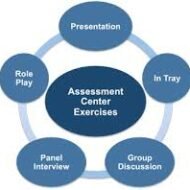
Assessment centers Some companies run a series of prolonged selection procedures (assessment centers) each lasting one or two days, and sometimes longer. Usually these are after the first round of interviews and before making the final selection, but they can be used as an initial selection process. They are usually held either on company premises or in a nearby hotel, and are measured by many employers to be the fairest and most accurate method of selecting staff. This is because they give a number of different selectors a chance to see you over a longer period of time than is possible with a single interview, and the chance to see what you can do, rather than what you say you can do, in a variety of situations. Assessment Centers typically include a number of elements. Social/informal events, where you get a chance to meet variety of people, including other candidates, the selectors, recent graduates and senior management. This is an excellent opportunity for you to find out more about the organization and to ask questions in a more informal or social setting. Information sessions, which provide more details about the organization and the roles available. Listen carefully, as it is likely to be more up-to date than your previous research. If you are unclear about anything, ask. It is often good to have a question prepared for these sessions, but make sure it is a sensible question and not one that has already been covered. Asking inappropriate questions just to get noticed does not impress the selectors. Tests and exercises designed to exhibit your potential. Selectors at assessment centers measure you against a set of competencies, and each exercise is carefully designed to assess one or more of these areas. Do not worry if you think that you have performed badly at any stage; it is more than likely that you will have the chance to compensate later on. It is also worth remembering that you are being assessed against these competencies and not against the other candidates, so rather than trying to compete against them, make sure that you demonstrate the qualities the organization is looking for. Remember that assessment centers are extremely expensive to run and that you have already come a long way to be invited – you may have as much as a one in six chance of being selected. Vestibule Training Vestibule training creates a miniature of the department for which the training program is carried on. It utilizes machinery similar to that in operation on the production floor. Qualified instructors, usually highly skilled operators or supervisors, are provided to conduct the program in this special section. Here the new employees are given a course of training in the particular machines they will be required to use and on the exact work they will do when they become a part of the regular production force. {In the early 1800s, factory schools were created, due to the industrial revolution, in which workers were trained in classrooms within the factory walls. The apprentice system was inadequate due to the number of learners that had to be trained as the machines of the Industrial Revolution increased the ability of the factory to produce goods. The factory owners needed trained workers quickly because there was a large demand for the produced goods. Towards the end of the 1800s, a method that combined the benefits of the classroom with the benefits of on-the-job training, called vestibule training, became a popular form of training. The classroom was located as close as conditions allowed to the department for which the workers were being trained. It was furnished with the same machines...
Posted by Managementguru in Human Resource, Principles of Management, Project Management, Training & Development
on Mar 22nd, 2014 | 0 comments
Off-The-Job Training In basket Exercise Recently, the in-basket has become a focus of interest because of its handiness in selection across a wide variety of jobs. A range of techniques have been used to develop in-baskets. In a traditional in-basket exercise, candidates are given time to review the material and initiate in writing whatever actions they believe to be most appropriate in relation to each in-basket item. When time is called for the exercise, the inbasket materials and any notes, letters, memos, or other correspondence written by the candidate are collected for review by one or more evaluators. Often the candidates are then interviewed to ensure that the evaluators understand actions taken by the candidate and the rationale for the actions. If an interview is not possible, it is also quite common to have the candidate complete a summary sheet (i.e., a questionnaire). Lecture A lecture is the method learners often most commonly associate with college and secondary education. Yet, it is also considered one of the least effective methods to use for adult learners. In this method, one person (the trainer) does all of the talking. He or she may use handouts, visual aids, question/answer, or posters to support the lecture. Communication is primarily one-way: from the instructor to the learner. Movies/videos/computer-based training Content for the training experience comes primarily from a videotape or computer-based program. Simulations Trainees participate in a reality-based, interactive activity where they imitate actions required on the job. It is a useful technique for skills development. Simulations are widely used now-a-days in medical field where surgeons find it very useful to train their hands on a virtual human body for complicated surgeries. Self-discovery Trainees discover the competencies on their own using such techniques as guided exercises, books, and research. Role Playing During a role-play, the trainees assume roles and act out situations connected to the learning concepts. It is good for customer service and sales training. Case Studies A case study is a description of a real or imagined situation which contains information that trainees can use to analyze what has occurred and why. The trainees recommend solutions based on the content provided. Seminar Seminars often combine several group methods: lectures, discussions, conferences, and demonstrations. Conference The conference training method is a good problem-solving approach. A group considers a specific problem or issue and they work to reach consensus on statements or solutions. When choosing from among these methods, the trainer must decide which one best suits the trainees, the environment, and the investments available. Many trainers will choose to combine methods or vary them. Others will select a single method that works best for them and never vary. With so many options, a trainer is limited only by his or her...
Posted by Managementguru in Human Resource, Principles of Management, Project Management, Training & Development
on Mar 22nd, 2014 | 0 comments
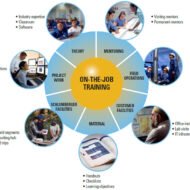
On The Job Training Methods For Effective Employee Development The method by which training is delivered often varies based on the needs of the company, the trainee, and on the task being performed. The method should suit the audience, the content, the business environment, and the learning objective. Ideally, the method chosen will motivate employees to learn, help employees prepare themselves for learning, enable the trainees to apply and practice what they’ve been taught, help trainees retain and transfer what they have learned, and integrate performance with other skills and knowledge. The basic objective of training is learning which brings about a radical change in the perspective of an individual preparing him for the task. On the Job Training: This is the most common method of training. The trainee is placed on the job and the manager or mentor demonstrates the trainee how to do the job. To be successful, the training should be done according to a structured programme that uses task lists, job breakdowns, and performance standards as a lesson plan. Common on the Job training methods include:- Demonstration: Demonstration is very effective for basic skills training. The trainer shows trainees how to do something. The trainer may provide an opportunity for trainees to perform the task being demonstrated. Panel: A panel provides several points of view on a topic to look for alternatives to a situation. Panel members may have differing views but they must also have objective concerns for the purpose of the training. This is an excellent method for using outside experts. Projects: Projects require the trainees to do something on the job, which improves the business as well as helps them learn about the topic of training. It might involve participation on a team, the creation of a database, or the forming of a new process. Employees can voluntarily under-take some small projects that would better the performance of a system. This would help the employee to become noticed and others ease of doing a particular thing and a source of inspiration. Say, Simplifying a database application by introducing a new software. Mentoring: A mentor can tutor others in their learning. Mentors help employees solve problems both through training them in skills and through modeling effective attitudes and behaviors. This system is sometimes known as a buddy system. Visit our GUMROAD Ebook Store for all your MBA guide...
Posted by Managementguru in Business Management, Human Resource, Organisational behaviour, Principles of Management, Project Management, Training & Development
on Mar 19th, 2014 | 0 comments
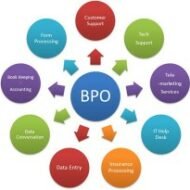
Call Centre Challenges The emergence of numerous “call centers” in developing countries like India and China, has posed some serious threats to the employees of these concerns. The concept of call center is a new find of the modern era, where they handle volumes of business process outsourcing for the developed countries. What are the various operations carried on in a call center? They handle inbound and outbound customer care services, telemarketing services, e-mail management services, pay roll accounting, help desk and many more back end activities. Benefits of Outsourcing: It proves to be a win-win situation for both the parties; the outsourcing company benefits from cheap labor, and the company that does the job earns good pay in the form of foreign exchange. But one has to understand the nuances of the call center operations; how it can be really worked out to one’s benefit? If you have a direct link with the outsourcing company, there is no need for you to share the profit. If the job is sublet to you, then your share gets reduced down the line. And also, the pay comes in a cycle of 45 days or so. So, it becomes mandatory that you should have the wherewithal to rotate your own funds for that 45 day period time, to fulfill establishment costs, power costs, salary and other miscellaneous expenses. What is the Pressure Situation? Let’s not get into the details of how to establish a call center and the necessary infrastructure to start one. The business has created a pressure situation, as it calls for erratic work hours and disturbed eating and sleep patterns. Definitely, it affects the youth, who form the major population of call centers, psychologically and socially as well. The erratic work schedules, (they work round the clock in shifts) the intense work pressure to achieve targets eventually leads to a pressure cooker like stress situation. Their altered sleep cycle is dangerous to both their physical and mental health. It is an evident fact that more number of persons working in this industry has started complaining about their physical and mental problems like Anxiety Depression Relationship-related problems Headaches Disturbed appetite Hearing loss Changes in thyroid and adrenaline levels Loss of weight Obesity and Smoking to reduce immense tension is also witnessed. The call center business has been a flourishing business in developing nations, though recently we tend to see a lull in the market, owing to the government regulations of the developed nations. Even the economy of developed countries, has taken a huge plunge owing to the recent economic recession. Naturally, when their financial markets have become unstable, they would not want to outsource to low-cost developing countries. The BPO’s or KPO’s (business process outsourcing and knowledge process outsourcing), as they are called should not become a fad, instead, developing nations can also concentrate on indigenous business clients, that are in need of their services. Note: India is the leading country for offshore outsourcing. The offshore outsourcing industry started in India and it has been able to grow the IT and BPO export sector to $47 billion and capture more than half the offshore outsourcing...