Posted by Managementguru in Business Management, Decision Making, Marketing, Organisational behaviour, Principles of Management, Project Management, Strategy
on Mar 22nd, 2014 | 0 comments
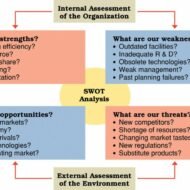
What is Swot Analysis and how to do a Swot Analysis Perfectly? Strategy formulation is an integral part of management decision making as strategies come to our risk whilst there are fluctuations in the external environment. A management expert will tell you rightly that strategies are not templates constructed for a specific purpose as they are formulated based on broad policies of a particular organization and have to be in tandem with the enterprise objectives. Nevertheless a CEO will find himself in situations where he might be forced to make instantaneous strategic decisions irrespective of the nature of the problem, only considering the magnitude of the situation. SWOT AND SYNERGY EQUATIONS Significance of SWOT Analysis: The analysis subjectively evaluates the impact of internal and external factors for a business objective. Internal processes and resources are considered strengths and weaknesses (S and W, respectively). External factors affecting the business and industry are considered opportunities and threats (O and T, respectively). An evaluation of these factors develops a strategic perspective that includes the competitive landscape and current market conditions. Need for Alternate Strategic Decisions: Lately we are witnessing a number of multinational giants going in for Joint Ventures and Collaboration. What is the root cause for such alternate strategic decisions? What happened to the value of the “Brand Image” of the organization or the “Profit Margins” which kept the company going? Well, this is where we have to look into the structure of their operations and most importantly the modality formulated to reach their ultimate objectives. Definitely, there would have been a big dent somewhere in the top management notch, failing to see through the obvious. Market Research is Inevitable for Decision Making: Situations change and we even experience this in our day to day lives, where decision making becomes very difficult at times; further we push the situation to extreme limits and make it worse. Planning is the very basis of our life that facilitates smooth functioning and change for the better. In big corporates, decision making is by and large the responsibility of the top management and they pass on the instructions down the line. It is but natural that the chairman and board of directors should make all the important decisions as they are the potential capital investors. Market research is another area that deserves mention at this juncture without which business persons cannot think of kicking off trade as it will be a sheer waste of money and time. Understanding the pulse of the market and your target customers always help in shaping up the right strategies concerning New product launch Consumer Preference Price determination Product modification etc., Test marketing is one of the strategies followed by many multi national companies while they launch their new products or wish to introduce variations in their product range. THE IMPORTANCE OF DECISION-MAKING Strategies are based on organizational policies and policies have to confer to the objectives and goals of the organization. The top management team should be a set of professional experts who should be able to gauge the existing as well as future trends of the market based on political, legal, environmental and economic changes and sketch their action plans accordingly. Decentralising decision making and delegating the authority as and when needed are also fine strategies to gain co-operation from your employees and to bring co-ordination in the entire business...

Posted by Managementguru in Business Management, Marketing, Organisational behaviour, Principles of Management, Strategy
on Mar 22nd, 2014 | 0 comments
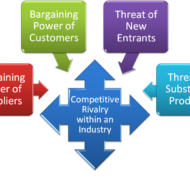
PORTER’S FIVE FORCES Porter’s five forces analysis-draws upon industrial organization (IO) economics to derive five forces that determine the competitive intensity and therefore attractiveness of a market. Survival of the Fittest: True to Darwin’s theory “Survival of the fittest”, only competitive firms survive in the business market, provided, they have made the right strategic choice by comprehensively analyzing their position in the industry. Every organization is part of the industry and almost all of them face competition. Thus, industry and competition are the vital considerations for making a strategic choice. All the firms in a particular industry vie for the same set of customers by offering identical or similar products with minor variations. The analysis of the external environment in relation to the context of industry attractiveness thus becomes essential. A Critical Evaluation of Michael Porter’s Five Forces Framework Industrial Analysis: Industry analysis helps a firm to also fix long range plans, by gauging long term growth opportunities present if any. Strategic choice is nothing but, to screen all possible strategic alternatives followed by narrowing down the choice to the best suited and feasible alternatives and ultimately choosing an optimum strategy. To explain it in more clear terms, let us look at this example. Say, if there are three big players of car manufacturers in an automobile industry. Each follows their own strategic style to capture the market. What are the threat factors? Threat can be in the form of four-wheeler manufacturers like trucks and jeeps, but these cannot be competitively priced. Threat can be in the form of suppliers who dominate the industry by having a grip on the supply of components, sub-assemblies and accessories. Threat in the form of new entrants, but the growth might be restricted due to government regulations. A thorough analysis of the automobile industry thus made can make things clear to the firm, as to where they stand in terms of market share, what are their strengths and weaknesses, who pose a threat, what are the potential opportunities for growth and to tap market segments whose needs are unidentified. Still, it will be a seller’s market where the buyers have no bargaining power. On the other hand, if the weather does not favor its growth, the firm has to immediately decide on its next course of action, calling for diversification. The possible threats for a firm can come from five directions as mentioned below: Potential threat from new firms entering the market Threat from substitutes available in the market Threat from competitors Bargaining power of the suppliers Bargaining power of the buyers The structure and dynamics of an industry has to be analyzed in order to determine the intensity of competition and profitability. As the market is very dynamic, it becomes mandatory for firms to evolve strategies embracing a modern approach, with emphasis on reappraisal of existing strategy in the light of changing external conditions and formulation of alternative...
Posted by Managementguru in Business Management, Human Resource, Organisational behaviour, Principles of Management, Training & Development
on Mar 22nd, 2014 | 0 comments
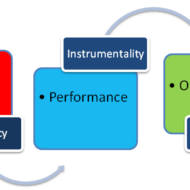
How to create an effective and Sustainable Model for Training and Development? The term “change” is synonymous with competitiveness in modern world and thus corporate firms are in a position to evolve unique, sustainable and strategic training model for employees that will facilitate the following: On one hand the training process motivates the suitable employees to perform well and makes them perceive their role properly in order to accomplish the enterprise objectives. On the other hand the organisation keeps itself abreast by constantly updating and understanding the training needs through Assessment of the external environment and Expectations of the employees in terms of rewards whether intrinsic or extrinsic. Porter and Lawler Model: The Expectancy Motivation Model of Porter and Lawler serves as an inspiration for effective training. The stress is on The value placed on performance outcome by the individual. The degree to which the individual believes that his efforts will lead to attainment of these rewards. Psychological aspect of this model: Almost all individuals are motivated by money ( by the way, Who doesn’t want money!). But money alone does not serve the purpose of motivation. Job satisfaction is a relative term in that different people find different things or elements motivating them in their work environment leading to job satisfaction. It might be Challenge Good inter personal relationship Pay Perks Culture Excellent leader Pressure Stress and the like… Assessment of training need: The training needs must be assessed by the respective organisations considering the following aspects: To transform the individual from the capacity of learner to executor Instil in him confidence to do the job well Relate his job to rewards so that he will try to excel Give your employees scope for career advancement Incorporate technical and technological innovations as part of your training process Physical, emotional and social elements in the internal as well as the external environment must be taken into consideration while training the workforce. Physical– relates to the physical fitness needed to perform the technical skills Psychological– relates to keeping the morale of the employees high at all points and maintaining an amiable work atmosphere Social– relates to the friendly relationship that should exist between the trainer and the trainees and among the trainees. Usefulness of the model: This model lends its support to the training and development process through three steps or stages. Diagnosis stage- Need analysis Formulation stage- Programme planning Evaluation Diagnosis stage: The interplay of ability and role perception Training brings out EFFICIENT as well as DEFICIENT performers. That is one good thing and also making the employee understand the role he is about to play as part of the organisation. Training through learning is one aspect which imparts knowledge and training is considered to be effective if one’s behaviour is modified as per the expectations and demands of the job. Role perception can be misunderstood by some individuals when they might try to exercise undue authority or overlook their duties and responsibilities. Confinement of authority Superior-Subordinate appraisal procedures Clear HR policy formulations are needed to avoid confusion and chaos in role playing. Formulation stage: The effected change through learning is expected to be retained by the employees throughout the career span in the organisation followed by constant grooming. The stress is on the value of the activity to be learnt Giving feedback on the progress of employees towards final training objectives Relate the learning activity to increasing, meaningful materials already studied outside the training programme. Evaluation stage: Training evaluation is particularly necessary when the organisation wants to encourage the competitive spirit amongst the trainers and evaluation is considered as a challenge by itself. If the training provided eliminates obstacles...
Posted by Managementguru in Business Management, Entrepreneurship, Human Resource, Organisational behaviour, Principles of Management, Startups
on Mar 22nd, 2014 | 0 comments
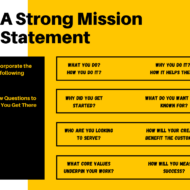
Why mission statements are important? Before going into that, let me first briefly tell you what a mission statement is. Contact Us for Promotions & Partnerships Firms in corporate business arena perform different business activities to earn profit as well as to retain their market share and stand. How does the general public know what they are up to? Is it really necessary for the firms to expose the nature of their activities to outsiders! Well, by explicitly defining the mission of your company, you stand a chance to gain identity, character and image and there is nothing to lose. A mission statement defines the basic reason for the existence of the organization and it clearly reflects your corporate philosophy. The management’s actions also might reflect their mission, in which case the mission statement is not explicitly defined and sometimes it could be deduced from the press statements released by the CEO. Whether defined or not defined, each and every organization has a definite mission that is clearly communicated to all the employees for action. When defined, it also serves as a means to highlight the firm’s social responsibility. Following are the Distinct Characteristics that a Mission Statement Should Possess It should be precise: The mission should neither be narrow as to restrict the activities of an organization nor too broad to make the situation pointless. It should be crystal clear: It should be clear enough to lead to action and not high-sounding and adhere to cheap publicity. It should be feasible: The actions mentioned must be well within the reach of the company and should not be impossible. It should be realistic and achievable. As, credibility is involved, firms must exercise caution when they release their mission statements. Feasibility mainly depends on the resources available that facilitate the firm to work towards the mission. It should be motivating: Motivating both for the employees and the society. Employees must identify themselves with the organization and feel proud that it is worth working for the firm and customers should take pride in associating themselves with that firm. It should be distinctive: It should project your distinctive competence to sustain competitive advantage. Say, if you own a garment shop, you should talk about the range of clothes that you can offer for different sections of the society and you can name yours a “Family Shoppe”, so that people will understand the nature of your business. It should indicate major components of strategy: If the aim of your company is stability, growth, diversification or concentration, all those can be included in your mission statement. It should also indicate how objectives are to be accomplished: The time period, production target, product specialization, product or process differentiation, everything can find their place in mission statements for the benefit of the society and self. Strategic management involves intelligent and timely decision making and mission statements are nothing but components of strategic planning that help the managers to lead the firm with some distinct “ideology” in the form of mission statements. Some Interesting Mission Statements Google’s mission is to organize the world’s information and make it universally accessible and useful. Nike-“Crush Reebok.” Wal-Mart-“To give ordinary folk the chance to buy the same thing as rich people.” Walt Disney-“To make people...
Posted by Managementguru in Change management, Human Resource, Principles of Management, Project Management, TQM, Training & Development
on Mar 22nd, 2014 | 0 comments
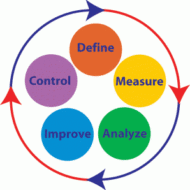
Zero defect achievement – Striving towards perfection! What is TQM: Quality management is all about being proactive and concepts like total quality management and six sigma of recent origin reiterate the fact that hundred percent error free performance is possible the first time and every time. This is what is called as zero defect achievement which most of the companies at corporate level are headed for. The intention is to strive for perfection in work, the way an archer aims for the bull’s eye on a target. It is time for people to cast off their conservative and archaic business practices and think out of the box to enjoy a sustainable competitive advantage driven by quality. Zero defects seek top performance standards the first time and every time. Management scholars offer several suggestions to improve the zero defects programme: The idea of zero defects programme has to be communicated through out the organization right from the top to the bottom level including managers, supervisors and workers. This would harmonize the functions of line and staff. Prerequisites needed for the programme have to be determined and made available. The culture and climate of the firm should be conducive to accomplish the programme. Explain in simple terms about the functions to be accomplished. Design some solid system of recognition. Set up a time schedule as time lines are very important when it comes to product delivery. Spot all the bottlenecks and remove them. Training is absolutely essential– the skill set and mind set of the employees have to be attuned to the goals of the venture. Mock training and rehearsals are helpful. Standardization is the key to the success of this programme. Bench Marking: Total quality management is a process contributing towards quality and bench marking is a means to achieve high quality performance by setting some top notch industry performers as reference points or standards. It is a continuous systematic process employed by a business enterprise to develop business and working processes that integrate the best practices available in the industry. Bench marking is a crucial element in the process of quality management. Quality is one field of production, which reflects the ethical viewpoint and approach of business firms towards the society and other investors or stakeholders. Bench marking is a modus operandi used to: Identify and define customer requirements Plan and establish effective goals and objectives Develop time measures of productivity Become more competitive Determine industry’s best practice The initial step is to decide what is to be bench marked-the product, services, customers or business processes in various departments. The second phase of action is to identify and select your competitors who will set the necessary precedence. With that as reference, decide on your company’s strategies by making meaningful and valid comparisons. Judge the competitor strengths and weaknesses and compare them with that of your own to get a clear picture of your current performance levels and capabilities. This will give you a clear indication on the action plans to be developed and implemented in a phased manner by your organization. Quality management is likely to happen only when all the employees of the organization work as a team with unified principles. Quality demands deep commitment and responsibility from the members of organizations. It calls for intense training to imprint the perception of quality in the minds of...