Posted by Managementguru in Business Ethics, Business Management, Organisational behaviour, Principles of Management, Strategy
on Mar 23rd, 2014 | 0 comments
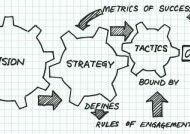
Tactics or Strategy – Ethical Considerations Give a man a fish everyday, his appetite is sated. Teach him how to fish; you have fulfilled his appetite for an entire life time. This is strategy. To make it work, to make the impossible, possible. There is no drawn out template for success or for that matter strategy. But both of them go together when the right strategy is used at the right time and you can bang on your target. Neither the same strategy fits the bill for everybody. Your smart approach to that particular situation backed up by your knowledge and experience does the magic. It cannot be taught, it comes from within when the situation warrants for action. It is more like “Survival of the fittest”, if you want to retain your niche in this business world you act fast and think wise. Tactics: How many of you are bold enough to think differently to make a difference, to make others feel your presence. Never implement tactics which is short lived and don’t make your presence felt either by imitation or by unethical competitor criticism. That will paint a greasy picture on your firm. That is of course strategy but cheap strategy. But always be on the run to know your competitors’ weaknesses and shortcomings which will make you improve your product or service. That is acceptable business practice where competitor spying gives us an edge in terms of identifying unexploited niches of the market. Resort to Constructive Strategies: Strategies must always be constructive and it assures success in the long run. Tactics or gimmicks will prove to be fruitful only for a short while and that is not your aim also. Will you be satisfied if you are able to sell your product or service as hot cakes only for a season! Is that going to cover your profit margin for the entire accounting year? True, strategies are always associated with making profits, boosting up the sales, for retaining the market share and maximizing the share value. But it should also make your business perennial and viable. Strategic Framework: Many of us forget that strategies are applicable in every activity of a firm that forms a compact framework which gives your business a solid foundation upon which you can build your empire of success without looking back. Right from framing your vision, mission, policies, procedures and programmes including recruitment, selection, training, evaluation and empowering your employees, strategies play their role in giving clarity and direction to the firm. Long-Term Planning: Although strategies are meant for long term planning, a periodic review and appraisal of the company’s strategies to all the employees concerned is a must to keep them informed. Strategies are secrets but not to the employees of your organization. Strategies are born out of compulsion, a compulsion to survive in the market and have an edge over others. So they must be meticulously planned after brain storming sessions and expert consultations. Sometimes even a small idea suggested by one of your employees might become the basis for a turnkey operation. So keep your eyes and ears open and also be open minded to accept ideas even from the lowest level as they are your pillars of strength and they know the pulse of the market and people better. Strategic Action Plans: Success is not a cake walk, it has to be achieved with great hardships and the taste of success will be sweeter. Strategies are formulated in every step of your business plan, remember it is an ongoing process; you have to revitalize your strategies every now and then to be in the scene, to make...

Posted by Managementguru in Business Management, Entrepreneurship, Human Resource, Organisational behaviour, Principles of Management, Startups
on Mar 22nd, 2014 | 0 comments
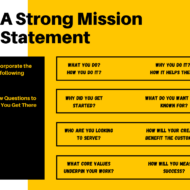
Why mission statements are important? Before going into that, let me first briefly tell you what a mission statement is. Contact Us for Promotions & Partnerships Firms in corporate business arena perform different business activities to earn profit as well as to retain their market share and stand. How does the general public know what they are up to? Is it really necessary for the firms to expose the nature of their activities to outsiders! Well, by explicitly defining the mission of your company, you stand a chance to gain identity, character and image and there is nothing to lose. A mission statement defines the basic reason for the existence of the organization and it clearly reflects your corporate philosophy. The management’s actions also might reflect their mission, in which case the mission statement is not explicitly defined and sometimes it could be deduced from the press statements released by the CEO. Whether defined or not defined, each and every organization has a definite mission that is clearly communicated to all the employees for action. When defined, it also serves as a means to highlight the firm’s social responsibility. Following are the Distinct Characteristics that a Mission Statement Should Possess It should be precise: The mission should neither be narrow as to restrict the activities of an organization nor too broad to make the situation pointless. It should be crystal clear: It should be clear enough to lead to action and not high-sounding and adhere to cheap publicity. It should be feasible: The actions mentioned must be well within the reach of the company and should not be impossible. It should be realistic and achievable. As, credibility is involved, firms must exercise caution when they release their mission statements. Feasibility mainly depends on the resources available that facilitate the firm to work towards the mission. It should be motivating: Motivating both for the employees and the society. Employees must identify themselves with the organization and feel proud that it is worth working for the firm and customers should take pride in associating themselves with that firm. It should be distinctive: It should project your distinctive competence to sustain competitive advantage. Say, if you own a garment shop, you should talk about the range of clothes that you can offer for different sections of the society and you can name yours a “Family Shoppe”, so that people will understand the nature of your business. It should indicate major components of strategy: If the aim of your company is stability, growth, diversification or concentration, all those can be included in your mission statement. It should also indicate how objectives are to be accomplished: The time period, production target, product specialization, product or process differentiation, everything can find their place in mission statements for the benefit of the society and self. Strategic management involves intelligent and timely decision making and mission statements are nothing but components of strategic planning that help the managers to lead the firm with some distinct “ideology” in the form of mission statements. Some Interesting Mission Statements Google’s mission is to organize the world’s information and make it universally accessible and useful. Nike-“Crush Reebok.” Wal-Mart-“To give ordinary folk the chance to buy the same thing as rich people.” Walt Disney-“To make people...
Posted by Managementguru in Human Resource, Principles of Management, Project Management, Training & Development
on Mar 22nd, 2014 | 0 comments
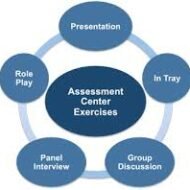
Off-The-Job Training In basket Exercise Recently, the in-basket has become a focus of interest because of its handiness in selection across a wide variety of jobs. A range of techniques have been used to develop in-baskets. In a traditional in-basket exercise, candidates are given time to review the material and initiate in writing whatever actions they believe to be most appropriate in relation to each in-basket item. When time is called for the exercise, the inbasket materials and any notes, letters, memos, or other correspondence written by the candidate are collected for review by one or more evaluators. Often the candidates are then interviewed to ensure that the evaluators understand actions taken by the candidate and the rationale for the actions. If an interview is not possible, it is also quite common to have the candidate complete a summary sheet (i.e., a questionnaire). Lecture A lecture is the method learners often most commonly associate with college and secondary education. Yet, it is also considered one of the least effective methods to use for adult learners. In this method, one person (the trainer) does all of the talking. He or she may use handouts, visual aids, question/answer, or posters to support the lecture. Communication is primarily one-way: from the instructor to the learner. Movies/videos/computer-based training Content for the training experience comes primarily from a videotape or computer-based program. Simulations Trainees participate in a reality-based, interactive activity where they imitate actions required on the job. It is a useful technique for skills development. Simulations are widely used now-a-days in medical field where surgeons find it very useful to train their hands on a virtual human body for complicated surgeries. Self-discovery Trainees discover the competencies on their own using such techniques as guided exercises, books, and research. Role Playing During a role-play, the trainees assume roles and act out situations connected to the learning concepts. It is good for customer service and sales training. Case Studies A case study is a description of a real or imagined situation which contains information that trainees can use to analyze what has occurred and why. The trainees recommend solutions based on the content provided. Seminar Seminars often combine several group methods: lectures, discussions, conferences, and demonstrations. Conference The conference training method is a good problem-solving approach. A group considers a specific problem or issue and they work to reach consensus on statements or solutions. When choosing from among these methods, the trainer must decide which one best suits the trainees, the environment, and the investments available. Many trainers will choose to combine methods or vary them. Others will select a single method that works best for them and never vary. With so many options, a trainer is limited only by his or her...
Posted by Managementguru in Human Resource, Principles of Management, Project Management, Training & Development
on Mar 22nd, 2014 | 0 comments
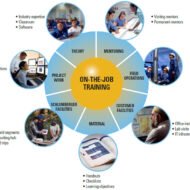
On The Job Training Methods For Effective Employee Development The method by which training is delivered often varies based on the needs of the company, the trainee, and on the task being performed. The method should suit the audience, the content, the business environment, and the learning objective. Ideally, the method chosen will motivate employees to learn, help employees prepare themselves for learning, enable the trainees to apply and practice what they’ve been taught, help trainees retain and transfer what they have learned, and integrate performance with other skills and knowledge. The basic objective of training is learning which brings about a radical change in the perspective of an individual preparing him for the task. On the Job Training: This is the most common method of training. The trainee is placed on the job and the manager or mentor demonstrates the trainee how to do the job. To be successful, the training should be done according to a structured programme that uses task lists, job breakdowns, and performance standards as a lesson plan. Common on the Job training methods include:- Demonstration: Demonstration is very effective for basic skills training. The trainer shows trainees how to do something. The trainer may provide an opportunity for trainees to perform the task being demonstrated. Panel: A panel provides several points of view on a topic to look for alternatives to a situation. Panel members may have differing views but they must also have objective concerns for the purpose of the training. This is an excellent method for using outside experts. Projects: Projects require the trainees to do something on the job, which improves the business as well as helps them learn about the topic of training. It might involve participation on a team, the creation of a database, or the forming of a new process. Employees can voluntarily under-take some small projects that would better the performance of a system. This would help the employee to become noticed and others ease of doing a particular thing and a source of inspiration. Say, Simplifying a database application by introducing a new software. Mentoring: A mentor can tutor others in their learning. Mentors help employees solve problems both through training them in skills and through modeling effective attitudes and behaviors. This system is sometimes known as a buddy system. Visit our GUMROAD Ebook Store for all your MBA guide...
Posted by Managementguru in Business Management, Change management, Human Resource, Organisational behaviour, Principles of Management
on Mar 20th, 2014 | 0 comments
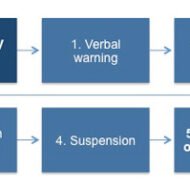
Organizational Discipline – A Way of Life Organizational Discipline: Discipline is the force that prompts individuals or groups to observe rules, regulations, standards and procedures deemed necessary for an organization. Discipline is one word that instills fear in the minds of individuals. The very word sounds autocratic when uttered by your boss and creates a feeling that you are being forcibly controlled. If you do not live up to the expectations of the management, definitely you are going to get listed for disciplinary action. Why is that discipline always gets enforced to gain obedience?Why people get intimidated when subjected to disciplinary action?Why streamlining your behavior becomes so difficult some times? Have you ever given a thought on how we always try to put the blame on management for being a father figure? We have to see things from a broader perspective. When you work for somebody, it is their prerogative to develop some rules and standardize some norms which they think is suitable for the mode of operations. Policies and procedures are formulated for the effective functioning of the organization. It is your responsibility to make them satisfied with your conduct to gain trust and confidence. Organizations are real time schools where you can learn a lot about proper social behavior and develop high standards of discipline. Learning Induces Change in Behavior Learning, an ongoing process is a wonderful experience and individuals must use the opportunity to fit themselves well in the human network when they work for big corporates. The objective of discipline is “orderly behavior”. How many of you maintain a cordial relationship with your peers in the organization?Are you sure they are not talking behind your back for some unpleasant quality of yours?Are you alienating yourself from the rest of the group? Self appraisal is the best way to rank yourself against various critical factors of interpersonal relationship with your team members. Things which we have to consider that might be the causes for indiscipline and misconduct stems from psychological, social and personality oriented factors. Absenteeism Pic Source: Dominion Systems Absenteeism is one thing that no superior can withstand as it directly affects the productivity and vitality of the company. The reasons if presented are weird, he becomes more agitated. Dishonesty is not a thing to be tolerated by the management. Insubordination also causes clashes between the executives and the employees as their “egos are battered.” Carrot and Stick Policy Considering from the employees’ point of view, the carrot and stick policy of the management alone do not make them committed to the firm. Challenging tasks, sense of participation, favorable work climate etc. makes them more responsible and faithful. Immediate rewards and recognitions are more appealing than deferred benefits like pension or gratuity. The emotional aspects of the employees must not be handled in a conservative but in a flexible manner by the management. This will create a feeling of trust and openness between the two. Democracy Hard and fast rules may not solve the purpose when there is no room for any humanism or democracy. This might even be the cause for employees to work against the interests of the company. This leads to disciplinary actions which prove hectic to both the parties. The management on its part has to definitely shed its autocratic attitude and adapt to more participative style of leadership. Personnel department has to play their administrative role in acting as a link factor between the employees and their superiors. Although managers exercise the authority of punishment, it is the HR department’s duty to develop proper procedures of administration of discipline and assist the management in conducting enquiries and solicit the cooperation...