Posted by Managementguru in Business Management, Organisational behaviour, Principles of Management
on Mar 6th, 2014 | 0 comments
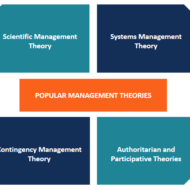
Theory of Management History and Evolution To understand the concept of management, a recap of its history and its slow but steady evolution is absolutely necessary. After the advent of machines, thanks to the industrial revolution of the eighteenth century, management has become an entity by itself. Pic Courtesy: Management Theories Since business activity is increasing by leaps and bounds globally, a more organized set up is called for, which has led to the development of different management concepts. Whether you consider management an art or a science, one definite thing is that, science and art complement each other and not mutually exclusive. Management gurus like Peter Drucker, Henry Fayol, Taylor and others have classified the essential features of management, for the benefit of the industry. Theory comes first followed by practice. Management knowledge certainly improves your style of working. How long do you think, luck, intuition or experience can be relied on, without a scientific knowledge of management. It is a thought to be pondered. Hypotheses Practical experimentation and analysis of theoretical hypotheses, yield better results and in course of time you tend to gain more scientific knowledge. Management is a process of planning, organizing, staffing, leading and controlling. Picture Courtesy: Technofunc.com The management process is applicable to all kinds of organizations and firms, be it a private firm, a government institution, a hospital, a school, a college, an university and other financial, profit making or non profit making NGO’s. This clearly indicates that management is a process that involves individuals who work in groups to accomplish their objectives in an effective and efficient manner. Levels of Management Does management pertain only to the top level management? A big no! It applies to managers at all levels. It is a chain reaction and a successful management totally depends on the synergistic activities of the people belonging to that organization. So, care must be taken by the managers to create and design an internal environment that is conducive for the smooth operations of the firm thus increasing the productivity. This does not mean that the external environment can be overlooked. A manager has to respond to the periodic changes, be it social, technological, economic or political in the external environment also. Management styles Management is a must for every organization and the style of management may vary according to the nature and size of business. Large organizations now-a-days prefer a “flat structure“, as it brings their employees closer and reduces the span of management, thus making communication faster. The more the number of levels, the more the conflict and improper communication. Although management pervades the entire organization, it is the duty of the top management cadre to initiate and maintain consistency in the process of management. All managers (by the term “manager “which is a much generalized term, we denote persons who hold authority to get things done; he may be a financial, administrative, human resource or a production executive) have a common aim, that is to create surplus. To increase productivity, create a suitable environment for the effective performance of their group and to solve crisis situations, they must be capable of seeing the “big picture”. Recent Developments A sea of changes has swept the theory of management area in recent times, owing to the development of different approaches. Management theory is criticized to have all the characteristics of a jungle as numerous management practitioners have recorded their findings in the management history. This led to severe confusion as to what management is, and how things should be organized; however, in modern corporate business world, the managerial activity is directed towards growth, thanks to the...

Posted by Managementguru in Business Management, Organisational behaviour, Principles of Management
on Mar 6th, 2014 | 0 comments
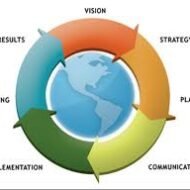
Critical Factors Influencing Corporate Management A corporate management is said to be capable only if it is able to integrate, coordinate and direct the functional capabilities towards overall objectives and common goals of a firm, that have a bearing on an organization’s capacity and ability to implement its strategies. Multitudinous factors affect the functioning of corporate general management system. It differs with each organization with differing objectives and mode of operations. Key Factors or Contributors: The firms must evolve an effective system for corporate planning. The objectives must be realistic and achievable and clear and complete communication of plans to various levels of organization helps in execution of action plans by the respective departments. A pucca management information system is necessary that integrates all the levels through a network of computers, facilitating information processing and task implementation. If the firm is oriented towards a god deal of risk-propensity, chances of rewards are also quite high. You cannot beat your competitors unless you possess a better shade of entrepreneurship in you than others. Competency development backed up by strategy formulations, in the wake of challenges and opportunities in the external environment is well appreciated. Why everybody always talk about strategy? It is one thing that warrants for a sure success, it implies that you are smart enough to think ahead of time, what others have failed to. Don’t you want to set a path forward for the future generations to come? Values that are unique to your organization add to the image of your company. Say, if you project “quality”, as your prime value system, definitely it is going to attract consumers who are very particular about quality unmindful of the price. Slowly the idea gathers momentum and your company’s image gets a boost. But don’t forget that you have to fulfill your commitments in terms of quality without any compromise. Reward systems must be worked out to gear up the morale of top managers who are the achievers of your management objectives. Their track records and degree of commitment should be analyzed to decide on pay and promotions. A favorable organizational climate is inevitable for the organization to progress in the desired direction without any internal politics and power struggles. The role of top management is very crucial in that, it has to identify people with vested interests and bring them back into the groove by making necessary changes in the organization structure or go for weeding out actions if things go out of control. Ultimately, the overall objectives of the organization is what that matters, and people must be trained to accept the organizational changes which form a part of the developmental procedures of management. Social responsibility is much talked about these days, and the corporate firms are in a position to discharge their duties pertaining to social welfare, as part of their corporate management programme.It has become a regular feature of the management process to part with a share of their profit towards a social cause. Corporate management is a comprehensive process that covers all aspects of the management with growth as its motto and social conscience as its...
Posted by Managementguru in Business Management, Organisational behaviour, Principles of Management
on Mar 3rd, 2014 | 0 comments
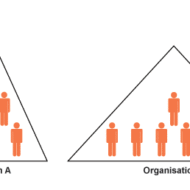
Levels of Organization An organization is a network consisting of people interacting to accomplish the enterprise objectives. The inter relationship is always complex as groups tend to develop conflicts and difference of opinion among themselves and in between. Hence the structure of an organization should be designed to clarify who is to do what task and who is responsible for what results and to furnish decision-making devoid of uncertainty. Organization implies to Recognizing and classifying the required activities Grouping of activities in order to achieve the objectives Appointing a manager and assigning him with the necessary authority to lead each group The provision for co-ordination vertically and horizontally “Organization is the establishment of authority and relationships with provision for coordination between them, both vertically and horizontally in the enterprise structure,” According to Koontz. FORMAL ORGANISATION It implies a formalized intentional structure of roles or positions. Formal organization must be flexible. The formal structure is laid down by the top management The levels are designed on the basis of specialization Purely task oriented and not people oriented Rules are very stringent and everyone is expected to follow them without fail INFORMAL ORGANISATION A network of personal and social relations arising spontaneously as people associate with one another and not restricted by the formal rules or structure. One important aspect of organizing is the establishment of department. Department designates a distinct area, division, or branch of an organization over which a manager has authority for the performance of specified activities. Spontaneous in nature More people oriented Based on religion, culture, common problems faced by the workforce etc., Membership is voluntary and the same person can be a member of many groups. ORGANISATION LEVELS AND SPAN OF MANAGEMENT Why there is a need to organize? To co-ordinate the activities of the people involved in the organization’s functions for which there needs to be certain levels established to facilitate the co-operation effective. There are two types of spans, 1. Wide span 2. Narrow span Pic Courtesy: LumenLearning WIDE SPAN: Wide span of management has fewer organizational levels with more number of sub-ordinates reporting to a superior. Though it proves advantageous for the superior as delegation becomes part of the process and hence work is shared, care must be taken in selecting the right people for completion of tasks and clear policies must be made to avoid confusion. There is this tendency of overloaded superiors to become decision bottlenecks and there exists the danger of superior’s loss of control too. This kind of management needs exceptionally qualified managers to lead the respective groups. NARROW SPAN: Narrow span of management involves many organizational levels with fewer number of employees reporting to a superior. This facilitates close supervision, close control and fast communication between superiors and subordinates. On the contrary, superiors tend to get too involved in subordinates’ work and this kind of management incurs higher costs due to many levels in the organization and there is excessive distance between the lowest and top most levels. FACTORS DETERMINING AN EFFECTIVE SPAN: 1. Training of Subordinates: Well trained subordinates save much time and energy of the superiors and training has to be a continuous process as the technological policies and procedures are subjected to change periodically. 2. Clarity of Delegation of Authority: Clarity implies direction and guidance from the manager’s end to the subordinate. A manager has the responsibility of clearly explaining the task and the methods involved to complete the task in a suitable manner to his subordinates. In cases of machine handling, “On the Job Training” becomes inevitable. If not, the work will not be completed as per the schedule due to lack of clarity. 3. Clarity of Plans: In a production environment, the workers have to be...
Posted by Managementguru in Business Management, Principles of Management
on Mar 3rd, 2014 | 0 comments
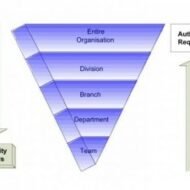
Centralization and De-Centralization Concepts CENTRALIZATION: The term “centralization” has several meanings: Centralization of Performance: Say, if the operations of a company is restricted to a single geographical location, it characterizes centralization of performance. Departmental Centralization: Specialized activities are carried out by a single department, say, maintenance of a whole plant, staff recruitment by HR department etc., Centralization as an aspect of management: This implies restricted delegation and exclusivity of decision-making by the top management. According to Allen, “Centralization is the systematic and consistent reservation of authority at central point in an organization.” According to Weihrich and Koontz, “Centralization (as an aspect of management) is the tendency to restrict delegation of decision-making. What are the special circumstances that force the managers to reserve authority and centralize decision making powers? 1. To facilitate personal leadership 2. To provide for integration 3. To handle emergencies 4. To utilize resources effectively and instantaneously. DECENTRALISATION: It is the tendency to disperse decision making authority in a structured and organized manner. It can be viewed as a philosophy rather than a principle where-in “discretion” plays a major role in deciding which decisions to push down into the organization structure and which to hold near the top. Capital expenditure, Investment analysis and major policy decisions have to be dealt with, by the top management. It is the systematic effort to delegate to the lowest levels of authority except that which can be exercised at central points. TYPES OF DECENTRALIZATION: Three approaches to the concept are: 1. PROFIT CENTRES 2. COST EXPENSE CENTRES 3. INVESTMENT CENTRES Profit Centre: Here the organization is split into divisions on a “product basis” and is given full authority to handle its own scheduled operations, right from placing orders to negotiating the sale of its finished products. Cost Expense Centre: Whenever it is easy to determine the cost of operations, cost centres are established. Cost centres run on “budgets” which acts as a control tool to run the units within the specified budgetary limits. Investment Centre: Useful in the case of big multi-product enterprises where product performance is measured by decentralizing the investment aspect. Each strategic business unit is responsible for the acquisition, use and disposition of fixed resources. Advantages of Decentralization: Managers and executives are relieved form excessive work pressure Even low level employees are involved in decision making thus bringing the decision making process closer to the scene of action. It facilitates product-diversification Creates an opportunity for learning Ensures effective control When a big organization is divided into relatively smaller units, it becomes flexible and also effects close control. Disadvantages of Decentralization: · Conflict arises between people belonging to different levels of the organization · Rising cost · Lack of co-ordination between production and marketing departments · No defined leadership Contingency Factors in Decentralizing: 1. Organizational goals 2. Organizational size 3. Geographical dispersion 4. Technical complexity of tasks 5. Time frame of discussions and decisions 6. Subordinates’ take on issues 7. Planning and control procedures 8. Environmental factors 9. Knowledge and experience of managers Effective Decentralization can be accomplished by · Establishing appropriate centralization · Developing efficient managers · Proper provision for communication and co-ordination · Establishing adequate controls Top management must be willing to delegate authority towards decision making; Middle management must be willing to accept responsibility that is being delegated. Only then effective decentralization is...
Posted by Managementguru in Business Management, Human Resource, Principles of Management
on Mar 2nd, 2014 | 0 comments
Objectives and Functions of HRM Human Resource Management is very challenging because of the dynamic nature of the people and it is not only managing men but involves administering a social system. According to Dale Yoder “Man power management is the function or activity in directing working men and women in maximizing their satisfaction in employment.” George R. Terry says, “Personnel management is concerned with the obtaining and maintaining of a satisfactory and satisfied work force.” OBJECTIVES OF HUMAN RESOURCE MANAGEMENT: 1. Social Objectives: a) Facing the challenge of unemployment and providing people with maximum employment opportunities is the first and foremost priority of countries like India where there is pressure of population growth. b) The employees must be able to derive maximum satisfaction from the work performed. c) The system should facilitate harmony and co-operative endeavor for one and all. 2. Personal Objectives: Job satisfaction and rewards in the form of pay, promotion and recognition is aimed at, on the part of employees. This can be achieved by providing adequate remuneration, opportunities for advancement, facilities for training and development, job security and proper work. 3. Enterprise Objectives: This can be achieved by selecting the right people for the right job, empowering them through training, development and participation. FUNCTIONS OF HUMAN RESOURCE MANAGEMENT: 1. Planning: Assessment of future man power requirement is done with the help of man power inventory chart followed by the recruitment and selection process. A clean job description is needed to lure people with the right skills for the right position. It is the responsibility of the manager of a firm to lay down specifications of the qualities and skills required by the workers and determining sources from where the workers are to be recruited. Selection is done by means of written test and personal interviews. 2. Organizing: This involves proper designing of organizational structure, the inter relationship between jobs, establishing smooth channels of communication, assignment of authority, responsibility and creating accountability, establishing line and staff relationship etc. 3. Directing: Issuing orders and instructions down the line and motivating the work force to carry out those instructions satisfactorily. Positive motivation in the form of financial and non-financial incentives, a good working environment is essential on the part of the management. 4. Controlling: The motive is to ensure that performance of each worker coincides with the plans or standards. Bench marking, Total quality management and Six sigma are some of the popular concepts of standardization. → Scope and Characteristics of...