Posted by Managementguru in Powerpoint Slides
on Mar 10th, 2014 | 0 comments
Capital Structure – Debt vs Equity Financial Markets – Instruments and Securities

Posted by Managementguru in Business Management, Human Resource, Labor Management, Principles of Management
on Mar 10th, 2014 | 0 comments
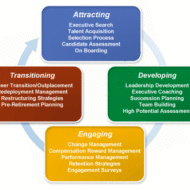
Dimensions of Human Resource Management I would like to brief you on some of the key aspects that mark the paradigm shift in the HR environment towards better management prospects. 1. The Human Resource function has shifted its focus to a much wider canvas that includes Empowerment of EmployeesRestructuring the Organisation and so on. 2. A range of HR sub-systems are involved in Planning The NumbersTypes And Skills Of HrEnsuring Their AvailabilityPlacing In The Right JobPromoting And Nurturing Their Mental HealthHelping Them Develop Special Talent And Skills 3. Human Resource is considered as an “investment” and no more an “expenditure”. Investment in TrainingRe-Training AndContinuous Learning On The Job develops the skills and competences of managers and employees and prove to be an useful investment. 4. The concepts of Learning Organisations AndTeam-Building serves a basis for “Competitive advantage” and “Motivating the employees.” 5. Values that are stressed upon are Co-OperationHarmonisationSynergyTrustBeing Pro-ActiveCollaboration 6. Strategy: VisionMissionObjectivesGoals– How these can be achieved? The techniques that are basically holistic in nature can solve the purpose. Such techniques involve SEWA– Self mastery, Empathy for workers, Worker-directedness and Achievement in performanceABO-Action by Objective Nine Dimensions of an Effective HR Department: What is the reputation of the HR department?What are the criteria (deliverables) that shape HR work?What is the mission or strategy of the capabilities – focused HR department?How is the HR department organised? How does HR facilitate the definition and creation of organisation capabilities?How do we make better HR investment and choices?How do we create HR practices?How does HR go about doing its work? What do HR professionals need to be, know, and do to be effective? Let us make a sincere comparison between the past and the present in terms of HR perspective These techniques produce performers who find their way through any set of given problems, manage themselves and lead the team to a stae of self- realisation. Old model vs New model 1. Job was the basic unit/ Team is the basic unit 2. Relations with environment there handled by the individuals/ Densely networked with environment 3. Information flow was vertical/ now it is vertical, horizontal and holistic 4. Many layers of management / Organisations have become flat 5. Emphasis on structures/ Emphasis on process and literally virtual organisations have evolved 6. Career path upward and linear/ career path lateral and flexible 7. Standardised evaluation and reward system/ Customised evaluation and reward system 8. Ethnocentric/ International 9. Single strong culture/ Multicultural and diversity of viewpoints and...
Posted by Managementguru in Business Management, Human Resource, Organisational behaviour, Principles of Management
on Mar 10th, 2014 | 0 comments
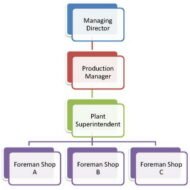
Line and Staff Authority LINE AUTHORITY: It is that authority which a superior exercises over his subordinates to accomplish primary objectives of the organization. The superior issues orders and instructions to his sub ordinates to complete the tasks. This authority is delegated to those positions or elements of the organization which have direct responsibility for accomplishing the primary enterprise objectives. The flow of authority is always in the downward direction from the superior to the subordinate and such relationship is called LINE RELATIONSHIP that exists in all departments of an organization. ROLES OF THE LINE RELATIONSHIP: 1. As a Chain of Command: Line officials are in the chain of command from the highest position to the lowest position in the organization. Each successive manager exercises command over his subordinates. 2. As a career of accountability: Each executive in the line is accountable for the proper performance of the tasks assigned to him and every subordinate is answerable to his superior. 3. As a Channel of communication: Since the line relationship involves issue of instructions from the authorities and reporting from subordinates, it facilitates and serves as an effective channel of communication. Line relationship helps the organization to work properly by Providing the decisions required for functioning Furnishing reference points for the approval of proposals Serving as a means of control by setting the limits of authority Establishing authentic communication channels to make leadership process effective STAFF AUTHORITY: Literally staff implies a stick carried in the hand for support. In the context of management, it implies to those elements that help the line authorities to function effectively in accomplishing the primary objectives of the enterprise. Staff provides advice assistance and information to line managers and they are distinguished into three categories namely, personal, specialized and general staff. They reduce the burden of line authorities and they too have the right to command and extract work from their subordinates. According to Henri Fayol “staff is an adjunct, reinforcement and a sort of extension of line manager’s personality.” LINE AND STAFF CONFLICTS: As always, functional and decisional conflicts arise between line and staff members. The causes may be attributed to the following reasons. 1. Line managers grudge against the staff personnel: a) The staff authorities try to encroach upon the line managers and tell them how to do their work b) Lack of well balanced advice from the staff managers c) Staff managers are not directly accountable and sport a jealous attitude towards line authorities d) Staff managers fail to see the big picture objectively and their interests are confined to specified situations e) Staff often tend to impose their superiority on line managers 2. Staff personnel complaints against the line managers a) Line managers don’t want to listen to the suggestions of the staff and make it a point to resist new ideas. b) Lack of authority on the part of staff managers to implement their innovative ideas and hence the dependence on line authorities. c) Line managers do not utilize the services of staff personnel properly and effectively. 3. The workers’ attitude a) The authority relationships between line and staff specialists are not clearly defined most of the time b) The basic difference in attitude and perception of the line and staff managers create difficulties for the work force in carrying out orders and...
Posted by Managementguru in Business Management, Entrepreneurship, Human Resource, Leadership, Organisational behaviour, Principles of Management
on Mar 9th, 2014 | 0 comments
Profile of a successful leader Adaptive Capabilities: Leaders need to radically change their mindset so as to stand the test of time; but the core leadership attributes like vision or creativity, intelligence, commitment, and a healthy dose of luck still continue to define the pre-requisites of success. Integrity of Character is most important when talking about successful leadership. The philosophical undercurrent is that “Be Good, Do Good” and you will be good. The motive must be devoid of mistakes though there is room for mistakes in judgment. Leaders must have a clear vision and be able to communicate this vision to others so that it becomes a shared vision and everybody willingly contributes in fulfilling the vision. Six ‘C’s or six criteria that determine a leader’s credibility Conviction Character Care Courage Composure Competence Cross-Functional Expertise – Acquisition of knowledge should make a leader humble and flexible and gaining knowledge must be seen as a life long experience rather than collection of voluminous data or skills. A leader will try to apply his broad functional knowledge and expertise in the right places and the results will be definitely magnificent. A leader must look into the possible options rather than to plan, the possible rather than the perfect, involvement instead of obedience. Change is the only entity that remains unchanged and it is inevitable for the leaders to consider change as the core element of growth. With accelerated pace of change in the economic, political and socio-cultural environment, leaders not only need to acquire new knowledge and skills but they also need to unlearn many of the things that have out-grown their purposes. Leaders should follow the CODE OF PRIDE to motivate the workforce. P– PROVIDE FOR A POSITIVE WORKING ENVIRONMENT R– RECOGNISE EVERYONE’S EFFORTS I– INVOLVE EVERYONE D– DEVELOP SKILLS AND POTENTIAL E– EVALUATE AND MEASURE CONTINUOUSLY In large corporate organizations, the leader must be willing to share power and control so that leadership is encouraged at various levels. Successful leaders are those who are self-motivated by setting their own standards and compete with themselves. Innovation is the need of the hour What do you mean by innovation? Creating something new or modifying the old one. Here the term innovation implies the change in the “THOUGHT PROCESS” of leaders who are able to turn a crisis into an opportunity. Also called as “THINKING OUT OF THE BOX” where a leader finds new application for old ideas which cannot be discarded or dis-regarded. “You must learn from your past mistakes but not Lea(r)n on your past successes”. High achievers take moderate risks calculating the circumstances and they rely on their own abilities unlike low achievers who invariably like to minimize risks or take wild and irrational risks. Running a corporate business has become more like an experiment since we cannot control or predict the future. It is highly unstable and unpredictable. So leaders have to cope up with this non-linear force acting in the external environment building up pressure. Leaving things as they are can be just as predictable as changing everything, you lose or win both ways. Now let us look at some of the definitions of Leadership 1. “Leadership is generally defined as influencing people so that they will strive willingly towards the achievement of group goals.”- Koontz and O’Donnell 2. “Leadership is the lifting of man’s visions to higher heights, the raising of man’s performance to higher standards, the building of man’s personality beyond its normal limitations.”- Peter F.Drucker 3. “Leadership is the ability to secure desirable actions from a group of followers voluntarily without the use of correction.”- Alford and Beatty 4. “Leadership refers to the quality of the behavior of individuals where by they guide people on their activities in organized efforts.”- Chester I.Bernard Behavioral Commitments of a Leader: Challenging the process Challenging the status quo and act as radical change agents Inspiring others by being pioneers, instigators, navigators and learners Showing risk-taking ability,...
Posted by Managementguru in Human Resource, Interview Questions, Principles of Management, Training & Development
on Mar 8th, 2014 | 0 comments
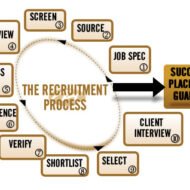
Recruitment Process Recruitment refers to that process carried on by the company to attract suitable candidates possessing the appropriate characteristics to help the organization reach its objectives. According to Byars and Rue, “recruitment involves a pool of people from which qualified candidates for job vacancies can be chosen.” The basic purpose is to develop a group of potentially qualified people. Recruitment Policy: The policies of recruitment are derived from the personnel policies of the organization where the company has to give due importance to government reservations, quotas, policies regarding sons of the soil, personnel policies of other organizations regarding merit, internal sources, social responsibility in absorbing minority sections, women etc. Sources of Recruitment: INTERNAL SOURCES: This include 1. Present permanent employees 2. Present temporary/ casual employees 3. Retrenched or retired employees 4. Dependents of deceased, disabled, retired and present employees. Why internal source is considered to be a better choice? To motivate the present employees To improve the morale aspect “Known devils are better than unknown angels”-The credibility of the present employees are well known and they can be judged easily Loyalty and sense of belongingness is there on the part of current employees The employees become highly committed when they are given a chance as they tend to shoulder more responsibility Employees’ psychological needs, economic needs for promotion and higher income can be satisfied Cost of selection can be minimized Similarly cost of training, induction, orientation, period of adaptability to the organization gets reduced Trade unions are happy Social responsibility towards the employees are discharged Good understanding and co-operation extended by co-workers Stability of employment is assured EXTERNAL SOURCES: 1. Educational and training institutes 2. Private employment agencies/exchanges 3. Public employment exchanges 4. Professional associations 5. Data banks 6. Casual applicants 7. Similar organizations 8. Trade Unions 9. Social media networking sites like Facebook and Linked in offer a huge platform for both recruiters and job seekers to find the best possible match. Why external source is considered to be a better choice? · The suitable candidates with skill set, knowledge and talent are generally available · Latest knowledge, skill, innovations or creative talent can be infused into the organization · Candidates can be selected without any pre- conceived notions or reservations · The cost shelled out for these external sources are minimum since they are placed in minimum pay scale · Expertise, excellence and experience in other organizations can be easily brought into the organization · Human resources mix can be balanced with different background, experience, skill etc. · Existing personnel will also broaden their personality · Quality of human resource will improve in the long run by development of unique culture RECRUITMENT TECHNIQUES: The management has to contact the prospective employees through various means and stimulate them for applying to the post prescribed. A. Promotions: This is a good technique to stimulate internal employees as they will be willing to shoulder more responsibilities if they are assured of promotions B. Transfer: If employees are transferred to the places of their choice, it will stimulate them C. Recommendations of the present employees: Management can contact, persuade the outsiders to apply for job in the organization through the recommendations to the candidates by the present employees, trade unions etc. D. Scouting: This is another way of recruiting where the representatives of a particular organization are sent to various sources of recruitment to motivate the prospective candidates to apply for the jobs. The representatives provide the necessary information about the company and clarify doubts of the candidates. E. Advertising: Though the popular and widely accepted way of recruitment, still it proves to be one-way communication. Newspapers, Magazines of all types, television and internet are the possible sources of advertising channels and internet marketing leads the rest. The technique of advertising should...