Posted by Managementguru in Business Management, Change management, Entrepreneurship, Human Resource
on Apr 16th, 2014 | 0 comments

Entrepreneurs are the mechanism by which our economy turns demand into supply. They create new ventures that provide new, improved products and services. Here we list some of the principal qualities of entrepreneurs and how those qualities help in shaping up our economy. Productivity Accelerators: Entrepreneurship raises productivity through technical and other forms of innovation. Entrepreneurs as risk bearers find resources and fill market gaps that would be missed by larger, more bureaucratic organizations. They allow a country to extract every last bit of marginal capacity out of whatever resources exist within the society. Brilliant Tips on Productivity by some Popular Entrepreneurs: Focus on one thing at a time: It may seem like a no-brainer, but multitasking can actually cut back on your productivity. Instead of juggling multiple projects at once, schedule out blocks of time — or even entire days — during which you only focus on one task or one project. Steph Auteri, @stephauteri, Word Nerd Pro Outsource, outsource, outsource: Everything may be a priority, but you are not equally brilliant at everything. Eliminate the unnecessary tasks and outsource your weaknesses so your time and focus is directed to where you’ll make the biggest impact for the business. Kelly Azevedo, @krazevedo, She’s Got Systems Define roles and divide work: Make sure everyone on the team has distinct roles defined, and divide work accordingly. Everyone on a proactive team will want to do everything, and clearly defined roles make it clear who should do what. David Gardner, @david_gardner, ColorJar Job Creators: It is a powerful tool of job creation –Entrepreneurship as a whole contributes to social wealth by creating new markets, new industries, new technology, new institutional forms, new jobs and net increases in real productivity. The jobs constructed through their activities in turn lead to equitable distribution of income which leads to higher standards of living for the population. Entrepreneurship facilitates the transfer of technology. Entrepreneurs play a strategic role in commercializing new inventions and products. They play a critical role in the restructuring and transformation of economy. Their behavior breathes vitality into the life of large corporations and governmental enterprises. Market Competitiveness: They make the markets more competitive and thereby reduce both static and dynamic market inefficiencies. Micro-preneurs working in the informal sector circumvent established government authority when governments and their programmes inhibit economic development. They stimulate redistribution of wealth, income and political power within societies in ways that are economically positive and without being politically disruptive. Social Welfare: They improve social welfare of a country harnessing dormant, previously overlooked talent. They create new markets and help in expansion into international markets. The unique feature of entrepreneurship – that it is a low cost strategy of economic development, job creation and technical innovations. Technology Innovation: Technology entrepreneurship is also important for sustainable development as Nobel Prize Laureate prof. Dan Schechtman puts it: “Technological entrepreneurship is a key to the well-being of the world”. India has been the first among the few developing countries to have assigned a significant and categorical state role to small scale industries from the first Five Year Plan itself, and the small scale sector has emerged as a dynamic and vibrant sector of the economy during the eighties. If the country develops pucca infrastructure and removes the hurdles in the operative environment politically and legally, no doubt the Indian economy will be scaling to greater heights. Surplus manpower (educated and un-educated), which has been a great liability can become an asset once those with potential are selectively groomed for self-employment and enterprise formation, leading to further job...

Posted by Managementguru in Interview Questions, Resume Samples
on Apr 6th, 2014 | 0 comments

Resume for Sales Know the purpose of your resume Need help in creating or updating your resume? It certainly can be a tough task because your resume is going to be reviewed by software as well as by hiring managers. This new column brings you top resume tips for choosing a resume format, selecting a resume font, customizing your resume, using resume keywords, explaining employment gaps, and more tips for writing interview winning resumes. Try to understand that the purpose of building your resume is to land an interview and make it as precise as possible and impress the recruiters with your profile. Business and Marketing Writing A great resume is one that highlights your strengths and emphasizes the highs of your career. It is imperative for every professional to get his resume periodically updated to move up the corporate ladder. A resume has four sections: Personal Information. This includes your full name, city, contact number, e-mail address and social media profiles. Your personal information can appear at the top center part of the resume with a header positioned below it. Employment History. Your work history must be arranged beginning from current or most recent employer. It must indicate your designation, inclusive dates of employment and a description of your scope of responsibilities. Educational Attainment. This should also be arranged according to highest level of education attained. Details should include degree earned, inclusive dates and relevant awards or achievements. You do not have to include information from secondary education and earlier. Special Skills. This section is where you highlight core competencies and other skills you have that are relevant to the job opening. What are the key ingredients of a great resume? A sparkling profile with sufficient emphasis on your key strengths. A cover letter that guarantees a personal interview. Customized and tailor-made resumes. Designed by skilled resume writing experts. Professional formatting and layout. What should be there in a profile statement? Understand that highlighting your skills and experience in your profile is the “Catch Point” to impress your new recruiters. Financial Planning and Strategy, Marketing Concepts, Positioning, People Management, Territory Management, Sales Planning, Competitive Analysis, Understanding the Customer, Product Development, Client Relationships, Creative Services are some of the criteria that make a marketing/sales manager stand out from the crowd. Try to bring out the achievements in your career till date and who might be the better master to do it other than yourself! Q: What’s the most common resume mistake? A: Making too many general claims and using too much industry jargon that does not market the candidate. A resume is a marketing document designed to sell your skills and strengths rather than just portray a bio of the candidate. For unemployed candidates, handing out resumes should be a full-time job. The majority of mid- to senior-level positions are filled through networking, so contact absolutely everyone you know in addition to recruiters who are in a position to hire you or share...
Posted by Managementguru in Business Management, Change management, Human Resource, Organisational behaviour, Principles of Management
on Mar 31st, 2014 | 0 comments
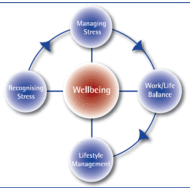
India often looks at Japanese or American models to comprehend the concepts of management. In reality, Indian scriptures can be considered as treasuries of management. The Bhagavat Gita, the Vedas and the Epics highlight the true spirit of working together and the need for de-stressing the self for enhanced performance levels. The idea of NISHKAMYAM (to perform one’s own work without expecting a result) is truly said to be the highest ideology preached by Lord Krishna. What Induces Stress? A dynamic condition in which an individual is presented with an opportunity or confronted with a demand, related to what she or he desires and for which the outcome is uncertain but important, can be called a stressful situation. The consequences of stress in an organizational set up express themselves in the form of physiological, psychological or behavioral symptoms, which are harmful to the individuals who experience high levels of stress. Symptoms of stress: AnxietyDepressionIncreased job dissatisfactionAbsenteeismDecline in productivityRapid turn overHigh blood pressureHeart diseasesHead aches Stress Can be Motivating: While long term stress is harmful to the individual and organization as well, it is said that short term stress serves the purpose of task accomplishment by individuals or groups, within the stipulated time. It serves as a motivation factor rather than a causative agent of frustration. It has been proved by scientists and medical researchers that stress has a direct effect on the metabolism of a person, that causes increase in heart and breathing rates, increase in blood pressure, thus inducing heart attacks. Equally important are the behavioral and attitudinal changes that are created by stress, which cannot be overlooked. Job Satisfaction: Psychological symptoms arise due to job-related dissatisfaction, boredom, work pressure, irritability and procrastination. Sometimes forceful involvement may also lead to decreased job satisfaction. The job to be carried out can be finished at the particular time if the individual is able to give one’s best shot. But when it is performed under stress, they complete the job with dissatisfaction. When the incumbent is asked to perform a task that lacks clarity, naturally ambiguity arises in his mind followed by anxiety. Behavioral Symptoms of Stress Changes in productivity levels, absence, and rapid staff turnover are stress symptoms of behavioral nature. It might be expressed even in the form of increased smoking, consumption of alcohol etc., Say for instance, in production department, when there is a need to supply a product in a very limited time, the workers may be active initially, but the performance slows down when they get totally tired or dissatisfied with the work. Again the demand by the superior adds additional stress that reaches unmanageable levels. Similarly, people taking care of administration, banking, marketing and other office related works fall a prey to stress. How to manage stress? From an organization view point, it is believed that a limited amount of stress may work wonders in terms of performance, with stress acting as a “positive stimulus”. But even low levels of stress are likely to be perceived as undesirable from an individual’s stand point. How could be the notion of management and individuals be different on the acceptable levels of stress? It does not solve the purpose. Individuals have to understand that, they have to live up to the expectations of the management in order to enhance their credit ratings, in terms of promotion and pay. They have to understand that challenges are to be perceived as opportunities to prove their mettle. Self and situational analysis, work analysis, time management and physical well- being are some techniques that practically solve problems of stress. “De-stressing the Self” Techniques for Employees Organisations can reduce stress of the employees...
Posted by Managementguru in Organisational behaviour, Principles of Management, Strategy
on Mar 31st, 2014 | 0 comments
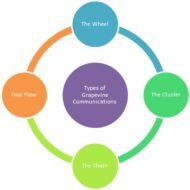
What is Grapevine? In every organization there exists an informal channel of communication called the grapevine in operation. It is called so because it stretches throughout the organization in all directions irrespective of the authority levels. Organizational Benefits that come along with Grapevine It is quite natural for a group of people working together to be interested in one another and talk about appointments, promotions, retrenchments or even domestic affairs. Some people derive extraordinary pleasure from gathering such ‘secret’ information and transmitting it to others. They are the leaders who control the grapevine. Soon this info reaches everybody and becomes an ‘open secret.’ Grapevine is more a product of a situation than of a person. Certain situations like insecurity of service, uncertainty over promotions, special increments to a colleague, certain innovations in the organization that are likely to affect the job prospects of the employees, are sure to activate the leaders of the grapevine that instantly spreads all kinds ofrumors in the organization. Communication Network of an Organization: The channel’s network is in a horizontal fashion as the communication is only between the workers of the same level of hierarchy. Apprehensions experienced by workers on matters like promotions and retrenchments become an obsession with them. Talking about them may not alleviate their fears, but it certainly provides them emotional relief. The existence of the grapevine proves that the workers are interested in their associates. The very fact they talk among themselves helps to promote organizational solidarity and cohesion. The management should work up this kind of situation to their advantage. How? Well, all information cannot be transmitted to the employees through the official channels. If there is some useful information unsuitable for being transmitted through official channels, it can be done through grapevine. The speed with which information is transmitted through the grapevine is just remarkable. Spot the Key Persons: The management should try to spot out the key persons involved in this process and keep them well informed to block harmful rumors reaching the employees. Also the grapevine can be used as an “acid test “to check the pulse of the employees. If there is any false rumor the management should immediately use the official channels to contradict and to dispel the fears from the minds of the employees. Grapevine might be Harmful Too: One of the major drawbacks of the grapevine is that it may spread baseless or distorted news which may sometimes prove harmful even to the employees. The information is sometimes incomplete leading to ambiguities. The swiftness with which the grapevine transmits information may even be damaging, before the management becomes aware of it and can take any rectifying steps. How to Handle the Rumor-Mongers? If the workers are associated with decision-making, the rumor-mongers will be automatically frustrated. If the workers are already aware, say, that the plant is to be modernized but the modernization process is not going to involve any retrenchments, the arrival of new machinery and engineers will not cause any undue apprehensions among them. Thus the harmful effects of the grapevine can be successfully counteracted. Organisations should indulge themselves in sending positive signals to the employees to win their trust and...
Posted by Managementguru in Business Management, Change management, Human Resource, Organisational behaviour
on Mar 30th, 2014 | 0 comments
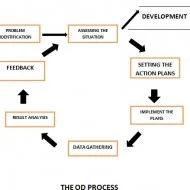
Integrated Organizational Development Organizational Development : in short OD, is a systematic, integrated and planned approach to improving enterprise effectiveness. Corporate firms can achieve success only when the available #resources are put to optimal use. Optimisation implies, deriving the best out of the limited or scarce resources. A firm is comprised of many departments, all of which compete for the same kind of resources and it becomes a tough proposition for the #management to allocate the resources suitably to different cost and #responsibility centers. The point is, changing needs of an organization has to be keenly observed by the management and if it senses a need for organizational development in any one of the disciplines, it should immediately employ appropriate #interventions to improve the #performance and #productivity. Culture – The Fundamental Aspect: Organizational development involves a paradigm shift in its culture, which is the fundamental aspect. It does not just mean finding solutions to problems. It is a process of managing change in an organization, resulting in behavioral changes in #employees for the good of the organization. Firms adopt different interventions to bring in changes in the behavior of employees through learning. The aim of introducing interventions would be to meet the short term and long term #objectives of the firm in an integrated fashion. Only when the employees are suitably appraised about the objectives and trained accordingly, their mindset gets tuned in to perform as per the expected standards. Intervention Techniques: Intervention techniques focus on shifting the individual’s focus from “me” to “us.” Before delving into the types of interventions, one might wonder why an organization needs to incorporate such interventions at the first place. The reasons may be attributed to the following: Some kinds of problems keep recurring to the surface. Even after solving a particular problem, another one of similar nature erupts. Productivity improvement techniques are not effective. Any amount of effort fails to yield the desired result. Employee morale is low and the top management is unable to pinpoint any particular reason for the undesired development. How to Overcome #Resistance from Employees’ End? Intervention techniques encourage employees to come out with suggestions and take part in decision making as well for the betterment of the organization. Though initially there might be a resistance to change, as it is natural for humans to resist change, gradually the workforce understands the importance of initializing the change that might have a direct bearing on them and their working environment. A holistic change is what is needed for an organization to rise as a whole to greater heights. #Group Training: Group training is a vehicle for individual change. It improves the listening skills, empathy, capability of being sensitive to fellow workers’ needs, interpersonal skills, and desired behavior in a social setup etc., Trainees selects the problem issues that are of interest to them, the setting being informal and unstructured and most interestingly there is no external force to structure the discussion. But it may be noted that the trainer interferes in extreme cases where the discussions turns out to be #counterproductive and destructive. #Survey Feedback: Survey feedback is another kind of intervention that gathers data from employees at different levels regarding the problem issues, through questionnaires and the feedback of the survey is analyzed by the top management to find the loopholes or bottlenecks hindering the development. This has been a popular organization development technique since time immemorial and still followed suit. These programs are useful in improving the #quality of work life and employee productivity. Analysis of the effectiveness of intervention programmes and evolving right research designs to measure the variables before and after the change, shall reveal the...