Posted by Managementguru in How To, How to Blog, How to make money online
on Aug 6th, 2016 | 0 comments

Pro Blogging Tips for Beginners This post brings you very useful information from pro-bloggers in the likes of Jeff Bullas. For some blogging may be a passion… For some blogging is a pastime… But lately… Blogging has become business… Blogging is the source of income for many… Follow these excellent tips from blogging and digital marketing experts that will guide you through all the hassles. I have tried to summarize the key points that will give you a fair idea about the blogging bascis. Here they come… A. Top 5 Tips That Can Make You a Successful Blogger 1. Get started with the right platform The very first challenge will be choosing the right blogging platform. There are a lot of free blogging platforms like Tumblr, WordPress, Blogger and Type Pad. All these offer free design themes that can be customized to suit your purpose. But it is always better to go for a self-hosted blog if you plan to convert your blog as a business in the long run. 2. Consider integration Getting your blog integrated with an existing website in order to build the content is good for SEO and also make the search engines fond of your content. SEO is all about keywords in your content and concentrating on this aspect becomes inevitable. Long tail keywords attract lot of traffic since the competition will be less. 3. Finding a niche Your blog must talk about something spectacularly specific or offer solutions to specific problems to please both the readers as well as the search engines. 4. Write about something that you love When you write about something that you are passionate about, you will enjoy doing it and you will also be good at it. 5. Offer something of value The blogs you write must be of something that the readers will value. This means you must offer them something in return for spending time reading your blog. Your blog will never be a success if you aren’t providing something of value. Such is the power of information and when you do it right, you win. This excellent Infographic compiled by Twelveskip.com lists down 26 AWESOME BLOGGING TOOLS LOVED BY THE PROS Following is a detailed post about “It’s All About Data! Measuring the Effectiveness of Content Marketing” from Onlyonemike.com. A very resourceful post that gives info on how to monitor content performance metrics and determine how to boost and improve content marketing in the future. https://onlyonemike.com/its-all-about-data-measuring-the-effectiveness-of-content-marketing/ B. Are You Making These Twenty Mistakes on Your Blog? Writing a blog is both a joy and frustration as you try and work out the ways to let readers on the world wide web discover you and let them know you exist. You have only a few seconds to help the reader decide whether they want to read your post or not so a headline that compels and teases the visitor to your blog or who sees your headline on a Tweet is a must in driving readership. Try COSCHEDULE HEADLINE ANALYSER that gives you a clear insight whether your post title rocks or sucks.. List posts such as “10 Ways To..” or The 5 Top …” are always effective. These might seem redundant and overused but the fact remains they work. Some bloggers wonder why they have no one reading their articles. I sometimes wonder how some blogs are ever found in an ocean of over 200 million blogs. So the challenge is that the writing is just the beginning and promoting your posts is the next step in driving readership and building a loyal following in your industry or niche. This excellent Infographic compiled by Classycareergirl.com lists down 15 Major...

Posted by Managementguru in Accounting
on Aug 6th, 2016 | 0 comments
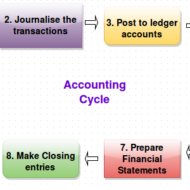
Financial statements have to be produced accurately at the end of the accounting period for tax purposes. An accounting period may be a month, a quarter of a year, or a whole year. The accounting cycle is the series of steps that take place in order to produce financial statements. A term that describes the steps when processing transactions (analyzing, journalizing, posting, preparing trial balances, adjusting, preparing financial statements) in a manual accounting system. Today many of the steps occur simultaneously when using accounting software. Following are the steps that complete an accounting cycle: Identify the transaction: This transaction could be the revenue from the sale of a product or a payment to another business for services. Analyze the transaction and how it is related to the accounting balance sheet. For example, determine which accounts are affected by the transaction and how they are affected. Record the transaction to a journal such as a sales journal. Journals are kept in chronological order and may be updated continuously, daily, or however often it is necessary. Record the transaction to the general ledger: Take all of your entries and categorize them by the account. Perform a trial balance: Debits and credits need to be equal at the end of an accounting cycle, so calculate the entries to ensure they match. Prepare adjustments: Just because entries are recognized, does not mean the work has been performed. Revenue can only be recognized when the work has been completed, so adjust the entries accordingly. Perform trial balance with adjustments: Take the adjustments from Step 6 and prepare a trial balance. If the debits and credits do not match, then you need to adjust them to make sure they do match. Prepare financial statements: From the adjusted trial balance, these corrected balances are used to prepare the financial statements. Close the accounts in preparation of the next accounting cycle. Revenues and expenses need to be closed out, which means they need to have zero balances. Balances are moved to the next cycle. Some Important Accounting Terms: Account A record in the general ledger that is used to collect and store similar information. For example, a company will have a Cash account in which every transaction involving cash is recorded. A company selling merchandise on credit will record these sales in a Sales account and in an Accounts Receivable account. Accounting Department Part of a company’s administration that is responsible for preparing the financial statements, maintaining the general ledger, paying bills, billing customers, payroll, cost accounting, financial analysis, and more. The head of the accounting department often has the title of controller. Accounting Equation Assets = Liabilities + Owner’s Equity. For a corporation the equation is Assets = Liabilities + Stockholders’ Equity. For a nonprofit organization the accounting equation is Assets = Liabilities + Net Assets. Because of double-entry accounting this equation should be in balance at all times. The accounting equation is expressed in the financial statement known as the balance sheet. Accounts Payable This current liability account will show the amount a company owes for items or services purchased on credit and for which there was not a promissory note. This account is often referred to as trade payables (as opposed to notes payable, interest payable, etc.) Accounts Receivable A current asset resulting from selling goods or services on credit (on account). Invoice terms such as (a) net 30 days or (b) 2/10, n/30 signify that a sale was made on account and was not a cash sale. Adjusting Entries Journal entries usually dated the last day of the accounting period to bring the balance sheet and income statement up to date on an accrual basis (as required by the matching principle and...
Posted by Managementguru in How To, Social Media
on Jul 29th, 2016 | 0 comments

5 Very Simple Yet Extremely Useful Tips for Tweeting Useful Tips for Tweeting Twitter is a great social media marketing platform for any serious webmaster or blogger looking to build online credibility and drive traffic to their blogs. If you are already using Twitter frequently, are you sure that you are tweeting effectively? If not than learn how to create Twitter account? Go to the Twitter homepage and locate the sign up box, which will lead you directly to the signup page. Enter your name, email address and preferred password, the click ‘Sign Up’. Take note that you can tie only one email address to one Twitter account. A new page will come appear asking you to select a username. Are you getting the most by engaging, growing and driving traffic to your website & Twitter profile by tweeting effectively? Today we’re going to take a look at 5 very simple yet extremely useful tips for better tweeting, for all you budding newbie and developing bloggers out there. OK now let’s get on with our top tweet tips… Tweet Tip 1 – Tweet regularly… Some people believe that tweeting continuously all day long is the best way to get your message across. Whilst this might work for a very few, effectively it can also annoy the majority of your followers. Saying that, tweeting regularly throughout the day, perhaps a few tweets every few hours or so is probably the most productive way to tweet regularly. As long as you’re diverse with what you’re tweeting about, tweeting regularly should promote healthy growth of your Twitter followers. So the first tip to remember is to ensure that you tweet regularly throughout the day. Tweet Tip 2 – Tweet stuff that is useful and relevant to your niche… When sharing stuff from the web or your blog or website for that matter, remember to keep usefulness, resourcefulness and relevancy above all in mind. This is essentially important if you want get as many targeted followers as possible. People follow you because they believe what you’re sharing with them is of great value, they’re interested in your tweets and therefore will regularly come back to see what you have to offer each time. Don’t make the habit of tweeting too much off-topic stuff, things that you essentially might find funny or interesting but others won’t! So remember tip two, tweet stuff that is relevant to your niche or topic… Tweet Tip 3 – Retweet… The ultimate reason why so much stuff is conveniently shared on the web through Twitter is thanks to the retweet button… This tip is particularly useful if you want to increase the engagement activity on your profile, as well as earn the respect and ensure that your followers remain loyal to you. Retweet other related content published by other bloggers for example, and they will in turn do the same with your content. Remember to use the ‘reply’ feature to thank other people that retweet and share your stuff with their own followers. Tip number three, easy to remember… retweet regularly… This Infographic gives you a fair idea on how often you should post on social media to get optimum results. Tweet Tip 4 – Engage more… Start conversations with other followers and respond to any messages and mentions in your activity bar. The whole reason of using Twitter is to socialize more which can help drive engaging visitors to explore more of what you have to offer, including your site or blog. Tweet Tip 5 – Schedule your tweets Understandably there are going to be times when you simply won’t be able to tweet stuff, and it...
Posted by Managementguru in How To, How to make money online
on Jul 28th, 2016 | 0 comments

Discover 10 ways you can make money online in a legit and quick manner. Online surveys…Paid for searching the web…Social Investment Networks…Sell your notes…Review websites & apps for cash…Get Paid To’ sites.
Posted by Managementguru in How To, Human Resource, Organisational behaviour, Training & Development
on Jul 16th, 2016 | 0 comments

What is a conflict? An organization is a network consisting of human element as the major functional source and as such is prone to weaker vulnerable aspects of human psychology. Conflict is, of course, one such weak point. The diverse functional groups in the organization get into conflicts while setting up objectives and goals; in prioritizing and weighing the objectives, the methods of their achievement and their evaluation. Though there are numerous kinds of conflicts, this is the major one affecting the functioning of the firm. Organizational conflict, or workplace conflict, is a state of discord caused by the actual or perceived opposition of needs, values and interests between people working together. Conflict takes many forms in organizations. Certain examples of conflicts: The objective of a project manager to construct a building might go against the objective of minimizing the project cost. For work force, their personal goals come before the organizational goals. The objective of the production department to increase productivity may go against the objective of maintaining the product quality. The objectives of the marketing department to increase the sales through promotions may not be welcome by the finance department whose objective will be to cut the cost. Reasons for conflicts: Lack of clarity as to the scope and relevance of functions in achieving the corporate objectives. Clash between line and staff authorities. Ignorance or lack of knowledge needed for decision making in the part of chief executives Different sets of beliefs and views, along with one’s personal interest and ego. Different kinds of attitudes of members of the organization Absence of clarity in organizational policy, procedures, rules and guidelines. The Results of Conflict: The most affected element in a group conflict is “Employee Morale.” Conflicts undermine professionalism and lead to under utilization of organizational capacity. Loss of Importance: A particular group of employees feel that their importance is being undermined. When a manager is being inducted from an outside source, the prospective employees of the firm feel that they have been let down by the management. Frustration: There are certain rules and regulations to be stuck to when issues arise. If the finance department is not consulted regarding issues related to insurance claims, there are chances that the company might lose a good deal. In such cases frustration arises which is not good for the health of the firm. Feeling of Insecurity: This affects severely the morale of an employee. A clerical staff feels insecure if new technological system is introduced in the company where he is a novice. When one’s importance is persistently reduced, he may start feeling redundant. Blocked Personal Growth: Persons who experience reduced importance may apprehend a situation where they don’t expect much by way of personal growth through increments and promotion. Functional Conflicts: Functional conflicts support the goals of a group, improve its performance and are constructive in nature. Dysfunctional conflicts hinder the performance of a group and are destructive in nature. It has not been precisely defined, as to what criterion demarcates functional from the dysfunctional. It is only the group’s performance and the delivered result or outcome that determines the nature of the conflict. Conflicts, irrespective of their type can bring these benefits to the firm: Bring hidden issues to the surface. Encourage creativity and innovation. Improves communication and make changes more acceptable. Increases group cohesion. Conflict Management – Conflict is a Part of Organizational Life Managers need to be alert to the presence of conflicts. Their focus should be oriented towards the goals to be accomplished. If there is a conflict, they should aim to resolve it smoothly by not over-reacting to the situation. They should take the help of persons who can best settle the issue, be ready to bargain and not issue orders. Their concentration should be on the problem and not on persons. True to the saying – Am I not destroying my enemies when I...