Currently Browsing: Entrepreneurship
Posted by Managementguru in Economics, Financial Management, International Business, Marketing, Project Management
on Mar 11th, 2014 | 0 comments
What is Trade? Trade is the exchange of commodity and services. International trade represents business transactions taking place at the global level, and it is fundamentally different from domestic trade. Trade at international level demands huge investments, network of franchisees and proficient people to run the show. Many corporate giants are trying to capture Asian markets, especially Indian market, which has become the industrial hub for such economic activities. Economic liberalization has been the focus of many developing countries for the past two decades and this has allowed multinational companies with huge investment potential to enrich the weaker economies. What is International Trade? International trade tries to generate more foreign exchange, which is always good for the economy. Say, if a country has rich resources of petroleum, naturally it will try to sell the surplus to countries not endowed with such natural resources. That is why Middle East nations are prosperous and economically independent. The diversity in productive possibilities in different countries is due to the presence of limited natural resources. When a country gets a head start in a particular product, it can become the high volume, low cost producer. The economies of scale give it a significant advantage over other countries, which find it cheaper to buy from the leading producers than to manufacture the product themselves. Barriers for Effective Trade Every nation must try to specialize in the production and export of those commodities, which are available in plenty and must import such products in the production of which they have a resource deficiency. It should be remembered that there are severe man made barriers in international trade such as, export duties, quotas, exchange restrictions etc.,that hinder the free movement of products. International Trade and Finance Nevertheless, it is not also possible for a country to produce domestically every kind of product. In spite of all these restraining factors, global trade is thriving, thanks to the advanced technological aspects introduced in communication and faster means of transportation. Distance is no more a constraint and the world has become one small global village. Foreign Exchange Issues All domestic transactions, say in a country like India take place in rupees, which is the legal tender in the country. However, in its trade with other countries like USA, Germany, Japan, France and Britain, the payments have to be made in terms of dollars, marks, yens, francs and pound sterling respectively. The mechanism through which payments are effected between two countries having different currency systems is called foreign exchange. It may be also defined as the exchange of money or credit in one country for money or credit in another. Foreign exchange rates can affect relative prices and net exports. A rise in the a nation’s foreign exchange will depress that nation’s net exports and output, while a fall in the foreign exchange rate will increase net exports and output. Because of the significant impact of exchange rates on national economies, countries have entered into agreements on international monetary...

Posted by Managementguru in Business Management, Entrepreneurship, How To, International Business, Marketing, Project Management, Sales, Startups
on Mar 11th, 2014 | 0 comments
Export can be in the form of merchandise (goods) or services (invisibles). When an entrepreneur wants to spread out his scope of business activity beyond the territory of his nation it is called export, whence he has to prepare himself to confront the challenges prevailing in the global market. How to go about Export? Business by itself calls for discipline whether you talk about your credit policy, quality of your product or services, on time delivery, payments, fund rotation, human resources management and the like. The taste of success in the domestic market gives you the necessary confidence to spread your wings far and wide. To be a part of the global market, you are expected to imbibe not only more discipline and order but you should be very thorough about the procedures and policies of the country, to which you are planning to export and the various legal formalities pertaining to your business activity. How to Export From India Pic Courtesy: Procedure to Start Export Business from India What will be your plan of action if your merchandise is disapproved of its quality after reaching the destination or the shipment gets destroyed due to some eventuality? To combat contingencies we have to have a representative working for us in the chosen place of activity who would report and handle the proceedings. Pre-Requisites for Exporting Goods: How many people do you think who have acquired the desire to export their products have a clear idea about the steps involved in starting an export business? First you have to secure the IEC CODE (import export code) from the DGFT (Director General of Foreign Trade) that comes under THE MINISTRY OF COMMERCE AND INDUSTRY. What is IEC Code? Import Export Code (also known as IEC) is a 10 digit identification number that is issued by the DGFT (Director General of Foreign Trade), Department of Commerce, Government of India. Info Courtesy: Shiprocket.in It is also known as Importer Exporter Code. It is mandatory for companies and businesses to obtain this code to start a business that deals with import and export in the Indian Territory. It is not possible to deal with export or import business without this code. While exporting you get the following edge over others: Exposure to forex marketExposure to diversified cultureExposure to varied laws and legal formalitiesExposure to business risks which you must take up as a challenge Having businesses in various countries is better than having all businesses in one country. It saves you during periods of economic recession. You experience market growth by entering into different and new markets; Asian and European markets are flooded with traders from all around the world since these regions enjoy a locational advantage in the world map and well connected through the sea and land. RBI Policies: Exporters must be aware of the fact that RBI policies are very severe when it comes to foreign exchange. So you should have proper informational inputs from the correct source and your capital has to be invested accordingly. Slide Courtesy: Import and Export Policies and Procedures Exploring unfamiliar and exotic markets is very difficult as they are always dynamic. You should see to it that you keep yourself posted with updates on INTERNATIONAL FINANCE, LENDING RATES etc. Also Read: 10 key steps to export success You can make a small business big and beautiful by adding some flavor to it like, Right time to launch your product in the global scenario, People’s preference being given priority by doing some demographic survey, Attractive campaigns and of course Your unendurable passion for business will do the rest to make your venture a successful one. Read...
Posted by Managementguru in Economics, Principles of Management, Project Management, Strategy
on Mar 11th, 2014 | 0 comments
E-Commerce Business Models – Highly Recommended Internet User Statistics in India: 100 Million unique internet users 25 Million Facebook users 20 Million Youtube users 10 Million tweeters Ecommerce market size: 46520 Crores Role of Trade and Commerce: Trade and commerce play a decisive role in boosting up a country’s economy. An economy is said to expand only when a country concentrates on bringing a radical change in its commercial activities. Needless to say, the invention of computers and computer based services, has revolutionized the industry of commerce, where trading is done online. The emergence of “E-Commerce” is a real benefit bestowed on the traders to sell their merchandise in a popular platform called internet. E-commerce has overturned the history of retail selling market, due to the unanimous support of the consumers. Lifestyle Changes: The changing life styles of consumers have led to the evolution of e-commerce as an appealing alternative to terrestrial retail network. Everything has been made simple and easy. All kinds of services are available for the consumer at a mouse click’s distance. Internet gives him the privilege and liberty to happily surf through the net, from the cool confines of his house, to finalize and order a product or service of his choice. Payment systems are again made easy, through PayPal or credit or debit cards, electronically verified and authorized. So, why would consumers wait in a long queue to avail a specific service or drive down to the market place for purchasing their merchandise anymore, when e-commerce presents them all in a platter at their door steps? The Internet – Virtual Market Place: Internet serves as the virtual market place, where exchange of goods and services are quick and convenient. Many big corporate companies have started selling their products online, to manage the stiff competition posed by other competitors and small online vendors. Online presence is necessary to accelerate your profits and retain your market share. Through e-commerce, you also stand a chance to win over the interests of various sections of a society because of global internet penetration. The following list would give you a fair idea about the extensive penetration of e-commerce cutting through various economic layers. You can compete globally with other big merchants, as this is a virtual market arena, devoid of any geographical boundaries. Your prerequisite would be a computer terminal with high speed internet connection and a valid bank account. Electronic fund transfer through Real Time Gross Settlement and Net Banking, through which you are able to receive and transfer funds immediately. Online business works round the clock, so you are accessible 24/7, that really helps you to increase your sales and thus your profit margins. There is no need for credit sales, until and unless you have a dealer network to which you have to extend credit facilities. Payment of tax, electricity bills, telephone bills are now made online through the internet. Firms are able to cut down their costs, in terms of infrastructure, marketing, holding inventory, customer relationship management, information processing etc. , The highlight is, you also get instant feedback on the price and other features of your product or service, that helps you to employ pricing and promotional strategies. Travel industry, consumer electronics, shipping industry, Companies producing fast moving consumer goods, car rentals and so many other industries are thriving in the web market, thanks to e-commerce. Talking about the shortcomings, I must say that internet has not touched millions of people yet across the globe, to enable them to enjoy the benefits and privilege of this new economic system-commerce may not suit certain sectors of business like perishable food items, where time is an...
Posted by Managementguru in Business Management, Entrepreneurship, Human Resource, Leadership, Organisational behaviour, Principles of Management
on Mar 9th, 2014 | 0 comments
Profile of a successful leader Adaptive Capabilities: Leaders need to radically change their mindset so as to stand the test of time; but the core leadership attributes like vision or creativity, intelligence, commitment, and a healthy dose of luck still continue to define the pre-requisites of success. Integrity of Character is most important when talking about successful leadership. The philosophical undercurrent is that “Be Good, Do Good” and you will be good. The motive must be devoid of mistakes though there is room for mistakes in judgment. Leaders must have a clear vision and be able to communicate this vision to others so that it becomes a shared vision and everybody willingly contributes in fulfilling the vision. Six ‘C’s or six criteria that determine a leader’s credibility Conviction Character Care Courage Composure Competence Cross-Functional Expertise – Acquisition of knowledge should make a leader humble and flexible and gaining knowledge must be seen as a life long experience rather than collection of voluminous data or skills. A leader will try to apply his broad functional knowledge and expertise in the right places and the results will be definitely magnificent. A leader must look into the possible options rather than to plan, the possible rather than the perfect, involvement instead of obedience. Change is the only entity that remains unchanged and it is inevitable for the leaders to consider change as the core element of growth. With accelerated pace of change in the economic, political and socio-cultural environment, leaders not only need to acquire new knowledge and skills but they also need to unlearn many of the things that have out-grown their purposes. Leaders should follow the CODE OF PRIDE to motivate the workforce. P– PROVIDE FOR A POSITIVE WORKING ENVIRONMENT R– RECOGNISE EVERYONE’S EFFORTS I– INVOLVE EVERYONE D– DEVELOP SKILLS AND POTENTIAL E– EVALUATE AND MEASURE CONTINUOUSLY In large corporate organizations, the leader must be willing to share power and control so that leadership is encouraged at various levels. Successful leaders are those who are self-motivated by setting their own standards and compete with themselves. Innovation is the need of the hour What do you mean by innovation? Creating something new or modifying the old one. Here the term innovation implies the change in the “THOUGHT PROCESS” of leaders who are able to turn a crisis into an opportunity. Also called as “THINKING OUT OF THE BOX” where a leader finds new application for old ideas which cannot be discarded or dis-regarded. “You must learn from your past mistakes but not Lea(r)n on your past successes”. High achievers take moderate risks calculating the circumstances and they rely on their own abilities unlike low achievers who invariably like to minimize risks or take wild and irrational risks. Running a corporate business has become more like an experiment since we cannot control or predict the future. It is highly unstable and unpredictable. So leaders have to cope up with this non-linear force acting in the external environment building up pressure. Leaving things as they are can be just as predictable as changing everything, you lose or win both ways. Now let us look at some of the definitions of Leadership 1. “Leadership is generally defined as influencing people so that they will strive willingly towards the achievement of group goals.”- Koontz and O’Donnell 2. “Leadership is the lifting of man’s visions to higher heights, the raising of man’s performance to higher standards, the building of man’s personality beyond its normal limitations.”- Peter F.Drucker 3. “Leadership is the ability to secure desirable actions from a group of followers voluntarily without the use of correction.”- Alford and Beatty 4. “Leadership refers to the quality of the behavior of individuals where by they guide people on their activities in organized efforts.”- Chester I.Bernard Behavioral Commitments of a Leader: Challenging the process Challenging the status quo and act as radical change agents Inspiring others by being pioneers, instigators, navigators and learners Showing risk-taking ability,...
Posted by Managementguru in Decision Making, Principles of Management, Project Management
on Mar 7th, 2014 | 0 comments
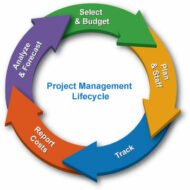
Fundamental Aspect of a Project Planning is the fundamental aspect of any management system as it sets the direction or pathway, which the firm has to follow in order to accomplish the goals and objectives of an organization. In a project management or a process management, planning is the key function followed by preparation of a proposal or a report that analyses and defines the resources necessary to carry on the project. This project report can then be sent for evaluation by an expert consultant to determine the feasibility and viability of the project. Organising to Get the Desired Result A project undertaken has to be meticulously planned and organized to achieve the desired result in the given time frame. One has to understand that a project differs from a process in that, it involves fixed time fame and cost frame. Say,for instance, your firm is rewarded with a project to design ERP solutions for a big corporate company. What will be step one? You will try to gather all the details regarding organization structure and hierarchy, people involved and their designations, availability of physical resources, whether the corporate firm is technically equipped, product portfolio, strategic business units and their viability, distribution channels and so on., As one is aware, enterprise resource solution software integrates production, marketing and human resource departments to facilitate even flow of information and quick execution of orders without any time delay. Picture Courtesy: Project Management and Leadership Champions Data Collection Data collection is inevitable and has to be precise to attain your set goals. The next logical step will be deciding the time frame and allocating resources (human and other physical resources) to carry on the project. If you feel that the delivery deadline cannot be met with, you have to immediately inform your sponsors about the time delay and extend your time frame for the project to materialize. On -Time Delivery Projects that involve production and delivery of goods depend on the manufacturing cycle time and delivery lead time. Implementation becomes a cake walk if your business plan has incorporated, 1) well laid down step by step procedures, 2) leverage for uncertainty in the external environment and 3) focus on proper communication. Communicating the entire project plan as per the intentions to the people concerned is very vital for the success of a project, because people should understand, what needs to be done, what is one’s role, and the strategies evolved by the management. PERT and CPM Program evaluation and review techniques (PERT) and critical pathway method are some of the tools that help in ascertaining the progress rate of projects. These tools help in identifying specific milestones and activities that are to be carried out in a sequential manner and also to estimate the time required for each activity, with a help of a network diagram. A very interesting and simple video explaining how to determine project duration using critical path…. Success of a project management is determined by Decision making ability Communication skills Negotiation techniques and Time management skills, of the project manager and also depends on how well it protects the interests of the stakeholders involved. A project is a comprehensive team effort with the budget and time well within the scope of the...