Currently Browsing: How To
Posted by Managementguru in How To, Human Resource, Strategy, Stress Management, Time Management, Training & Development
on Sep 15th, 2015 | 0 comments

Work Can be Play – How to Overcome Burnout? Let me Start With Some Quotes to Motivate You: “There are no secrets to success; it is the result of preparation, hard work and learning from failure.” “Falling down is how we grow. Staying down is how we die.” “Success is going from failure to failure without losing your enthusiasm.” “You must be the change you wish to see in the world. “Keep your face to the sunshine and you can never see the shadow.” Strategy of Smart Work I would like to suggest a few ways as to “How to improve your efficiency and quality of your work” without feeling the pinch. You don’t need to put in enormous hours of work to prove your mettle as it might only make you more exhausted and drain you of your physical and mental stamina. When we’re working hard, other areas of our life get neglected: Maybe you’re working long hours but eating poorly and never exercising. It might not seem like such a bad choice now, but when you run into health problems a few years down the road, you’re going to wish you’d found a better balance. Working too hard can have a really negative effect on your quality of life, too. Long hours and the pressure to keep doing more can lead to stress, burn out, depression, or just that miserable feeling of is this all there is to life? So how can you get away from the mindset of working hard and start working smart? Every 20 minutes take a break – Getting up to have a coffee or some water will make you feel agile. This suits well for the desk potatoes who are wedded to the computers. Prioritize the issues to be sorted out that particular day and focus your attention only on those issues until they are solved. This acts as a positive reinforcer and prepares you for the next challenge. If you find yourself with an excuse not to do it, tell yourself “Do it now”. “First Things First” is one of Stephen Covey’s “7 Habits” in 7 Habits of Highly Effective People. It means taking care of the most important things in your life before turning to the rest. Rather than trying to do everything at once, pick one or two key goals for each year, and focus wholeheartedly on those. It’s much better to actually accomplish a dream than to have a vague stab at lots of different things … only to end up making very little progress. Info: Pickthebrain.com Learn to say “NO” However, you can easily take it too far. At some point, you need to learn to decline opportunities. Your objective should be to take on only those commitments that you know you have time for and that you truly care about. Sleep at least 7-8 hours. Most people need 7-8 hours of sleep for their bodies and minds to function optimally. You know if you’re getting enough. Listen to your body, and don’t underestimate the value of sleep. Devote your entire focus to the task at hand. Close out all other browser windows. Put your phone away, out of sight and on silent. Find a quiet place to work, or listen to some music if that helps you. Exercise and eat healthy Numerous studies have linked a healthy lifestyle with work productivity. Similar to getting enough sleep, exercising and eating healthily boost energy levels, clear your mind, and allow you to focus more easily. Delineate a time limit in which to complete task. Instead of just sitting down to work on a project and...

Posted by Managementguru in Business Management, How To, Marketing
on Aug 18th, 2015 | 0 comments

So you want to know how to be successful in sales and want to know how to become a better salesperson? Sales success begins with attitude, it’s directly connected to understanding that the sale is not about you; It’s not about commission, It’s not about moving an item of off the shelves, and it’s not about the hefty paycheck. It’s not about you – it’s about the customer. Sales Pitch is the Key: Nowadays, an effective sales pitch is a two-way street — a conversation where you listen to the buyer, ask real questions, and offer them a solution to a challenge they’re experiencing. A good sales pitch starts with a great first impression. Sales professionals work hard to make a memorable and positive initial impact by creating laser-focused one-liners, but it’s just as important that your short, snappy delivery also resonates long after you’ve delivered that opening line. You want a presentation that holds your audience’s attention — the longer you’re able to keep that attention, the higher your chances of winning them over. And captivating your audience involves being prepared with relevant buyer information, and a pitch that actively includes the buyer in the discussion. At its most basic level, the sales pipeline represents your company’s sales process and how your company tracks progress through each stage of the process. Knowing that, here are a few tips to get you on your way to a more effective sales pitch: Do the Due Diligence Give Them the Answers To Your Homework You’re Listening, But Are You Hearing Your Buyer? A Call for “Call to Actions” If you are engaging your customer over the phone, to achieve sales success, be upfront about the reason for your call, vouch for the integrity of the product or service you are selling, and draw comparisons between your prospect and satisfied customers. When leaving voicemails, emails or follow-up messages, it’s important to reiterate the reason for contacting them, as well as summarizing your intent. Finish up the message with an suggested action either on your part or theirs. Pipeline #Management: Pipeline management includes everything from the way the sales pipeline is designed to how it is measured and how it is used to drive sales-rep performance. Without a clearly defined sales process, the pipeline has no foundation. We found that sales forces were most effective at managing their pipelines if they invested time in defining a credible, formalized sales process. In fact, there was an 18 percent difference in revenue growth between companies that defined a formal sales process and those that didn’t. https://youtube.com/watch?v=PvZ-Ky3xrW0%3Flist%3DPL5B53174B0151071A Track the Source: For optimal sales effectiveness, you need to provide employees with a tool that captures information about each and every interaction with your prospects and customers. This includes integrating your different channels, such as your website. People most often hear about your company and products and services through ads, referrals, online banner ads or some other form of advertising. You need to keep track of what actually caused these suspects to raise their hands so you can better determine what works and what doesn’t. Curated from 3 Best Practices of Sales Forces Are you a Problem-Solver; then you have a streak of sales person in you: Great salespeople also tend to be into solving problems and driving for results. They’re positive in their attitude, powerful and authoritative. The traits that make them so great at sales also can lead to traits that present difficulties for managers. They can be impulsive, demanding and unrealistic in their expectations. They may lack attention to detail and are often disorganized. In order to motivate and lead salespeople effectively, you want to think about what’s important to them...
Posted by Managementguru in How To, Human Resource, Interview Questions
on Aug 13th, 2015 | 0 comments
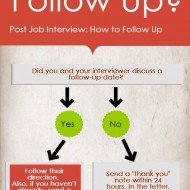
Here is a brief and concise article on how to go about post job interview follow-up https://www.youtube.com/watch?v=oHHRI3Qcb8Q So tell me, should candidates send a follow up note after an interview? Yes, always. Whether or not a candidate is truly in the running, the interviewer can get crazy busy and it’s important to always follow up with a note and even a call in a week if there’s no word back on next steps. Candidates should never be afraid to ask for acknowledgement and closure, even if it’s not the news they want to hear. It is a great way to not only let someone know that you appreciated their time and insights – but also to make sure they are aware of your interest and enthusiasm, and reinforce how you “fit”. From a recruiting perspective, what’s the purpose of sending a follow-up? The follow-up is a way to reiterate interest and reaffirm why the candidate is the best fit for the role. It’s never too late, although at that point the hiring manager may have already made her decision. But front-running candidates do decline offers and take other positions, so there’s always a possibility of being considered. A note will probably not be able to turn around an interview that did not go well, but it could be something that could help differentiate you from equally strong candidates. From a recruiting perspective, the recruiter will appreciate someone showing their understanding of and connection with the company, the role, and/or the people they met. That could make a big difference. Picture Courtesy: Careerbliss Show that you can be graceful: Follow up with post-interview thank-you letters to each person you talked with on your job interview. The first step in your follow-up is a polite handwritten note card to each interviewer. You won’t be able to fit many words on each note card, and you don’t need to. Your handwritten thank you note is very important, because the biggest problem you face after your job interviews is that the interviewers forget who you are. They will literally forget you unless you bring yourself back to mind by mentioning something specific that you and each interviewer talked about. An interviewee says: You guys have no idea how effective this method is! In my last interview, I left knowing that I bombed it because I wasn’t receiving any positive feedback from my interviewer. I was pretty bummed out by it but nevertheless, I sent him a thank you letter via email just to thank him for his time. I didn’t expect a response but little did I know, a few days later I got a nice reply from him and a week after that, I got called in for a second interview! Just goes to show how far a little effort can take...
Posted by Managementguru in Change management, Decision Making, Entrepreneurship, How To, Human Resource
on Jul 23rd, 2015 | 0 comments

I was going through this quote by Vince Lombardi the other day and couldn’t control my amusement and laughter for some time. “If you aren’t fired with enthusiasm, you will be fired with enthusiasm.” But the truth behind this statement looms large in front of all HR professionals when they start working for an organization in whatever capacity. Results, Targets, Closing the sale, Clinching the deal are the inevitable management mantras that drive the executives crazy. Isn’t it funny that it is very important to keep the morale high of the survivors during a layoff strategy! How on earth one can expect such a thing to happen when you know the sword is dangling above your head too! Please remember, “Resources are hired to give results, not reasons.” You need to be a star performer the first time and every time. Why Downsizing Happens? When the management of an organization finds out that their organization is not operating at peak efficiency, they naturally look for ways to make the organization more productive. This is seldom accomplished via organizational downsizing, which is a reduction in organizational size and operating costs implemented by management in order to improve organizational efficiency, productivity and/or the competitiveness of the organization. Courtesy: Cartoonstock.com Organizational downsizing affects the work processes of an organization since the end result of the downsizing is typically fewer people performing the same workload that existed before the downsizing took place. Download this Team Meeting Planner and Let us Know if You Found it Useful Team-Meeting-Agenda-PlannerDownload The act of downsizing results in two categories of people: victims, the people who involuntarily lose their jobs due to organizational downsizing, and survivors, the employees who remain after organizational downsizing takes place. When is Downsizing the Answer and How to Do it Right? “When downsizing is a knee-jerk reaction, it has long-term costs.” In order for an organizational downsizing to be most effective, management must connect openly and honestly with their employees concerning the reason for the downsizing and the downsizing plan. Managers also need to listen to employees and provide comfort when necessary in order to keep the morale high among the survivors of the downsizing. It is also important that management take steps to prepare the workforce in advance of the downsizing. Proper planning includes outplacement strategies, which is the process of supporting former employees in finding new employment and training and re-skilling the remaining workers into their new jobs. By treating the victims of downsizing fairly and compassionately, the survivors of the downsizing are more likely to remain loyal to their organization. Best Practices for Managing the Downsizing Process Be transparent about the current conditions that the organization faces and the potential impact on the workforce.Treat laid-off employees with respect and sensitivity.On the day of discharge, give employees options on how they want their exit handled.Ensure that procedures used to make decisions are seen as just and fair.Carefully examine the impact of employment downsizing on all HR systems.Give survivors a reason to stay and new hires a reason to join. Kim Cameron’s 3 Types of Downsizing Strategies 1. Workforce Reductions – short-term strategy to cut the number of employees through attrition, early retirement or voluntary severance packages, and layoffs or termination. 2. Work Redesign – medium-term strategy in which organizations focus on work processes and assess whether specific functions, products and/or services should be eliminated. 3. Systematic Change – long-term strategy that changes the organization’s culture and attitudes, and employees’ values, with the goals of reducing costs and enhancing quality. Why Do Organizations Downsize? Declining profitBusiness downturn or increased pressure from competitorsMerging with another organization, resulting in duplication of effortsIntroduction of new technologyThe need to reduce operating costsThe desire to...
Posted by Managementguru in Business Management, How To, International Business
on Jul 9th, 2015 | 0 comments

International Business Travel Tips “Travel is more than the seeing of sights; it is a change that goes on, deep and permanent, in the ideas of living.” – Miriam Beard Whether this is your first time to travel or you’ve traveled for more times than you can count, relax. Business trips can be fun. Of course, you have meetings to attend, business to take care of and employees to follow up with. Work does not mean you cannot see new places and meet new people. If you’re visiting a new city, you should take time to walk around and have fun. Here are the things you need to do to make your trip relaxing. International travel for business can be a very exciting opportunity. You not only get to see new and interesting parts of the world, but you even get paid while doing it. In order to have the best experience possible, there are things you can do in advance to prepare. Here are some invaluable tips to help execute the perfect international business trip. Explore Airbnb One experience that might be frustrating to many foreign travellers is a procedure called Immigration Check. It is always better to be at the airport atleast three hours ahead of time to complete this gruelling procedure so that you can relax in the lounge. Otherwise you will be made to stand in the long queues testing your patience. Create an Organized itinerary: Plan Your Trip Make sure that your days are packed with opportunities to help your company. Scheduling time for appointments, meetings, and personal time is very important to executing a beneficial international business trip. An itinerary should be a good guide for your trip’s goals and achievements. Because you do not want to waste any time on this trip, it’s better to plan in advance to take full advantage of the opportunity. “All journeys have secret destinations of which the traveler is unaware.” –Martin Buber The words sound like a no brainer but seriously plan your trip. If you want to have fun, check events, restaurants, and places you are interested to see online and how close they are to where you intend to stay. You don’t want to spend your trip worrying about missing a meeting and definitely not exploring the city’s transportation system. Take some time before you actually travel and plan exactly where you want go. For directions, you can download Tripomatic: Trip Planner. This application comes with maps needed, so download it to your phone and you’re good to good to go. Tripomatic works offline. Learn about the Culture and Customs: Before landing in said country, it’s important to understand the environment, culture and practices of this region. Knowing up-to-date news and information about your international travel destinations will help you avoid inappropriate comments or disrespectful behavior. Not only is it important to understand the culture, but it is also beneficial to know protocols, customs and etiquette as well. This includes things like: common greetings, religious practices, business manners, dietary practices, and acceptable humor. “If you reject the food, ignore the customs, fear the religion and avoid the people, you might better stay at home.” – James Michener Learn the Native Tongue: While not every business trip requires learning a whole new language, it’s always advisable to seek out some basic vocabulary for the region you are visiting. The use of a translator might be beneficial as well. Communication is a huge part of business and breaking down those barriers will only help you with your business endeavors. “Like all great travelers, I have seen more than I remember, and remember more than I have...